Seattle Area Code: All 5 Codes (206, 253, 425, 360, 564) Guide (2026)
Complete guide to all Seattle area codes — 206, 253, 425, 360, and 564. Learn which codes serve the Puget Sound region, their history, time zone, and how to identify scam calls from Seattle numbers.
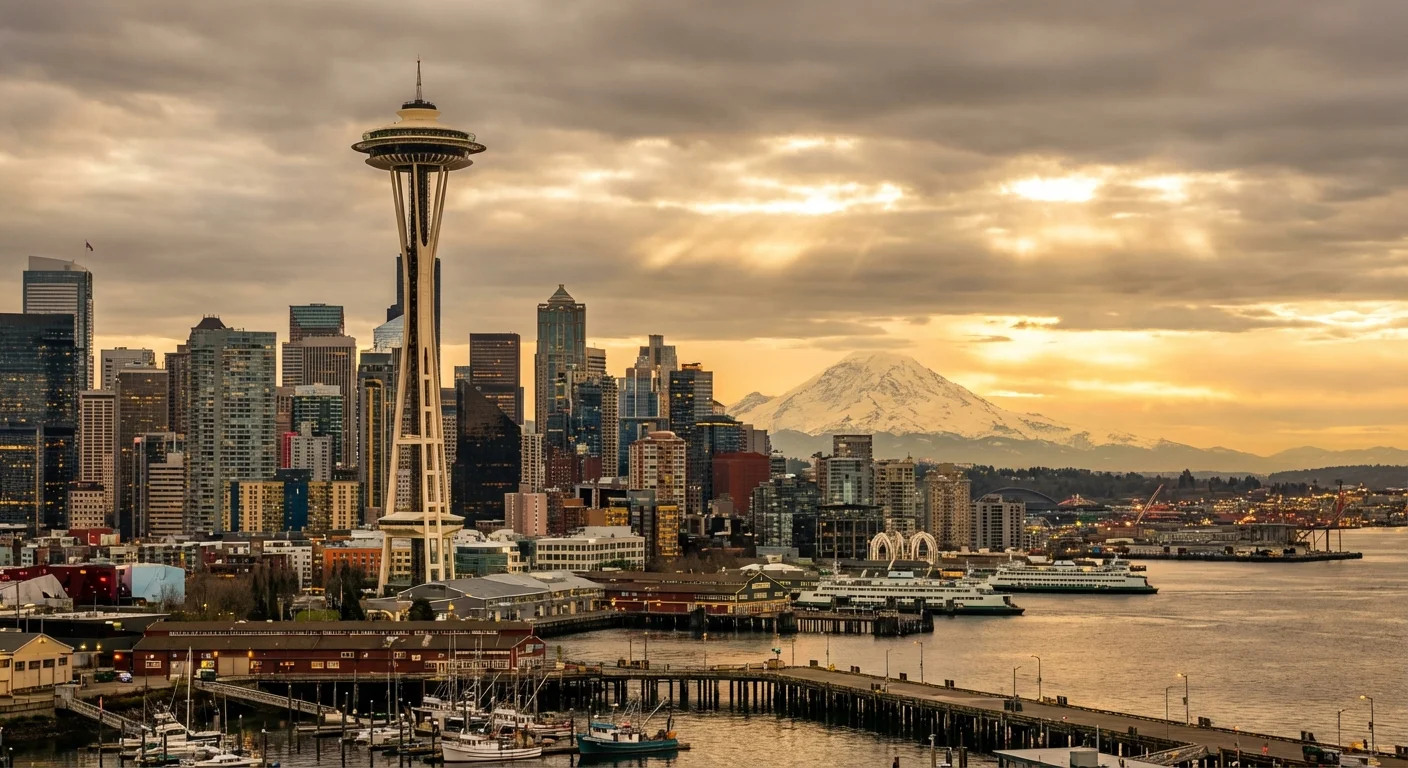
The Seattle area code is five codes: 206, 253, 425, 360, and 564, serving the Puget Sound region's approximately 4 million people. Area code 206 — one of the original 86 codes from 1947 — once covered the entire state of Washington. Today it's been carved down to just Seattle proper and a few neighboring cities, while the suburbs and surrounding areas have their own codes.
This is the city that burned to the ground and then raised its streets 22 feet, where a $600 record contract launched a $30 billion music revolution, where 40,000 protesters shut down the World Trade Organization, where a hijacker named "D.B. Cooper" jumped into the night with $200,000 and was never found, and where they imploded a stadium they were still paying for — then kept paying for 15 more years. Seattle is also built on a fault line, sits in the shadow of the most dangerous volcano in the United States, and once put up a billboard asking the last person leaving to turn out the lights.
Seattle Area Code Quick Facts
All Seattle Area Codes: Complete Timeline
One of the original 86 NANP codes. Initially covered all of Washington State. Now serves Seattle proper, Shoreline, Mercer Island, Burien, SeaTac, Tukwila, and Bainbridge Island.
April 27 — South Sound split from 206. Covers Tacoma, Federal Way, Kent, Auburn, Puyallup, Lakewood, and Pierce County.
April 27 — Eastside/North split from 206 (same day as 253). Covers Bellevue, Redmond, Kirkland, Everett, Bothell, Lynnwood, and Renton.
January 15 — Greater Western Washington split from 206. Covers Olympia, Bellingham, Vancouver WA, the Olympic Peninsula, and San Juan Islands.
September 30 — Overlaid on 360 territory. Expanded to 206 territory in June 2025. Mandatory 10-digit dialing across all of western Washington.
How One State Code Became Five Metro Codes
In 1947, area code 206 covered the entire state of Washington — every phone from Seattle to Spokane to the Olympic Peninsula. In 1957, 509 was split off for eastern Washington. For the next 38 years, 206 still served all of western Washington.
In January 1995, 360 was carved out for the broader western Washington region (Olympia, Bellingham, the Olympic Peninsula). Then on April 27, 1997, the remaining 206 was split three ways in a single day: 206 kept Seattle proper, 253 took the South Sound (Tacoma, Federal Way, Pierce County), and 425 took the Eastside (Bellevue, Redmond, Everett).
The splits were contentious. Seattle exurb residents protested being moved out of 206 — the code carried cultural cachet as the Seattle identifier. Renton successfully lobbied to join 425 rather than 253 because 425 was associated with the relatively wealthy Eastside. The 564 overlay was added to 360 territory in 2017, with expansion to 206 territory in June 2025 as 206 approached number exhaustion.
The Great Fire of 1889: They Raised the Entire City
On June 6, 1889, at approximately 2:20 PM, a pot of glue boiled over in Victor Clairmont's cabinet shop, igniting turpentine-soaked wood shavings on the floor. The fire destroyed 25 city blocks (64 acres), every wharf and mill from Union to Jackson Streets, all railroad terminals, and the entire commercial core. Damage: up to $20 million. Five thousand men lost their jobs.
Fifteen days later, the city council voted to raise the streets 12 to 22 feet above the original grade. Buildings erected immediately after the fire had their ground floors end up below the new street level — creating the "Seattle Underground" that tourists visit today. Within one year, 465 buildings had been rebuilt in brick. Seattle's population grew by nearly 20,000 in the year following the fire (33% growth), making it the largest city in the newly admitted state of Washington.
Boeing: From a Boathouse to "Turn Out the Lights"
On July 15, 1916, timber merchant William Boeing incorporated the Pacific Aero Products Company in a converted boathouse (the "Red Barn") on the Duwamish River. His first employees were carpenters, cabinetmakers, and seamstresses — reflecting the building's origins as a yacht workshop. By 1968, Boeing employed over 100,000 people in the Seattle area, driven by the 747 program.
Then the bottom fell out. The 747 program hit cost overruns. The US Senate killed funding for Boeing's Supersonic Transport on December 3, 1970. The workforce plummeted to 32,500 — a loss of over 60%. Seattle's unemployment hit 14%. Approximately 86,000 jobs vanished statewide.
On April 16, 1971, two real estate agents paid $160/month for a billboard near Sea-Tac Airport: "Will the last person leaving SEATTLE — Turn out the lights." It was displayed for only 15 days but became arguably the most famous piece of outdoor advertising in Pacific Northwest history. Their reasoning: out-of-town clients "were amazed that Seattle wasn't a ghost town with weeds growing in the streets."
The $600 Contract That Launched a Music Revolution
On April 1, 1988, Bruce Pavitt and Jonathan Poneman formally incorporated Sub Pop Records with pooled capital of $19,000. That money was spent "in, like, thirty days." On June 5, 1988, an obscure band from Aberdeen, Washington (population ~16,000) called Nirvana played the Central Tavern in Pioneer Square. Pavitt and Poneman were among the handful of people in attendance.
On January 1, 1989, Nirvana signed a three-record contract with Sub Pop. The advance: $600 for the first year. Their debut album "Bleach" was recorded for $606.17. Geffen Records later bought the contract for $72,000 plus royalties. "Nevermind," released September 24, 1991, has sold over 30 million copies worldwide. That $600 contract investment led to one of the best-selling albums of all time and launched an entire musical genre — grunge — that defined a generation.
The Battle of Seattle: 40,000 Protesters Shut Down the WTO
On November 30, 1999, between 40,000 and 60,000 protesters converged on downtown Seattle and successfully blocked delegates from reaching the opening ceremonies of the World Trade Organization Ministerial Conference. The WTO opening ceremony was cancelled for the first time in its history.
Police responded with tear gas, pepper spray, and rubber bullets — and ran out of riot-control chemicals. Mayor Paul Schell declared a civil emergency and imposed a curfew covering 37 square kilometers of downtown. Governor Gary Locke deployed two battalions of National Guard. Nearly 600 people were arrested; property damage reached $3 million, with downtown businesses claiming $20 million in combined losses. Police Chief Norm Stamper resigned. The "Seattle Round" of trade talks collapsed entirely, and the protests are credited with launching the modern anti-globalization movement.
Pike Place Market: Saved by 23,105 Votes
Pike Place Market opened August 17, 1907, making it one of the oldest continuously operated farmers' markets in the United States. By the late 1960s, city leaders planned to demolish it and replace it with hotels, a parking garage, and a hockey arena.
Preservationists led by architect Victor Steinbrueck collected 53,000 signatures for a ballot initiative. On November 2, 1971, Seattle voters approved Initiative One: 76,369 for preservation vs. 53,264 against — a margin of 23,105 votes. The market's fish-throwing tradition, which turned a near-bankrupt fish market into one of Seattle's most famous attractions, reportedly started as a prank on one employee in 1986.
D.B. Cooper: The Only Unsolved Hijacking in Aviation History
On November 24, 1971 — Thanksgiving Eve — a man using the name "Dan Cooper" (media mistakenly reported "D.B. Cooper") boarded Northwest Orient Airlines Flight 305 from Portland to Seattle-Tacoma International Airport. He handed a flight attendant a note claiming he had a bomb in his briefcase and demanded $200,000 in cash and four parachutes.
After receiving the money at Sea-Tac, Cooper released the 36 passengers. He ordered the crew to fly toward Reno at low altitude with the rear stairs lowered. Somewhere over southwestern Washington, at approximately 8:00 PM, he jumped into darkness, rain, and sub-zero windchill carrying the $200,000 in a knapsack.
The only evidence ever found: on February 10, 1980, eight-year-old Brian Ingram uncovered three deteriorating packets of $20 bills — approximately $5,800 — on the bank of the Columbia River. The serial numbers matched the ransom. The case remains the only unsolved hijacking in the history of commercial aviation. The FBI suspended active investigation in July 2016 after 45 years.
The Kingdome: Imploded in 16.8 Seconds, Paid Off 15 Years Later
The Kingdome — the world's largest thin-shelled concrete dome, spanning 660 feet — was approved at $40 million but cost $67 million. On July 19, 1994, four 26-pound waterlogged ceiling tiles fell toward the field, just 30 minutes before gates opened for fans. Repair cost: $67.6 million — roughly equal to the original construction cost.
On March 26, 2000, at 8:32 AM, 4,450 pounds of gelatin dynamite in 5,905 holes, connected by 21.6 miles of detonation cord, collapsed the 25,000-ton roof in 16.8 seconds — a Guinness World Record. When the Kingdome was imploded, King County still owed $206 million on it. Taxpayers continued paying bonds on a demolished stadium for 15 more years. The debt was finally retired in March 2015.
The Green River Killer: 49 Victims, No Death Penalty
Gary Leon Ridgway began killing in 1982 along the Green River and Pacific Highway South in south King County. First identified as a suspect in 1983, he evaded arrest for nearly two decades. DNA evidence finally led to his arrest on November 30, 2001.
On November 5, 2003, Ridgway pleaded guilty to 48 counts of aggravated first-degree murder — receiving 48 consecutive life sentences without parole. In exchange, prosecutors dropped the death penalty. His obligation: confess to as many killings as he could remember and help locate victims' remains. In 2011, he pleaded guilty to a 49th count when additional remains were identified. In taped interviews, Ridgway claimed responsibility for 71 murders. He remains incarcerated at the Washington State Penitentiary.
Seattle Area Code Tools
Related Area Codes
Need a Seattle Phone Number?
Get a Seattle area code number with BubblyPhone. Make affordable international calls, keep your existing number, and stay connected to the Emerald City.