Boston Area Code: All 8 Codes (617, 857, 781, 339, 508, 774, 978, 351) Guide (2026)
Complete guide to all Boston area codes — 617, 857, 781, 339, 508, 774, 978, and 351. Learn which codes serve Greater Boston, their history, time zone, and how to identify scam calls from Boston numbers.
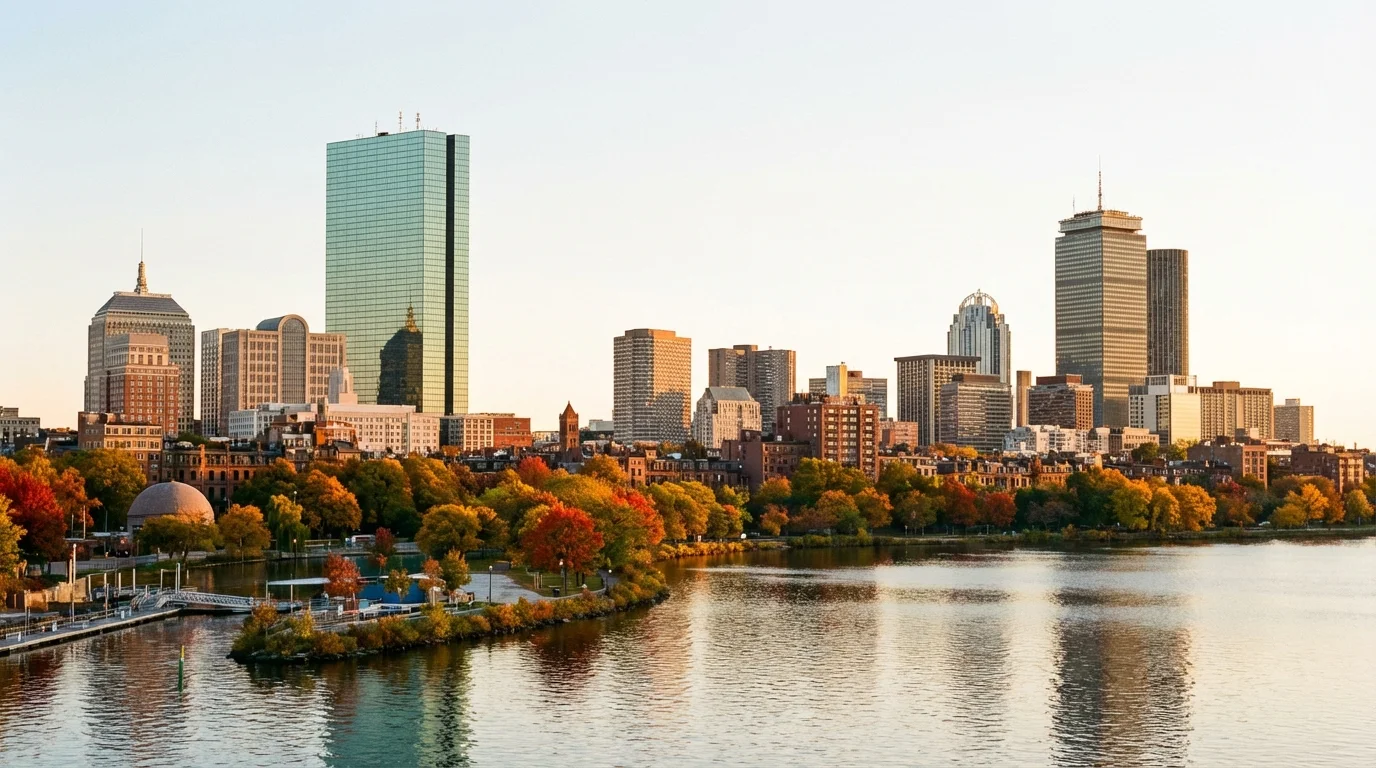
The Boston area code isn't one code — it's eight. Greater Boston is served by area codes 617, 857, 781, 339, 508, 774, 978, and 351, organized into four overlay pairs covering central Boston, the Route 128 suburbs, southeastern Massachusetts, and the Merrimack Valley. With approximately 4.9 million people in the metro area, Boston needed four separate splits and four overlays to keep up with demand.
This is the city that started a revolution by dumping tea worth $2.1 million into a harbor, spent $14.8 billion burying a highway, has a university older than calculus, watched 2.3 million gallons of molasses kill 21 people, and sold Babe Ruth for $100,000 — then didn't win another World Series for 86 years. Boston is where Paul Revere never actually said "The British are coming" and where a college dropout named Mark Zuckerberg changed human communication from a dorm room.
Boston Area Code Quick Facts
All Boston Area Codes: Complete Timeline
One of the original 86 NANP codes. Initially covered all of Massachusetts. Now serves central Boston, Cambridge, Brookline, and Somerville.
July 16 — Southeastern Massachusetts split from 617. Covers Worcester, Cape Cod, New Bedford, Fall River, and the Islands.
September 1 — North-central Massachusetts split from 508. Serves Lowell, Lawrence, Haverhill, Gloucester, and the Merrimack Valley.
February 1 — Inner suburbs split from 617. Covers Route 128 corridor: Quincy, Braintree, Newton (partial), Wellesley, Lexington.
November 3 — Overlaid on 617 for central Boston. Mandatory 10-digit dialing begins for Boston proper.
May 2 — Overlaid on 781 for inner suburbs. 10-digit dialing required across the Route 128 belt.
February 12 — Overlaid on 508 for southeastern Massachusetts. Cape Cod, Worcester, and South Coast go 10-digit.
April 2 — Overlaid on 978 for north-central Massachusetts. Lowell, Lawrence, and North Shore go 10-digit.
How Massachusetts Needed Eight Codes for One Metro
In 1947, area code 617 covered the entire state of Massachusetts — every phone from Provincetown to the Berkshires. The state's population was about 4.7 million. For four decades, one code was enough.
Then came the 1988 split: southeastern Massachusetts (Worcester, Cape Cod, New Bedford, Fall River) became 508. A decade later, the 1990s telecom explosion — cell phones, pagers, fax machines, dial-up internet — burned through numbers faster than anyone predicted. 978 was carved out for the Merrimack Valley in 1997. 781 took the Route 128 suburbs in 1998.
By 2001, all four territories were running low again. Rather than splitting further, Massachusetts added four overlays simultaneously: 857 over 617, 339 over 781, 774 over 508, and 351 over 978. The entire state went to mandatory 10-digit dialing. Boston, a metro area of under 5 million, now had more area codes than Houston's 7.3 million.
The Tea Party That Started a Country
On December 16, 1773, approximately 116 men — many of them members of the Sons of Liberty — boarded three ships (Dartmouth, Eleanor, and Beaver) at Griffin's Wharf and dumped 342 chests of East India Company tea into Boston Harbor. The tea was worth approximately £10,000 in 1773 currency — roughly $2.1 million in 2023 dollars.
The destruction took about three hours. The participants were meticulous: they damaged nothing except the tea, swept the decks afterward, and replaced a padlock that was accidentally broken. Britain's response was the Coercive Acts (which colonists called the "Intolerable Acts") — closing Boston Harbor, dissolving the Massachusetts legislature, and quartering British troops in private homes. These acts united the colonies and led directly to the First Continental Congress in 1774 and the outbreak of war at Lexington and Concord on April 19, 1775.
Paul Revere Never Said "The British Are Coming"
On the night of April 18, 1775, silversmith Paul Revere rode from Boston to Lexington to warn Samuel Adams and John Hancock that British regulars were marching to arrest them and seize weapons stored in Concord. The phrase everyone knows — "The British are coming!" — was invented by Henry Wadsworth Longfellow in his 1861 poem "Paul Revere's Ride."
Revere would never have said "British" — most colonists still considered themselves British subjects. The actual warning was "The Regulars are coming out!" — referring to British regular army soldiers. Revere was also not alone: William Dawes took a different route to Lexington, and Dr. Samuel Prescott was the only one of the three who actually made it to Concord. Revere was captured by a British patrol in Lincoln. He was released but his horse was confiscated.
The Big Dig: America's Most Expensive Highway Project
Boston's Central Artery/Tunnel Project — universally known as the Big Dig — buried the elevated Interstate 93 through downtown Boston into a 1.5-mile tunnel. Planned in 1982, construction ran from 1991 to 2007. The original budget was $2.8 billion. The final cost: $14.8 billion (adjusted for inflation, approximately $24.3 billion in 2024 dollars), making it the most expensive highway project in American history.
At its peak, the project employed 5,000 workers per day and had to navigate around active subway lines, century-old utilities, and buildings that couldn't be disturbed. Workers excavated 16 million cubic yards of dirt — enough to fill Gillette Stadium 16 times.
On July 10, 2006, a 12-ton concrete ceiling panel fell in the connector tunnel, crushing a car and killing Milena Del Valle, a 38-year-old newlywed on her way to Logan Airport. The collapse was caused by epoxy anchor bolts that failed under sustained load — a defect the contractor, Bechtel/Parsons Brinckerhoff, had known about. Bechtel eventually paid $407 million in the largest settlement in Massachusetts history.
Harvard and MIT: $84 Billion and 266 Nobel Prizes
Harvard University, founded in 1636 — 140 years before the Declaration of Independence — sits in Cambridge (area code 617/857). It is the oldest institution of higher education in the United States. Its endowment of approximately $56.9 billion is the largest of any university on Earth. Eight US presidents attended Harvard, including John Adams, both Roosevelts, JFK, and Barack Obama.
One mile down Massachusetts Avenue, the Massachusetts Institute of Technology (founded 1861) has an endowment of approximately $27.4 billion. Between them, Harvard and MIT affiliates have won a combined 266 Nobel Prizes. MIT alumni have founded companies generating combined annual revenues of approximately $2 trillion — which would make "MIT Nation" roughly the 10th-largest economy in the world, between Italy and Canada.
The Great Molasses Flood: 2.3 Million Gallons at 35 MPH
On January 15, 1919, a 50-foot-tall steel storage tank belonging to the Purity Distilling Company ruptured in Boston's North End, releasing 2.3 million gallons of crude molasses. The wave — 25 feet high at its peak — surged through the streets at an estimated 35 miles per hour.
The flood killed 21 people and injured 150. It buckled the supports of the Boston Elevated Railway, knocked buildings off their foundations, and swept horses, dogs, and people into the harbor. The cleanup took over 87,000 man-hours. Harbor water remained brown until summer. Locals claimed for decades that the North End still smelled like molasses on hot days. The disaster led directly to stricter building codes in Massachusetts and established the precedent that engineers must certify structural plans — a standard now universal across the US.
The Marathon Bombing: Four Days That Paralyzed a City
On April 15, 2013 — Patriots' Day — two pressure-cooker bombs exploded near the finish line of the Boston Marathon at 2:49 PM, killing 3 people and injuring an estimated 264. The dead were Krystle Campbell (29), Lu Lingzi (23, a Boston University graduate student from China), and Martin Richard (8).
On April 18, the FBI released surveillance images of two suspects — brothers Dzhokhar and Tamerlan Tsarnaev. That night, they killed MIT Police Officer Sean Collier (26) and carjacked an SUV. Tamerlan was killed in a shootout in Watertown early April 19. Governor Deval Patrick ordered an unprecedented shelter-in-place for the entire Boston metro area — effectively locking down a city of 4.9 million people. Dzhokhar was found hiding in a dry-docked boat in a Watertown backyard that evening. He was convicted on all 30 counts and sentenced to death. The phrase "Boston Strong" became a national rallying cry.
Fenway, the Green Monster, and the Curse of the Bambino
Fenway Park opened on April 20, 1912 — five days after the Titanic sank — making it the oldest active Major League Baseball stadium. Its most famous feature is the Green Monster: a 37-foot, 2-inch left field wall just 310 feet from home plate. The wall was originally bare wood and covered in advertisements before being painted green in 1947.
In January 1920, Red Sox owner Harry Frazee sold Babe Ruth to the New York Yankees for $100,000 (plus a $350,000 loan secured against Fenway Park itself). Before the sale, the Red Sox had won five of the first fifteen World Series. After: zero titles for 86 years. The "Curse of the Bambino" finally ended on October 27, 2004, when the Red Sox swept the St. Louis Cardinals — but only after becoming the first team in MLB history to overcome a 3-0 deficit in the ALCS against the Yankees.
Whitey Bulger: When the FBI Protected the Mob
James "Whitey" Bulger ran South Boston's Winter Hill Gang for over two decades while simultaneously serving as an FBI informant — the most damaging corruption scandal in Bureau history. His handler, Agent John Connolly, tipped Bulger off to investigations, allowed him to commit murders, and helped eliminate rival criminals.
Bulger was indicted in 1995 but fled after Connolly warned him. He spent 16 years as a fugitive on the FBI's Ten Most Wanted list. He was finally captured in Santa Monica, California, in June 2011 at age 81, living under a fake identity with $822,000 in cash hidden in the walls of his apartment. He was convicted of 11 murders and sentenced to two consecutive life terms. On October 30, 2018, the day after his transfer to USP Hazelton in West Virginia, Bulger was beaten to death by fellow inmates. He was 89.
Route 128: America's Original Silicon Valley
Before there was a Silicon Valley, there was Route 128 — the semicircular highway ringing Boston's suburbs (area codes 781/339). In the 1950s through the 1980s, this corridor was the global center of the technology industry. Digital Equipment Corporation (DEC), Raytheon, Wang Laboratories, Data General, Lotus Development, and dozens of minicomputer and defense contractors lined the highway.
DEC, headquartered in Maynard, was once the second-largest computer company in the world after IBM. Wang Labs, founded by Shanghai-born An Wang, employed 33,000 people and hit $3 billion in revenue. Then the personal computer revolution arrived, and Route 128's minicomputer giants collapsed. DEC was sold to Compaq in 1998 for $9.6 billion. Wang Labs filed for bankruptcy in 1992. The corridor's rigid, hierarchical corporate culture couldn't adapt as fast as Silicon Valley's startup ecosystem. Boston learned the lesson: today, Kendall Square in Cambridge is one of the world's densest concentrations of biotech and AI startups.
The Busing Crisis: Boston's Violent Struggle with Desegregation
On June 21, 1974, Federal Judge W. Arthur Garrity Jr. ruled that the Boston School Committee had deliberately maintained a racially segregated school system in violation of the Constitution. His remedy: mandatory busing of students between predominantly white and predominantly Black neighborhoods.
When busing began on September 12, 1974, violence erupted — particularly in South Boston, where white residents hurled rocks, bottles, and racial slurs at buses carrying Black students. On October 7, a Haitian immigrant was dragged from his car and beaten nearly to death in South Boston. The National Guard was placed on standby. Over the following years, approximately 30,000 white students left the Boston public school system, and the city's reputation as a bastion of Northern liberalism was shattered. The crisis shaped Boston's racial politics for decades and remains one of the most painful chapters in the city's history.
Boston Area Code Tools
Related Area Codes
Boston Codes
- 617 — Central Boston original (1947)
- 857 — Central Boston overlay (2001)
- 781 — Inner suburbs (1998)
- 339 — Inner suburbs overlay (2001)
- 508 — SE Massachusetts (1988)
- 774 — SE Massachusetts overlay (2001)
- 978 — North-central MA (1997)
- 351 — North-central overlay (2001)
Need a Boston Phone Number?
Get a Boston area code number with BubblyPhone. Make affordable international calls, keep your existing number, and stay connected to the Cradle of Liberty.