773 Area Code: Chicago IL Location, Time Zone & Scam Check (2026)
The 773 area code covers Chicago's residential neighborhoods — from Wicker Park to Hyde Park, Bronzeville to Wrigleyville. Learn its dramatic 312 split story, Central time zone, scam risks, and why three music genres were born here.
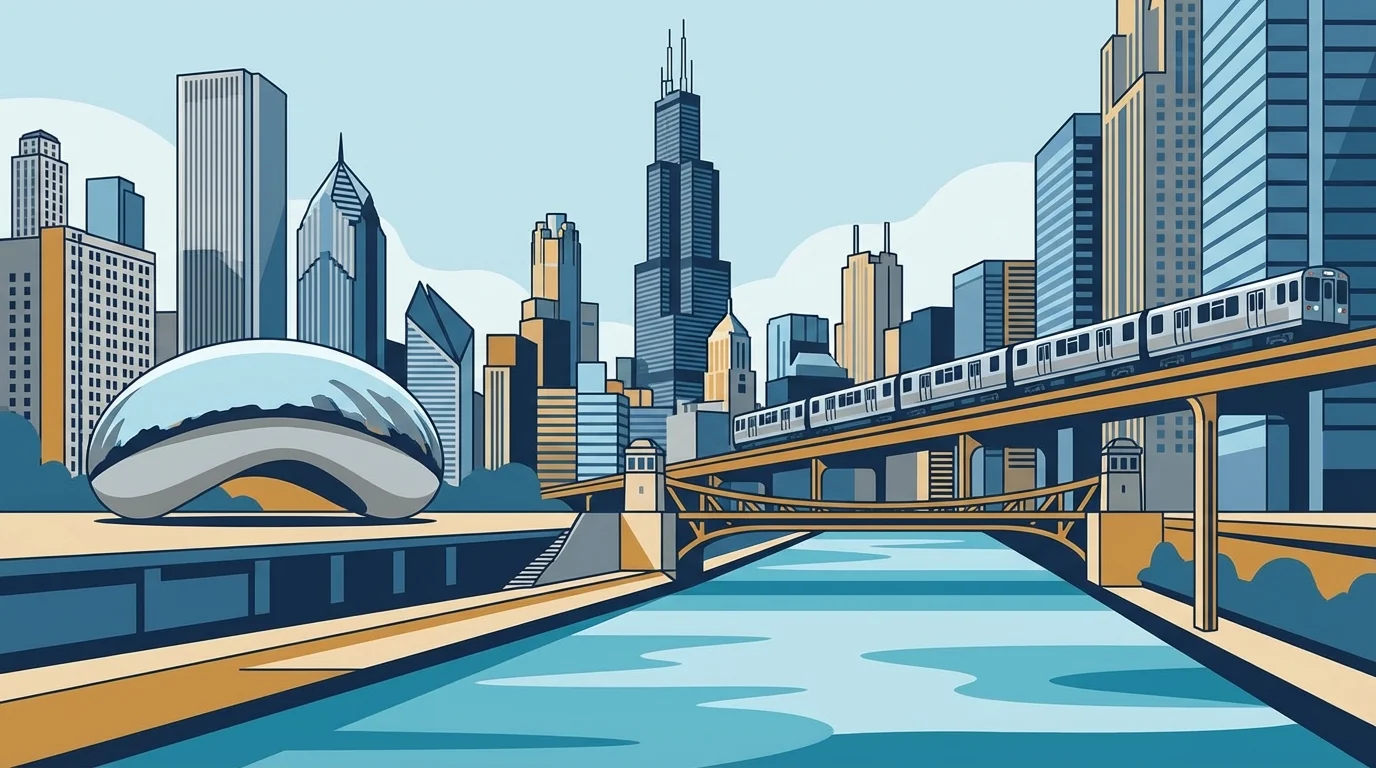
The 773 area code covers the residential neighborhoods of Chicago, Illinois — a ring of some of the most culturally rich, historically significant, and architecturally important neighborhoods in America, surrounding the compact downtown core that kept the iconic 312.
Created on October 12, 1996, when the Illinois Commerce Commission split 312 into two codes, 773 inherited the neighborhoods where Chicago actually lives — from the blues clubs of Bronzeville to the indie scene of Wicker Park, from Obama's Hyde Park home to the ivy-covered walls of Wrigley Field. This is the area code where house music was invented, where the atomic age began, and where tavern-style pizza (not deep-dish) is what locals actually eat.
This guide covers the 773 area code's location, the dramatic 312 split story, Central time zone details, scam risks, and the cultural layers that make Chicago's neighborhoods unlike anywhere else.
773 Area Code Quick Facts
State
Illinois
Major City
Chicago (neighborhoods)
Coverage
All Chicago outside downtown Loop
Time Zone
Central (CT / UTC-6)
Type
Geographic split from 312
Introduced
October 12, 1996
Population Served
~2.4 million (with 312/872)
Overlay Code
872 (2009)
Neighborhoods in the 773 Area Code
When 312 split in 1996, downtown kept the original code — roughly bounded by North Avenue, Western Avenue, 31st Street, and Lake Michigan (~16 square miles). Everything else became 773. That means 773 covers the vast majority of Chicago's 77 community areas — the famous neighborhood system created by University of Chicago sociologists in the 1920s that's unique in the United States.
| Neighborhood | Side | Known For |
|---|---|---|
| Logan Square | Northwest | Puerto Rican heritage, craft cocktail bars, boulevards |
| Wicker Park | West | 1990s alternative scene epicenter, galleries |
| Hyde Park | South | University of Chicago, Obama's home, Museum of Science & Industry |
| Lakeview / Wrigleyville | North | Wrigley Field, Boystown, lakefront |
| Pilsen | Southwest | Mexican-American murals, National Museum of Mexican Art |
| Bronzeville | South | Historic "Black Metropolis," Great Migration culture |
| Lincoln Square | North | German heritage, Brown Line corridor |
| Humboldt Park | West | Puerto Rican flag gateway, Paseo Boricua |
| Little Village | Southwest | 26th St — 2nd-highest-grossing commercial strip in Chicago |
| Pullman | Far South | First planned industrial town in the US, National Monument |
| Uptown | North | Aragon Ballroom, Green Mill jazz club |
| Austin | West | Chicago's most populous community area |
Chicago Area Code Timeline
Chicago's area code history is a story of explosive growth. The original 312 covered all of Chicagoland in 1947 — then the city's population boom, followed by the 1990s cell phone revolution, shattered it into pieces:
1947 — Original
One of the original 86 NANP codes. Covered all of Chicagoland — city and suburbs.
1989 — Split
November — Suburbs split off. 312 shrinks to Chicago city limits only.
1996 — Split
January 20 — Northern suburbs (Evanston, Schaumburg, Arlington Heights) split from 708.
1996 — Split
Western suburbs (Naperville, Aurora, Wheaton) split from 708.
1996 — Split
October 12 — Chicago neighborhoods outside downtown split from 312. 312 shrinks to ~16 square miles (the Loop, Near North, Gold Coast, River North, South Loop).
2009 — Overlay
November 7 — Overlay for both 312 and 773. New numbers anywhere in Chicago may be 872. 11-digit dialing becomes mandatory.
The 312 Split: "773? Is That an Area Code or an Airplane?"
When the Illinois Commerce Commission announced the split in November 1995, the reaction was fierce. Chicagoans saw 312 as an identity marker — an area code with personality and prestige, like 212 in Manhattan.
"I identify with 312. It has personality. It's a strong statement and it's totally Chicago. This 773 is wispy, it's elevator music."
— PR firm president quoted in the Chicago Tribune, 1996
Crain's Chicago Business ran the headline "773? IS THAT AN AREA CODE OR AN AIRPLANE?" — mocking the new number before it even launched. T-shirts appeared. After the 1989 suburbs split, Chicagoans had printed shirts reading "Go Home, 708ers!" Now the same status anxiety was playing out within the city itself.
Critics noted that Chicago — already deeply segregated by race, neighborhoods, sports affiliations, and economic class — was getting yet another dividing line, this time drawn by phone numbers. Downtown 312 became the "power area code," while 773 inherited the neighborhoods where the city's culture actually lived.
Three Music Genres Born in the 773
Chicago Blues (1940s–1960s)
The Great Migration brought Delta blues musicians north to Chicago. Muddy Waters moved to Chicago in 1943 and couldn't be heard playing acoustic guitar in noisy South Side clubs — so he amplified his guitar, creating the electric blues. Chess Records, founded by Polish Jewish immigrant brothers Leonard and Phil Chess, recorded Muddy Waters, Howlin' Wolf, Bo Diddley, Willie Dixon, Chuck Berry, and Buddy Guy from their building at 2120 S. Michigan Avenue.
On Maxwell Street, merchants provided musicians with electricity and extension cords to amplify their instruments over the market noise. This is where Chicago blues — distinct from acoustic Delta blues — was born, and it directly evolved into rock & roll.
Chicago House Music (Late 1970s–1980s)
House music was born at The Warehouse, a nightclub at 206 South Jefferson Street. DJ Frankie Knuckles moved from New York in 1977 to become the club's resident DJ. As disco declined nationally, Knuckles innovated by re-editing songs, extending breaks, and mixing disco with European electronic music.
The genre's name literally comes from the club — promoters described events as "house parties." In 2004, Chicago renamed the street "Frankie Knuckles Way". He is known as "The Godfather of House Music."
Chicago Drill (2010s)
Drill music originated on the South Side in the early 2010s. Chief Keef (Keith Cozart) posted videos to YouTube while under house arrest as a teenager. His 2012 track "I Don't Like" hit the Billboard Hot 100 and caught Kanye West's attention, who released a remix. Chief Keef is credited as the progenitor of drill, which later spread to London, Brooklyn, and globally.
The Real Chicago Food: Not What You Think
Tavern-Style Pizza (What Locals Actually Eat)
Deep-dish (invented at Pizzeria Uno in 1943) is Chicago's most famous export — but it accounts for only 9% of pizza deliveries in the city. The real Chicago pizza is tavern-style: thin crust, cracker-crisp, cut into squares (not slices). Before Prohibition, each of Chicago's 77 neighborhoods had taverns where barkeeps made thin-crust pizzas to keep patrons drinking longer. The square cut was practical — taverns had no silverware or plates, so pieces were set on napkins. Records of square-cut pizza on Taylor Street date to the 1930s.
The Chicago Hot Dog: Depression-Era Invention
Two Austro-Hungarian immigrants sold their Vienna Beef franks at the 1893 World's Columbian Exposition. During the Great Depression, Maxwell Street vendors turned produce carts into hot dog carts, adding toppings to justify the nickel price. The "No Ketchup" Rule: ketchup's sweetness overpowers the complex flavors — yellow mustard, neon-green relish, onion, tomato slices, pickle spear, sport peppers, celery salt on a poppy seed bun. The all-beef, kosher-style frank was originated by Fluky's in 1929.
Italian Beef: The Real Chicago Sandwich
Born in Chicago's Italian neighborhoods at "peanut weddings" — modest celebrations where newly arrived immigrants stretched a small amount of beef by slicing it paper-thin on bread doused in beef broth. Al's Beef started selling them commercially in 1938. The FX show The Bear (2022–present) brought global attention to the sandwich — and to Chicago's 773 food culture.
Engineering Marvels of the 773
The Atomic Age Began Here
On December 2, 1942, at 3:25 PM, in a converted squash court under the west stands of Stagg Field at the University of Chicago (Hyde Park), physicist Enrico Fermi initiated the world's first self-sustaining nuclear chain reaction. The experiment lasted 28 minutes. It was the first major technical achievement of the Manhattan Project.
The River Reversal
After an 1885 rainstorm fouled Chicago's water supply and killed nearly 12% of the population from cholera, the city did the unthinkable: reversed the Chicago River. The 28-mile Sanitary and Ship Canal (opened January 1, 1900) was one of the largest earth-moving projects ever undertaken. The American Society of Civil Engineers named it one of the "Seven Wonders of American Engineering."
Birthplace of the Skyscraper
Just 13 years after the Great Fire of 1871, architect William Le Baron Jenney built the Home Insurance Building (1884) — using a steel-cage frame instead of load-bearing masonry walls. It is universally considered the world's first skyscraper. The fire that destroyed Chicago created the architectural revolution that defined modern cities.
37 Movable Bridges
Chicago has 37 movable bridges — the most in North America, second only to Amsterdam worldwide. The city pioneered the trunnion bascule bridge (French for "seesaw"). The first one opened in 1902 at Cortland Street. These techniques were so innovative they helped build the Panama Canal.
The Second City: Where Comedy Lives
The Second City opened on December 16, 1959, at 1842 North Wells Street. Its roots go deeper: in 1955, University of Chicago students in Hyde Park formed the Compass Players, using theater games taught by Viola Spolin. This was the direct precursor to The Second City and the birth of modern improv.
Since SNL began in 1975, the show has hired 50+ cast members and writers from The Second City, including: John Belushi, Dan Aykroyd, Bill Murray, John Candy, Chris Farley, Mike Myers, Steve Carell, Tina Fey, Amy Poehler, Stephen Colbert, and Julia Louis-Dreyfus.
The 1893 World's Fair: Chicago Changes Everything
The World's Columbian Exposition opened in Jackson Park (a 773 neighborhood) on May 1, 1893, with over 150,000 visitors per day across six months.
Inventions at the Fair
- The Ferris Wheel — Designed by George Ferris. 36 cars, 40 riders each, 264 feet tall. At 50 cents per ride, it grossed ~$750,000 and saved the fair from bankruptcy.
- Juicy Fruit gum — Introduced by Wrigley
- Cracker Jack — First mass-produced
- Brownies — Created for the fair's Palmer House Hotel
- Vienna Beef hot dogs — The Chicago dog origin story
Lasting Impact
- The "White City" neo-classical buildings became templates for American civic architecture for decades
- The Midway Plaisance entertainment zone gave English the word "midway" for carnival areas
- The zipper was first exhibited here (invented by Whitcomb Judson in 1891)
- The fair attracted 27.5 million visits — half the US population at the time
Pullman: America's First Planned Industrial Town
Built in 1880 on 4,000 acres, Pullman was the first planned industrial community in the United States. Created by George M. Pullman to house workers building his luxury railroad cars, the community included 1,500+ company-owned houses with amenities unprecedented for working-class housing: indoor plumbing, gas, garbage pickup, and sewers.
The Pullman Strike of 1894 was a watershed moment in American labor history. President Obama designated Pullman a National Monument in 2015 — the first and only National Parks designation in Chicago.
Bronzeville: The Black Metropolis
During the Great Migration (starting 1916), hundreds of thousands of Black Americans moved to Chicago's South Side. Restricted by discriminatory housing policies, the community was confined to a narrow strip — creating a cultural density that rivaled Harlem.
Bronzeville was home to Gwendolyn Brooks (first Black Pulitzer Prize winner), Richard Wright (Native Son), Louis Armstrong, Bessie Coleman (first Black woman to hold a pilot's license), and Ida B. Wells. The name "Bronzeville" was proposed by editor James J. Gentry as a less derisive alternative to the media's "Black Belt" and "Black Ghetto."
Chicago Icons
Wrigley Field (1914)
The second-oldest MLB park after Fenway Park (1912). Originally built as Weeghman Park for the Federal League's Chicago Whales — the only surviving Federal League ballpark. The ivy-covered outfield walls were planted in 1937 by Bill Veeck. Wrigley is the only MLB stadium without padded outfield walls (grandfathered in because of the ivy). Its hand-turned scoreboard remains operational. Designated a National Historic Landmark in 2020.
Michael Jordan & the Bulls Dynasty
6 NBA championships in two three-peats (1991–1993, 1996–1998). The 1995–96 Bulls set a then-record 72 regular-season wins. Jordan won 6 Finals MVP awards (a record) and 5 regular-season MVPs. The Bulls are the only NBA team to have won multiple championships while never losing an NBA Finals series.
Lincoln Park Zoo: Free Since 1868
Founded in 1868, it is the oldest free public zoo in America. In 1878, park commissioners decreed the zoo "must always remain free." The zoo privatized in 1995 but maintained free admission and signed a contract guaranteeing free admission through at least 2050.
Why "Windy City" Has Nothing to Do With Wind
The nickname is not primarily about weather. Nineteenth-century journalists — especially from rival New York City — mocked Chicago politicians as "full of hot air." The most famous attribution is to New York Sun editor Charles A. Dana in 1893, who used it to ridicule Chicago's boastful campaigning to host the World's Fair.
Etymologist Barry Popik found evidence the name was established by the 1870s, used by rival Midwest cities as both a literal weather reference and a metaphorical jab at Chicago's braggadocio. The insult was eventually reclaimed by Chicagoans as a point of pride.
Related Area Codes
Understanding 773 in the Chicago area code landscape:
Frequently Asked Questions
Need a 773 Chicago Number?
Get a Chicago area code number with BubblyPhone. Make affordable international calls, keep your existing number, and stay connected to the 773.
Get Your Chicago Number