408 Area Code: San Jose CA Location, Time Zone & Scam Check (2026)
The 408 area code covers San Jose and Silicon Valley in Santa Clara County, California. Home to the HP garage, the Traitorous Eight, and the birthplace of the hard disk drive. Learn its location, time zone, and scam risks.
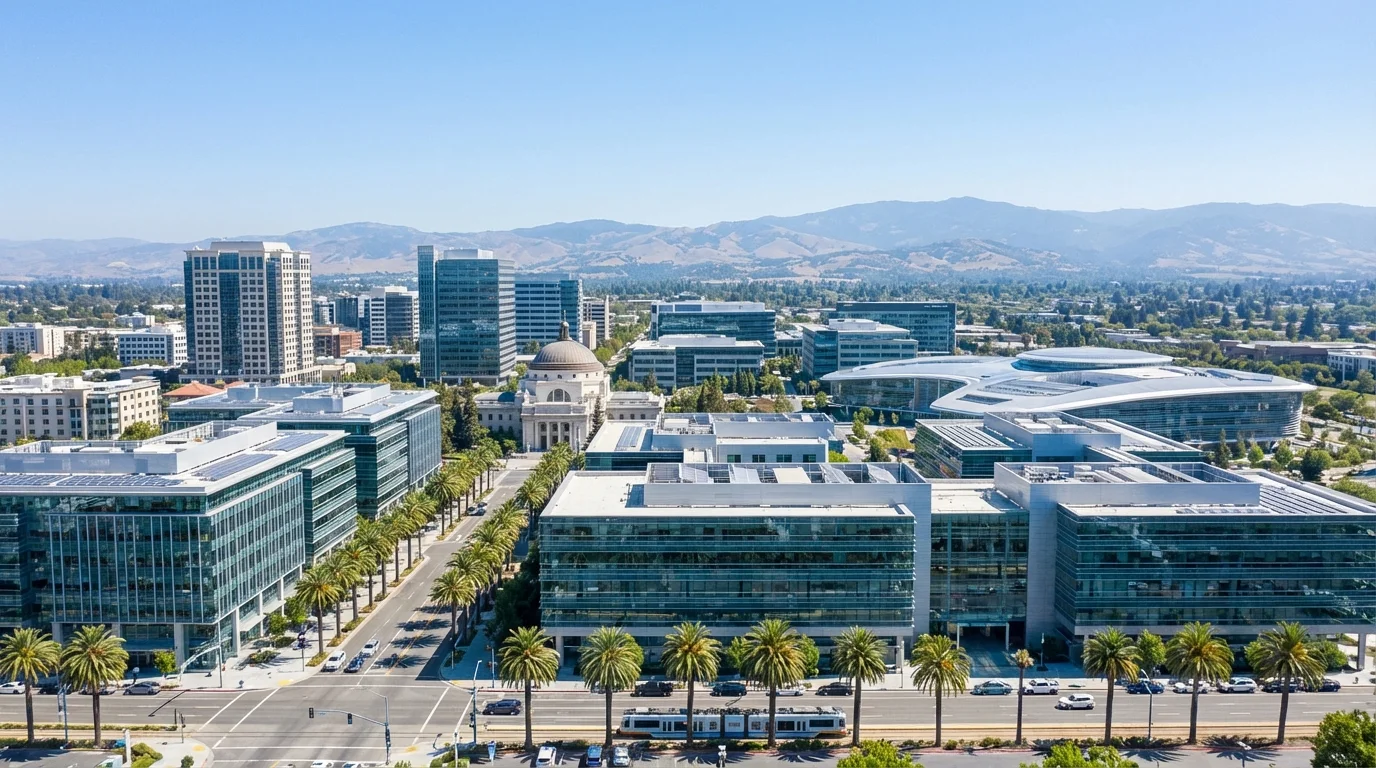
The 408 area code covers Santa Clara County — the geographic heart of Silicon Valley. Created in 1959 as a split from 415, it serves approximately 1.9 million people across San Jose, Sunnyvale, Santa Clara, Mountain View, Cupertino, and surrounding cities. The area code shares its territory with overlay code 669 (added 2012).
This is where the hard disk drive was invented, where eight researchers walked out on a Nobel laureate and accidentally created a $2 trillion industry, where a broken laser pointer became eBay's first sale, and where Nolan Bushnell bought a rat costume thinking it was a coyote and named it Chuck E. Cheese. Before all of that, it was the largest fruit-producing region in the world.
408 Area Code Quick Facts
Cities in the 408 Area Code
| City | Population | County |
|---|---|---|
| San Jose | 970,000 | Santa Clara |
| Sunnyvale | 155,000 | Santa Clara |
| Santa Clara | 129,000 | Santa Clara |
| Mountain View | 82,000 | Santa Clara |
| Milpitas | 80,000 | Santa Clara |
| Cupertino | 60,000 | Santa Clara |
| Campbell | 43,000 | Santa Clara |
| Los Gatos | 33,000 | Santa Clara |
| Saratoga | 31,000 | Santa Clara |
| Morgan Hill | 46,000 | Santa Clara |
| Gilroy | 59,000 | Santa Clara |
| Los Altos | 31,000 | Santa Clara |
The "Traitorous Eight" Who Created Silicon Valley
William Shockley won the 1956 Nobel Prize for co-inventing the transistor. He set up Shockley Semiconductor Laboratory in a Mountain View Quonset hut and recruited brilliant young PhDs — then managed them with paranoia, ordering lie detector tests over minor issues.
On September 18, 1957, eight researchers walked out. Shockley, furious, dubbed them the "Traitorous Eight." They formed Fairchild Semiconductor with a $1.38 million loan from Sherman Fairchild. What happened next changed the world: by a 1986 count, 126 semiconductor companies traced directly to Fairchild. A 2014 analysis found over 92 public Bay Area tech companies descended from it, with a combined market value of over $2 trillion — while Fairchild itself never exceeded $2.5 billion.
Notable "Fairchildren": Gordon Moore and Robert Noyce founded Intel (1968). Jerry Sanders founded AMD (1969). Eugene Kleiner co-founded Kleiner Perkins, one of the most influential VC firms in history. The Traitorous Eight's deal is considered one of the first venture capital-backed semiconductor deals.
The Garage: $538 and a Coin Toss
In 1938, Dave and Lucile Packard moved into the first-floor apartment at 367 Addison Avenue, Palo Alto. Bill Hewlett slept in the shed out back. They worked in the one-car garage with $538 in capital. In 1939, they settled the order of their names with a coin toss.
Their first product: the HP 200A audio oscillator. One of their first customers: Walt Disney Studios, which bought eight HP 200B oscillators to develop the sound system for Fantasia (1940).
The garage became California Historical Landmark No. 976 — the official "Birthplace of Silicon Valley" (1989) — and was added to the National Register of Historic Places in 2007. The mentor behind it all: Stanford dean Frederick Terman, the "Father of Silicon Valley," who created Stanford Industrial Park in 1951, leasing university land to HP, Varian, GE, and Lockheed.
Companies Born in the 408
- •Apple (1976) — Steve Jobs and Steve Wozniak funded the startup by selling a VW minibus and an HP calculator ($1,300 total). The Apple I sold for $666.66 each. The first 50 went to the Byte Shop in Mountain View
- •Cisco (1984) — Named for San Francisco. Stanford contemplated filing criminal complaints against founders Bosack and Lerner for using university network designs. They were later forced out by VCs with $170 million
- •Adobe (1982) — Named after Adobe Creek in Los Altos, which ran behind John Warnock's house. Their PostScript technology, licensed by Apple for the LaserWriter, sparked the desktop publishing revolution
- •eBay (1995) — First item sold: a broken laser pointer for $14.83 to a man who collected broken laser pointers. The famous origin story about Pez dispensers? A complete fabrication invented by a PR manager in 1997
- •Netflix (1997) — The idea came during carpooling between Santa Cruz and Sunnyvale. They tested the concept by mailing a CD — it arrived intact, so they launched with 30 employees and 925 DVD titles
- •PayPal — Two rival companies on the same Palo Alto street in a "blood feud" merged to create PayPal. The "PayPal Mafia" went on to found YouTube, LinkedIn, Palantir, SpaceX, Tesla, Yelp, and Affirm
Before Silicon: The Valley of Heart's Delight
Before semiconductors, Santa Clara Valley was called the "Valley of Heart's Delight" — a name attributed to John Muir. By 1890, the valley had 4,454,945 fruit trees. It was the largest fruit-producing and packing region in the world until the 1960s, with 39 canneries in operation.
The term "Silicon Valley" first appeared in print on January 11, 1971, in journalist Don Hoefler's article in Electronic News. But Hoefler didn't coin it — his friend Ralph Vaerst suggested it, and a May 1970 ad had already used the phrase. The "Silicon" refers to the semiconductor chips manufactured in the region starting with Shockley's lab in 1956.
Things Invented in the 408
- •The hard disk drive (1956) — IBM engineer Reynold B. Johnson's team created the IBM 305 RAMAC at the San Jose lab, the world's first commercial hard disk drive
- •The floppy disk (1967–1971) — Developed at IBM's San Jose Research Lab by David L. Noble's team
- •Eggo waffles (1953) — Invented by Frank Dorsa of San Jose. Originally called "Froffles" (frozen + waffles), produced on Eggo Way near US 101
- •Chuck E. Cheese (1977) — Opened by Atari co-founder Nolan Bushnell on Winchester Boulevard in San Jose. The animatronic costume was supposed to be a coyote but turned out to be a rat
- •"The Wave" — Invented by Krazy George Henderson at San Jose State. First documented wave: October 15, 1981, at an Oakland A's playoff game
The Winchester Mystery House: 36 Years of Building
Sarah Winchester purchased an eight-room farmhouse in 1886 for $12,570. Construction ran continuously for 36 years until her death in 1922. At its peak, the house was reportedly seven stories tall with 500 rooms. At the time of her death: 160 rooms, 40 staircases, 2,000 doors, 47 fireplaces, and 10,000 windows.
The 1906 earthquake destroyed the top three stories — Sarah never built above four stories again. In 2016, preservationists discovered a sealed room in the attic where Sarah had been trapped during the earthquake, which she boarded up and never reopened.
The ghost story? Historians like Mary Jo Ignoffo argue it's a marketing invention from 1923. There are no records of seances at the house. Her family denied she was superstitious. Winchester was likely an innovative and intelligent woman unfairly depicted as "crazy."
California's First Capital — and the City That Ate Itself
San Jose was California's first state capital (December 15, 1849). The capitol was 60 feet long and 40 feet wide. The winter of 1850–51 was so muddy that legislators fled to Vallejo. The original building burned in 1853; its site is now under the Fairmont Hotel.
It's also the largest city in the Bay Area and the 12th largest in the US — yet perpetually overshadowed by San Francisco. The transformation from agricultural town to sprawling metropolis was engineered by City Manager "Dutch" Hamann (1950–1969), whose staff was nicknamed "Dutch's Panzer Division." He used strip annexations — annexing narrow corridors to capture future tax revenue. During his tenure, San Jose approved over 1,400 annexations, growing from 17 square miles to 137 square miles.
Two Communities Found Nowhere Else
San Jose has the largest Vietnamese population of any city outside Vietnam — approximately 143,000–180,000 residents, about 14% of the city. Little Saigon along Story Road is the cultural epicenter, home to Grand Century Mall and Vietnam Town.
San Jose's Japantown is one of only three surviving Japantowns in the US and is considered the most authentic because it was never torn down and rebuilt. Of 53 businesses forced to close during WWII internment, 40 had reestablished by 1947.
Today's Japantown sits on land that was once Heinlenville, San Jose's last Chinatown. After arson destroyed the Market Street Chinatown in 1887, a German businessman named John Heinlen — who had faced his own discrimination — braved death threats to lease land to displaced Chinese residents. A park was named in his honor in 2020.
The Man Buried Under His Telescope
Lick Observatory on Mount Hamilton (4,265 ft) was the world's first permanently occupied mountaintop observatory, completed in 1888. It was funded by James Lick — a carpenter and piano maker who became California's wealthiest man — with a $700,000 bequest (roughly $24.5 million today), the largest gift in the history of science at the time.
Lick is buried under the telescope itself. His coffin was interred in the pillar on which the 36-inch refractor stands, with a brass plaque reading "Here lies the body of James Lick." He had requested burial "after the manner of Sir Christopher Wren" at St. Paul's Cathedral. It's reportedly the only observatory in the world to bury its benefactor beneath its telescope.
408 Area Code History
| Code | Year | Type | Event |
|---|---|---|---|
| 415 | 1947 | Original | Original area code covered the entire San Francisco Bay Area — San Francisco, Marin, the East Bay, and the South Bay. |
| 408 | 1959 | Split | March 1 — South Bay and Central Coast split from 415. Covered Santa Clara, Santa Cruz, Monterey, and San Benito counties. |
| 831 | 1998 | Split | July 11 — Santa Cruz, Monterey, and Salinas split off to form 831. 408 shrinks to Santa Clara County. |
| 669 | 2012 | Overlay | November 20 — First overlay for 408 and first overlay in the Bay Area. Mandatory 10-digit dialing. |
408 Area Code Tools
Related Area Codes
Bay Area
- 408 — San Jose / Silicon Valley (1959) — this article
- 669 — Silicon Valley overlay (2012)
- 415 — San Francisco (408's parent code)
- 510 — Oakland / East Bay
- 650 — San Mateo / Palo Alto
Need a 408 Silicon Valley Number?
Get a Silicon Valley area code number with BubblyPhone. Make affordable international calls, keep your existing number, and stay connected to the 408.