512 Area Code: Austin TX Location, Time Zone & Scam Check (2026)
The 512 area code covers the greater Austin metro area in central Texas — one of the original 86 area codes from 1947. Home to 1.5 million bats under a bridge, Silicon Hills, and the Live Music Capital of the World. Learn its location, time zone, and scam risks.
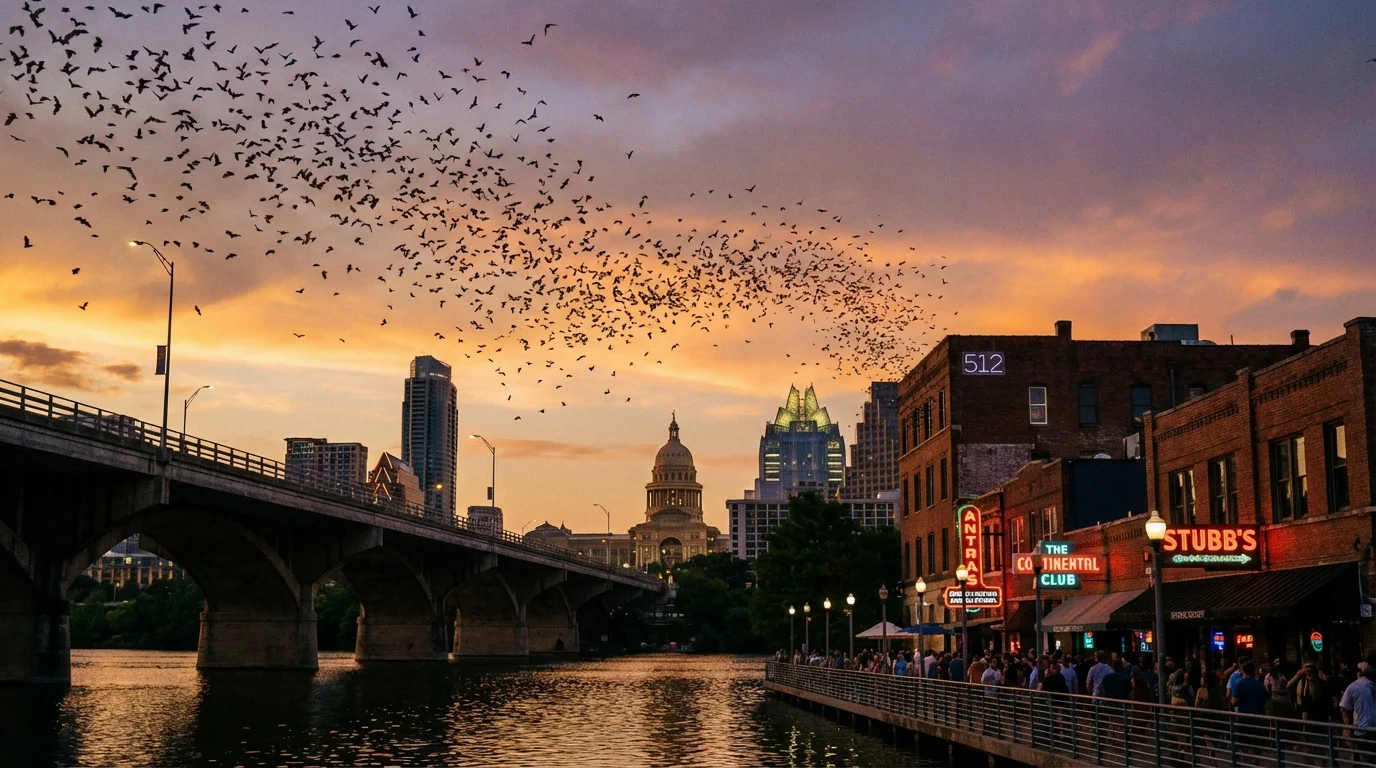
The 512 area code covers the greater Austin metropolitan area in central Texas — one of the original 86 area codes created in 1947 and still in active use. It serves over 2.3 million people across Travis, Williamson, Hays, Bastrop, and Caldwell counties. The area code shares its territory with overlay code 737 (added 2013).
Austin is the state capital, the "Live Music Capital of the World," and home to 1.5 million bats under a single bridge. It's also where Michael Dell started a computer company in his dorm room, where America's first serial killer operated three years before Jack the Ripper, and where the Texas Capitol was paid for not with money — but with 3 million acres of land.
512 Area Code Quick Facts
Cities in the 512 Area Code
| City | Population | County |
|---|---|---|
| Austin | 993,500 | Travis |
| Round Rock | 135,000 | Williamson |
| Cedar Park | 82,000 | Williamson |
| Georgetown | 75,000 | Williamson |
| San Marcos | 68,000 | Hays |
| Pflugerville | 72,000 | Travis |
| Kyle | 60,000 | Hays |
| Leander | 65,000 | Williamson |
| Hutto | 40,000 | Williamson |
| Buda | 18,000 | Hays |
| Bastrop | 11,000 | Bastrop |
| Lockhart | 15,000 | Caldwell |
From College Town to Silicon Hills
Austin's tech transformation has a precise starting point: 1983, when the Microelectronics and Computer Technology Corporation (MCC) — a consortium formed as the US industry's response to Japan's Fifth Generation Computing Project — chose Austin over more than 100 competing cities, including Atlanta, Research Triangle, and Stanford's backyard. Atlanta's mayor Andrew Young publicly accused Austin of "buying the project." The real reason? UT Austin's campus was right there.
Then in 1984, a UT freshman named Michael Dell founded Dell from his dorm room. The company created a ripple effect that transformed the region.
Today, over 5,500 tech companies operate in the Austin area:
- •Tesla — moved HQ from Palo Alto to Austin in 2021; $700M+ Gigafactory investment
- •Dell Technologies — founded and HQ'd in Round Rock; $88.4B revenue (2024)
- •Samsung — $17B semiconductor fab in Taylor (largest foreign direct investment in Texas history)
- •Apple — approximately 7,000 employees in Austin offices
- •Whole Foods — founded at 900 North Lamar Boulevard in 1980 with 19 employees and $45,000 in borrowed money
The Whole Foods origin story is pure Austin: founders John Mackey and Renee Lawson opened the first store on September 20, 1980. Less than a year later, the worst flood in 70 years wiped out the entire inventory — $400,000 in losses, no insurance. The store reopened 28 days later.
Live Music Capital of the World
Austin City Council officially declared the title on August 29, 1991, though it first appeared in Billboard magazine on July 20, 1985. The reason it stuck: Austin had more live music venues per capita than anywhere else. Bands could book three shows a week without leaving town.
The Armadillo World Headquarters (1970–1980) was ground zero. On August 12, 1972, Willie Nelson — freshly relocated from Nashville, still short-haired and clean-shaven — played to roughly 400 people. Half had come for the opening act. That night is widely recognized as the birth of the modern Austin music scene, fusing country with blues and rock into "outlaw country."
Antone's (founded 1975) launched Stevie Ray Vaughan, who moved to Austin at 17, was so broke he slept on pool tables and collected bottles to buy guitar strings, and went on to reignite modern blues before dying in a helicopter crash in 1990 at age 35.
Austin City Limits premiered on PBS in 1975 — its pilot starred Willie Nelson. It's now the longest-running music series in American television history (51 seasons), the only TV program to receive the National Medal of Arts, and was inducted into the Rock and Roll Hall of Fame in 2010.
SXSW: 700 People When They Expected 150
Planning began in 1986 in the offices of The Austin Chronicle. Co-founder Louis Black came up with the name "South by Southwest" while literally lying on his back on the floor during a naming brainstorm. They picked March because it was the slowest week for Austin music venues.
The first SXSW in March 1987 expected 150 attendees. Over 700 showed up. Approximately 200 bands played at 15 venues. It "was national almost immediately." The festival added Film in 1994 and Interactive in 1995 — the Interactive component famously launched Twitter (2007) and Foursquare (2009) into the mainstream.
1.5 Million Bats Under a Bridge
The Ann W. Richards Congress Avenue Bridge hosts the largest urban bat colony in the world — an estimated 1.5 million Mexican free-tailed bats. It's a maternity colony: females raise approximately 750,000 pups each year.
It happened entirely by accident. When the bridge was reconstructed in 1980, nobody realized the new crevices underneath would make ideal roosting spots. The bats were initially despised — there was genuine talk of extermination. Bat Conservation International founder Merlin Tuttle waged a persistent public education campaign that reversed public opinion.
Today, the colony attracts 140,000 tourists and generates approximately $10 million annually. Free-tailed bats in Texas save farmers over $1 billion per year in avoided pesticide use — a single bat can prevent more than 20,000 moth eggs from being laid in one night.
The UT Tower and Its $46.9 Billion System
The University of Texas Tower stands 307 feet tall, completed in 1937. Its walls are Indiana limestone, its red roof tiles were produced in Spain, and its marble comes from five states. The clock's rim and hands are gilded with gold leaf. A peregrine falcon nicknamed "Tower Girl" has nested at the top since at least 2010.
When the tower glows orange, UT won. When a "1" appears on all sides, it's a national championship. The tradition was created by Carl J. Eckhardt (class of 1925), who oversaw physical plant operations for 40 years.
The money behind it: UT Austin's endowment was $19.7 billion as of 2025 — the UT System's overall endowment reached $46.9 billion, making it the richest public university system in the country. That wealth traces back to the 1923 discovery of the Santa Rita oil well, which grew the endowment by 445% in a single year.
The Capitol Paid for With 3 Million Acres
The Texas State Capitol stands 302.64 feet — 14.64 feet taller than the US Capitol — sheathed in "sunset red" pink granite donated by quarry owners near Marble Falls.
Texas didn't pay for it with money. Instead, the state traded over 3 million acres of Panhandle land to a Chicago syndicate led by US Senator Charles B. Farwell. That land became the XIT Ranch — running 200 miles along the New Mexico border across 10 counties, one of the largest ranches in history.
The construction was controversial: when non-union granite cutters were used, the International Association of Granite Cutters voted 500 to 1 to declare a boycott. The builders imported 64 Scottish stonecutters and were promptly fined $64,000 for using illegal immigrant labor.
America's First Serial Killer — Three Years Before Jack the Ripper
In 1884–1885, a series of at least eight axe murders terrorized Austin — three years before Jack the Ripper appeared in London's Whitechapel district. The victims were attacked in their beds as they slept, and the early victims were predominantly Black servant girls.
The name "Servant Girl Annihilator" was coined by O. Henry (William Sydney Porter), who was living in Austin at the time. The four-toed footprint found at multiple crime scenes was never revealed to the public during the investigation. The prime suspect, Nathan Elgin, was later shot by police — and the autopsy revealed he was missing a toe on his right foot.
A popular legend claims Austin installed its famous moonlight towers in response to the murders. The timeline doesn't hold up — the murders ended in 1885, and the towers weren't purchased until 1894 — but the story endures as Austin folklore.
The Only City in the World With Moonlight Towers
Austin is the only city in the world that still has functioning moonlight towers — 165-foot-tall vertical trusses originally topped with six carbon arc lamps each, producing blue-white light reaching 3,000 feet in diameter.
Austin bought 31 of them secondhand from Detroit in the 1890s. They were erected in 1894–1895. Today, 17 survive (15 standing, 2 in storage). They were designated Texas State Landmarks in 1970 and listed on the National Register of Historic Places in 1976. In 2024, the last tower was upgraded from incandescent to LED.
Movie fans may recognize one: the moonlight tower in the Zilker Park neighborhood is the party location in Richard Linklater's 1993 film Dazed and Confused.
512 Area Code History
| Code | Year | Type | Event |
|---|---|---|---|
| 512 | 1947 | Original | One of the original 86 area codes. Covered all of south-central Texas — Austin, San Antonio, Corpus Christi, Brownsville, and the Rio Grande Valley. |
| 210 | 1992 | Split | San Antonio and the Rio Grande Valley split off. Austin kept 512 to spare state government agencies from changing their numbers. |
| 361 | 1999 | Split | February 13 — Corpus Christi and the Coastal Bend split off. Selena's "El Chico del Apartamento 512" referenced Corpus Christi when it was still 512. |
| 737 | 2013 | Overlay | July 1 — First overlay for 512. The 370th area code put into service in North America. Mandatory 10-digit dialing. |
Breakfast Tacos, BBQ, and the Taco War
Austin didn't invent the breakfast taco — the food was deeply embedded in San Antonio and the Rio Grande Valley long before Austin claimed it. The earliest known Austin print reference is November 1983 in Texas Monthly. A 2016 Eater article triggered a full-on "Breakfast Taco War" between Austin and San Antonio that made national headlines.
Franklin Barbecue, founded by Aaron Franklin in 2009, has sold out of brisket every single day since opening. Bon Appétit called it "the best BBQ in the country" in 2011. In July 2014, President Obama visited and bought lunch for the people waiting in line behind him. Franklin won the James Beard Award for Best Chef: Southwest in 2015.
Barton Springs: Sacred Water, Endangered Salamander
Barton Springs Pool — three acres, up to 18 feet deep, fed by underground springs at a constant 68–74°F year-round — is Austin's soul. The Tonkawa Native Americans considered the springs sacred and believed the waters had healing properties. Robert Redford learned to swim here at age five while visiting family.
Living in the springs is the Barton Springs salamander — a lungless species found nowhere else on Earth, listed as federally endangered in 1997. It's become a flashpoint in Austin's development-vs-environment battles, as urban runoff degrades its habitat. Nearly 800,000 people visit the pool annually.
"Keep Austin Weird" — The Real Story
The phrase was coined by Red Wassenich, a librarian at Austin Community College, in 2000. He was calling in a donation to KOOP Radio when the host asked why he was donating. Wassenich replied: "I don't know. It helps keep Austin weird." He started printing bumper stickers in July 2000 and never intended it as a marketing slogan — he meant it as an "unmaterialistic" sentiment about what made Austin different. Despite his objections, the phrase was trademarked by others and commercialized. Wassenich died on February 28, 2020, remembered for "choosing community over capital."
512 Area Code Tools
Related Area Codes
Need a 512 Austin Number?
Get an Austin area code number with BubblyPhone. Make affordable international calls, keep your existing number, and stay connected to the 512.