San Diego Area Code: All 4 Codes (619, 858, 760, 442) Guide (2026)
Complete guide to all San Diego area codes — 619, 858, 760, and 442. Learn which codes serve Greater San Diego, their history, time zone, and how to identify scam calls from San Diego numbers.
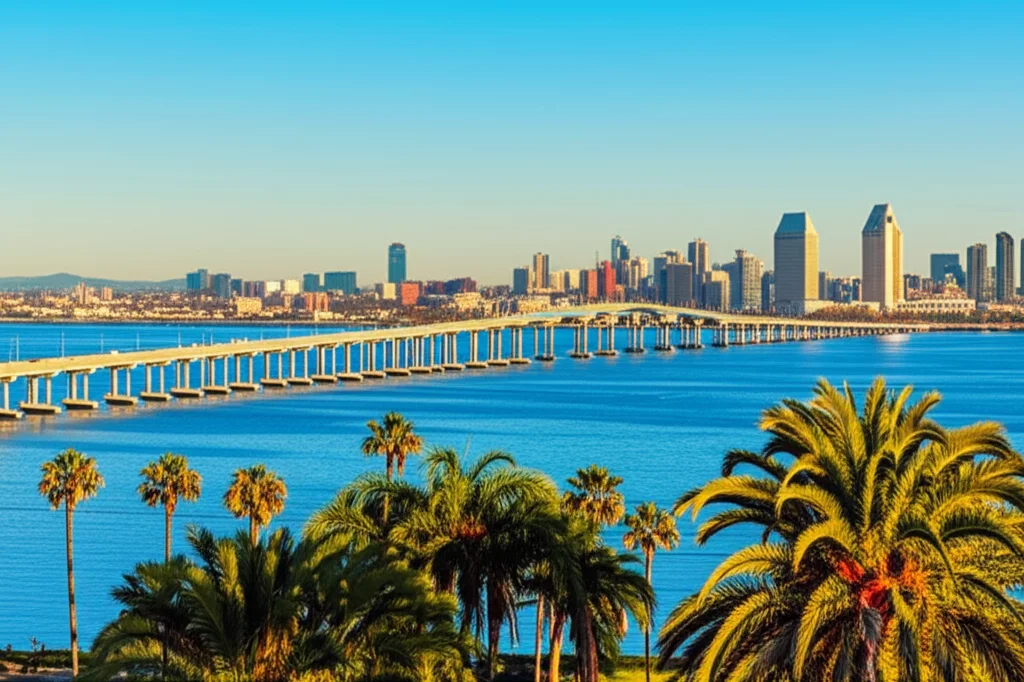
The San Diego area code is actually four codes: 619, 858, 760, and 442, serving roughly 3.4 million people in California's southernmost metro area. San Diego sits just 17 miles from the busiest international land border crossing on Earth, hosts more military personnel than any other metro in the United States, and has a zoo that exists because a doctor heard a lion roar from his car in 1916.
This is the city where California's deadliest air disaster killed 144 people over a residential neighborhood, where bulldozers were stopped by a human chain that became a National Historic Landmark, where 5,000 union radicals converged after a man was branded with a lit cigar, and where 300 nerds in a hotel basement created an event that now generates $160 million a year. San Diego's story is considerably stranger than its postcard reputation suggests.
San Diego Area Code Quick Facts
All San Diego Area Codes: Complete Timeline
November 5 — Split from 714, which had covered most of Southern California since 1951. Originally served all of southernmost California from San Diego to the Nevada border. Now covers central and southern San Diego County.
March 22 — Split from 619. Covers roughly 46,666 square miles (29% of California's land area): northern San Diego County (Oceanside, Carlsbad, Escondido) plus Imperial, Inyo, and Mono counties.
June 12 — Split from 619. Serves northern and coastal San Diego: La Jolla, Del Mar, Poway, Mira Mesa, Scripps Ranch, Sorrento Valley, University City.
November 21 — Overlaid on 760 for northern San Diego County and inland regions. Mandatory 10-digit dialing required across the 760/442 territory.
How San Diego Outgrew Three Area Codes
Until 1982, San Diego didn't have its own area code at all. The entire region was part of 714, which had covered most of Southern California since 1951. On November 5, 1982, 619 was carved out — the 125th area code in the NANP — and it covered an enormous territory from San Diego east to the Nevada border, including Imperial County and the desert regions.
Fifteen years later, the 1990s telecom explosion hit. 760 was split off in 1997 for northern San Diego County and the inland deserts — at 46,666 square miles, it covered roughly 29% of California's total land area. 858 followed in 1999, taking the northern and coastal communities: La Jolla, Del Mar, Poway, Mira Mesa.
A planned fourth code — 935 — was supposed to split off southern San Diego in 2000, but opposition to endless splits led regulators to implement 1000-block number pooling instead, and 935 was cancelled. The 442 overlay was added to 760 territory in 2009. Then in June 2018, the boundary between 619 and 858 was eliminated entirely — both codes now serve the same geography across San Diego proper, with mandatory 10-digit dialing.
America's Most Military-Dense Metro: $61.3 Billion
San Diego is the most military-concentrated metro area in the United States. According to the 2025 SDMAC/UC San Diego report, defense accounts for $61.3 billion in total regional economic output — 22.2% of the region's entire Gross Regional Product. That includes $19.8 billion in defense contracts to 2,000+ local companies, $15.1 billion in military payroll, and $4.3 billion in retirement and veterans' benefits.
The county has seven major military installations: Camp Pendleton (the Marines' prime West Coast amphibious base with 17 miles of coastline), Naval Base San Diego (largest naval base on the West Coast), MCAS Miramar (formerly home to Top Gun), Marine Corps Recruit Depot (trains 21,000+ recruits per year — every male enlisted Marine west of the Mississippi), Naval Air Station North Island, Naval Base Point Loma, and Naval Medical Center San Diego. Approximately 357,000 local jobs — direct and indirect — depend on the military.
The San Diego Zoo: Born from a Lion's Roar
On September 16, 1916, Dr. Harry M. Wegeforth was driving home from surgery when he heard the roar of a lion from an abandoned exhibit left over from the 1915–16 Panama-California Exposition in Balboa Park. He turned to his brother Paul and said: "Wouldn't it be splendid if San Diego had a zoo!"
On October 2, 1916, five men held the Zoological Society's first meeting. The original collection: 32 cages along Park Boulevard holding kangaroos, bears, lions, leopards, and a female Kodiak bear named Caesar that had been the mascot of the USS Nanshan. Today the San Diego Zoo spans 100 acres in Balboa Park with 12,000+ animals of more than 680 species, drawing 4+ million visitors annually — the most visited zoo in the United States. The Zoo Safari Park adds another 2,000 acres near Escondido.
PSA Flight 182: California's Deadliest Air Disaster
At 9:01 AM on September 25, 1978, Pacific Southwest Airlines Flight 182 — a Boeing 727 carrying passengers from Sacramento — collided midair with a Cessna 172 Skyhawk over San Diego's North Park neighborhood, three miles northeast of downtown. 144 people died: 135 on the airliner, 2 in the Cessna, and 7 on the ground. Twenty-two homes were destroyed or damaged.
The NTSB found that the Cessna's yellow fuselage blended visually with the multicolored houses of the residential neighborhood below, making it nearly invisible to the jet's crew. Approach Control had also failed to advise Flight 182 to remain above 4,000 feet — a single instruction that would have prevented the collision entirely. At the time, it was the deadliest air crash in US history. It remains California's deadliest aviation disaster. The crash led to immediate implementation of Terminal Radar Service Areas around busy airports nationwide.
Chicano Park: From Bulldozers to National Historic Landmark
Barrio Logan — once the second-largest barrio on the West Coast — was systematically dismembered in the 1950s and 1960s. Thousands of homes were demolished for Interstate 5, then for rezoning, then for the San Diego-Coronado Bridge, whose on-ramps bisected the neighborhood's main corridor on Logan Avenue.
On April 22, 1970, bulldozers arrived on land beneath the bridge pylons to build a Highway Patrol substation — on a site the city had promised the community would become a park. Hundreds of residents formed a human chain around the bulldozers and occupied the space for 12 days. In 1973, artist Salvador Torres proposed transforming the bridge's massive concrete pylons into canvases. Today Chicano Park covers 7.9 acres with 80+ murals — the largest concentration of Chicano murals in the world. It was designated a National Historic Landmark in December 2016.
San Ysidro: The Busiest Land Border Crossing on Earth
The San Ysidro Port of Entry — connecting San Diego to Tijuana, Mexico — is the busiest international land border crossing in the world. Approximately 70,000 northbound vehicles and 20,000 northbound pedestrians cross every day. In 2019, more than 15 million vehicles and 36.7 million people entered the US at San Ysidro. Total annual individual crossings in both directions exceed 106 million.
Between 2009 and November 2019, the General Services Administration completed a $741 million reconstruction of the entire port — including new inspection areas, the PedWest pedestrian facility (22,300 sq ft, 12 northbound lanes), and a realigned southbound I-5 approach. The project was completed on time and on budget.
Comic-Con: From 300 Nerds to $160 Million
On August 1–3, 1970, Shel Dorf — a Detroit comics fan who had moved to San Diego — organized the first "San Diego Golden State Comic Convention" in the basement of the US Grant Hotel. 300 people attended. Guests included Ray Bradbury, Jack Kirby, and A.E. van Vogt. The event featured a dealers' room, panels, and film screenings — essentially inventing the template for every comic convention that followed.
Today Comic-Con International draws 135,000+ attendees (venue maximum capacity) and generates an estimated $160+ million in regional economic impact, including $96.8 million in direct attendee spending. It's signed through 2027 to remain in San Diego, despite ongoing debates about the Convention Center's capacity.
The Coronado Bridge: Designed with Pushpins and String
The San Diego-Coronado Bridge opened August 3, 1969, at a final cost of $47.6 million (originally proposed at $30 million, ballooned after the Navy required clearance for aircraft carriers). It stretches 11,179 feet (2.12 miles) with an 80-degree curve and a 4.67% grade.
Principal architect Robert Mosher designed the bridge's now-iconic S-curve — reportedly working it out one afternoon with a few pushpins and a piece of string. The bridge introduced orthotropic roadway construction to the United States, a stiffening technique that increased structural strength. Its construction, however, devastated Barrio Logan — demolishing thousands of homes and bisecting the neighborhood, directly sparking the Chicano Park movement.
The Salk Institute: A Temple of Science on Pacific Cliffs
In 1960, Jonas Salk — who had developed the polio vaccine in 1955 — chose San Diego for his research institute. The city gifted him 70 acres of clifftop land overlooking the Pacific in La Jolla, approved by voters in a referendum. Salk secured a $20 million grant from the National Science Foundation and recruited founding consultants including Francis Crick, co-discoverer of DNA's double helix.
Salk commissioned architect Louis I. Kahn, who created what is widely considered one of the greatest works of American architecture: two mirror-image six-story structures flanking a grand travertine marble courtyard, bisected by a slender channel called the "River of Life" aligned directly at the Pacific Ocean. Kahn used pozzuolanic concrete — rediscovering Roman waterproofing techniques — and forbade any grinding, filling, or painting of the finished surfaces. Adjacent sits UC San Diego, founded November 18, 1960, creating one of the most powerful concentrations of scientific research on the West Coast.
The October Firestorms: 2003 and 2007
On October 25, 2003, a lost hunter named Sergio Martinez lit a signal fire to attract rescuers in the Cleveland National Forest. The Cedar Fire burned 280,278 acres — at the time, the largest fire in California history. Driven by Santa Ana winds at 3,600 acres per hour, it destroyed 2,820 buildings and killed 15 people. Total damage: $204 million. Martinez's sentence: six months in a work-furlough program and $9,000 in restitution.
Four years later, the 2007 Witch Creek Fire burned 197,990 acres, destroyed 1,125 homes, and triggered the evacuation of 500,000 people — one of the largest evacuations in California history. Insured damages exceeded $1.14 billion. Together, the 2003 and 2007 firestorms reshaped San Diego's relationship with wildfire, leading to massively expanded fire prevention infrastructure and evacuation protocols.
San Diego Area Code Tools
Related Area Codes
Need a San Diego Phone Number?
Get a San Diego area code number with BubblyPhone. Make affordable international calls, keep your existing number, and stay connected to America's Finest City.