Portland Area Code 503 & 971: Complete Guide to Stumptown (2026)
Complete guide to Portland area codes 503 and 971, plus Vancouver WA on 360 and 564. Learn about the city named by a coin flip, Nike's waffle iron origin, Powell's Books, the Rajneeshee bioterror attack, and D.B. Cooper.
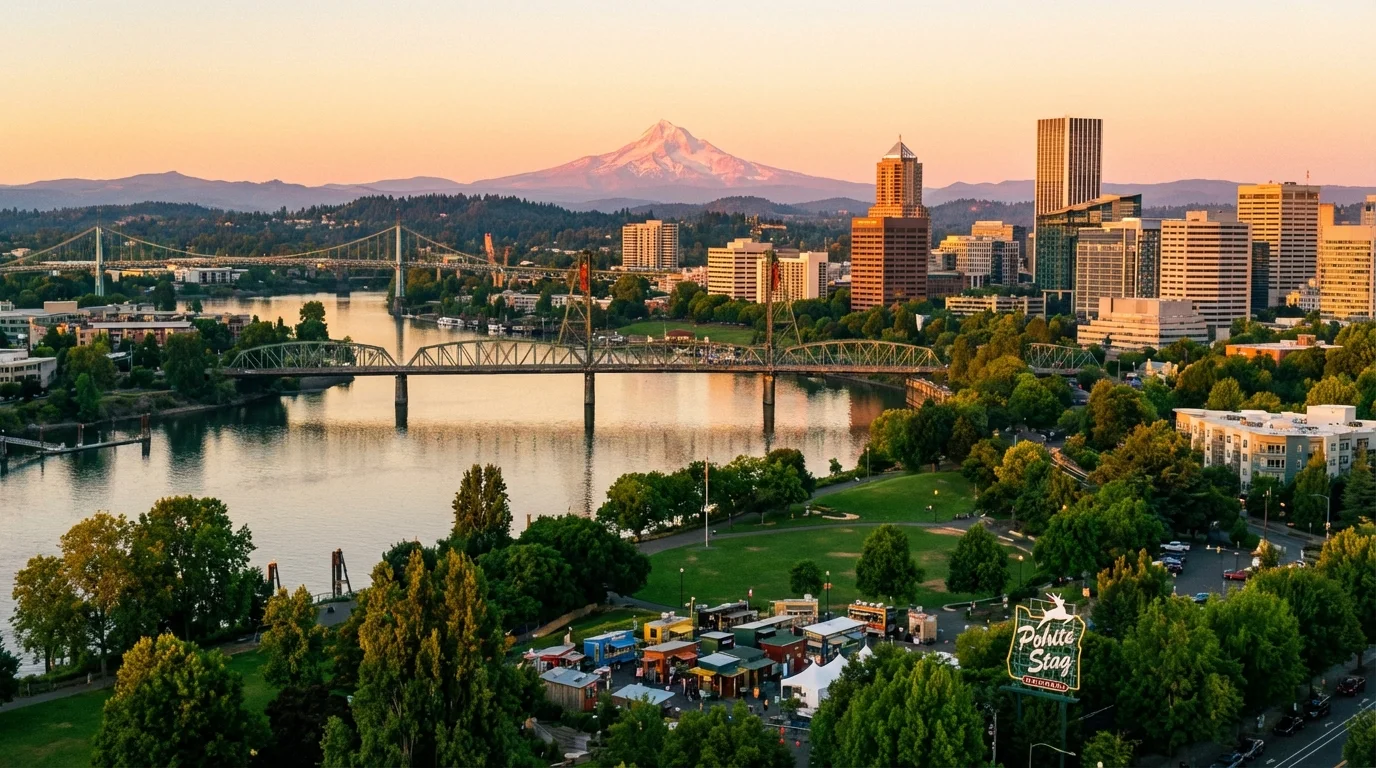
The Portland area code is 503, with overlay code 971 serving the same territory since 2000. Portland is also a cross-state metro: suburbs in Washington state (Vancouver, WA) use 360 and 564. The metro area spans two states and is home to approximately 2.5 million people.
This is the city that was named by a coin flip, where a coach ruined his wife's waffle iron inventing a shoe sole that launched a $46 billion company, where the world's largest independent bookstore fills an entire city block, where a religious cult carried out the largest bioterror attack in American history to rig a county election, and where the state Supreme Court made Oregon the only state in the country where obscenity isn't a crime. Portland is a city of bridges, stumps, and contradictions.
Portland Area Code Quick Facts
Portland Area Codes: A Cross-State Metro
One of the original 86 NANP codes. Covered all of Oregon for 48 years until 1995, when southern and eastern Oregon split off as 541. Now serves northwestern Oregon: Portland, Salem, Hillsboro, Beaverton, the coast.
Added as an overlay on 503's territory in October 2000. Covers the exact same geographic area. Created because cell phones, pagers, and fax lines were exhausting 503 numbers. Triggered mandatory 10-digit dialing.
Serves western Washington outside the Seattle metro, including Vancouver, WA (Clark County, pop. ~521,000) — directly across the Columbia River from Portland. Split from Washington's original 206.
Overlay on 360, activated in 2017. Serves the same western Washington territory as 360, including Portland's Vancouver, WA suburbs.
The Coin Flip That Named Portland (1845)
In 1845, two land claim co-owners needed to name their settlement about 14 miles upriver from where the Willamette and Columbia Rivers meet. Asa Lovejoy of Boston, Massachusetts, wanted to name it "Boston." Francis Pettygrove of Portland, Maine, wanted "Portland." They agreed to settle it with a coin toss — best two out of three.
Over dinner in the parlor of Francis Ermatinger's home on Sixth Street in Oregon City, Pettygrove pulled an 1835 American copper Matron Head penny from his pocket. He won. The city was formally incorporated on February 8, 1851.
The actual coin — known as the "Portland Penny" — was donated to the Oregon Historical Society around 1910 and remains on display there today. One copper cent is the entire reason it isn't "Boston, Oregon."
Nike: A Waffle Iron, a $35 Logo, and a $46 Billion Empire
On January 25, 1964, University of Oregon track athlete Phil Knight and his coach Bill Bowerman agreed to go 50/50 on a company called Blue Ribbon Sports, importing Japanese running shoes. In 1970, Bowerman was eating breakfast when he stared at his waffle iron and had an idea: reverse the waffle pattern to create raised rubber nubs for shoe traction. He poured melted urethane into his wife Barbara's waffle iron — and forgot to grease it first, gluing it permanently shut. He ruined multiple waffle irons before perfecting the design.
The resulting "waffle sole" debuted at the 1972 U.S. Olympic Trials in Eugene. Meanwhile, in 1971, Knight — then teaching accounting at Portland State University — overheard graphic design student Carolyn Davidson say she couldn't afford oil painting supplies. He hired her at $2/hour to design a logo. She presented five designs; Knight chose the Swoosh: "I don't love it, but it will grow on me." Her total invoice: $35. In September 1983, Knight gave her 500 shares of Nike stock, a diamond-and-gold Swoosh ring, and chocolate swooshes. Those 500 shares, after splits, became 32,000 shares worth approximately $3 million by 2023.
Blue Ribbon Sports became Nike, Inc. on May 30, 1978. Nike's Beaverton headquarters — the Philip H. Knight Campus — spans 400 acres with 75+ buildings and 11,000+ employees. FY2024 revenue: $51.4 billion.
Powell's Books: An Entire City Block of Stories
In the summer of 1971, Walter Powell managed his son Michael's used bookstore in Chicago while Michael went on vacation. Walter caught the bookselling bug and opened his own used bookstore in Portland with 100 boxes of books purchased at a rummage sale. Michael joined him in 1979, and sales grew 38% annually from 1979 to 1983.
The flagship Powell's City of Books occupies a full city block between NW 10th and 11th Avenues: 68,000 square feet of retail floor space (approximately 1.6 acres), 9 color-coded rooms, over 3,500 sections, and more than 1 million books on shelves at any time. Combined retail and online inventory exceeds 4 million volumes. The store buys approximately 3,000 used books per day.
Now operated by Emily Powell (third generation), it is the world's largest independent new-and-used bookstore.
The Rajneeshee Bioterror Attack: Salmonella on the Salad Bar
In 1981, followers of Indian spiritual leader Bhagwan Shree Rajneesh established a commune on a 64,000-acre ranch in rural Wasco County, Oregon. To win control of the 1984 Wasco County elections, his personal secretary Ma Anand Sheela devised a plan to incapacitate local voters.
Between September 9 and September 17, 1984, they contaminated salad bars at 10 restaurants in The Dalles, Oregon, with Salmonella enterica Typhimurium cultured in makeshift laboratories at the commune. Result: 751 people contracted salmonellosis and 45 were hospitalized. It was the first and largest bioterrorist attack in United States history.
The scheme backfired: the outbreak increased voter turnout among alarmed locals, who voted overwhelmingly against Rajneeshee candidates. Sheela was sentenced to 59 years but was paroled after serving only 29 months. She later moved to Switzerland. The story was told in the 2018 Netflix documentary Wild Wild Country.
D.B. Cooper: America's Only Unsolved Hijacking
On November 24, 1971 (Thanksgiving Eve), a man walked up to the Northwest Orient Airlines counter at Portland International Airport and bought a one-way ticket to Seattle for $20 cash. He wrote "Dan Cooper" on the ticket, boarded Flight 305 (a Boeing 727-100), took seat 18-E, and ordered a bourbon and 7-Up.
After takeoff, Cooper handed a note to a flight attendant stating he had a bomb. He demanded $200,000 in $20 bills and four parachutes. The plane landed in Seattle, where Cooper released all 36 passengers, then ordered the crew to fly toward Mexico City at the slowest possible airspeed (~150 knots), at 10,000 feet, with the rear airstair lowered. Shortly after 8:00 PM, somewhere over southwestern Washington, he jumped into a rainstorm and -7°C temperatures.
On February 10, 1980, eight-year-old Brian Ingram found $5,800 in decaying $20 bills buried along the Columbia River bank. The serial numbers matched the ransom. No other physical evidence has ever been found. The FBI suspended the investigation in July 2016 after 45 years — making it America's only unsolved commercial airline hijacking.
Bridge City: 12 Bridges Across the Willamette
Portland has 12 bridges spanning the Willamette River within city limits, earning it the nickname "Bridgetown." Highlights include the Hawthorne Bridge (1910) — the oldest operational vertical-lift bridge in the US — the St. Johns Bridge (1931), a Gothic-style suspension bridge painted green, and the Tilikum Crossing (2015), which cost $130 million and is the only bridge in Portland closed to private motor vehicles (pedestrians, bikes, buses, and light rail only).
The first bridge across the Willamette in Portland was the original Morrison Bridge in 1887 (now on its third replacement, built 1958). The Steel Bridge (1912) has a unique double-decked design where both decks lift independently. If you count the three bridges connecting Portland to Washington state across the Columbia River, the city's total reaches 15.
Oregon's Environmental Firsts: The Governor Who Told Tourists to Stay Away
Governor Tom McCall (1967–1975) made Oregon the national leader in environmental law. The Oregon Beach Bill (1967) declared the entire 362-mile Oregon coastline public property — Oregon is the only state where every inch of beach is publicly accessible by law. The Oregon Bottle Bill (1971), signed July 2, 1971, made Oregon the first state in the US to implement a container deposit law, mandating a 5-cent deposit on beer and soft drink containers.
Results were dramatic: beverage containers in roadside litter dropped from 40% before the law to 6% by 1979. McCall famously told visitors in a 1971 CBS interview: "Come visit us again and again... but for heaven's sake, don't come here to live."
"Keep Portland Weird" — Stolen from Austin
The slogan originated in Austin, Texas, where Red Wassenich coined "Keep Austin Weird" in 2000 during a pledge call to KOOP Radio. In 2003, Portland record store owner Terry Currier (owner of Music Millennium, Portland's oldest record store) heard about the Austin slogan from a friend and adapted it.
That same year, 2003, saw the opening of Voodoo Doughnut by Kenneth "Cat Daddy" Pogson and Tres Shannon. The twin launches cemented Portland's countercultural brand identity, which the TV show Portlandia (premiered January 21, 2011, ran 8 seasons on IFC) would later amplify globally. Currier trademarked "Keep Portland Weird" in 2007.
Portland Area Code Tools
Related Area Codes
Portland Metro Codes
- 503 — Portland / NW Oregon (1947)
- 971 — Portland overlay (2000)
- 360 — Vancouver, WA (1995)
- 564 — WA overlay on 360 (2017)
Nearby Area Codes
- Seattle — Seattle, WA (5 codes)
- 541 — Southern/Eastern Oregon
- 458 — Oregon overlay on 541
- 208 — Idaho
- 530 — Northern California
Need a Portland Phone Number?
Get a Portland area code number with BubblyPhone. Make affordable international calls, keep your existing number, and stay connected to Stumptown.