Oregon Area Codes: Complete Guide to All 4 OR Codes (2026)
Complete guide to all 4 Oregon area codes including 503, 971, 541, and 458. Coverage maps, time zones, history, and the stories behind the Beaver State.
Oregon has 4 area codes in 2 overlay pairs: 503 and 971 cover northwestern Oregon, including Portland, Salem and Hillsboro, and 541 and 458 cover the rest of the state, including Eugene, Bend, Medford and Corvallis. Every local call in Oregon needs all 10 digits.
This is the state where a track coach poured rubber into his wife's waffle iron and invented a sole worth $46 billion, where a government engineer used 119 times the recommended amount of dynamite on a dead whale, where a religious commune poisoned 10 salad bars to rig a county election, where a man in a clip-on tie parachuted out of a commercial airliner with $200,000 and was never found, and where one in ten pioneers died on a 2,000-mile trail that ended in Oregon City. Oregon's motto is "She Flies With Her Own Wings" — and the stories prove it.
Oregon Area Codes Quick Facts
All 4 Oregon Area Codes
503 (1947, original) • 971 (2000, overlay) — Portland, Salem, Beaverton, Hillsboro, Gresham, Lake Oswego, Tigard, Oregon City, Tillamook, Astoria, McMinnville. Home to Nike, Intel, and Powell's Books. 10-digit dialing since October 2000.
541 (1995, split from 503) • 458 (2010, overlay) — Eugene, Bend, Medford, Corvallis, Ashland, Klamath Falls, The Dalles, Pendleton, Coos Bay, Roseburg, Springfield. Home to Crater Lake and the Oregon Shakespeare Festival. 10-digit dialing since January 2010.
Oregon Area Code Timeline
503 covers all of Oregon — one of the original 86 US area codes
541 splits from 503 on November 5 — takes everything outside northwestern Oregon
971 overlays 503 on October 1 — Oregon's first overlay, Portland/Salem metro
458 overlays 541 on February 10 — all of Oregon now has overlays and requires 10-digit dialing
Nike: A Waffle Iron, $35 Logo, and $46 Billion Later
Blue Ribbon Sports was founded on January 25, 1964, with a handshake deal between University of Oregon track coach Bill Bowerman and his former runner Phil Knight (503 area code). Their combined investment: roughly $1,200. Knight sold the first shoes — Japanese-made Onitsuka Tigers — out of the trunk of his green Plymouth Valiant at track meets.
In 1971, Bowerman realized a waffle iron's grid pattern could create a lightweight, grippy sole. He poured urethane rubber into his wife Barbara's waffle iron — permanently ruining it. Nike received U.S. Patent No. 3,793,750 for the waffle sole on February 26, 1974. That same year, Carolyn Davidson, a Portland State University graphic design student, was paid $35 to design the Swoosh logo. In 1983, Knight gave her 500 shares of Nike stock, a diamond Swoosh ring, and chocolates. After stock splits, those 500 shares became 32,000 shares worth approximately $3 million.
The company rebranded to Nike in 1971, named after the Greek goddess of victory. Today it's headquartered in Beaverton and posts over $46 billion in annual revenue — all tracing back to a ruined kitchen appliance and a $35 logo.
Crater Lake: 1,943 Feet Deep and a 450-Year-Old Floating Log
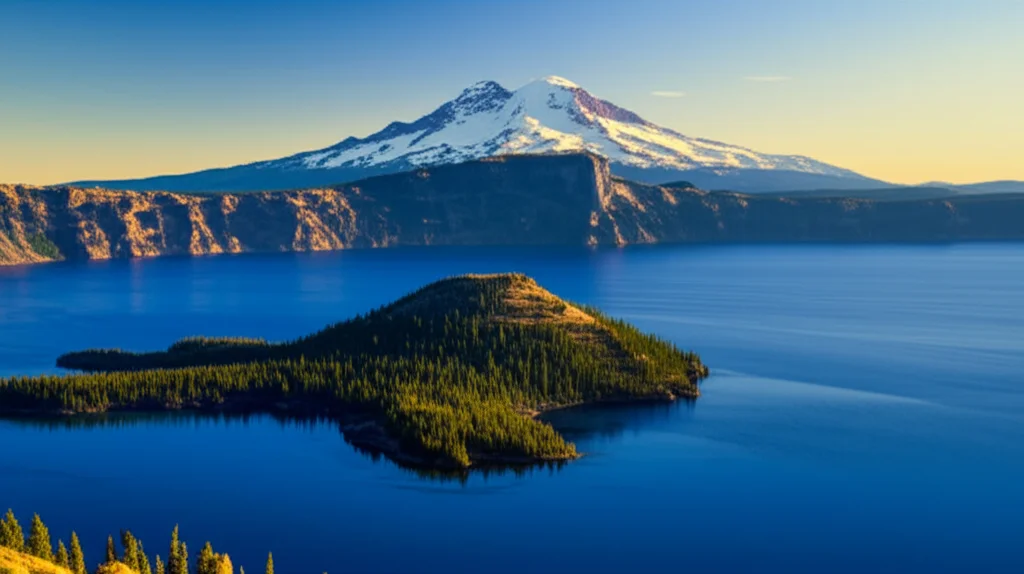
Crater Lake in Klamath County (541 area code) is 1,943 feet deep — the deepest lake in the United States. It formed approximately 7,700 years ago when Mount Mazama, originally standing about 12,000 feet tall, erupted catastrophically and collapsed into a caldera 5 miles wide and 1 mile deep. The eruption sent pyroclastic flows as far as 43 miles down every valley.
The lake has no inlets or tributaries — it's fed entirely by rain and snowfall, making its water among the purest in the world with visibility to 120 feet. The strangest resident is the "Old Man of the Lake" — a 30-foot mountain hemlock log that has been floating vertically since at least 1896. Carbon dating puts the log at over 450 years old. In 1938, a park naturalist tracked it traveling over 62 miles in 3 months. In 1988, scientists tied the Old Man to Wizard Island because it was a navigational hazard for their submarine — a storm immediately blew in. When they freed it, the skies cleared. Rangers now leave the Old Man alone. Crater Lake became a National Park in 1902.
The Exploding Whale of Florence: 1,000 Pounds of Dynamite (1970)
On November 9, 1970, a 45-foot, 8-ton sperm whale carcass washed ashore near Florence on the central Oregon Coast (541 area code). Oregon's beaches were managed by the Highway Division, not Parks. Engineer George Thornton was put in charge because his supervisor had gone hunting.
A military veteran on the scene warned that the planned half ton (1,000 pounds) of dynamite was wildly excessive — he recommended 20 sticks. His advice was ignored. At 3:45 PM on November 12, the charge detonated. KATU reporter Paul Linnman filmed the explosion. Onlookers a quarter mile away were pelted with whale debris. A chunk of blubber the size of a coffee table crushed the roof of a nearby car. Most of the whale remained intact.
In 2020, Florence residents voted to name a new recreational area "Exploding Whale Memorial Park" with a commemorative plaque. Oregon State Parks now requires whale carcasses to be buried where they land.
The Rajneeshee Bioterror Attack: Salad Bars and Stolen Elections (1984)
In 1981, followers of Indian guru Bhagwan Shree Rajneesh purchased a 64,229-acre ranch in rural Wasco County (541 area code) and built the commune of Rajneeshpuram. They took over the nearby town of Antelope (population ~40), won the city council election, and briefly renamed the town "Rajneesh."
To win the November 1984 Wasco County elections, cult leaders Ma Anand Sheela and Ma Anand Puja contaminated salad bars at 10 restaurants in The Dalles with Salmonella typhimurium bacteria. 751 people fell ill; 45 were hospitalized. Remarkably, no one died. It was the first and largest bioterrorism attack in U.S. history. The plot wasn't uncovered for over a year. Rajneesh was deported in 1985; Sheela was sentenced to 20 years (served 29 months). The story was documented in the 2018 Netflix series Wild Wild Country.
D.B. Cooper: The Only Unsolved Skyjacking in American History
On November 24, 1971, a man using the name Dan Cooper boarded Northwest Orient Airlines Flight 305 at Portland International Airport (503 area code), ordered a bourbon and soda, then handed a flight attendant a note saying he had a bomb. After landing in Seattle, he exchanged the 36 passengers for $200,000 in cash (~$1.6 million today) and four parachutes.
Somewhere over southwestern Washington at approximately 10,000 feet in freezing rain and 200 mph winds, Cooper opened the rear stairway of the Boeing 727 and jumped into the night. Despite 45 years of FBI investigation (codenamed NORJAK), he was never found. In 1980, an 8-year-old boy named Brian Ingram found $5,800 in deteriorating $20 bills buried along the Columbia River near Portland — serial numbers matched the ransom. No other bills have ever surfaced. The FBI suspended the case in July 2016.
The Oregon Trail: 2,000 Miles, One Grave Every 50 Yards
The Oregon Trail stretched approximately 2,000 miles from Independence, Missouri to the Willamette Valley, with Oregon City (503 area code) as the primary terminus. Between 1840 and 1860, an estimated 350,000 to 420,000 emigrants walked the trail, averaging 15 to 20 miles per day over 4 to 6 months.
Approximately 1 in 10 emigrants died en route — an estimated 20,000 to 30,000 people, producing roughly one grave every 50 yards from Missouri to Oregon City. The #1 killer was cholera, not Native Americans — contrary to Hollywood myth, fewer than 350 pioneers were killed by Native Americans in two decades of peak migration. The final 100 miles were the worst: the Barlow Road around Mount Hood reached a 60% grade at Laurel Hill, where wagons had to be lowered by ropes.
Powell's Books: A Full City Block and 4 Million Volumes
Powell's City of Books occupies a full city block in Portland's Pearl District (503 area code), spanning 68,000 square feet of retail space. Founded in 1971 by Walter Powell, a retired Chicago painting contractor, the store contains 9 color-coded rooms, over 3,500 sections, and stocks over 1 million books on the shelves with a total inventory of more than 4 million volumes.
It's recognized as the world's largest new and used independent bookstore — one of the few bookstores in the world with its own internal maps to help customers navigate. It's consistently ranked among Portland's top tourist attractions.
Intel and the Silicon Forest: Oregon's $16.8 Billion Tech Engine
Intel opened its first Oregon plant in 1976 in Washington County (503 area code), attracted by inexpensive land, cheap electricity, and abundant water. A pivotal moment came in the 1980s when Intel moved its microprocessor development team from Santa Clara to Oregon because it couldn't stop engineers from quitting in Silicon Valley.
That one relocation decision turned rural farmland into the "Silicon Forest." Today Intel operates four campuses in Hillsboro, employs approximately 22,000 people in Oregon, has invested over $64.8 billion in capital, and generates an annual economic impact of $16.8 billion. Each Intel job creates an estimated 4-5 additional jobs in the surrounding area, supporting over 105,000 indirect jobs statewide. Intel accounts for approximately 4% of statewide employment.
Oregon Area Code Tools
Related Area Code Guides
OR City Guides
- Portland Area Code — 503/971 guide
- 541/458 — Eugene / Bend / Medford
Nearby State Guides
- Seattle Area Code — 206/253 guide
- 360 Area Code — Western Washington
- 208 — Idaho
- 530 — Northern California
Need an Oregon Phone Number?
Get an Oregon area code number with BubblyPhone. Choose from Portland (503), Eugene (541), or any other OR area code. Affordable calls and flexible plans.