San Jose Area Code 408 & 669: Complete Guide to Silicon Valley (2026)
Complete guide to San Jose area codes 408 and 669, plus Silicon Valley codes 650 and 510. Learn about the Traitorous Eight, HP Garage, Apple's $666.66 computer, Winchester Mystery House, and the Valley of Heart's Delight.
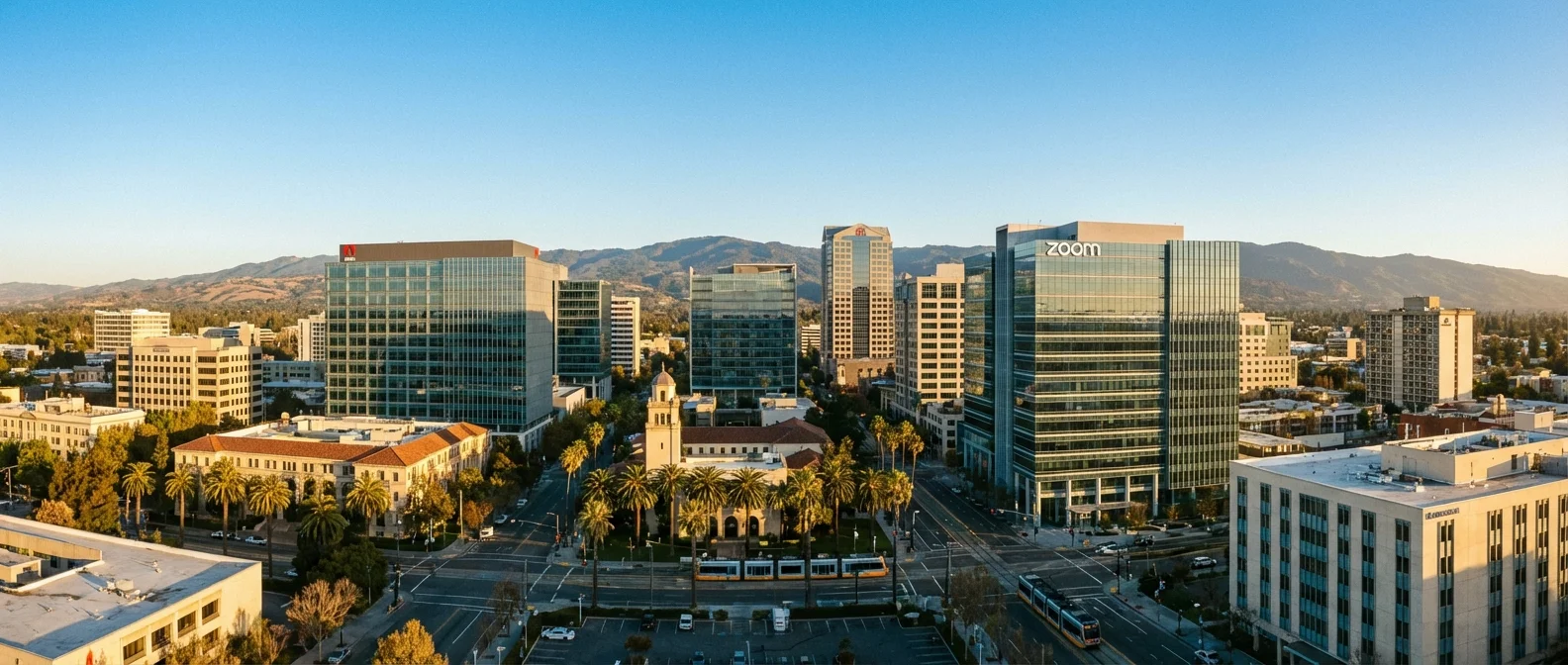
The San Jose area code is 408, with overlay code 669 serving the same territory since 2012. The broader Silicon Valley uses additional codes: 650 covers Palo Alto and Mountain View, while 510 and 341 serve East Bay suburbs like Fremont. San Jose is the 12th largest city in America (~997,000 residents) and the capital of the world's most important technology ecosystem.
This is the valley where a Nobel Prize winner's terrible management skills accidentally spawned an entire industry, where a coach ruined his wife's waffle iron and launched a $51 billion shoe company (that's Nike, in nearby Beaverton — but the Valley has its own version), where a man sold his 10% share of a company for $800 that's now worth $300 billion, where a widow built a 160-room mansion for 36 years straight because she believed she was haunted by ghosts, and where the state's first legislature earned the nickname "The Legislature of a Thousand Drinks." Before any of this, it was the prune capital of the world.
San Jose Area Code Quick Facts
San Jose & Silicon Valley Area Codes
Split from 415 in June 1959. Covers most of Santa Clara County: San Jose, Sunnyvale, Santa Clara, Cupertino, Campbell, Milpitas, Saratoga, Los Gatos, Morgan Hill, Gilroy. 59% utilization as of late 2023.
Activated November 20, 2012, as an overlay on 408. Covers identical territory. At 68.6% utilization — actually higher than 408 — driven by VoIP and IoT allocations from tech companies.
Created August 2, 1997, split from 415. Covers San Mateo County plus Palo Alto, Mountain View, Los Altos. Home to Stanford, Sand Hill Road (VC row), Meta HQ (Menlo Park). Projected exhaustion: Q3 2029.
Split from 415 in September 1991. Covers Oakland, Berkeley, Fremont, Hayward. Overlay 341 activated July 2019. Fremont (pop. ~230,000) is a major Silicon Valley suburb in the 510 territory.
The "Traitorous Eight": How Silicon Valley Was Born by Accident
William Shockley won the 1956 Nobel Prize in Physics for co-inventing the transistor and opened Shockley Semiconductor Laboratory in a former fruit packing shed at 391 San Antonio Road, Mountain View — the first silicon-based semiconductor company in what would become Silicon Valley. Arnold O. Beckman of Beckman Instruments funded the venture.
Shockley was a brilliant physicist but a terrible manager — paranoid, abusive, and dictatorial. On September 18, 1957, eight of his top researchers resigned en masse. Shockley called them the "Traitorous Eight": Julius Blank, Victor Grinich, Jean Hoerni, Eugene Kleiner, Jay Last, Gordon Moore, Robert Noyce, and Sheldon Roberts. Sherman Fairchild provided a $1.38 million loan, and they founded Fairchild Semiconductor.
The impact was staggering: over 20 years, 65 companies were started by teams tracing their origins to Shockley Semiconductor. Fairchild spawned Intel, AMD, National Semiconductor, and LSI Logic. Fairchild's own valuation never exceeded $2.5 billion, but its surviving progeny have been estimated to be worth over $2 trillion.
The HP Garage: Birthplace of Silicon Valley (1939)
At 367 Addison Avenue, Palo Alto, Bill Hewlett and Dave Packard formalized their partnership on January 1, 1939, working out of a one-car garage. Dave and his wife Lucile rented the first-floor apartment; Bill lived in the shed out back. Their first product was the HP 200A audio oscillator.
One of their earliest customers was Walt Disney Studios, which purchased eight oscillators (the improved HP 200B, at $54.40 each) to test and certify sound systems in theaters showing Fantasia (1940) — the first major film in stereophonic sound.
In 1989, the State of California designated the garage California Historical Landmark No. 976 with the title "Birthplace of Silicon Valley." HP purchased the property in 2000 for $1.7 million and spent five years restoring it to its 1939 condition. It's on the National Register of Historic Places.
Apple: The $666.66 Computer and the $800 Mistake
Apple Computer Company was founded on April 1, 1976, by Steve Jobs (21), Steve Wozniak (25), and a third co-founder most people forget: Ronald Wayne (41). Jobs sold his Volkswagen Bus and Wozniak sold his HP-65 calculator, raising a combined $1,300. Wozniak designed and hand-built the Apple I and debuted it at the Homebrew Computer Club. The retail price: $666.66. Wozniak said he was "unaware of the coincidental mark of the beast" — he simply liked repeating digits, and the wholesale price was $500 marked up by one-third.
The real story is Ronald Wayne. Just 12 days after co-founding Apple, Wayne sold his 10% stake back for $800. He later received an additional $1,500 — $2,300 total. Wayne feared personal financial liability if the company failed. Today, that 10% stake would be worth approximately $300–400 billion based on Apple's $3.5+ trillion market cap. It may be the most expensive business decision in human history.
The Winchester Mystery House: 160 Rooms, 36 Years, $5.5 Million
Sarah Winchester, widow of Winchester Repeating Arms heir William Wirt Winchester, purchased an eight-room farmhouse in San Jose in 1886. She then directed continuous construction for 36 years (1886–1922), until her death on September 5, 1922, at age 82. The construction cost an estimated $5.5 million — equivalent to over $80 million today.
At its peak, the house allegedly had approximately 500 rooms, though demolitions and the 1906 earthquake reduced it. When Sarah died, it contained: 160 rooms, 2,000 doors, 10,000 windows, 47 stairways, 47 fireplaces, 13 bathrooms, and 6 kitchens. Legend holds she believed she was haunted by the ghosts of those killed by Winchester rifles, and that a psychic told her to never stop building.
The house features staircases that lead to ceilings, doors that open to walls, and windows built into floors. It opened to the public on June 30, 1923, and over 12 million visitors have toured it since. It's both a California Historical Landmark and on the National Register of Historic Places.
California's First Capital: "The Legislature of a Thousand Drinks"
San Jose served as California's first state capital from November 13, 1849, to May 1, 1851. The city was designated at the Constitutional Convention in Monterey. The first legislature convened on December 15, 1849, in a building 60 feet long, 40 feet wide, and two stories tall.
Conditions were disastrous: the statehouse wasn't ready on time, hotel facilities were inadequate, and an unusually wet winter flooded downtown streets. The early assembly earned the nickname "The Legislature of a Thousand Drinks," attributed to Senator Thomas Jefferson Green, who reportedly ended each session with: "Let's have a drink! Let's have a thousand drinks!" The legislature moved to Vallejo in 1852, then Benicia, before finally settling in Sacramento. The original San Jose capitol building was destroyed by fire in 1853.
The Valley of Heart's Delight: From Prune Capital to Silicon Valley
Before it was Silicon Valley, Santa Clara Valley was known as "The Valley of Heart's Delight" — a name coined around 1915. At its peak, the valley had over 100,000 acres of orchards producing prunes, apricots, cherries, and walnuts with 39 canneries operating simultaneously.
The prune industry traces to French immigrant Louis Pellier, who arrived during the 1849 Gold Rush. In 1856, his brother Pierre traveled to France and returned with cuttings of French prune trees — the scions were stuck into potatoes and packed in sawdust for the sea voyage. By 1887, San Jose alone had 52,000 acres of prune trees. Santa Clara County became the nation's largest prune exporter between 1920 and 1940.
Because of the Pellier brothers' introduction, California still produces 96% of the nation's prunes and 40% of the world's prunes. The transition happened rapidly in the 1960s: orchards were bulldozed for housing tracts and semiconductor plants. By the 1970s, the "Valley of Heart's Delight" was gone, replaced by "Silicon Valley."
"Dutch's Panzer Division": 1,389 Annexations in 19 Years
Anthony P. "Dutch" Hamann served as San Jose's City Manager from 1950 to 1969 and single-handedly transformed San Jose from a small agricultural town into a sprawling metropolis through the most aggressive annexation campaign in American municipal history.
In 1950, San Jose had roughly 92,000 people across 17 square miles. Hamann's staff — nicknamed "Dutch's Panzer Division" for the speed of their land grabs — approved 1,389 annexations during his tenure. His signature tactic was "strip annexations": annexing narrow corridors of land around planned shopping centers so no other city could claim the sales tax revenue.
By the time he left office, San Jose covered 149 square miles with a population of approximately 460,000. The city nearly quintupled in population from 1950 to 1970, averaging an 8% annual growth rate. San Jose surpassed San Francisco as the Bay Area's most populous city in the 1990 Census.
San Jose Area Code Tools
Related Area Codes
Need a San Jose Phone Number?
Get a Silicon Valley area code number with BubblyPhone. Make affordable international calls, keep your existing number, and stay connected to the tech capital of the world.