Idaho Area Codes 208 & 986: Complete Guide to the Gem State (2026)
Idaho area codes 208 and 986. Coverage, the 70-year single-code history, time zone split, 10-digit dialing, and calling tips for the Gem State.
Idaho Area Codes 208 & 986: Complete Guide to the Gem State (2026)
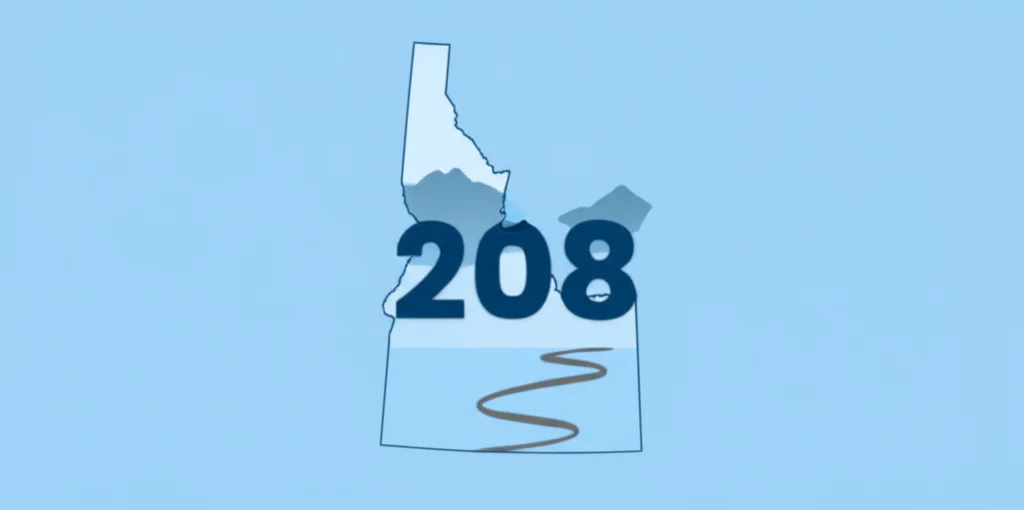
For 70 years, every phone number in Idaho started with the same three digits: 208. From Boise to Bonners Ferry, Twin Falls to Moscow, one area code covered all 83,569 square miles and 44 counties. That changed in 2017 when the 986 overlay arrived — but 208 remains so deeply woven into Idaho's identity that residents wear it on T-shirts, stamp it on bumper stickers, and even tattoo it on their skin.
This guide covers everything you need to know about Idaho's two area codes — their history, what they serve, why the state fought for years to keep a single code, and practical tips for calling the Gem State.
Idaho Area Codes at a Glance
Both area codes serve the entire state. The code doesn't indicate which city or region a number is from.
Why Does Idaho Only Have 2 Area Codes?
Idaho's relatively small population (~2.06 million) meant that 208 served the entire state for 70 years without running out of numbers. When demand from cell phones and internet services threatened exhaustion around 2001, the Idaho Public Utilities Commission fought it off with number pooling — first in Boise (2002), then statewide (2007). By 2013, conservation couldn't hold anymore, so the IPUC approved a statewide overlay rather than a geographic split, preserving every existing 208 number.
Coverage by Region
Both 208 and 986 blanket the entire state, but Idaho's regions are culturally and geographically distinct:
Treasure Valley
Boise, Meridian, Nampa, Caldwell
State capital and population center — ~40% of all Idahoans
Magic Valley
Twin Falls, Jerome, Burley
Agricultural heartland, home to Shoshone Falls
Eastern Idaho
Idaho Falls, Pocatello, Rexburg
Idaho National Laboratory corridor
North-Central Idaho
Lewiston, Moscow
Pacific Time Zone, University of Idaho
Northern Panhandle
Coeur d'Alene, Sandpoint, Post Falls
Pacific Time Zone, culturally tied to Spokane, WA
Central Mountains
Sun Valley, McCall, Stanley
Frank Church Wilderness, world-class skiing
Idaho's Time Zone Split
Mountain Time (MT)
Southern ~75% of the state, including Boise, Twin Falls, Pocatello, Idaho Falls, and Sun Valley. Home to about 90% of Idaho's population. UTC-7 standard / UTC-6 daylight.
Pacific Time (PT)
The 10 northern Panhandle counties, including Coeur d'Alene, Moscow, Lewiston, and Sandpoint. One hour behind the rest of Idaho. UTC-8 standard / UTC-7 daylight.
The boundary roughly follows the Salmon River. Unlike the area codes (which are statewide), the time zones actually divide Idaho — so always check which zone someone is in before calling.
Things You Didn't Know About Idaho
First Nuclear Electricity Ever
At 1:50 p.m. on December 20, 1951, Experimental Breeder Reactor I (EBR-I) near Arco became the first nuclear reactor in the world to generate usable electricity — enough to light four 200-watt bulbs. The next day, it powered the entire building. EBR-I is now a National Historic Landmark.
First City Lit by Atomic Power
Arco, Idaho (population 879) became the first city in the world powered entirely by nuclear energy on July 17, 1955, when the nearby BORAX-III reactor lit the town. Arco proudly displays this distinction on its welcome signs to this day.
World's First Ski Chairlift
Sun Valley opened December 21, 1936, with the world's first ski chairlift — invented by Union Pacific engineer James Curran by adapting banana-loading conveyor systems from cargo ships. Union Pacific chairman Averell Harriman spent $1.5 million to build the resort during the Great Depression.
Deeper Than the Grand Canyon
Hells Canyon on Idaho's western border plunges 7,993 feet from the Seven Devils Mountains to the Snake River — making it the deepest river gorge in North America, deeper than the Grand Canyon. The gorge stretches 10 miles wide.
Taller Than Niagara
Shoshone Falls near Twin Falls drops 212 feet — 45 feet higher than Niagara Falls — and spans nearly 1,000 feet wide. Known as the "Niagara of the West," its height advantage was there long before any tourist ever saw Niagara.
One-Third of America's Potatoes
Idaho produces roughly 14.3 billion pounds of potatoes annually — about 30% of the entire U.S. crop from around 315,000 acres. Despite this dominance, Idaho potato acreage hit a 70-year low of 300,000 acres in 2025.
Largest Lower-48 Wilderness
The Frank Church-River of No Return Wilderness spans 2,366,757 acres — larger than Yellowstone. Named after Senator Frank Church and designated in 1980, it's the largest contiguous wilderness area in the contiguous United States.
Boise's Underground Hot Water
Boise operates the largest municipally-run geothermal heating system in the U.S. Since 1983, 177°F water has been pumped through 20 miles of pipes, heating over 6 million square feet across 88 downtown buildings — including City Hall, the State Capitol, and Boise State University.
Craters of the Moon
Craters of the Moon National Monument covers 750,000 acres of lava fields in south-central Idaho. The landscape includes over 60 lava flows, 25 cinder cones, and a 52-mile-long crack in the Earth's crust called the Great Rift. The most recent eruption was just 2,100 years ago — and geologists consider future eruptions likely. NASA astronauts trained here in the 1960s because of its moon-like terrain.
Idaho Area Code Timeline
Area code 208 established
One of the original 86 North American area codes, 208 covers the entire state of Idaho — every city, every county.
Number pooling begins in Boise
The IPUC implements number pooling in Boise to delay projected 208 exhaustion, originally expected by 2003.
Statewide number pooling
Number pooling expands to all of Idaho, pushing the exhaustion date further into the future.
Exhaustion projected for mid-2018
NANPA warns that conservation alone can no longer sustain the 208 code. A new area code is needed.
IPUC approves area code 986
The commission chooses a statewide overlay over a geographic split, preserving all existing 208 numbers.
Permissive 10-digit dialing begins
Starting November 5, Idahoans can dial 10 digits but 7-digit calls still work during the transition period.
Mandatory 10-digit dialing
As of August 5, all calls require 10 digits. New numbers may be assigned 986 starting September 5. Idaho's 70-year single-code era ends.
First 986 prefix assigned
On March 16, the first NPA-NXX prefix is officially assigned under area code 986.
Tips for Calling Idaho Numbers
10-Digit Dialing Required
Since August 2017, all Idaho calls require 10-digit dialing (area code + number). 7-digit calls no longer connect. This applies even if both you and the person you're calling have 208 numbers.
Check the Time Zone
The area code won't tell you which time zone someone is in — both 208 and 986 span the entire state. Northern Idaho (Coeur d'Alene, Moscow, Lewiston) is on Pacific Time, one hour behind Boise and southern Idaho.
208 vs 986
Both codes serve the same geography. Most existing numbers are 208 — you'll primarily see 986 on newer lines assigned after September 2017. There's no difference in calling cost or service quality between the two.
Get an Idaho Number
Need a local Idaho presence? BubblyPhone offers virtual phone numbers with Idaho area codes — call and text from anywhere with a real 208 or 986 number.