986 Area Code: Idaho Statewide Location, Time Zone & Scam Check (2026)
The 986 area code is a statewide overlay for 208 covering all of Idaho — from Boise to Coeur d'Alene. Learn about coverage area, time zone, scam protection, and the state that held a single area code for 70 years.
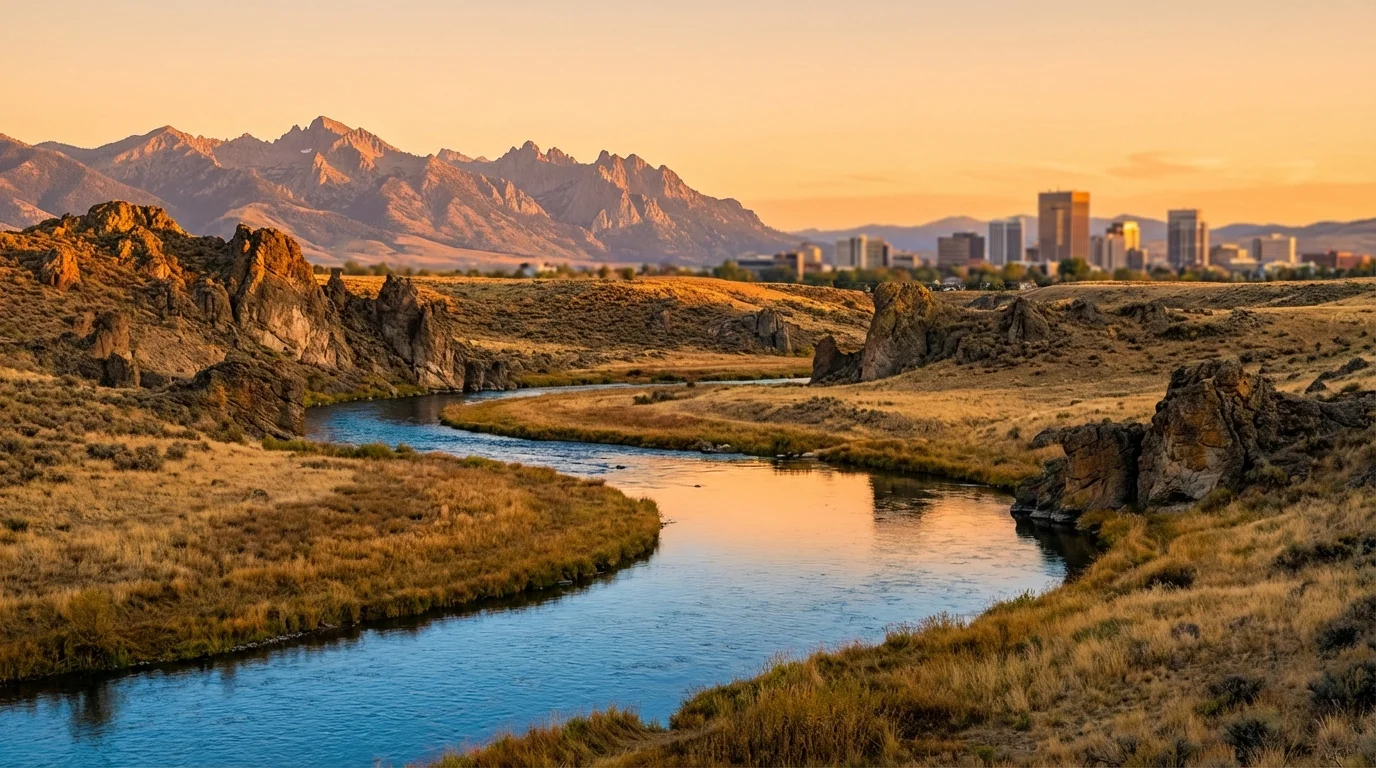
The 986 area code is a statewide overlay for 208, covering the entire state of Idaho — all 39 counties, from Boise to Coeur d'Alene to Idaho Falls. It serves approximately 2 million people, making it one of the few area codes that covers an entire state.
Idaho held a single area code for 70 years — one of the last states in America to add a second. This is a state where four light bulbs changed the world, where a banana conveyor engineer invented the ski chairlift, where Apollo astronauts rehearsed moonwalks on lava fields, and where a ghost town sits at the bottom of a reservoir because of the Gold Rush. Also, the water coming out of the canyon walls has been underground for 200 years.
986 Area Code Quick Facts
Cities in the 986 / 208 Area Code
| City | Population | County |
|---|---|---|
| Boise | 235,000 | Ada |
| Meridian | 130,000 | Ada |
| Nampa | 108,000 | Canyon |
| Idaho Falls | 66,000 | Bonneville |
| Pocatello | 56,000 | Bannock |
| Caldwell | 62,000 | Canyon |
| Twin Falls | 53,000 | Twin Falls |
| Coeur d'Alene | 55,000 | Kootenai |
| Post Falls | 41,000 | Kootenai |
| Lewiston | 34,000 | Nez Perce |
| Moscow | 26,000 | Latah |
| Rexburg | 36,000 | Madison |
208/986 Area Code Timeline
One of the original 86 area codes in the North American Numbering Plan. Covered the entire state of Idaho — all 39 counties.
Idaho PUC implements number pooling in Boise to extend 208's life. NANPA had projected exhaustion by 2003. Extended statewide in 2007.
Statewide overlay activated. Mandatory 10-digit dialing began August 5, 2017. Idaho kept a single area code for 70 years — one of the last states to add a second.
The 70-Year Holdout: Idaho's Last Single Area Code
Area code 208 was assigned in 1947 as one of AT&T's original 86 area codes — covering every square inch of Idaho. For seven decades, it was all the state needed. Idaho's small, spread-out population meant the phone number supply held out far longer than in most states.
Then cell phones changed everything. By 2001, NANPA projected 208 would exhaust its number pool by 2003. The Idaho PUC tried a clever stalling tactic: number pooling — sharing blocks of 1,000 numbers among carriers instead of the standard 10,000-number blocks. Implemented in Boise in 2002 and extended statewide in 2007, it bought 15 extra years.
On November 2, 2015, the Idaho PUC finally approved 986 as a statewide overlay. Mandatory 10-digit dialing began August 5, 2017. For many rural Idahoans who'd dialed seven digits their entire lives, it was the end of an era. Idaho had been among the last states in America with a single area code — and 208 remains one of only 15 of the original 86 codes still serving an entire state.
Four Light Bulbs That Changed the World
At 1:50 p.m. on December 20, 1951, in a remote stretch of desert 18 miles southeast of Arco, Idaho, Experimental Breeder Reactor I (EBR-I) produced the world's first usable nuclear electricity — enough to light four 200-watt light bulbs. The next day, it powered the entire building.
EBR-I's primary mission wasn't just generating electricity — it was proving Enrico Fermi's "breeding" principle: that a reactor can create more fissile material than it consumes. In 1953, EBR-I confirmed this was true. The reactor produced 200 kW of electricity from 1.4 MW of thermal energy and operated until 1964.
Then came BORAX-III. On July 17, 1955, the nearby reactor supplied approximately 2,000 kilowatts to the town of Arco (population 879) for about two hours — making it the first city in the world lit by nuclear power. Arco still has a lava-rock-faced building on US-26 with a lighted sign proclaiming the achievement. EBR-I is now a free museum and U.S. National Historic Landmark.
52 Nuclear Reactors in the Desert
Since 1949, the Idaho National Laboratory (INL) has built and operated 52 nuclear reactors — the largest concentration of nuclear reactors anywhere in the world. The site covers 890 square miles of high desert, larger than the entire state of Rhode Island.
Most of the 52 were first-of-a-kind designs, including the Navy's first prototype nuclear propulsion plant that led to nuclear submarines. "Nearly every operating reactor in the world has technological roots in Idaho," according to INL. Only four of the 52 remain in operation today.
The site also witnessed America's only fatal reactor accident. On January 3, 1961, the SL-1 reactor exploded, killing three operators: Army Specialists John Byrnes (22) and Richard McKinley (27), and Navy Electrician Richard Legg (26). The central control rod had been withdrawn 67 centimeters — far past the 10 centimeters needed for maintenance. Whether it was an accident or deliberate remains one of nuclear history's darkest mysteries. The bodies were so radioactive they were buried in lead-lined caskets inside metal vaults covered with concrete. Cleanup took 24 months and generated 99,000 cubic feet of contaminated material.
Hemingway's Last Stand: Suite 206 and a Ketchum Cemetery
Ernest Hemingway first arrived in Sun Valley on September 20, 1939, driving a dusty black convertible with journalist Martha Gellhorn. Railroad magnate Averell Harriman had personally invited him as a celebrity draw, alongside Clark Gable, Gary Cooper, and Marilyn Monroe.
Hemingway set up his Royal typewriter in Suite 206 of the Sun Valley Lodge — which he nicknamed "Glamor House." Over three months, he wrote major portions of For Whom the Bell Tolls. His 22-year relationship with Idaho deepened over many long autumn stays in the Wood River Valley.
In 1959, he bought a house near Ketchum for $50,000 and moved in permanently. His health and mental state deteriorated; he underwent electroshock therapy at the Mayo Clinic but could no longer write. On the morning of July 2, 1961, Hemingway died at his Ketchum home. He was buried four days later in the Ketchum city cemetery. His grave is a flat, unadorned slab — deliberately simple for one of the most famous writers in history.
How a Banana Conveyor Engineer Invented the Ski Chairlift
In 1935, railroad chairman Averell Harriman decided to build America's first destination ski resort to boost winter rail ticket sales. He sent Austrian sportsman Count Felix von Schaffgotsch on a cross-country scouting mission. The Count chose Ketchum, Idaho — then a fading mining town. Sun Valley Lodge opened December 1936.
The revolutionary innovation came from Union Pacific bridge engineer James Curran, who adapted his experience building banana conveyor systems that loaded fruit onto ships in Honduras. The continuous-flow principle was the same — but now carrying humans uphill. To test the concept, Curran attached a chair to the side of a Union Pacific truck and used a volunteer to scoop up while driving along.
The world's first ski chairlift opened on Dollar Mountain on December 21, 1936, with capacity for 400 skiers per hour. Harriman hired Steve Hannagan — the same publicist who coined "Miami Beach" — to promote the resort. Hannagan invented the name "Sun Valley" and the tagline: "Winter sports under a summer sun."
Idaho's Third-Largest City Was a Prison
Following Executive Order 9066, the Minidoka War Relocation Center opened August 10, 1942, in the Snake River Plain desert, 20 miles northeast of Twin Falls. Over 13,000 Japanese Americans were imprisoned at Minidoka. At peak population — 9,397 on March 1, 1943 — it was Idaho's third-largest city.
The remarkable paradox: despite being imprisoned by their own government, 844 men from Minidoka volunteered or were drafted for military service — the highest enlistment rate of any of the ten internment camps. Many joined the 442nd Regimental Combat Team, the all-Japanese-American unit that became the most decorated unit for its size and length of service in U.S. military history, earning over 18,000 individual medals.
73 men from Minidoka were killed in action — dying for a country that had imprisoned their families. President Clinton designated the site a National Monument in 2001. In 2006, President Bush signed legislation guaranteeing $38 million to restore Minidoka and nine other former internment camps.
The Basque Capital of the Americas
Boise has the largest concentration of Basque people outside the Pyrenees: approximately 16,000 people of Basque descent, most tracing their ancestry to Bizkaia in northern Spain. The first Basque arrival, Antonio Azcuenaga, came in 1889, trailing sheep through southwest Idaho during the mining boom.
Downtown Boise's Basque Block (Grove Street between 5th and 6th) includes the Basque Museum & Cultural Center, a fronton (pelota handball court), the Basque Center clubhouse, and Basque restaurants. The museum runs the nation's first Basque preschool and offers language classes.
Jaialdi, held every five years since 1987, draws 30,000–40,000 attendees — the largest Basque festival in the United States. Events include herri kirolak (rural sports): wood chopping, wagon lifting, and hay bale pulling — competitions that originated in actual Basque farm chores.
Where Water Travels 200 Years Underground
The Eastern Snake River Plain Aquifer underlies 10,800 square miles of southern Idaho, storing an estimated 200–300 million acre-feet of water — roughly equivalent to the entire volume of Lake Erie. Rivers flow over the porous lava fields of the Craters of the Moon area, sink underground, and travel through volcanic basalt for nearly 200 years before emerging as massive springs.
At Thousand Springs near Hagerman, water bursts from the canyon walls midway up the cliff face at a constant 58°F. The area contains 11 of the 65 largest cold springs in the United States. Well yields of 2,000–3,000 gallons per minute with only a few feet of drawdown are common.
This aquifer water supports Idaho's $150 million per year trout farming industry. Idaho produces 70% of all domestic trout — approximately 41 million pounds per year — from about 80 fish farms concentrated in the Magic Valley around Hagerman, Buhl, and Twin Falls. A moratorium on new water rights from the Eastern Snake Plain has been in effect since 1992.
Where Apollo Astronauts Rehearsed Moonwalks
On August 22, 1969 — less than six weeks after Apollo 11 — NASA sent astronauts to Craters of the Moon National Monument in southern Idaho for geology field training. The lava field consists of over 60 different lava flows, the most recent roughly 2,100 years old.
The astronauts who trained there: Gene Cernan, Alan Shepard, Joe Engle, and Edgar Mitchell. As Mitchell explained: "The idea was to get us well-trained so that we could be the eyes of the geologists when we were on the moon."
What happened to the trainees: Alan Shepard became the 5th person to walk on the Moon (Apollo 14). Edgar Mitchell became the 6th, spending 9 hours on the lunar surface. Gene Cernan went to the Moon twice and on December 17, 1972, became the last human to walk on the Moon — a record that still stands over 53 years later.
Idaho by the Numbers
- •Shoshone Falls near Twin Falls is 212 feet tall — 45 feet taller than Niagara Falls. It spans nearly 900 feet across, earning it the nickname "the Niagara of the West"
- •Boise's geothermal system is the largest municipally operated geothermal heating utility in the US. It delivers 177°F water through 20 miles of pipes to heat 88 buildings. Idaho's Capitol was the first US statehouse heated by geothermal hot water, tapped from 3,000 feet underground
- •Frank Church Wilderness at 2.367 million acres is the largest contiguous federally managed wilderness in the Lower 48 — 1.5 million acres have no maintained trails at all. Named for the "River of No Return" — the Salmon River — because early settlers could float downstream but couldn't navigate back upstream
- •Idaho's state seal, designed by Emma Edwards Green in 1891, is the only US state seal designed by a woman. She was paid $100. The man and woman are depicted at equal height — Green was a suffragist and designed it anticipating Idaho granting women the vote (which it did in 1896)
- •Island Park has the longest Main Street in America at 33 miles. And Pocatello passed a 1948 ordinance making it illegal to frown — violators were sent to a "Smileage Station"
986 Area Code Tools
Related Area Codes
Idaho / Northwest
- 986 — Idaho statewide overlay (2017) — this article
- 208 — Idaho (original 1947 code)
- 509 — Eastern Washington (Spokane)
- 206 — Seattle, WA
- 406 — Montana (statewide)
Mountain West
- 720 — Denver, CO
- 801 — Salt Lake City, UT
- 385 — Salt Lake City overlay
- 307 — Wyoming (statewide)
- 541 — Eastern Oregon
Need an Idaho Phone Number?
Get an Idaho area code number with BubblyPhone. Make affordable international calls, keep your existing number, and stay connected to the 986/208 region.