Second Phone Line Options and How to Choose
Table of Contents
- Another identity without replacing your main number
- Second phone line options compared
- Choose the separation you'll actually maintain
- Set up the calling path before sharing the number
- Check the endpoint, not just the account
- Separate the jobs people confuse
- Caller ID is a label, not proof
- Personal contact without permanent access
- A public business number with a clear owner
- Run a realistic acceptance test
- Budget for your actual calling pattern
- Preserve the identity you publish
- Match the setup to the situation
- Make the setup fit the job
Fixed-telephone penetration fell 45% between 2005 and 2023, according to the International Telecommunication Union, but a second phone line hasn't disappeared: it's now usually another mobile number or internet-based calling identity. Choose yours by separating what you need to do, place calls, receive callbacks and texts, display a recognizable caller ID, or reach emergency services.
What a Second Phone Line Means Now
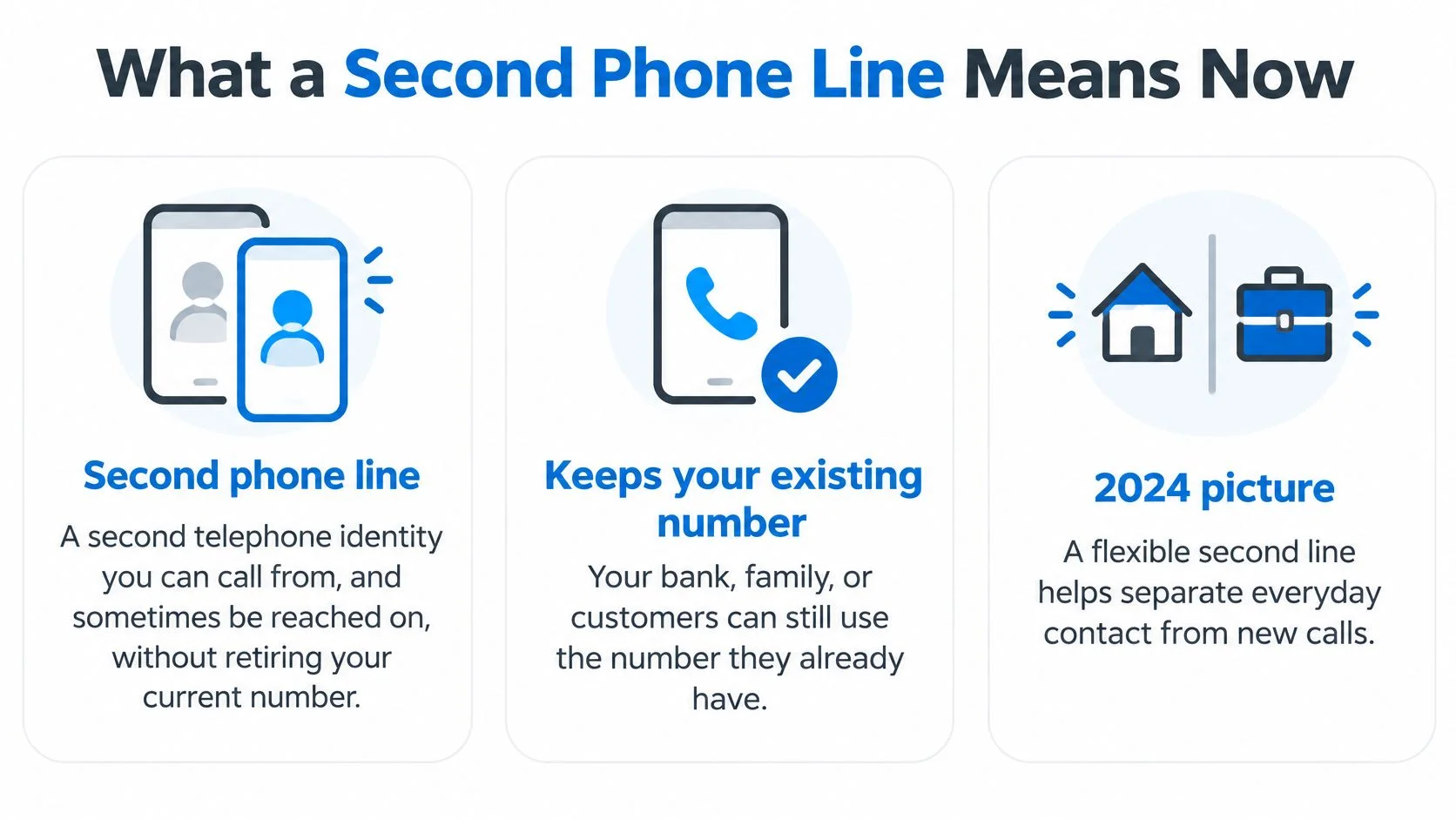
A second phone line gives you another telephone identity without replacing your existing number. Your bank, family, and established customers can keep using the contact details they already have.
By 2024, there were approximately 9.1 billion mobile-cellular subscriptions, equal to 112 subscriptions per 100 inhabitants, according to the ITU's mobile subscription indicators. The figure counts subscriptions, not individual people. People and organizations may hold extra lines for work, travel, devices, or contacts in another country.
A second line works like a second front door: it gives callers another way in, and it needs its own lock. Treat it as a separate identity with clear limits, not as a guaranteed emergency line or a permanent mobile connection.
Another identity without replacing your main number
An extra line can come from a mobile subscription, another SIM, a dedicated business number, or a virtual number over broadband. Each setup has different trade-offs. A mobile line provides calling and texting within its service coverage; a virtual number separates the public telephone identity from the SIM in your pocket, while relying on connectivity and account access.

Decide who should have the new number and what they need to do with it. A buyer arranging furniture collection needs a way to discuss pickup, not ongoing access to your primary mobile. A customer needs a reliable callback route, not just a number shown on an outgoing call.
A local-looking area code alone does not establish emergency suitability. Check location and emergency routing separately. Three practical jobs often shape the choice: protecting privacy, calling relatives abroad, and publishing a work number. Define the job before choosing the technology.
Five Second-Line Options Compared
Customers choose among four ways to maintain another line and an outbound-only stopgap. Match the job to the table before buying hardware or adding a recurring plan.
Second phone line options compared
The country column describes the subscription's home numbering and coverage arrangement, not an absolute ban on travel. Roaming can extend a mobile line's reach, but you still need to understand that plan's coverage and roaming terms.
Choose the separation you'll actually maintain
A second physical phone gives you the clearest boundary. You can leave the work handset behind, keep its contacts separate, and avoid selecting the wrong outgoing line. The trade-off is practical: another battery, charger, and device to carry.
Dual-SIM or eSIM suits someone who wants separate numbers without separate hardware. Confirm that your particular handset supports the active-line combination you need, and label the lines before making calls. Buying a data-only travel eSIM doesn't, by itself, give you another telephone number.
Dual-SIM is an established hardware category: Accio's market overview estimated the global dual-SIM smartphone market at 1.8 billion units in 2023. That market estimate doesn't establish compatibility for your handset, so check the device settings and specifications rather than assuming.
An extra mobile-plan line is mainly an account-management choice. It can simplify billing, but a shared bill doesn't automatically mean both numbers work on the same phone. Establish how the additional line reaches your device before ordering it.
For a virtual number, prioritize how you'll answer. A desk-based worker may prefer a browser; someone moving between appointments needs an app or forwarding route. Don't confuse an outgoing caller-ID display with an assigned number that customers can call back.
- Occasional overseas calls: An outbound-only arrangement can be enough if nobody needs to return calls to that identity.
- Public business contact: Choose a dedicated inbound number and test its answering route.
- Shared staff responsibility: Decide who answers, who handles missed calls, and where voicemail goes.
When staff routing becomes more complicated than forwarding to a single handset, the PBX insights from IT Cloud Global, published by IT Cloud Global, LLC, provide useful context on organizing business telephone calls. A solo trader usually needs a clear answering routine before a more elaborate telephone system.
How a Browser Virtual Line Works
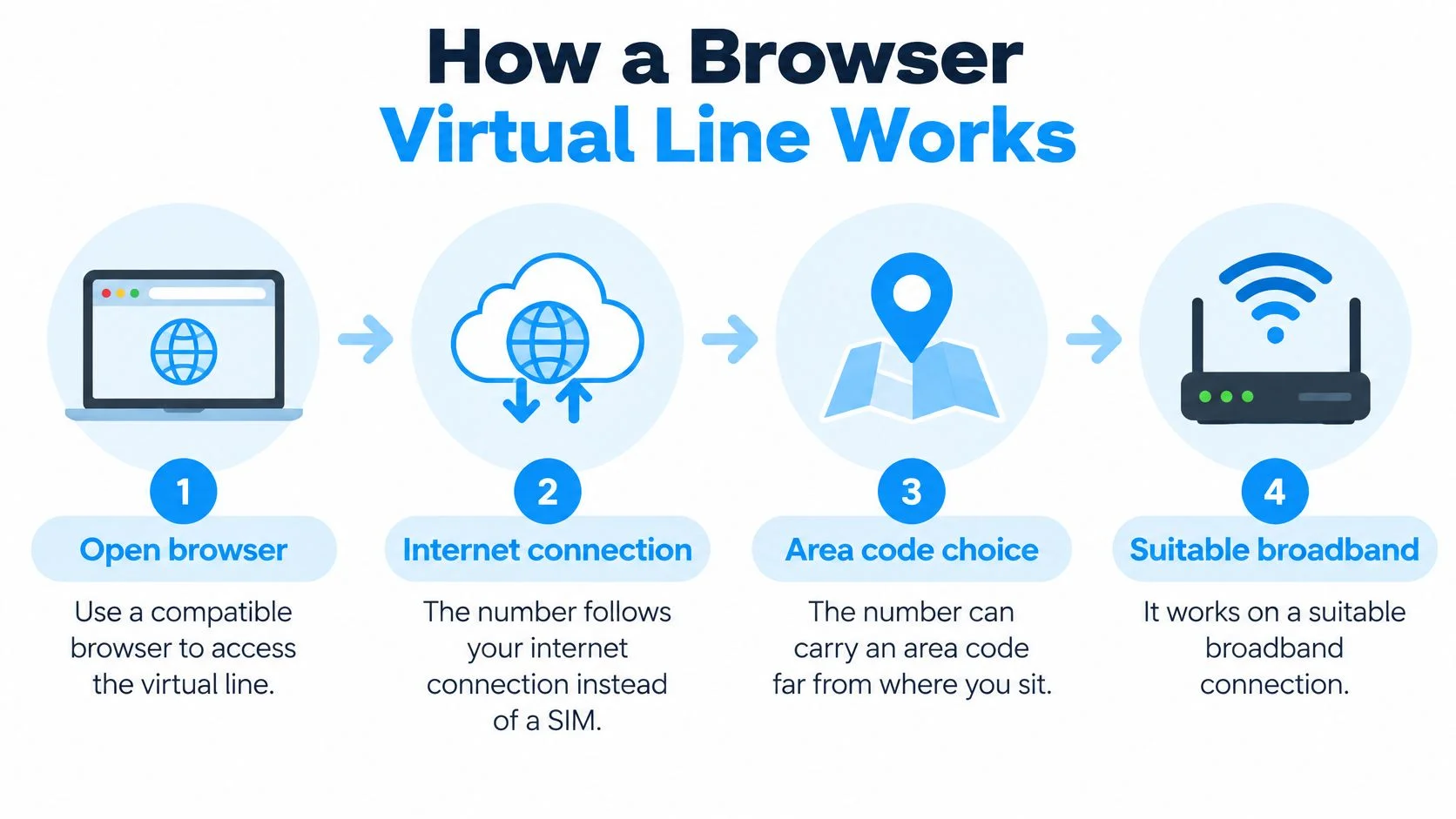
A browser virtual line routes calls through an internet connection rather than a separate voice SIM. Your number can stay the same as you move between suitable connections, while the call still depends on the internet, the device, and its power supply staying up.
The FCC's VoIP guidance explains that a service can use an area code different from the user's physical location. It also notes that calls may fail if internet access is unavailable, overloaded, or interrupted by a power outage.

Set up the calling path before sharing the number
For BubblyPhone, the setup is:
- Open a modern browser. Use your laptop or phone, allow microphone access, and select the microphone and speaker you intend to use. A headset helps prevent speaker audio from feeding back into the microphone.
- Create an account and add prepaid credit. Calling itself doesn't require a subscription. Keep access to your recovery email, particularly if you'll sign in while traveling.
- Enter the full telephone number. Check the destination and displayed rate before pressing call. Don't assume the site can infer the intended country from an incomplete local number.
- Let the recipient answer normally. They receive an ordinary telephone call on their landline or mobile. They don't need an app, an account, or the same service.
- Add a dedicated BubblyPhone number if callbacks matter. Incoming calls can ring in the browser or app, forward to your mobile, or go to voicemail. The number can also receive texts.
- Test inbound calls from another phone. Confirm the correct device rings, answer it, and check audio in both directions before publishing the number.
- Test what happens when you leave the desk. Close the browser or laptop, then call again. Set up forwarding or use the phone app if calls must reach you while the computer is unavailable.
Calls use HD voice over global carrier infrastructure, with encryption in transit. You still need a working microphone, a stable connection, and an available device to answer.
Check the endpoint, not just the account
A successful login proves you can access the service. It doesn't prove your browser has permission to use the microphone or that incoming calls will reach a sleeping computer.
Before an important supplier or family call, make a short audio check. Pause heavy uploads if your connection struggles, and use a quieter room rather than trying to overcome background noise by increasing speaker volume.
Practical rule: Test the line in the state you'll actually leave it, not only while the setup page is open.
When a Second Line Is the Wrong Tool
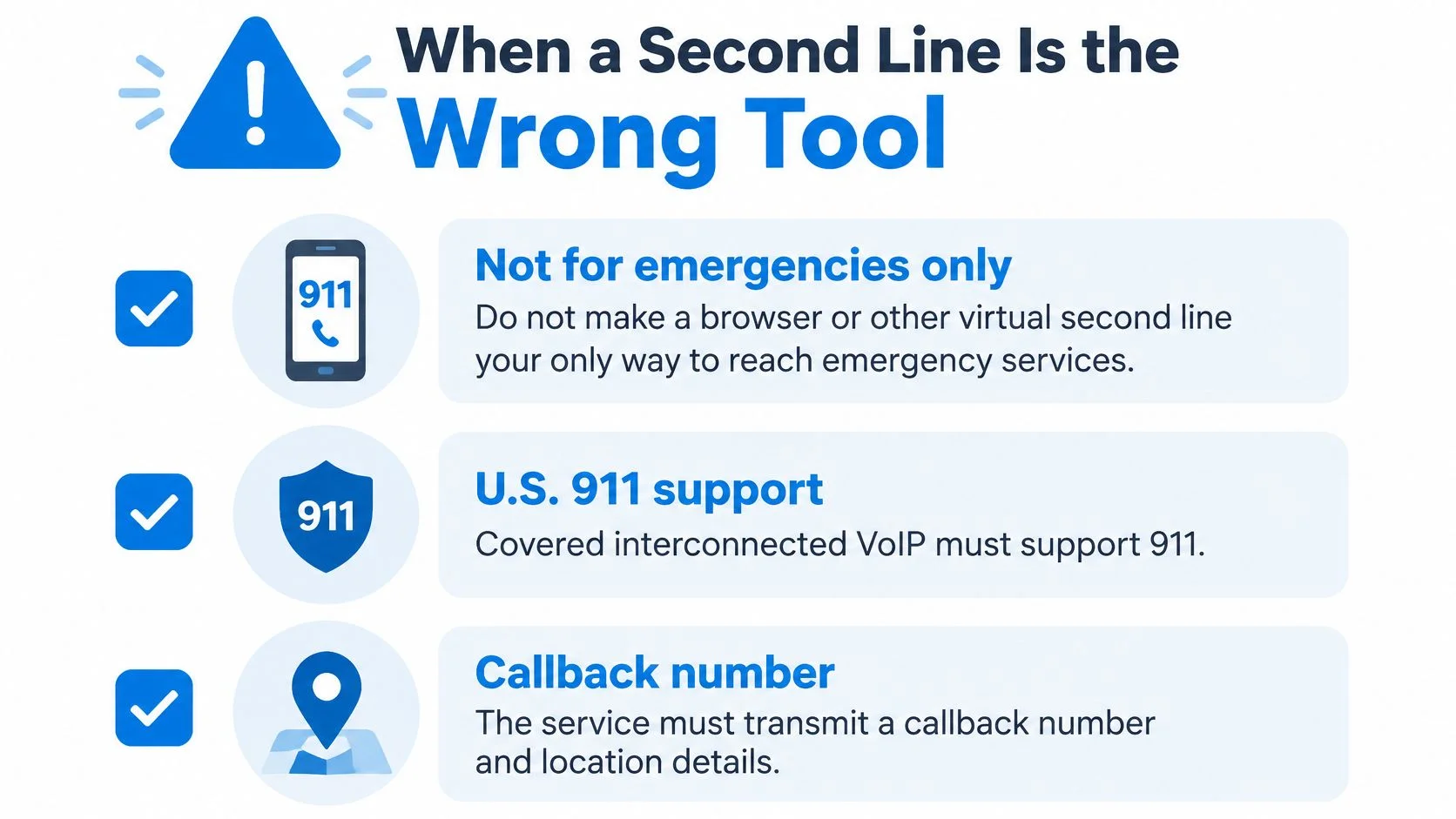
Don't make a browser or other virtual second line your only way to reach emergency services. A convenient public number and a dependable emergency channel are different requirements.
In the United States, covered interconnected VoIP services must support 911, transmit a callback number and location, and explain their limitations, according to the FCC's VoIP and emergency-service guidance. A non-fixed service may rely on a registered location that you must keep current when you move.

Separate the jobs people confuse
Evaluate these functions independently:
- Outbound calling: Can you reach the ordinary landlines and mobiles you need?
- Inbound reach: Can someone call you back, leave voicemail, or send a text you can receive?
- Caller-ID identity: What number will the recipient see, and are you authorized to present it?
- Emergency routing: Does the service support emergency calls where you are, and what location will it transmit?
A line can handle international outbound calls well while offering no personal callback number. Another can receive customer calls reliably at a desk but become unsuitable when you travel without updating its registered address.
For emergencies, establish the actual operating conditions. Confirm support in the country you're visiting, identify the address registered to the line, update it when you relocate, and retain a conventional mobile or local emergency option.
Forwarding solves an answering problem, not a location-routing problem. A phone forwarding number can send ordinary incoming calls to another handset, but you shouldn't treat that setting as proof of emergency readiness.
Caller ID is a label, not proof
An incoming number can help someone recognize your business, but it doesn't establish who is speaking. For sensitive requests, verify the person through an established contact route instead of trusting the screen.
The FCC's caller-ID spoofing guidance says deliberately transmitting misleading caller-ID information with intent to defraud, cause harm, or wrongfully obtain something of value is prohibited under U.S. rules, with penalties of up to $10,000 per violation. Use an assigned number or an authorized, verified identity rather than deceptive manipulation.
A separate business number also doesn't create permission to contact anyone you like. The Congressional Research Service's explanation of federal calling and texting rules describes consent requirements and restrictions affecting automated calls and texts, including commercial communications.
These are U.S. rules, not a worldwide permission framework. For cross-border outreach, consider the recipient country's telecommunications and privacy requirements too.
A browser line can be a good fit for privacy, supplier contact, and temporary business use. It becomes the wrong choice when you require capabilities it doesn't provide, especially when you expect it to replace your sole emergency channel.
Workflows for Home Life and for Work
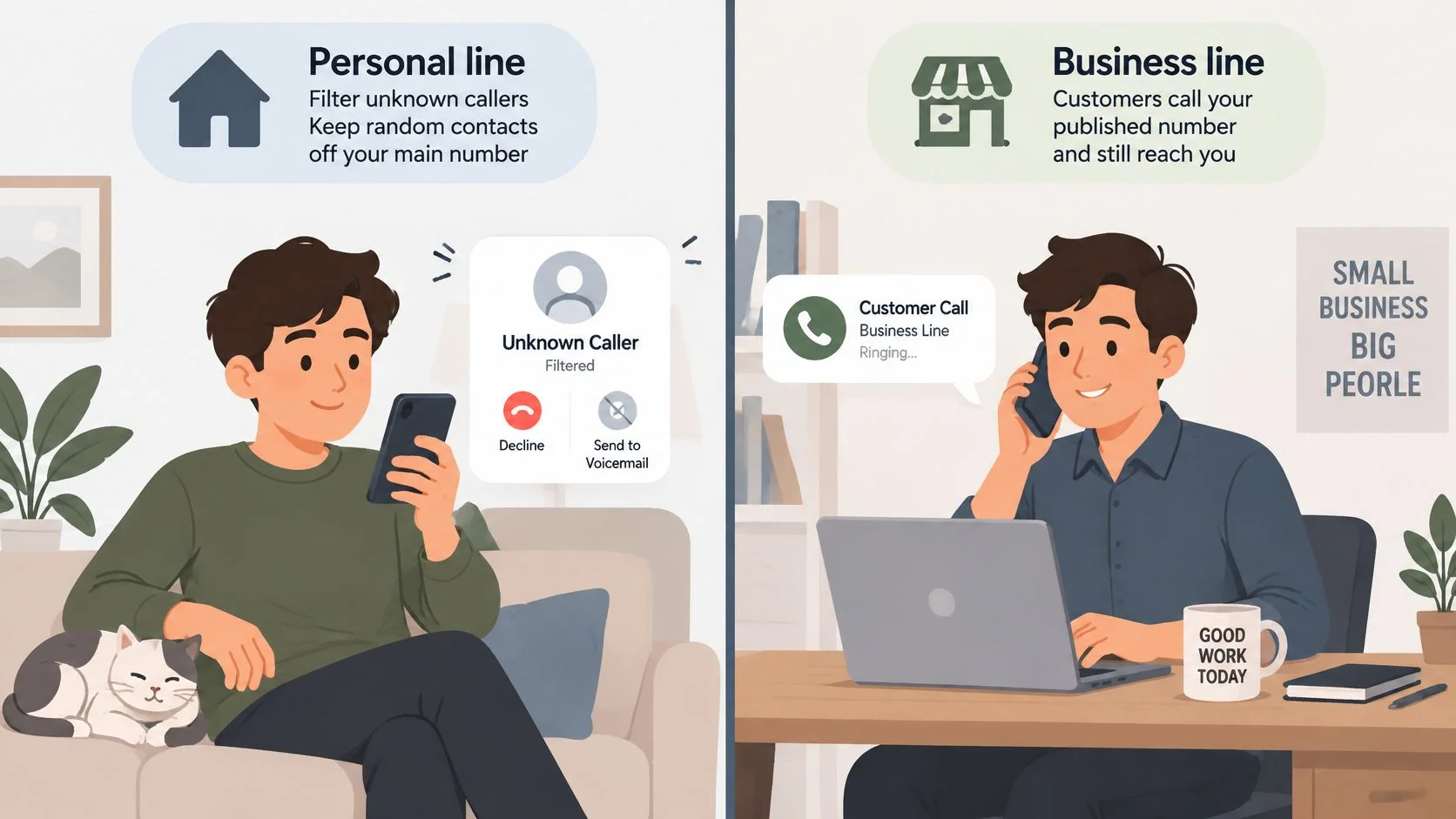
Use a personal second line to keep unfamiliar contacts away from your main number. Use a business line to give customers a published contact point with a deliberate answering routine.
Personal contact without permanent access
Say you're selling furniture before moving abroad. Put the second number on the listing, answer collection questions through the browser or app, and forward calls to your mobile only while you're available.
Once collection is arranged, voicemail can handle calls you don't want interrupting your day. Use a greeting that explains when you'll respond without revealing your home address, travel dates, or unnecessary personal details.

For family abroad, the workflow is different. Call their existing landline or mobile from the browser, and give them your dedicated callback number if you want them to initiate calls too.
A dead local SIM doesn't necessarily prevent browser calling if suitable internet access is available. Still, arrange your arrival contact and local emergency option before depending on hotel or public connectivity.
Keep bank recovery and essential one-time codes on your primary mobile. A secondary number you might stop maintaining shouldn't become the only way to regain access to your main accounts.
A public business number with a clear owner
Consider a small importer handling overseas suppliers. The owner publishes a dedicated number in the email signature, answers through the browser during desk hours, and forwards incoming calls when leaving for deliveries.
Unanswered calls go to a business voicemail greeting, not a personal message intended for family. The owner checks voicemail at defined points during the day and records which supplier needs a callback.
A virtual phone number for a small business is useful when the answering process is explicit. If colleagues share responsibility, name the person covering incoming calls and the person handling messages; don't assume everyone will notice the same missed call.
Receive-only texts can carry incoming messages, but you can't reply by sending SMS from that line. Give customers a separate written-contact route when a conversation needs a text response.
Run a realistic acceptance test
Before printing the number on cards, run a one-week trial workflow:
- Inbound traffic: Arrange ten real incoming calls at different points in your normal routine.
- Away-from-desk handling: Complete a forwarded call with the laptop unavailable.
- Missed-call handling: Leave a voicemail and confirm you can retrieve it.
- International calling: Place a call to a landline abroad and check that both people can hear clearly.
Treat those as your own test targets, not a reliability guarantee. Publish the number only after the routine works without keeping the setup screen open.
What You Pay and What You Keep
Judge a second phone line by its billing structure and the continuity of the number, not just its advertised entry cost. Separate outgoing usage from the recurring cost of maintaining an inbound identity.
Budget for your actual calling pattern
With prepaid browser calling, you pay for outgoing usage; a dedicated inbound number is a separate decision. Our calling is billed per minute, rounded up to the next whole minute, and the optional dedicated-number plan is the only recurring product.
Read the live destination rates before dialing rather than looking for a single worldwide rate. Estimate the calls you expect to make, including how rounded billing affects short conversations, and add a dedicated number only if incoming contact matters.
Don't confuse a credit balance with the right to retain a telephone number. They serve different purposes, and a phone number rental arrangement needs to remain active under its applicable terms.
Preserve the identity you publish
Save and share the number in full international form. ITU-T Recommendation E.164 limits an international telephone number to 15 digits, excluding the international dialing prefix, with the country code included in that total.
A familiar local number without its country code can leave relatives or suppliers abroad guessing. Copy the complete international number into signatures and contact records rather than relying on callers to reconstruct it.
Before giving up a number, remove it from account recovery and update customers, employers, banks, and saved profiles. The FCC's unwanted-communications guidance explains the reassigned-number issue: a disconnected number can later belong to someone else, while old contacts continue using it.
Keeping a number in your address book isn't the same as retaining control of it.
If you want to move the number instead, establish portability before canceling anything. In the United States, the FCC's number-portability guidance says numbers can generally move between wireline, IP, and wireless services within the same geographic area, and simple ports are generally processed within one business day.
- Prepare ownership details: Gather the current account information and confirm the receiving service can accept the number.
- Start with the new service: Initiate the transfer there and keep the existing service active during the process.
- Verify completion: Test outgoing calls, incoming calls, and supported text reception before treating the move as finished.
Keep your recovery email current too. A portable number is little use if you can't regain access to the account that controls it.
Choose a Second Line for the Job You Have
Pick a setup that meets your hardest requirement. The right choice depends on which parts of a phone line you need: outbound calling, inbound reach, caller ID, or a mobile connection that works independently of a browser.
Match the setup to the situation
Carry another phone when separation must be physical. Work contacts, notifications, and device access stay apart from your personal handset. The trade-off is carrying and charging another device.
Use dual-SIM or another mobile-plan line for everyday mobile use. This suits calls and texts through a mobile network in the relevant coverage area. Check how the phone handles the active line before choosing a plan.
Use prepaid browser calling for occasional calls to ordinary phones. It suits overseas family calls, supplier conversations, and administrative calls where the recipient does not need an app or account. An outbound-only setup works when callbacks to the displayed caller ID are unnecessary.
Choose a dedicated number when people need to reach you. BubblyPhone Numbers provide inbound calling, two-way SMS, voicemail, and call forwarding. A US number can receive calls and texts wherever you live, including outside the US. Decide how you will answer before sharing the number.
Make the setup fit the job
For each use, identify the required direction of contact and where calls must ring. A browser dialer handles outbound calls; a dedicated number adds a route for inbound contact. With a BubblyPhone number, calls can ring in the browser or app, forward to a mobile, or go to voicemail.
Use this quick decision check:
- Keep work and personal devices physically separate: carry another phone.
- Make regular mobile calls and texts: use a second mobile-plan line.
- Call overseas numbers occasionally: use prepaid browser calling.
- Receive callbacks or texts on a separate identity: get a dedicated number and choose how to answer it.
A US number changes the number people can reach, not your physical location. Keep that distinction in mind when deciding which services should have the number.
Make a call with BubblyPhone to try browser-based calling to landlines and mobiles without requiring the recipient to install an app or create an account. It works in any browser, credits start at $5 and never expire, and calling needs no subscription. Enter the number, check the displayed rate, and press call before deciding whether you also need a dedicated second identity for callbacks.