Phone Number Rental Explained and How to Choose
Table of Contents
- Why people choose it
- Think of it like a mailing address
- Why E.164 matters
- What virtual does not mean
- Why this model has become normal
- Five situations where rental makes sense
- Where buyers get tripped up
- The two layers of cost
- How per-minute billing changes the real total
- What to check on the rate sheet
- The basic setup flow
- What inbound usually includes
- What happens after setup matters too
- A simple decision checklist
- How to avoid overpaying
Phone number rental means you pay for a virtual dedicated number that reaches you through software routing instead of a physical SIM or phone line. In practice, that usually means a monthly fee for the number itself, plus per-minute inbound call charges that are rounded up to the whole minute, while SMS on rented numbers is often receive-only.
If you're looking at a second number for work, travel, privacy, or support calls, the confusing part isn't the idea of “renting a number.” The confusing part is what you're renting, what inbound service really includes, and where the ongoing cost comes from. Many people assume they're buying a line like an old mobile plan. They're not.
What you rent is a phone identity that can stay the same while its destination changes behind the scenes. That matters because people increasingly treat phone numbers as portable assets. Since wireless porting began in 2003, more than 855 million numbers have been ported in the United States, with over 253 million numbers currently ported and 95.1% of ports happening within the same service type, according to an August 2025 FCC summary cited in this market overview. That behavior tells you something simple. People expect their number to stay with them even when service changes.
Introduction to Phone Number Rental
Phone number rental is a way to use a phone number without owning a separate device or keeping a second SIM active. You rent the number itself, then direct calls and inbound messages to wherever you want them to go.
That setup helps in very ordinary situations. A consultant wants a public work number but doesn't want clients calling a personal mobile. A traveler needs a stable contact point while moving between countries. A small business wants a local-looking number for a city where no one sits full time. An expat wants a separate identity for banks, service providers, or family call routing.
Why people choose it
The main appeal is separation.
- Privacy: You can share a number without exposing your main personal line.
- Continuity: You can keep the public-facing digits while changing the phone or destination behind them.
- Flexibility: You can route calls to another number, voicemail, or another workflow without replacing hardware.
- Lower setup friction: You don't need to manage another handset just to maintain another identity.
A rented number also makes sense when you need a stable inbound contact point but your actual location changes. That's common for remote teams, founders, property managers, and people living between countries.
If your use case is business-facing, a guide on virtual phone numbers for small business can help you think through whether you need a local presence, a support line, or just a clean second number.
The practical question isn't “Can I get another number?” It's “Do I need another device, or just another identity?”
What a Rented Phone Number Actually Is
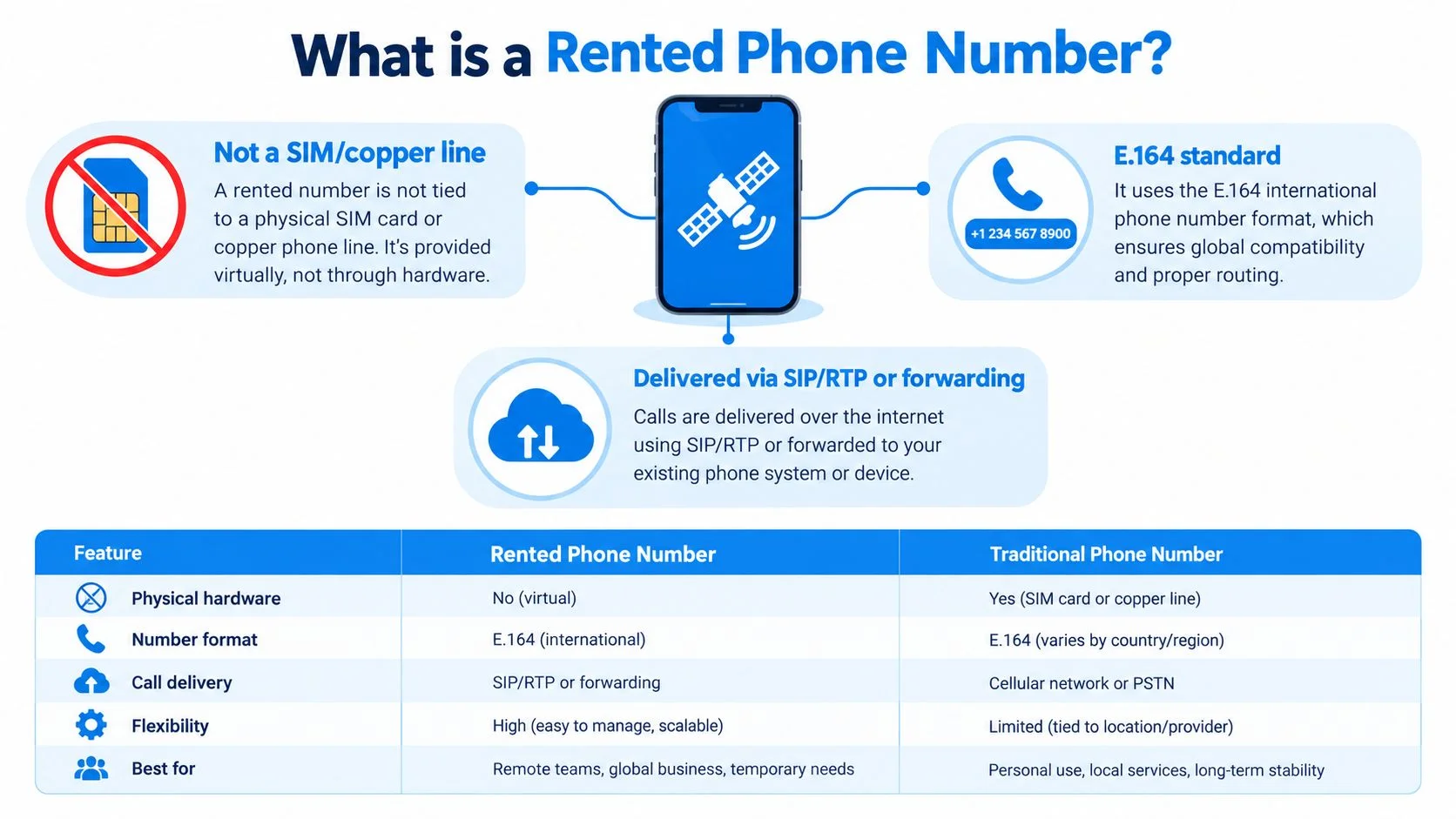
A rented phone number is not a physical line. It's a regulated E.164 numbering resource that gets delivered through software-based call routing, typically via SIP signaling and RTP media or by forwarding to another endpoint, as explained in this virtual phone number reference.

Think of it like a mailing address
The easiest analogy is a mailing address with forwarding.
People keep writing to the same address. Behind the scenes, mail gets redirected to wherever you are. A rented phone number works in a similar way. The public digits stay fixed, but the destination can change.
That destination might be:
- Another phone number you already use
- A browser or app endpoint
- Voicemail
- A call-handling workflow for a team
The number is the public identity. Routing is the hidden plumbing.
Why E.164 matters
E.164 is the global numbering standard for phone numbers. The ITU describes a portable number as an entire E.164 number subject to number portability in its portability supplement. The standard also limits international numbers to 15 digits, which matters because it keeps the number recognizable and standardized even when delivery happens over IP instead of copper or a SIM.
That's why a virtual number can still look and behave like a “real” number to callers. It is real. It's just not tied to one piece of hardware.
What virtual does not mean
Virtual does not mean unregulated.
National rules still apply. Depending on where the number is issued and used, you may have to complete identity verification, prove address or business presence, or meet emergency-calling and local numbering rules. That's where many buyers get surprised. They think they're renting software. In part, they are. But they're also using a telecom resource governed by local numbering policy.
Key idea: You're renting identity and routing, not a physical line.
Why this model has become normal
The market itself has grown far beyond a niche telecom feature. One estimate put the global virtual phone number for business market at USD 2.14 billion in 2025, rising to USD 2.32 billion in 2026 and projected to reach USD 3.84 billion by 2032 at a CAGR of 8.66%. Another estimate put the broader virtual phone number market at USD 8.2 billion in 2025, projected to reach USD 16.8 billion by 2034 at a CAGR of 8.9%, with cloud-based deployment at 72.3% share and Asia Pacific at 38.2% share, according to this market report summary. You don't need those figures to rent a number, but they help explain why this has become standard buying behavior.
Common Use Cases for Rented Numbers
A consultant publishes a work number on her site, answers it on her personal phone during business hours, and turns it off at night without changing the number customers know. A small support team in one country rents a local number in another because buyers are more likely to call a familiar area code. A traveler keeps one contact number active while the destination phone changes underneath.
Those situations look different on the surface, but they use the same underlying thing: a rented number as a stable public identity, while the routing behind it can change.

Five situations where rental makes sense
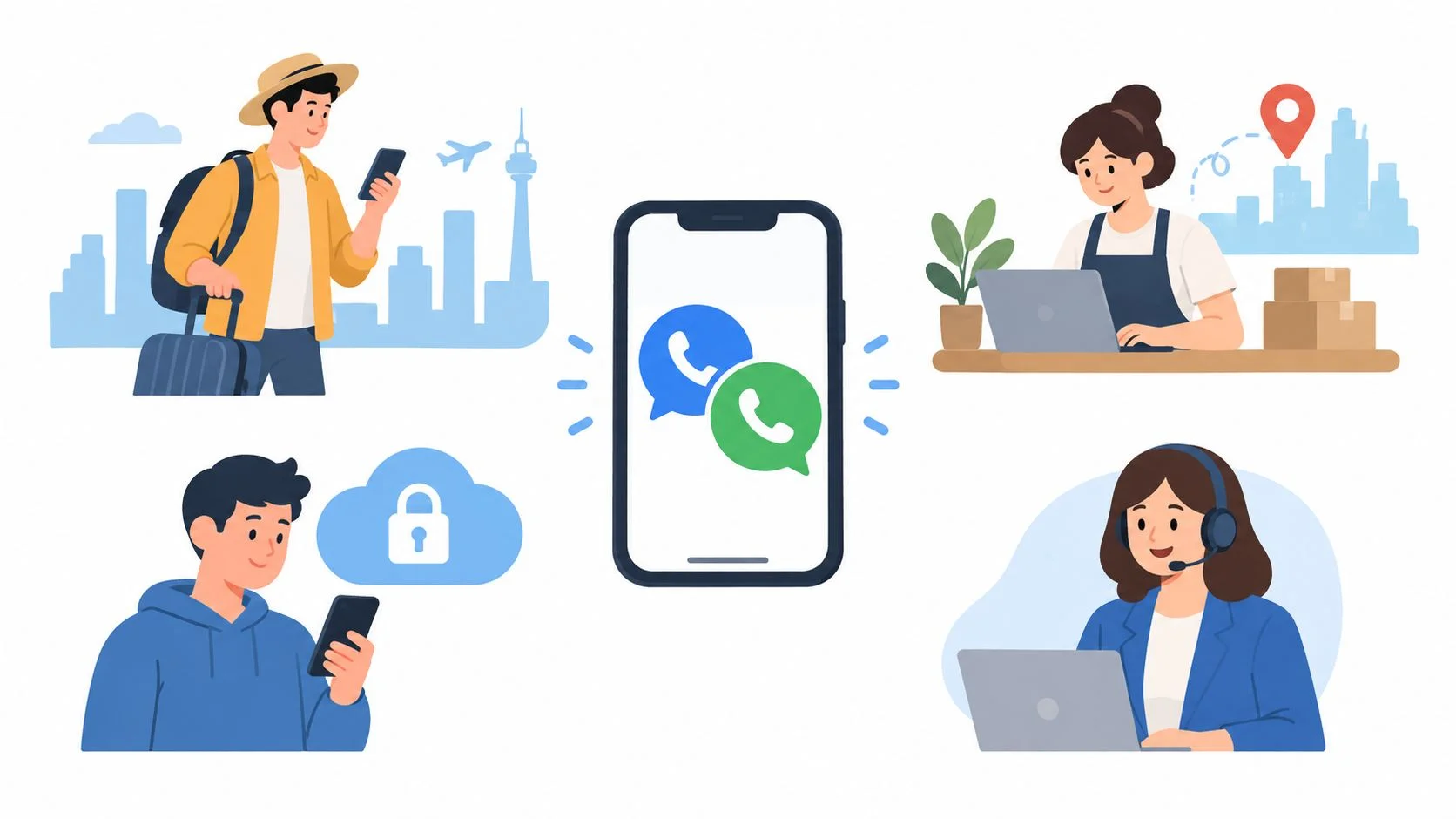
- A private second line: A freelancer can publish one number for clients and keep a personal mobile number private. The rented number becomes the front door. Calls can ring a personal phone, a desk phone, or voicemail depending on the schedule.
- A local business presence: A company can rent a number that matches the city or country its customers expect to reach. The team does not need to sit in that location. The number is local to the caller, while the answering workflow can be anywhere the provider allows.
- Travel or expat continuity: Someone who moves often can keep one number as a long-term identity. The handset, SIM, or forwarding destination may change. The number people saved in their contacts does not.
- Support and callback handling: A rented number works well when inbound calls should follow rules instead of one person's availability. Calls can ring a queue, go to voicemail after hours, or forward to a backup person if the first destination does not answer.
- Inbound verification or alerts: Some setups need a number mainly to receive one-time codes, appointment confirmations, or service alerts. In that case, receive-only SMS may be enough. The key question is simple: can the rented number accept inbound texts for your use case, and are there limits on message type, country, or sender?
The practical difference between a second SIM and a rented number is easy to miss. A second SIM gives you another device connection. A rented number gives you another public identity that can be pointed, redirected, paused, or replaced as your workflow changes.
Where buyers get tripped up
“Inbound” does not always mean the same thing across providers.
For voice, inbound may mean the number can receive calls, but the call still has to be routed somewhere and the minutes may still be billed. For SMS, inbound may mean the number can receive texts only, not send replies. For some plans, voicemail, forwarding, or multi-user routing are separate features rather than part of the base rental.
That is why the safest buying approach starts with the job you need the number to do. If the number is for ads, ask where calls ring and what happens after hours. If it is for verification texts, ask whether the plan supports receive-only SMS and whether short-code or app verification traffic is allowed. If it is for sales, a call is not always the only endpoint. Some teams get better results by offering both a phone option and meeting booking for inbound sales.
A quick product walkthrough helps make these use cases less abstract:
How Pricing and Billing Work
A rented phone number is usually billed like a parking space plus the traffic that uses it. You pay one recurring fee to keep the number assigned to your account, and you may pay separate usage charges when calls or messages pass through it.
That distinction matters because the number itself is only the public address. The cost of keeping that address active is different from the cost of routing live traffic to your chosen destination.
The two layers of cost
The first layer is the rental fee. The E.164 number is reserved for you during the billing period.
The second layer is usage. For voice, that often means inbound minutes. For some setups, forwarding, voicemail handling, or outbound calling are priced separately as well.
“Inbound included” is where buyers often get confused. It can mean the number is allowed to receive calls, not that every received minute is free. A provider may include number activation and basic receiving capability, then bill for the actual call time once someone rings the number and the platform routes that call.
How per-minute billing changes the real total
Many providers bill voice usage by the minute and round partial minutes up to the next whole minute. If a caller speaks for 20 seconds, the billed usage may still count as one minute. If a caller speaks for 1 minute and 10 seconds, the billed usage may count as two minutes.
That rule affects some workflows more than others.
- Short, frequent calls: Billing rounds up more often, so small calls add up faster.
- Longer conversations: The rounding effect is smaller relative to the full call length.
- Forwarded inbound traffic: You need to confirm whether the act of receiving and routing the call creates usage charges.
- Voicemail-first setups: Costs may look different from a team that answers every call live.
What to check on the rate sheet
For current country and number pricing, review the BubblyPhone rate table for number rental and usage.
A simple budgeting rule helps. Price the number, then price the behavior around the number. A low monthly rental can still become a poor fit if the number receives many short calls and each one is rounded for billing.
One more point is easy to miss. In many setups, you are not renting a phone line in the old carrier sense. You are renting a software-routed identity that stays assigned to your account for a period of time, with separate charges for what the platform does with the traffic attached to that identity. That is the clearest way to compare plans without overpaying.
Setting Up Your Number and Receiving Calls and SMS
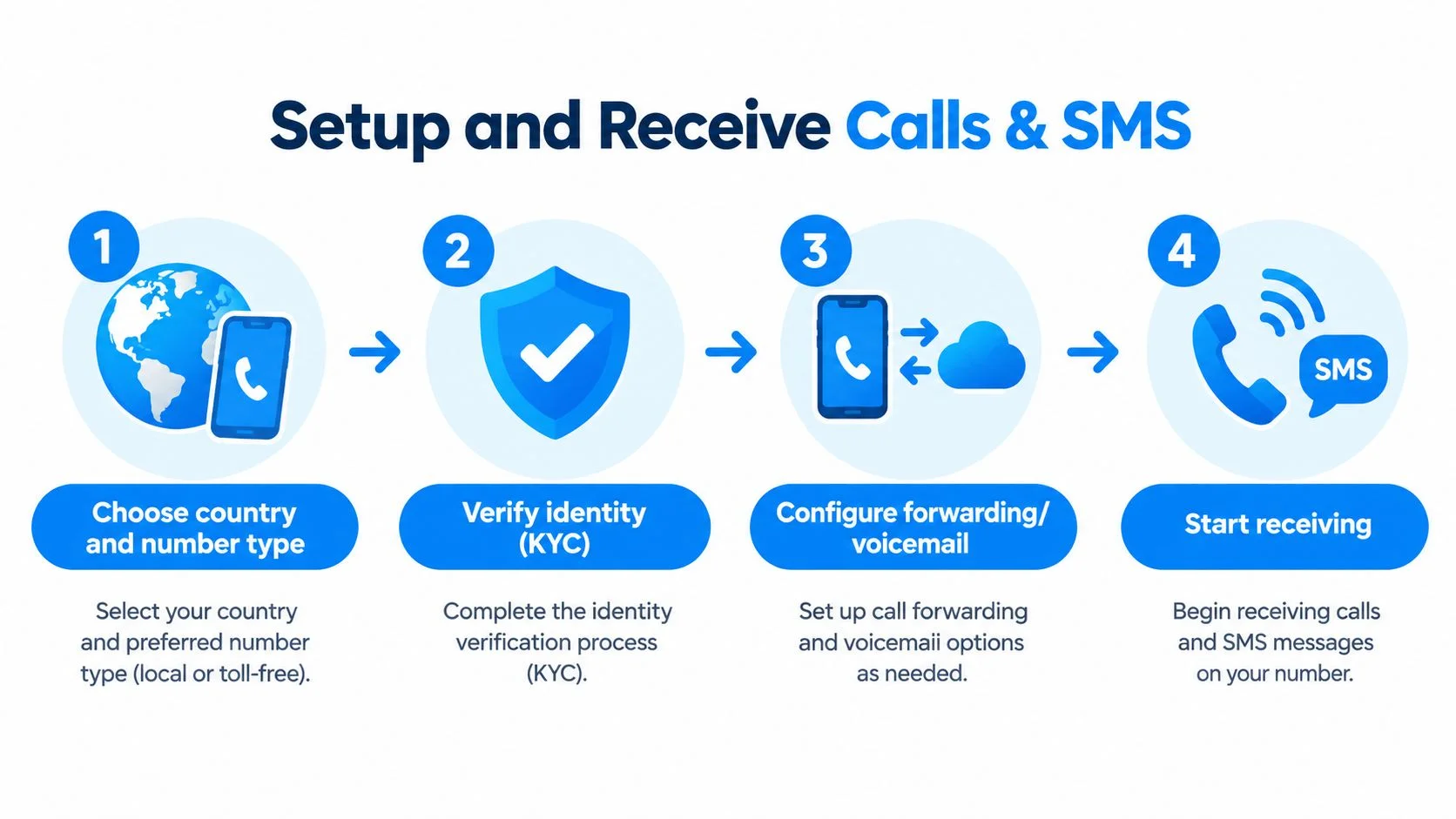
A rented number is ready only after it knows where to send traffic. The number is the public address. Your routing rules are the instructions behind the address, deciding whether a call rings your mobile, lands in voicemail, or enters a shared inbox. That is the practical setup job.

The basic setup flow
Start with the number itself. Pick the country and number type that match what callers expect to see. A local-looking identity may help people answer or call back, but it also has to match the provider's rules for that market.
Next comes verification. Phone numbers are regulated resources, so providers often ask for identity details, business documents, or proof of address before activation. Treat this more like opening a utility service than creating a casual app account.
Then set the handling rules. Choose where incoming calls should go, how long they should ring, what happens if nobody answers, and whether SMS can be received. Some numbers support voice only. Some support inbound SMS but not outbound texting. That distinction matters if the number will receive login codes, customer replies, or delivery alerts.
Test before you publish. Call from another phone, leave a voicemail, and send a message if SMS reception is enabled. A short test catches routing mistakes early, especially if calls are forwarded across countries or to different team members.
A practical getting-started reference is this guide on getting a US number.
What inbound usually includes
“Inbound” often sounds simpler than it is. It usually means the number can accept traffic and pass it into a rule set inside the platform.
That can include:
- Receiving calls: The number accepts incoming voice calls.
- Forwarding: Calls route to another phone number or destination.
- Voicemail: Unanswered calls can be stored with recordings for later review.
- Inbound SMS reception: The number can receive messages when that capability is enabled.
- Optional transcription: Voice messages or calls may be converted into text at added usage cost.
If you want broader context on how number rental fits into business calling and messaging workflows, this collection of unified communications topics covered is useful.
One practical example is BubblyPhone, which offers dedicated numbers that can receive inbound calls, forward calls, receive voicemail and SMS, and optionally add per-minute transcription. Keep one limit in view. SMS on dedicated numbers should be treated as receive-only unless the product documentation for your exact number and market says otherwise.
What happens after setup matters too
Numbers have a lifecycle. If you cancel one, it is usually removed from your account and held out of circulation for a period before it can be assigned again. Providers do this to reduce confusion from old contacts, delayed messages, or stale account links.
The safe habit is simple. If a rented number is tied to logins, support flows, or customer messages, remove those links before cancellation and confirm they are updated elsewhere.
A cancelled number is not just a billing change. It is also an identity change.
How to Choose the Right Rental Plan
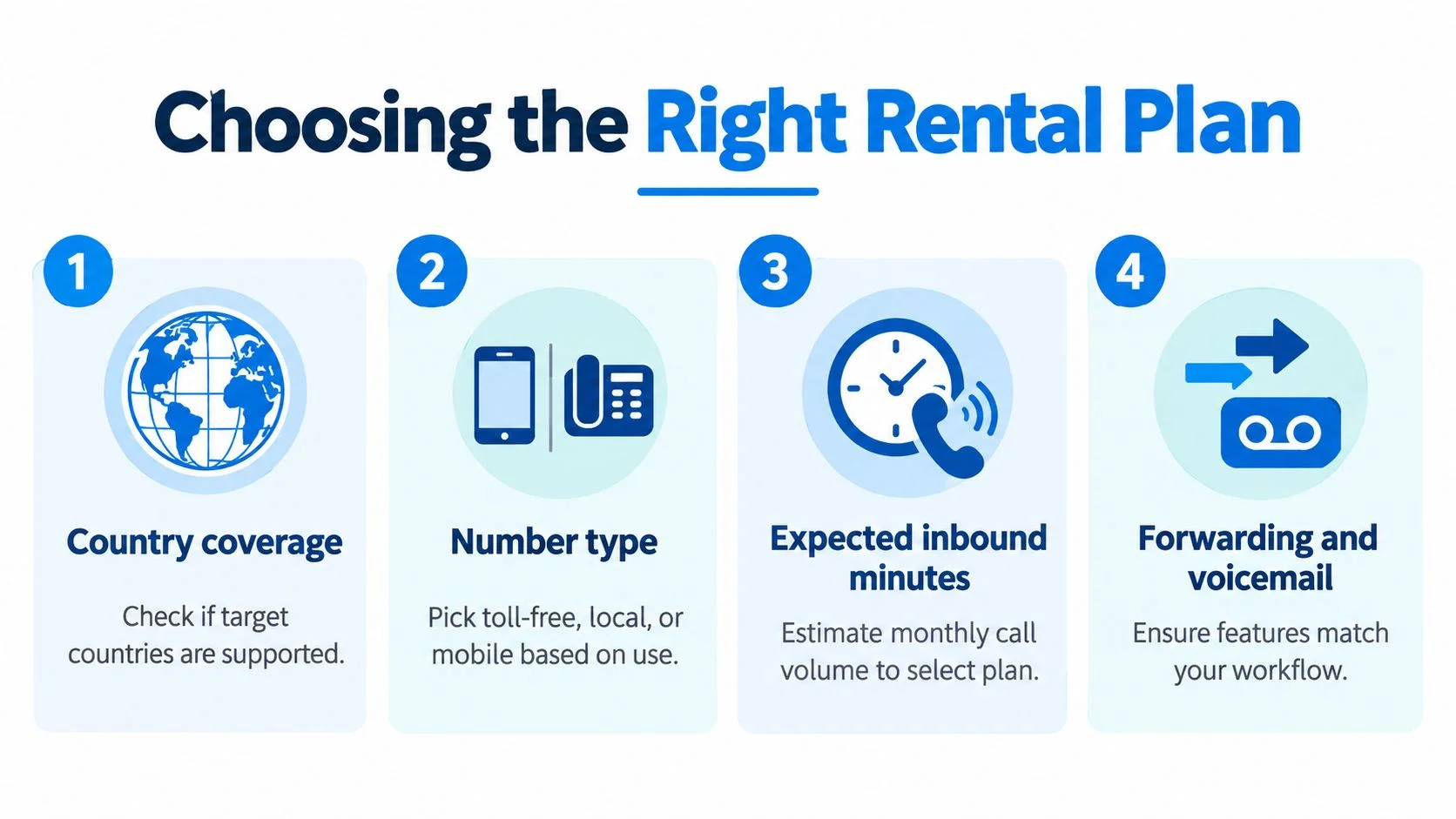
A good rental plan fits the job the number will do after setup. That sounds obvious, but people overspend. They shop for a phone number as if they are buying a permanent line with every feature attached, when they are really renting an E.164 identity that software routes and bills over time.

Start with the use case.
If the number will sit on a contact page and receive a few calls a week, you usually need a different plan than a number used for support, property inquiries, hiring, or account verification replies. The monthly fee is only one part of the cost. Usage, routing options, and message support often decide whether a plan stays affordable after the first bill.
A simple decision checklist
Ask these questions before you rent:
- Where should the number belong? Choose the country and, if relevant, the local area your callers expect to see.
- What kind of identity do you need? A local number, mobile-style number, or another format can affect both trust and availability.
- How much inbound traffic do you expect? A lightly used number and a busy reception number can have very different usage costs.
- What should happen when someone calls? Forward to one person, ring several destinations, send to voicemail, or use a simple queue.
- Do you need inbound SMS? Confirm that the number can receive messages, and treat SMS as receive-only unless your number documentation says more.
- Will you need records after the call? Voicemail storage or transcription can be useful, but they should solve a real workflow problem.
How to avoid overpaying
Two mistakes show up often. One is renting for the wrong geography because the broader option sounds safer. The other is paying for advanced handling before the number has proved it will be used enough to justify it.
A cheaper approach is to size the plan the way you would size a mailbox. First choose the address people need to reach. Then estimate how much mail will arrive. Only after that do you add extras for sorting and storage.
Use this order:
- Pick the exact country or local presence you need
- Estimate monthly inbound minutes conservatively
- Choose only the handling features you will use from day one
- Add voicemail, SMS reception, or transcription only when the workflow calls for them
As noted earlier, check the current rate table before you publish the number. Read the billing rules carefully, especially how inbound minutes are charged and rounded. A plan that looks inexpensive at the monthly level can cost more in practice if the number receives many short calls.
One final test helps. If you had to explain the number's job in one sentence, could you do it? “This number forwards new sales calls to my mobile.” “This number receives booking texts.” “This number collects voicemail after hours.” If the job description is vague, the plan usually is too.
Buy for the first real month of use. That is usually enough to choose well without paying for a larger setup you may never need.
Conclusion and Next Steps with BubblyPhone
Phone number rental is simpler once you strip away the telecom wording. You're renting a software-routed phone identity, not a separate physical line. The usual cost model is a recurring number fee plus rounded per-minute inbound billing, and the practical value comes from receiving calls and SMS, forwarding calls, and using voicemail without carrying another device.
If that's what you need, keep your selection process narrow. Pick the right country, confirm receive-only SMS if that matters, and check billing behavior before publishing the number.
If you want to put this into practice, you can make a call with BubblyPhone directly in any browser, and the person you call doesn't need an app or account. Credits start at $5 and never expire, so it's a practical fit if you want browser-based calling alongside an optional dedicated number.