What Are International Calls and How They Work in 2026
Table of Contents
- The formal definition in plain words
- Cases that look international but aren't
- Cases that don't look international but are
- The travelling recipient problem
- The handoff in plain terms
- Why quality problems usually start on your side
- Three failures and three different fixes
- How the main models feel in practice
- Roaming is a separate charge
- Why the number on your screen proves little
- Three steps for an unexpected call
An international call is a phone call that starts in one country and ends in another, decided by where the caller and recipient are, not by the device or network used. If you're on Wi-Fi at home calling a landline abroad, is that still international, and why can a call to the next country sometimes cost less than a call you make while you're travelling there?
Those questions trip people up because three ideas get mixed together. International describes the destination. Roaming describes using your own SIM outside its home network. Internet calling describes how your voice travels. Once you separate them, dialing, call quality, and billing become much easier to predict.
What an International Call Really Is
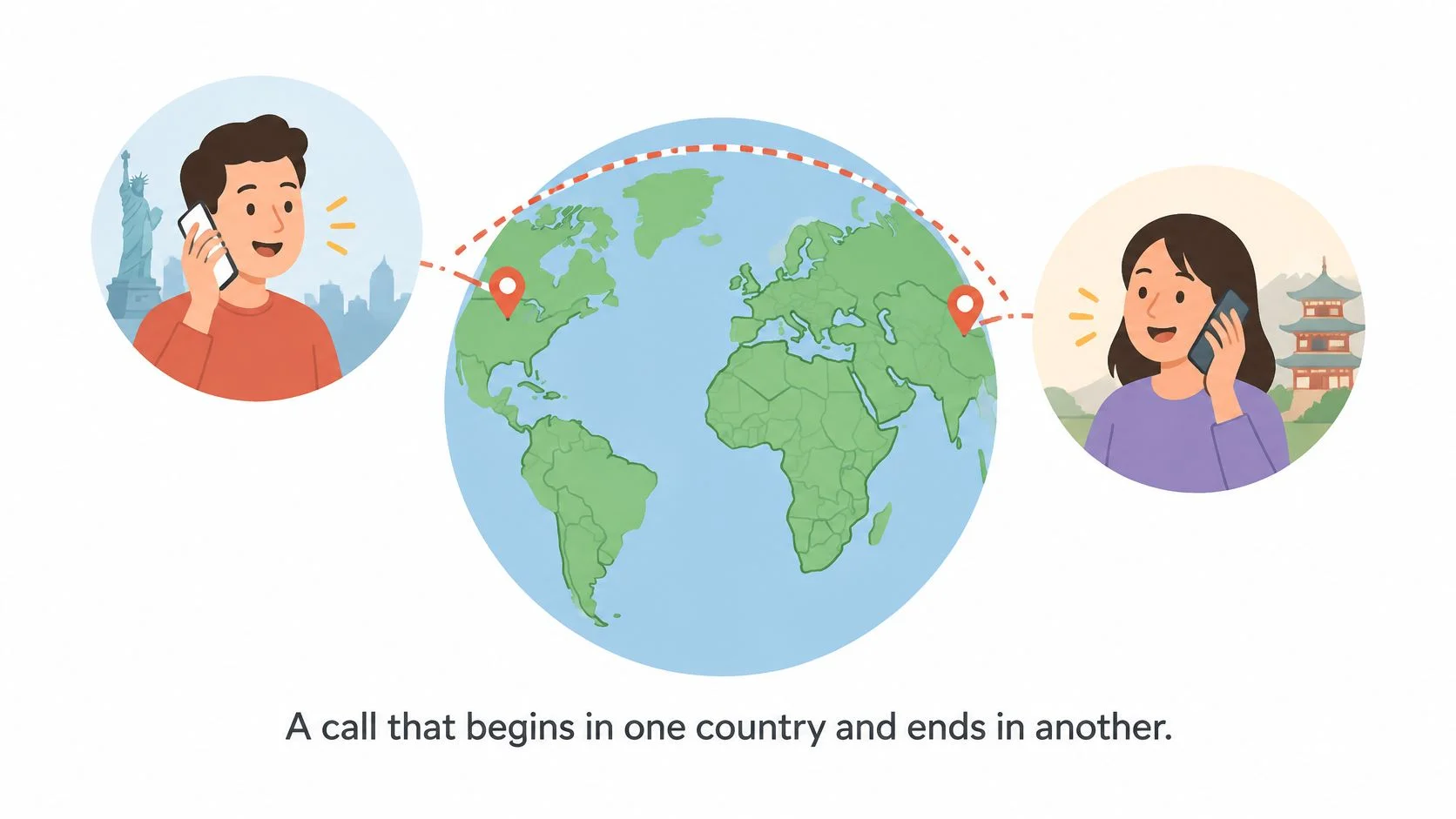
An international call is a phone call that starts in one country and ends in another. The technology doesn't decide the label. Your location and the recipient's location do.
Say you're in Chicago and you call your aunt's landline in Toronto. You could dial from a desk phone, a mobile, or your laptop browser. All three calls are international because the call starts in the United States and ends in Canada.

Think of a letter. It's international mail because of the address on the envelope, not because you used a particular pen or because a plane carried it part of the way. A phone call works the same way. The address is the phone number, and the country part of that address tells networks where the call has to go.
The formal definition in plain words
The International Telecommunication Union handbook on telecommunication data defines these calls as calls originating domestically and terminating abroad. That covers a call from a fixed geographic number to a foreign landline or mobile. For mobile traffic, it covers minutes that start on one country's mobile network and end on a network outside that country.
That wording matters because it separates two things readers often confuse. A domestic long-distance call can travel a long way, but both ends stay in the same country. An international call can be short in distance, such as across a nearby border, but it still crosses into another country's numbering and network system.
Counting these calls has also changed over time. Older statistics were built around traditional phone networks, and calls routed through private leased lines or the internet were sometimes recorded as national traffic. That doesn't change what happened between the two people. It only shows why old traffic totals don't always line up cleanly with newer ones.
Practical rule: Look at the country code of the number you're dialing. If it belongs to a different country from where you are, the call is international.
That's the test to use before you think about apps, Wi-Fi, or price. Answering what are international calls starts with that simple location check. Everything else, including how the voice travels and who pays, is a second question.
Which Calls Count as International
A call counts as international whenever the number you dial, or the caller's and recipient's locations, sit in different countries. Changing the device or connection doesn't change that result.
Cases that look international but aren't
Distance alone doesn't make a call international. Ohio to California is far, but both numbers are in the United States, so it's domestic long distance. A call across a city, a region, or a state stays domestic as long as both endpoints remain in one country.
The reverse also happens. Two towns can sit close together on opposite sides of a border. A call between them may travel only a short distance, yet it's international because the numbers belong to different countries.
Cases that don't look international but are
A browser call can feel like ordinary internet use because you're sitting at home on Wi-Fi. If you're in Canada and the mobile number is in Mexico, it's still an international call. The phone at the other end rings on a Mexican network, and the call has to be handed to that network to reach it.
The same logic applies to a bank, a government office, or a relative's landline abroad. You're calling a foreign phone number, not just opening a chat with someone who happens to be online. If both people use accounts in the same messaging service and no phone number is dialed, that's a service-to-service call, which is a different situation from calling a landline or mobile number in another country.
If a real phone number in another country rings, treat the call as international even when you started it from a browser.
The travelling recipient problem
Here's where people get caught out. Say you and your friend both have United States numbers. You're at home and your friend is visiting Japan. When you dial the usual US number, you're placing a domestic call from your side because both numbers share the same country code.
Your friend's phone, though, is roaming in Japan. Their plan may charge them for receiving that call abroad. So one call can be domestic for the caller and a roaming event for the recipient at the same time.
Now reverse it. You're the traveller in France using your home SIM to call the United States. You're making an international call and you're also roaming. Those are two separate facts, and they can lead to two separate kinds of charges.
Before you dial, write down three things. Note your country, the recipient's country, and whether either phone is roaming. That quick check tells you how to classify the call and alerts you to check billing for the person who might pay unexpectedly.
How to Dial Any Country Correctly
To dial a number in another country, replace your local exit code with a plus sign, add the destination country code, and drop the domestic trunk prefix. The result is the standard international format that works from almost anywhere.

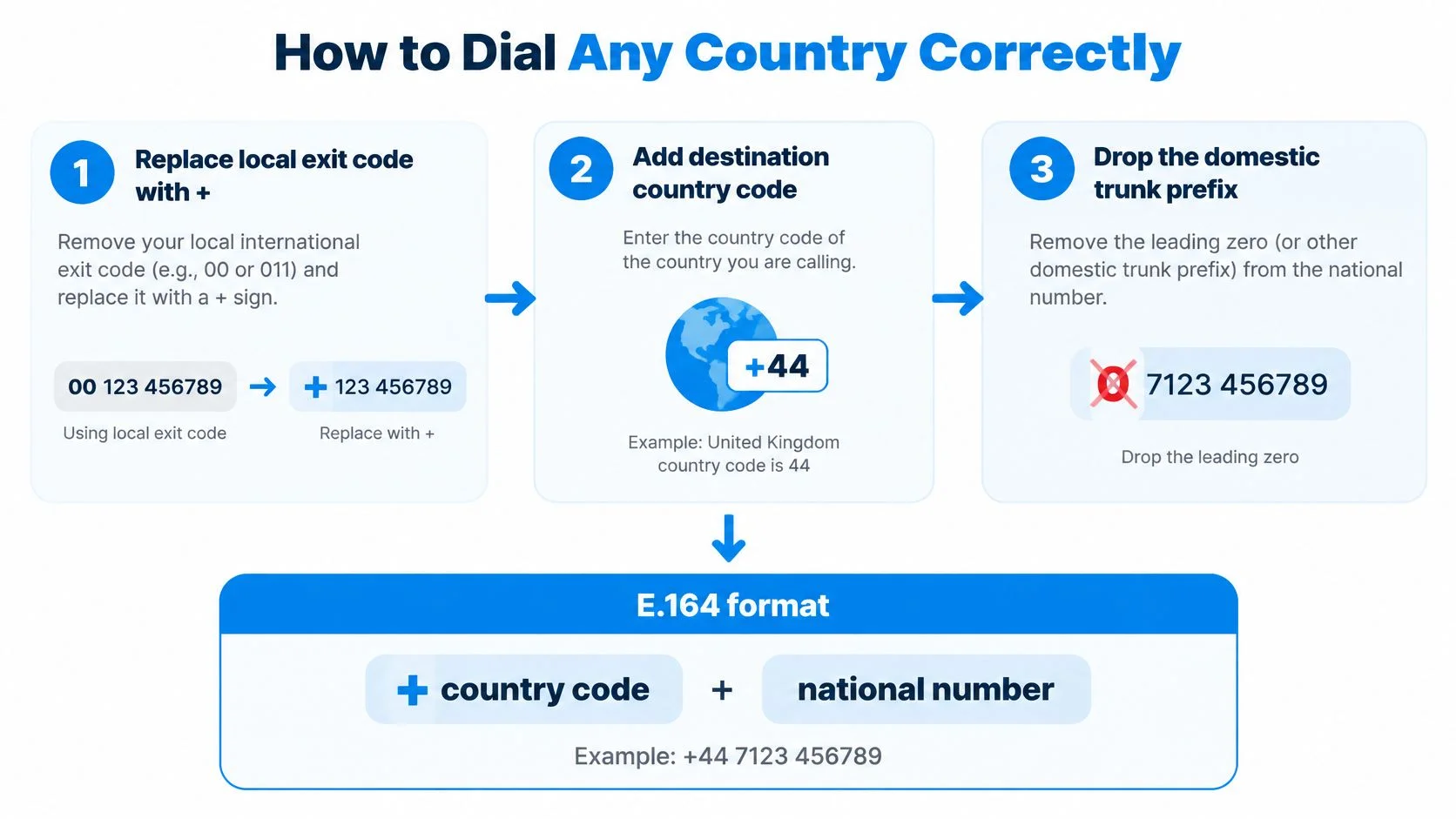
The global format is called E.164. The ITU-T E.164 numbering recommendation structures it as country code, then national destination code, then subscriber number, with geographic numbers limited to a maximum of 15 digits, excluding the international dialing prefix. Networks read the country code first to choose a route, which is why the format has to be clean.
- Replace your exit code with a plus sign: On most phones, press and hold 0 to type +. The plus works from any country, so you don't need to remember whether the local exit code is 011, 00, or something else.
- Add the destination country code: Use the code for the country you're calling, such as 44 for the United Kingdom or 49 for Germany. If you're unsure, check it against a complete list of country codes before you dial.
- Drop the national trunk prefix: Many countries use a leading 0 for domestic dialing. Don't keep that 0 after the country code. Keeping it is one of the most common reasons an international call fails.
- Count the digits: The full number after the plus sign must stay within 15 digits. If yours is longer, you've probably kept a trunk prefix or added an exit code by mistake.
- Check the number type: Work out whether you're calling a landline or a mobile. Destinations can price them differently, and the number range often tells the network which type it is.
- Save the contact in plus format: Store it once as + followed by the full number. It'll then work from any country and any device without editing.
This short video walks through the same dialing sequence visually, which helps if the trunk prefix step still feels unclear.
A masked example looks like this: +44 7XXX XXXXXX. The 44 leads, and the national number follows without its domestic 0. In a browser dialer, you can usually pick the country or paste the plus-format number, and the service normalizes it before routing. Correct normalization prevents failed calls from omitted country codes and supports accurate destination-based billing.
How the Call Reaches a Foreign Phone
A traditional international call travels over circuit-switched national networks joined at interconnection points, while an internet-based call sends your voice as data packets until a gateway hands it to a phone network near the recipient. Either way, the recipient's phone rings like any other call and needs nothing installed.
The handoff in plain terms
With a traditional call, your local network reads the country code, passes the call across an international interconnect, and the destination network delivers it to the phone. A dedicated circuit path is held open for the conversation. That model is predictable, but it depends on line condition and capacity between networks.
With an internet-based call, your browser turns your voice into packets and sends them over your broadband or mobile data connection. The service reads the country code, selects an available route through enterprise-grade global carriers, and converts the audio at a gateway so it can enter the destination's fixed or mobile network. The ITU-T E.164 recommendation on international numbering underpins the number parsing that lets systems identify the destination before selecting that route.
That final handoff is the key point. This isn't only two browsers talking to each other. The call leaves the internet and terminates on a real telephone network, which is why a grandmother with a basic landline can answer without an app, an account, or a smartphone.
Why quality problems usually start on your side
For internet-based calling, your own connection does most of the damage or most of the good. Weak Wi-Fi, a congested mobile signal, or a overloaded home router can cause delay, choppy audio, and dropped words. The technical names are latency, jitter, and packet loss, but the fix is practical. Move closer to the router, switch from weak mobile data to stable Wi-Fi, and close heavy downloads during the call.
Route quality also matters once the call leaves your connection. Congestion, codec negotiation, and gateway conversion can affect clarity and whether the call completes. You can't control those directly, but you can separate them from problems you can fix. If every call sounds poor from one room and fine from another, your local connection is the likely cause.
Three failures and three different fixes
- Invalid number: The country code is wrong or missing, or you've kept a trunk 0. Check the number in plus format and dial again.
- Busy or no answer: The route worked, but the person or line isn't available. Wait and try again, and check the time difference first.
- Route temporarily unavailable: The destination can't be reached on the selected route right now, or the attempt times out. Retry after a short pause so the service can select another route.
Keeping those categories separate saves time. A numbering error won't heal itself on a retry, while a busy line doesn't mean you typed the wrong number. On your side, browser calling needs only a modern browser, a microphone, and a stable connection. Destination pricing still differs by country because termination resources, regulation, and mobile versus fixed routing costs differ by number range.
How International Calls Are Billed
International calls are billed by the minute at a rate that depends on the destination, the number type, and the billing model you use. The model matters as much as the destination, so compare how each one charges before you rely on it.
How the main models feel in practice
With pay-as-you-go prepaid credit, you add a balance first and each call deducts a per-minute charge from it. You can see spending directly and you aren't paying a monthly fee for minutes you may not use. Check the rounding rule, because a call that runs just past a minute boundary may be charged for the next started minute.
A monthly bundle can suit people who call the same covered countries often. The trap is coverage. An allowance may include landlines in some countries but exclude mobiles, premium ranges, or other destinations entirely, and calls outside the allowance revert to per-minute charges. Our guide to how international calling rates are explained breaks down why destination and number type change the price.
A mobile plan add-on is convenient because it sits on the bill you already pay. It can still cost more per minute than a standalone service, and the headline price may apply only to selected destinations. Read the destination list and number-type rules, not just the monthly add-on price.
Roaming is a separate charge
International calling is not roaming. Ofcom guidance on bills and charges explains that roaming happens when you use a mobile phone abroad through a visited network, while international calling generally means calling a number registered in another country from your current network or internet connection. Ofcom warns that roaming can create additional charges and advises travellers to check their package or contact their provider before going overseas.
So a caller at home may pay an international-call charge. A traveller abroad may pay roaming charges for using the phone itself, on top of the cost of reaching the destination. A recipient who's roaming may also pay to receive the call, depending on their plan. That is why asking who pays matters on both sides, not only on the caller's side.
An apparently simple call can involve two bills. Always ask which side is roaming before a long conversation.
Before any long call, ask three questions. Which rate applies to this exact destination and number type? Who pays if the recipient is abroad? Does a connection fee apply, and how is time rounded? With BubblyPhone, calling is billed per minute and rounded up to the whole minute, with no connection fees, and no subscription is needed for calling. The only recurring product is the optional dedicated-number plan.
One-Ring Callbacks and Unknown Foreign Numbers
Don't return a missed call from an unknown international number until you've checked it, because the callback can lead to large per-minute charges. A one-second ring can be a trap, not a genuine attempt to reach you.
The FCC guide to the one-ring phone scam describes callers who use international numbers or spoofed caller ID to prompt a callback. The callback may connect to a number outside the United States and lead to a connection fee plus significant per-minute charges while you're kept on the line. Those charges may appear on your bill as international, toll-calling, or premium-service fees.
Why the number on your screen proves little
Caller ID can be spoofed. A scammer can falsify the information sent to your display, so the call may look local, familiar, or as if it comes from an organization you trust. A foreign-looking number doesn't prove the caller is in that country, and a local-looking number doesn't prove they're nearby.
That cuts both ways. A relative travelling abroad, a bank's overseas support team, or a supplier in another country may legitimately show an unfamiliar international number. If you get a suspicious missed call from a code you don't recognize, our explainer on a missed call from the +62 country code shows how to check the origin before you react. The safe response isn't to trust or distrust the display. It's to verify through a channel you choose.
Three steps for an unexpected call
- Don't answer or call back yet: Let an unfamiliar international number go to voicemail. A genuine caller who needs you can leave a message or reach you another way.
- Find the official number yourself: Search the number, or take the organization's number from its statement or official website and call that instead. Don't use a number the caller gives you during the suspicious call.
- Protect your credentials: Never give account numbers, passwords, or PINs during an unexpected call. Hang up and verify independently if the caller pressures you to act quickly.
There's an honest trade-off. Blocking all international callers reduces scam exposure, but it can also stop legitimate calls from relatives, banks, pension services, or suppliers abroad. Suppressing or hiding caller ID can make your own legitimate calls less likely to be answered too.
If you never need to dial abroad from a particular line, ask your phone provider to block outgoing international calls on it. That removes the most expensive callback risk while still letting you use a separate browser-based service when you deliberately want to place an international call.
Confirm the Number and Make Your First Call
You can place an international call from a browser by entering the full number with its country code and pressing call. Confirm the number first, then follow four short steps.

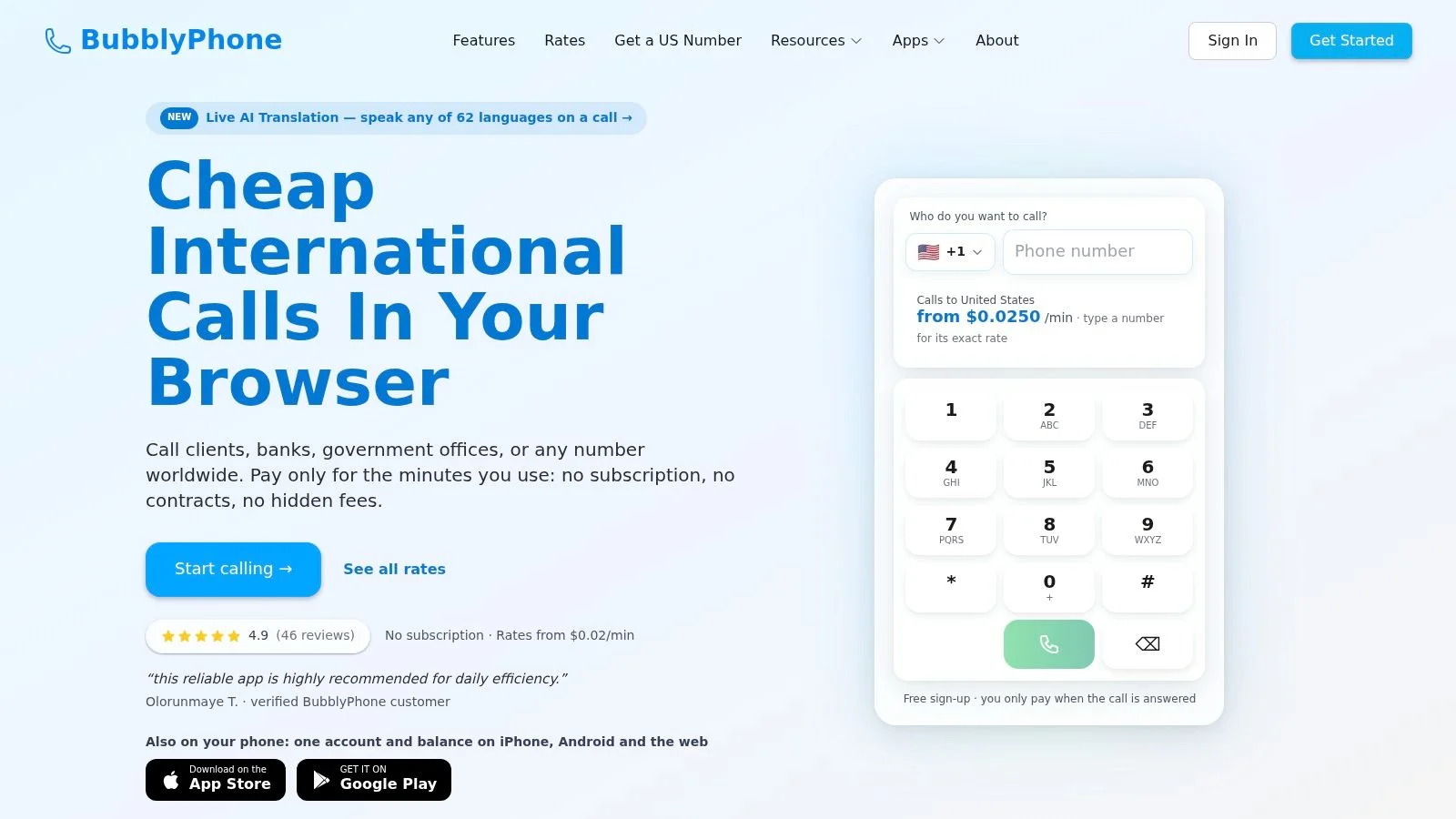
- Confirm the plus format: Check that the number starts with + and the right country code, with no domestic trunk 0 after it.
- Open the dialer in a modern browser: Use a laptop, tablet, or phone. You don't need a SIM card, an extension, or your mobile carrier's international settings.
- Enter the number and check the rate: Review the destination price on the current international rates page before you dial, so the landline or mobile cost is clear upfront.
- Top up and press call: Add prepaid credit, then place the call. Calls can reach phones in 222 countries by typing a number and pressing call.
The person you call needs no app and no account, and the call works with any landline or mobile. Calling is pay as you go, billed per started minute with no connection fees, and there's no subscription for calling. The only monthly charge is an optional dedicated US number for people who need to receive calls. On dedicated numbers, SMS is receive-only.
Do the one check that prevents most failures. Confirm the country code, remove any stray trunk 0, and make your first call.
Ready to call a landline or mobile abroad without asking the other person to install anything? BubblyPhone works in any browser, the person you're calling needs no app or account, and credits start at $5 and never expire. Confirm the country code, enter the number, and press call.