How to Call New Zealand from the USA (2026)

Table of Contents
- Copy first, then convert
- Understand what each part does
- Make the first attempt easy to check
- Geographic and mobile prefixes identify different things
- Service numbers need a separate decision
- Choose the recipient's window first
- Keep Chatham contacts separate
- Change one thing per attempt
- Separate ringing problems from audio problems
- Check the cost before connecting
- Keep the first call straightforward
From a US landline, dial 011 64 and the New Zealand number with its leading 0 removed; from a mobile or browser, use +64 instead of 011. Keep every other digit in the number.
You might have a relative's number saved exactly as they sent it, or a New Zealand office number copied from an email signature. Before you call, check whether it's an ordinary mobile or landline, and whether the person is awake. A domestic prefix left in place or a freephone number closed to overseas callers can stop an otherwise correctly dialed call.
Dial New Zealand From the USA Step by Step
A conventional US phone uses the international access code, New Zealand's country code, and the destination number without its domestic leading zero. The FCC's international calling guide identifies 011 as the US international access code and explains that the destination country code, area code, and telephone number follow it.
For the finished example, a domestic Auckland number written as 09 475 0201 becomes 011 64 9 475 0201, using New Zealand's country code +64 identified in the ITU's numbering publication. On a mobile or browser dialer, the equivalent is +64 9 475 0201.
How to dial New Zealand from the USA
Copy first, then convert
- Copy the complete number. Start with the contact's original message or the organization's contact page. Keep the original nearby so you can compare it with what you enter. If there's an extension, set it aside rather than attaching it to the main number.
- Choose your starting format. A conventional US landline starts with the US international access code. A mobile or internet dialer generally uses the plus sign. These are alternative ways to begin an international call, not ingredients to combine.
- Remove only the domestic leading zero. For a hypothetical mobile number,
021 123 4567becomes+64 21 123 4567. Don't delete zeros from the middle or end. A domestic prefix such as020becomes the international start+64 20, but that prefix alone isn't a complete phone number. - Put the country code before the remaining number. If the contact already sent a correctly formatted international number, leave it in international format. Don't add another country code or another international access prefix.
- Clean up the entry. Remove brackets, spaces, and dashes if the dialer rejects them. Keep the initial plus sign when using international format. Don't paste labels such as “mobile,” an extension marker, or a pause character into the main destination field.
- Check the destination before calling. In a browser dialer, select New Zealand or paste the international number, according to the field's instructions. If the country selector already supplies the code, check that you haven't added it again.
The most useful check is a side-by-side comparison. Ignore the removed domestic prefix and compare the remaining digits from left to right. This catches a copied digit or accidental deletion more reliably than repeatedly looking at the finished number.
Practical rule: Remove the domestic prefix, not every zero you see.
Understand what each part does
The access prefix tells a conventional US telephone service that you're placing an international call. The country code identifies New Zealand. The remaining digits identify the destination within New Zealand's numbering system.
That distinction explains why keeping the domestic zero causes trouble. It belongs to the domestic dialing format, not immediately after the country code in an ordinary internationally formatted landline or mobile number.
You may also see a contact written with a zero in brackets after the country code. For an international call, treat that bracketed zero as a domestic-format reminder, not a digit to dial. If the notation is unclear, ask the recipient to send the number in international format.
For a hypothetical Wellington number, 04 123 4567 becomes 011 64 4 123 4567 from a conventional US phone or +64 4 123 4567 from a mobile. These examples demonstrate conversion; they aren't test destinations.
Make the first attempt easy to check
Save the converted number with the contact's name and city. If you regularly switch between a mobile and browser calling, the international format is easier to reuse than a saved US-landline access sequence.
Don't add digits to make the number resemble a US phone number. Don't shorten it because it looks unusually long, either. Different New Zealand services use different number formats.
Let the call ring rather than hanging up immediately because setup feels slower than a domestic call. International call setup can take several seconds before you hear ringing.
If an organization requires an extension, wait for the main line or automated menu to answer before entering it. A correctly formatted main number and an extension serve different purposes, and combining them can make a dialer reject the destination.
New Zealand Prefixes and Number Types
The digits after +64 tell you what kind of New Zealand number you're calling. For a standard landline or mobile, drop the domestic leading zero and keep the remaining area or mobile digits.
New Zealand numbering information in the ITU's national numbering-plan document allows national numbers of 3 to 14 digits, excluding the country code, across geographic, mobile, freephone, premium-rate, and special-service ranges. Number length alone can't confirm that every type is reachable from overseas.
New Zealand prefixes and what to dial
The sample subscriber digits below show formatting only. They are not numbers to call.
Geographic and mobile prefixes identify different things
A geographic prefix points to the broad area associated with a landline. A mobile prefix identifies a number range; the person's current city can differ.
The X in the mobile pattern is a placeholder, not a digit to dial. Copy the actual mobile digits your contact provides. For example, 027 555 0188 becomes +64 27 555 0188 in international format.
For a quick reference on the international format, see this New Zealand country-code guide.
Service numbers need a separate decision
Freephone numbers such as 0800 and 0508 are designed for eligible callers, and the organization may offer a separate number for callers abroad. Premium-rate 0900 numbers can carry a premium charge, so use one only if you intend to reach that service and accept its charges.
A number can be correctly written and still fail from overseas because its service type has different access rules. See the troubleshooting table in Calls That Fail and How to Fix Them for what to check.
When New Zealand Is Awake
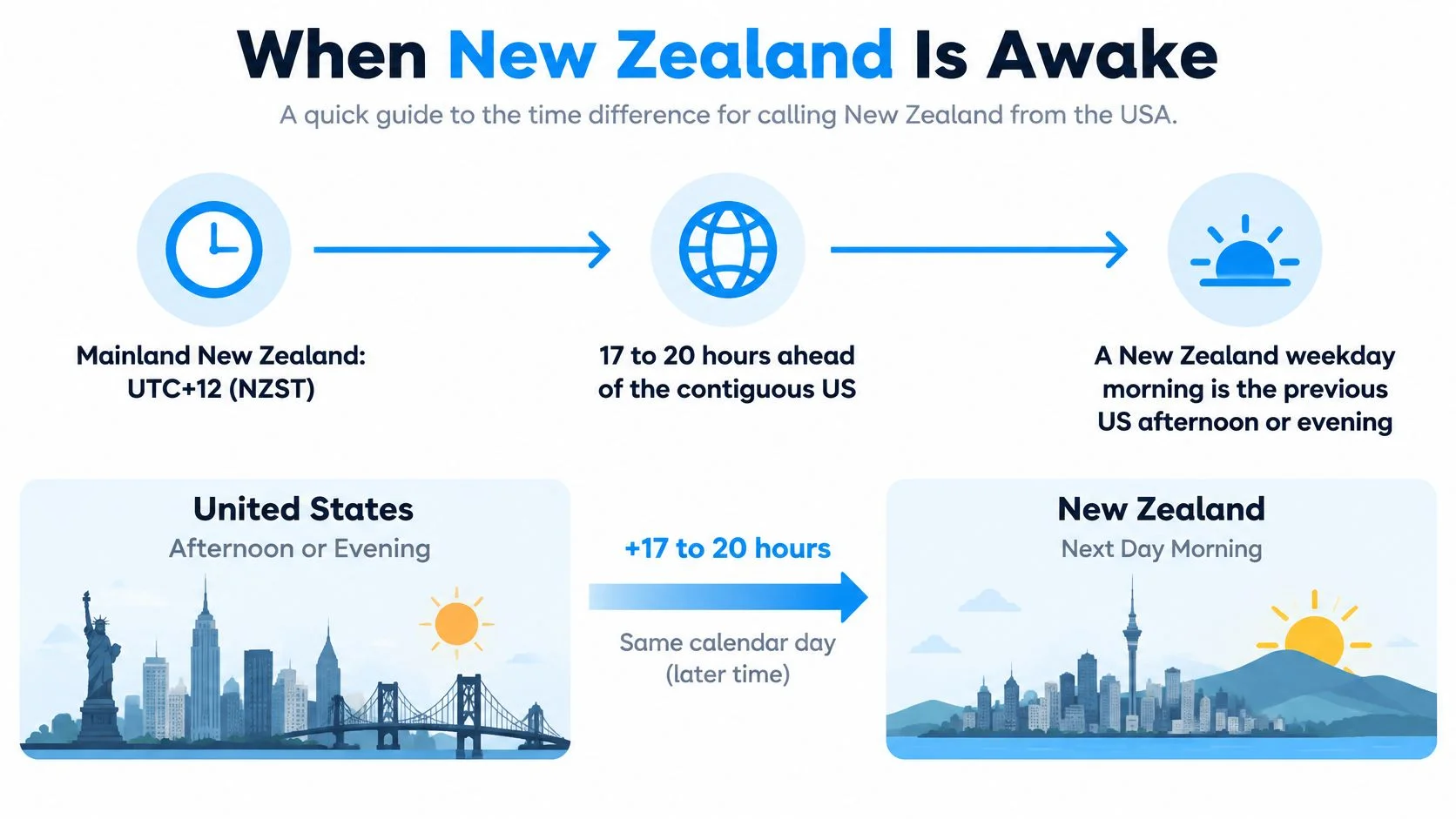
New Zealand is well ahead of the US, so a New Zealand weekday morning generally falls on the previous US afternoon or evening. Check the recipient's city and the calendar date before calling, not just the hour.
For a worked January example, assume Auckland is on daylight time and New York is on Eastern Standard Time. Noon in Auckland is then 6:00 p.m. the previous day in New York, or 3:00 p.m. the previous day in Los Angeles.
Use the visual comparison as a reminder to check both clocks and both dates.

Choose the recipient's window first
For that same January scenario, an Auckland evening window of 7:00 to 9:00 p.m. would mean 1:00 to 3:00 a.m. Eastern. That's usually an awkward choice for the US caller.
Reverse the arrangement for a family call: 7:00 to 9:00 p.m. Eastern becomes 1:00 to 3:00 p.m. the next day in New Zealand. Confirm that the recipient is available rather than assuming an afternoon is convenient.
Business calls require a weekday check too. A New Zealand office's Monday opening falls on Sunday in the US, so waiting until your own Monday may miss the recipient's intended workday.
According to the New Zealand government's daylight-saving guidance, mainland New Zealand uses UTC+12 in standard time and UTC+13 in daylight time; daylight saving begins at 2:00 a.m. on the last Sunday in September and ends at 3:00 a.m. on the first Sunday in April. The guidance also identifies the Chatham Islands as 45 minutes ahead of the mainland.
New Zealand and US time offsets
Keep Chatham contacts separate
Don't use an Auckland clock for someone in the Chatham Islands. Save the contact with a city or island label so you select the right location when scheduling.
US and New Zealand daylight-saving changes don't line up. Use our Best Time to Call tool for the actual date rather than relying on a memorized gap.
Confirm an appointment with the weekday, date, time, and recipient's location.
For another way to follow the calling process, watch this walkthrough.
Calls That Fail and How to Fix Them
When a call fails, check for the domestic zero left after the country code before blaming the network. Then test an ordinary landline and mobile to distinguish a destination-specific problem from a broader calling issue.
Some numbers look valid but won't connect from abroad. The ITU's internationally dialable numbering plan lists 0508 and 0800 service groups with international reachability subject to agreement, so correct formatting alone doesn't guarantee access.
New Zealand call problems and the next test
Change one thing per attempt
Start with the number exactly as supplied by the recipient. Compare the converted entry against it, then remove extension text and formatting characters before retrying.
Next, call a known geographic landline and a known mobile, with the recipients' permission. If those connect but an organization's service number doesn't, ask the organization for a different contact number instead of repeatedly changing your dialing format.
If neither ordinary destination connects, check the account balance and whether the selected route is available. A failed call to every destination points you toward account or connection checks, not repeated edits to a confirmed contact number.
Our call-failure troubleshooting guide can help you work through those checks without changing several settings at once.
Separate ringing problems from audio problems
Ringing without usable audio calls for a different test than a rejected number. Check that the browser has microphone permission, the correct microphone is selected, and the headset isn't muted.
Try another supported browser if permission appears correct. On a locked-down office network, switch to a home connection or phone hotspot to test whether the network is blocking call audio.
- Only the recipient can hear you. Check your speaker output and headset selection.
- Only you can hear the recipient. Check your microphone, browser permission, and local network.
- The call ends soon after connection. Check available credit before treating it as a destination problem.
- A premium destination keeps failing. Stop retrying and obtain an ordinary contact number.
For support teams, log the symptom separately from the conversation outcome. A rejected destination, an audio fault, and a completed conversation need different follow-up actions; SignalZen's guide to average handle time is useful context when reviewing how those interruptions affect customer-support workflows.
Repeated redialing rarely fixes a restricted service number. Once you've confirmed the format and isolated the destination, the useful next step is another number for the person or office.
Place the Call With BubblyPhone
A New Zealand number can look ready to dial and still fail if its domestic leading zero remains. Use the international format you prepared in Step 1, then check the destination's rate before calling.
With BubblyPhone, you can call a regular New Zealand landline or mobile through a browser dialer. The person receiving the call uses their existing phone, with no app or account needed.
Check the cost before connecting
Calling is pay as you go, with no calling subscription. Calls are billed per minute and rounded up to the nearest whole minute. Credits start at $5 and never expire.
Check the live New Zealand calling rates for the number type you're calling. A mobile and a geographic landline may have different rates, so check the specific destination rather than assuming one price applies to every call.
An optional US phone number is a separate product. You don't need one to place an outbound call to New Zealand.
Keep the first call straightforward
If you're traveling outside the US, you can still call a New Zealand contact from a browser. Before connecting, allow microphone access and check that your headset or speakers are ready. During the call, confirm that you can both hear clearly.
A standard landline or mobile is a better test than an organization's restricted service number. Numbers beginning with 0800 or 0508 may not accept calls from overseas, even when the digits are correct. If one fails, ask for an ordinary geographic or mobile number instead.
The recipient's local time matters too. Chatham Islands time is 45 minutes ahead of mainland New Zealand, so check which part of the country they're in before choosing when to call.
Call a New Zealand landline or mobile with BubblyPhone from a browser. The person you're calling needs no app or account. Credits start at $5 and never expire.