Phone Forwarding Number Explained and How to Get One

Table of Contents
You've switched phones, crossed a border, or started taking business calls from a second location, but your callers still need one dependable number. A phone forwarding number gives you that stable identity by accepting incoming calls on one number and routing them to another phone, wherever you are.
That sounds similar to turning on call forwarding in your phone settings, but the distinction matters. Basic carrier forwarding changes where calls to your existing line ring. A dedicated forwarding number is a separate communications identity that can remain yours while you change devices, destinations, or locations.
What a Phone Forwarding Number Is
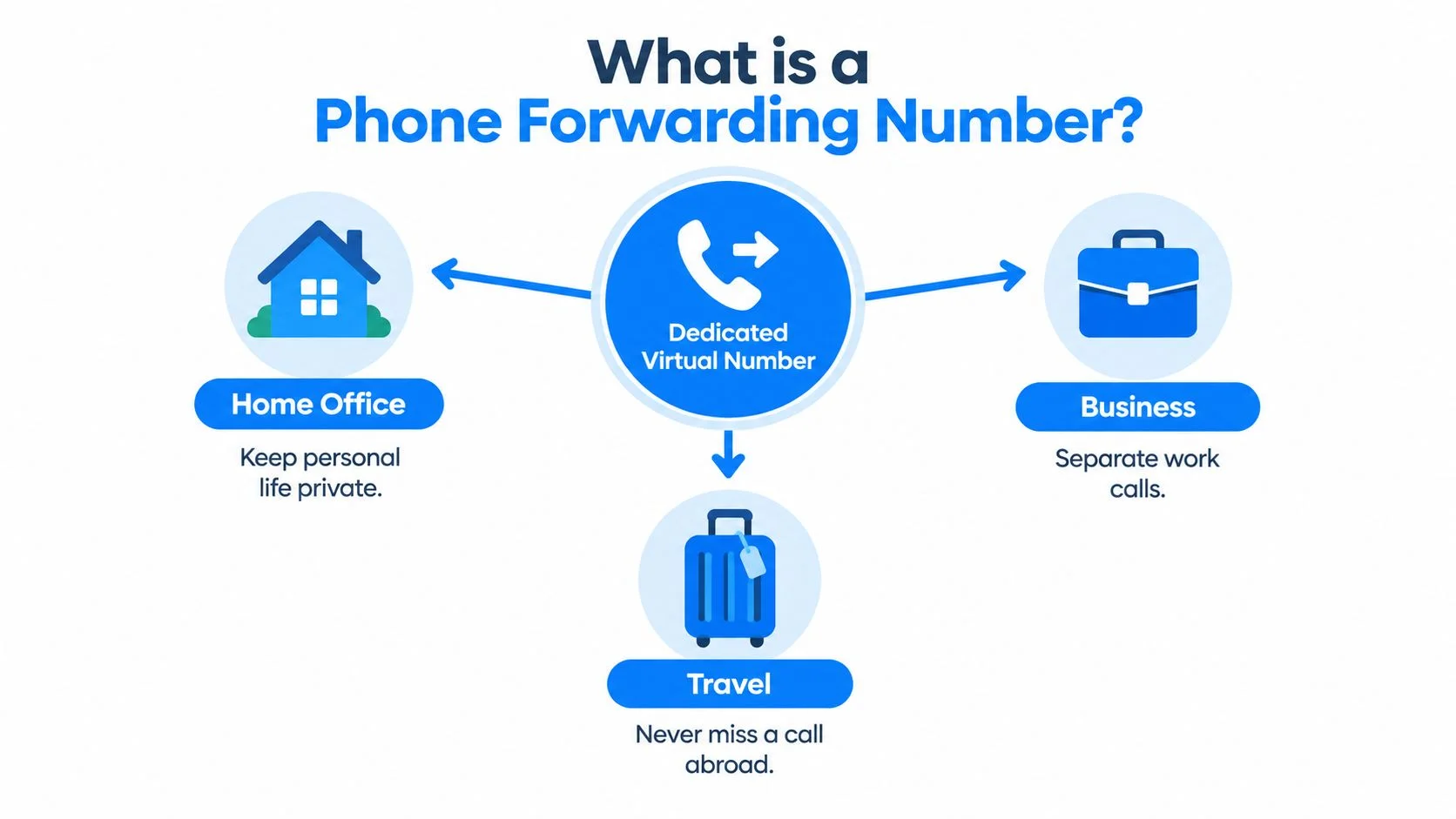
A phone forwarding number is a telephone number assigned to receive incoming calls and pass them to a destination you choose. The number is held by the routing service, while the destination can be your mobile, office line, home phone, or another reachable endpoint.
A small business owner working from home might publish this dedicated number instead of a personal mobile number. Calls can reach the current phone today and a different destination later, while the number on the website and client records stays unchanged. That separation makes the number a communications identity, not merely a setting on one handset.

The number is the identity
The distinction between a number and the device using it has a long history. U.S. local number portability became a legal requirement through Section 251(b)(2) of the Communications Act in 1996, followed by FCC implementation rules. By November 2003, customers in the 100 largest U.S. metropolitan statistical areas could port numbers between providers, and nationwide availability began in May 2004. The regulatory history of local number portability documents how keeping a number while changing the service behind it became normal.
A dedicated number builds on that expectation. It is separate from a SIM card and from a handset line with a temporary redirect. It functions as an international E.164 address, consisting of a country code and national significant number, with a maximum of 15 decimal digits, excluding the international dialing prefix. ITU-T E.164 guidance defines this numbering structure for global routing.
Carrier forwarding may use a control code followed by the destination number. A dedicated plan generally provides a persistent number and a dashboard for selecting destinations, conditions, voicemail behavior, and related controls. A business call continuity guide can help companies assess how reachability should work during travel, staffing changes, or outages.
For the related idea of a separate virtual identity, consult BubblyPhone's virtual phone number guide. The operating principle is straightforward: callers dial one stable number, while you decide where the call goes.
How Dedicated Number Plans Route a Call
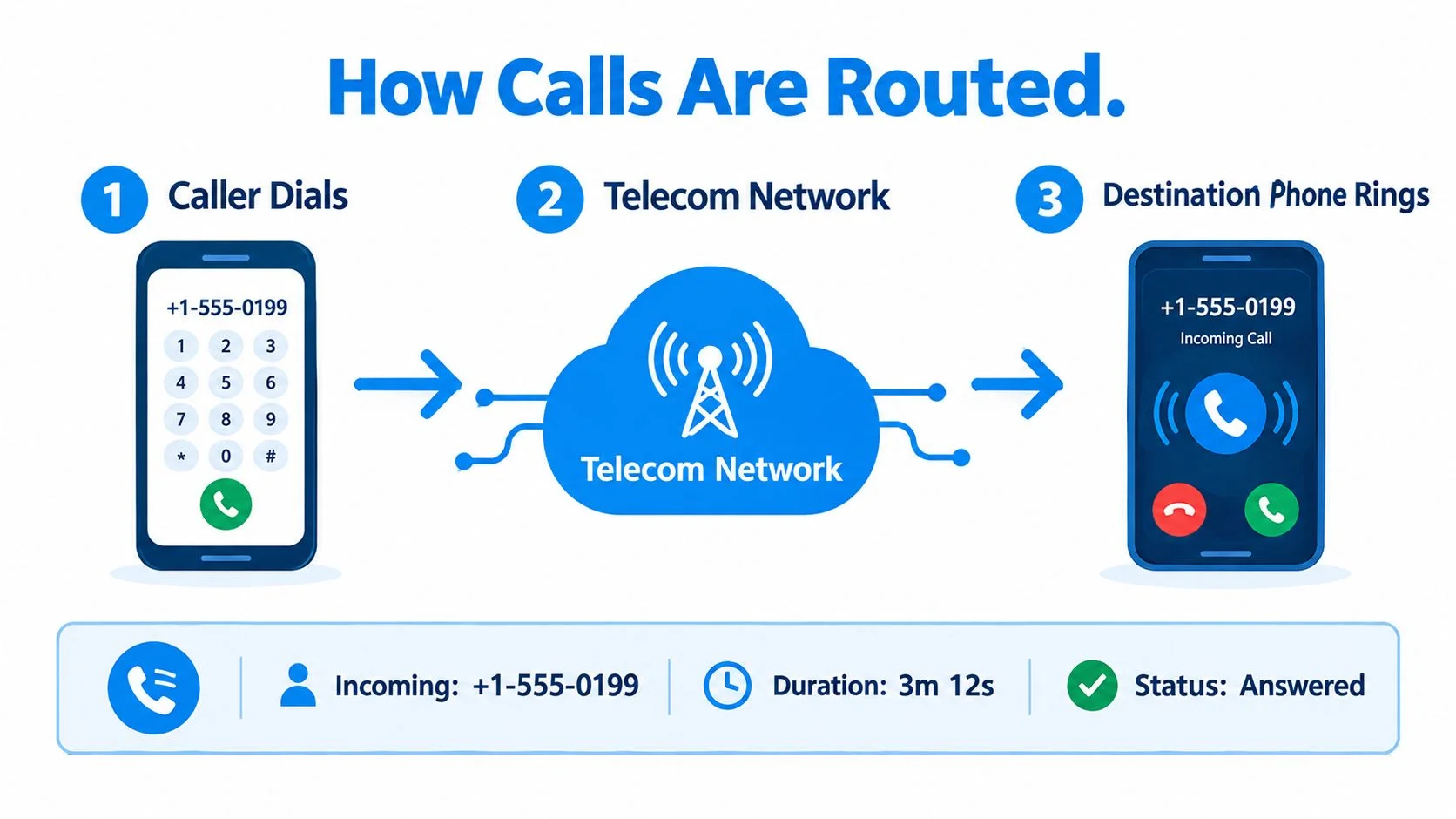
A dedicated number handles a call in two connected stages. First, the service receives the call addressed to the assigned number. Next, it starts a new outbound leg to the destination selected by your forwarding rule.
The sequence looks like this:
- Ingress signaling: The caller dials the dedicated number, and the forwarding platform receives the call request.
- Rule lookup: The platform checks whether unconditional, busy, no-answer, or unreachable forwarding applies.
- Destination attempt: The platform sends a new call toward the configured destination.
- Result recording: The system records whether the destination answered, rejected the call, failed to connect, or timed out.

Why two legs matter
Forwarding isn't a second independent inbound call. It's a conditional routing operation, and each leg can have its own answer state, failure reason, caller-ID treatment, media path, and billing exposure.
That explains several everyday behaviors. The caller may hear ringing while the destination is still being attempted. A destination can reject the new leg even though the dedicated number successfully received the original request. A timeout can send the caller to voicemail even when the destination device itself is online.
A useful dashboard should distinguish incoming, forwarding attempted, answered, rejected, and failed states. It should also verify destinations, show an explicit timeout, and keep a readable event log. These aren't cosmetic features. They help you determine whether a missed call came from an unreachable destination, a rejected attempt, a bad number format, or a rule that sent the call somewhere unexpected.
Operational rule: Treat every forwarding destination as a separate call leg that needs its own validation and monitoring.
Browser-based routing replaces many old keypad workflows with an authenticated dashboard. Changing a destination should require confirmation, and repeated rule edits should be rate-limited. Alerts for unusual international destinations are especially important because an account takeover can turn incoming traffic into chargeable outbound calls. For background on the broader technology behind internet voice termination, see this voice termination overview.
Forwarding Rules, Voicemail, and SMS on Dedicated Numbers
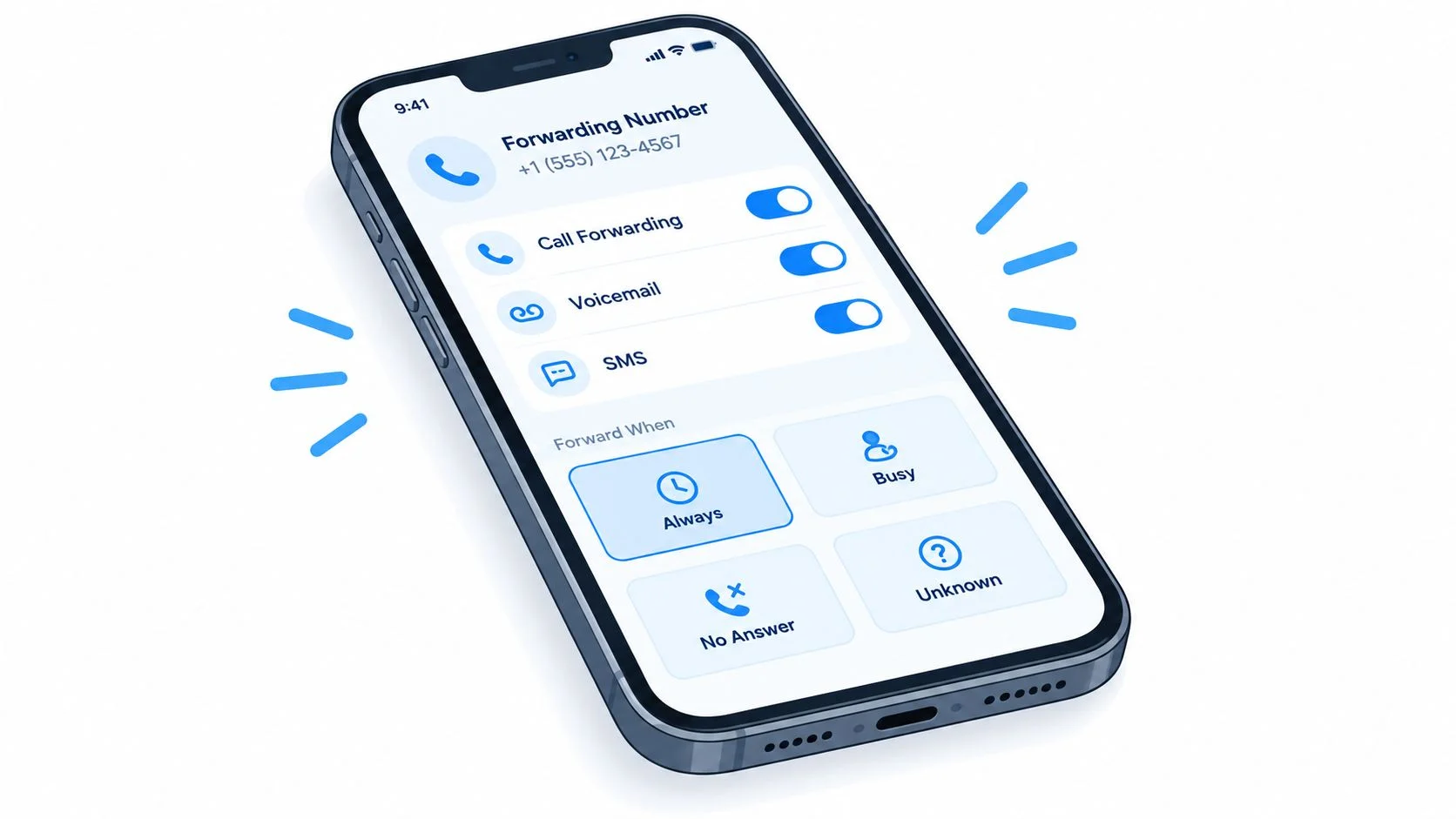
Forwarding rules decide what happens when the destination is available, busy, unanswered, or unreachable. A dedicated number's dashboard should make those conditions visible instead of hiding them behind one generic “forward calls” switch.

Match the rule to the situation
Unconditional forwarding sends every incoming call directly to the selected destination. It's suitable when the dedicated number is only an entry point and you always want another phone to ring.
Busy forwarding applies when the destination is already handling a call. It can send the next caller to a backup number or voicemail instead of leaving the caller with a busy signal.
No-answer forwarding waits for the destination to ring for the configured period. If you don't answer, the platform can try another number or place the caller in voicemail. A short timeout may make the service feel abrupt, while a long one can delay the fallback.
Unreachable forwarding handles conditions such as a switched-off device, lost registration, or unavailable roaming connection. It's particularly useful when you travel, but it doesn't make the destination suitable for emergency calling.
A practical dashboard might try your mobile first, then a colleague, then voicemail. It should show the order, the timeout for each attempt, and the final result. Voicemail is different from a missed-call alert. A missed-call alert tells you that someone tried to reach you. Voicemail gives the caller a way to leave information that you can retrieve later, and voicemail-to-email can make that message easier to process.
What SMS can and can't do
Dedicated numbers may support receiving SMS, including verification codes sent to the number. On BubblyPhone dedicated numbers, SMS is receive-only, so don't plan workflows around sending replies or outbound text campaigns. If your process depends on a code, test reception before relying on the number for account recovery or verification.
Number type also affects messaging eligibility and compliance. If your use case involves business messaging concepts, this explanation of choosing a 10DLC long code provides useful terminology, but it doesn't change the receive-only limitation described here.
For voicemail greetings, message retrieval, and related controls, consult BubblyPhone's voicemail features guide. Configure the fallback path before publishing the number, not after the first important call goes unanswered.
Where a Forwarding Number Earns Its Keep
A dedicated forwarding number earns its place when you need a stable public identity that isn't tied to one handset. It can separate business calls from personal life, keep a familiar number reachable during travel, or give a software system an inbound voice surface.
Business continuity
A small company may publish one number for suppliers, customers, and contractors, then forward calls to whoever is on duty. The owner doesn't need to issue a new number when work moves from a home office to a shared workspace. A business that handles short-term rentals might also benefit from a dedicated answering workflow, such as an Airbnb answering service, when callers need a human response outside the operator's normal availability.
Travel and privacy
An expat can keep a familiar number for family or financial contacts while forwarding calls to a reachable local device. Someone selling products online can publish a separate number, screen incoming calls, and retire that number later without exposing the personal line.
These uses become overkill if you have one phone, one number, no travel, and no need to separate callers. In that case, basic phone settings may solve the problem with less administration.
Developer and operations use
A developer can use the number as an entry point for an automated voice workflow, then route complex calls to a human. An operations team can use the same pattern for regional coverage, escalation, or after-hours support. The value comes from the stable ingress identity, not from owning another physical handset.
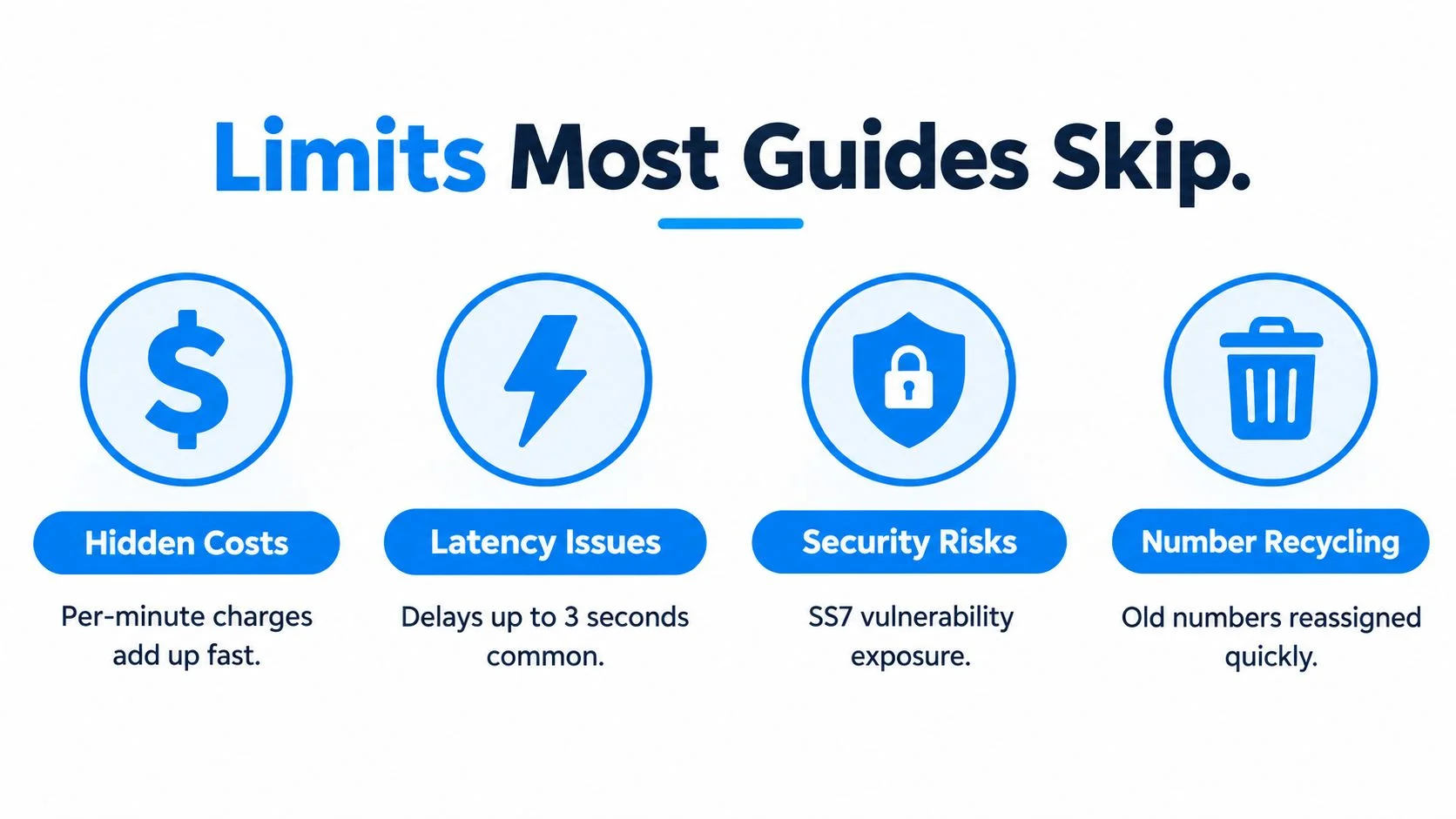
Limits Most Forwarding Guides Skip
Forwarding improves reachability, but it doesn't guarantee caller trust, emergency suitability, SMS reciprocity, or legal permission to contact people. The most serious problems appear when users treat a forwarding number as a complete replacement for a local mobile service.

Caller-ID trust can fall
Forwarding may preserve, alter, or inconsistently present the original caller's identity depending on the countries, networks, and services involved. In the United States, consumers received approximately five billion robocalls in April 2025, averaging 15 per consumer, according to a congressional hearing record. The hearing document also discusses STIR/SHAKEN, which is designed to verify whether transmitted caller-ID information matches the caller's legitimate number.
Forwarding isn't spoofing. Spoofing deliberately falsifies transmitted caller-ID information, while forwarding is a routing action authorized by the account holder. Authentication still doesn't guarantee that a recipient's phone will avoid a spam label or that the person will answer an unfamiliar identity.
Use numbers authorized for the account, test calls across several networks, publish a recognizable business identity, and maintain a fallback callback number. A forwarding setup can increase availability while reducing answer rates if recipients see an unfamiliar or inconsistently authenticated identity.
Emergency calling doesn't follow you
A forwarded number doesn't automatically transfer your physical location to emergency responders. European interoperability guidance identifies accurate caller location as critical for emergency intervention and highlights unresolved issues involving packet-switched emergency communication, roaming, and emergency SMS. The emergency communications guidance also describes situations where LTE emergency calls may fail or become anonymous during roaming, leaving a public-safety answering point unable to call back after a dropped call.
Keep a locally reachable device or number when traveling, and verify emergency support with the underlying local provider. Ordinary calls can work perfectly while emergency access remains unsuitable.
SMS and legal exposure need separate planning
Receive-only SMS means verification workflows can work in one direction, but support replies and outbound campaigns need another lawful channel. Forwarding also doesn't remove consent requirements. The FCC says prerecorded telemarketing calls to residential or wireless numbers generally require prior written consent, while autodialed or prerecorded calls and texts to wireless numbers generally require oral or written consent, subject to exceptions such as emergency communications involving danger to life or safety. The FCC's robocall guidance explains these requirements and defines caller-ID spoofing.
A compromised forwarding account can also send chargeable traffic to premium or international destinations. Monitor destinations, duration, answer ratio, and spending, then suspend unusual patterns automatically.
Setting Up a Forwarding Number the Right Way
A forwarding setup can fail even when the destination phone works normally. Use a fixed order: standardize the destination, verify reachability, set the rules, secure the account, then test the entire call path. This separates formatting errors, routing choices, and account risks from genuine network faults.
- Normalize every number. Store and enter destinations in plus-prefixed E.164 format, with the country code followed by the national number. Avoid mixing local dialing formats, trunk prefixes, and uncertain leading zeros. A consistent format helps the service route calls correctly and present identity information predictably.
- Verify the destination. Confirm that the forwarding service can reach the destination for incoming calls. Test inbound SMS separately if the number will receive verification codes. A destination that accepts local calls may still fail when reached internationally or through another network.
- Choose each rule deliberately. Use unconditional forwarding when the destination should always ring. Choose busy, no-answer, or unreachable conditions when a fallback is needed. Set a clear timeout, then decide whether unanswered calls should reach voicemail, another destination, or a notification.
- Harden the account. Use authenticated dashboard access and enable two-factor authentication where available. Require confirmation for destination changes, restrict repeated rule edits, and activate alerts for unusual international destinations. These measures make it harder for an attacker to redirect calls or use the number for toll fraud.
Keep the forwarding number separate from the destination phone. That separation preserves a stable communications identity while devices, locations, or staff change. It also gives you a place to review caller-ID behavior before publishing the number.
- Test before publishing. Call from a mobile, a landline, and an internet-based phone service when available. Check caller-ID presentation, ringing and timeout behavior, voicemail, SMS reception, and the final activity log. Test after changing destinations as well, because a rule update can affect identity presentation or fallback routing. Record a callback option for callers who reach voicemail.
Practical rule: One successful call proves very little. Test the normal route and every fallback route you expect to use.
Is a Forwarding Number Right for You and How to Start
A dedicated forwarding number is right for you if you need a stable identity separate from a device, expect to change destinations, or want an inbound number for business or software workflows. Basic carrier forwarding may be enough if you only need your existing phone to ring somewhere else occasionally.
Ask yourself three questions:
- Do callers need one number while your device or location changes? If yes, a dedicated identity is more useful than a temporary handset setting.
- Do you need conditions, voicemail, SMS reception, or multiple destinations? If yes, choose a plan with visible rules and logs rather than a single on-or-off switch.
- Can you protect and monitor the account? If not, don't publish the number until you can secure destination changes, test caller ID, and review activity.
A browser-based service such as BubblyPhone lets you call regular landlines and mobiles in 200+ countries from a browser, while the recipient doesn't need an app or account. Calling uses prepaid credits billed per minute and rounded up to the whole minute. No subscription is needed for calling, while the optional dedicated-number plan is the recurring product. You can review current destination pricing on the live rates page.
Start with a $5 top-up, and credits never expire. That model suits occasional international calling, travel, family contact, and testing a forwarding workflow before you commit to a more involved setup.
Visit BubblyPhone to make a call from any browser to a landline or mobile, without requiring an app or account for the person you're calling. Start with a $5 top-up, keep your credits as long as you need, and use the service when a reliable international connection matters.