Prepaid Phone Numbers: What They Are and How to Choose
Table of Contents
- How Each Option Handles Inbound Calls and Activity
- Why Lapse Rules Affect Most Mobile Users Worldwide
- Calling Family Abroad on Landlines and Mobiles
- Running a Small Business With Overseas Suppliers
- Traveling or Working Remotely for a Few Months
- Two Edge Cases Worth Checking Early
- Before You Link a Prepaid Number to Any Account
- Country Rules for Registration and Portability
- Three Steps to Test Your First Call
Do you assume a fresh prepaid SIM gives you a clean, private phone identity with no strings attached? Most guides treat prepaid phone numbers as simple budget plans focused on minutes and data, while overlooking that a prepaid number is a temporary identity that expires when you stop funding it and often carries a previous owner's digital history.
A prepaid phone number is a mobile or virtual line you pay for upfront before placing calls or receiving messages, with no monthly postpaid bill. Choosing the right setup means looking past headline top-up prices to understand how inbound calls work, what keeps a line from lapsing, and why relying on a temporary number for account logins can create serious security risks.
Prepaid Numbers Compared With Calling Credit and Virtual Numbers
A prepaid phone number is a line funded before you use it, with zero recurring postpaid bills. People shopping for flexible calling frequently mix up three very different tools: prepaid SIM cards, pay-as-you-go calling credit, and dedicated virtual numbers.
Each option solves a distinct communication problem. Comparing them side by side makes it clear what you pay for, whether people can call you back, and what keeps the service running.
| Option | What You Pay | What You Can Receive | What Keeps It Active |
|---|---|---|---|
| Prepaid SIM or mobile line | Top up, then usage draws down the balance | Calls and texts on the line's own network | Lapses if the balance runs out or the line goes inactive |
| Pay-as-you-go calling credit | Buy credit, pay per minute for outbound calls | Outbound calls only; no own number for inbound calls | Set by the provider; check balance rules before topping up |
| Dedicated virtual number | Monthly fee for the number plus calling credit | Inbound calls, voicemail and receive-only SMS | Runs month to month and can be cancelled at any time |
How Each Option Handles Inbound Calls and Activity
A prepaid SIM or mobile line attaches a real telephone number to a physical SIM card or eSIM on a cellular network. You load credit onto the account, and every call, text, or megabyte draws down that balance until you top up again. Because the number belongs to a mobile carrier's pool, letting the balance hit zero or leaving the line idle past the carrier's grace period causes the number to lapse.
Pay-as-you-go calling credit works differently because it focuses strictly on outbound calling. You load funds into an account and dial landlines or mobiles worldwide through a browser or app using pay-as-you-go VoIP, paying strictly per minute. There's no personal phone number attached to your balance, so nobody can dial you back on a permanent line, and expiration depends entirely on the provider's balance policy.
A dedicated virtual number bridges the gap when you need a permanent inbound identity without swapping physical SIM cards. You pay a predictable monthly fee for the number itself alongside calling credit, and the line handles inbound calls, voicemail, and receive-only SMS over an internet connection. Because it runs month to month with no long-term contract, it stays active as long as your monthly charge is covered and stops the moment you cancel.
Simple decision rule: If people need to call you on a number, you need a prepaid SIM or a virtual number; if you only need to call abroad, calling credit is enough.
How a Prepaid Number Works From Activation to Lapse
What keeps a prepaid number yours after activation? Paying upfront starts the service, but keeping the number depends on the provider's funding, renewal, and inactivity rules. Treat it like a temporary identity with a renewal deadline: a working line today does not guarantee you can receive calls or account-recovery messages later.

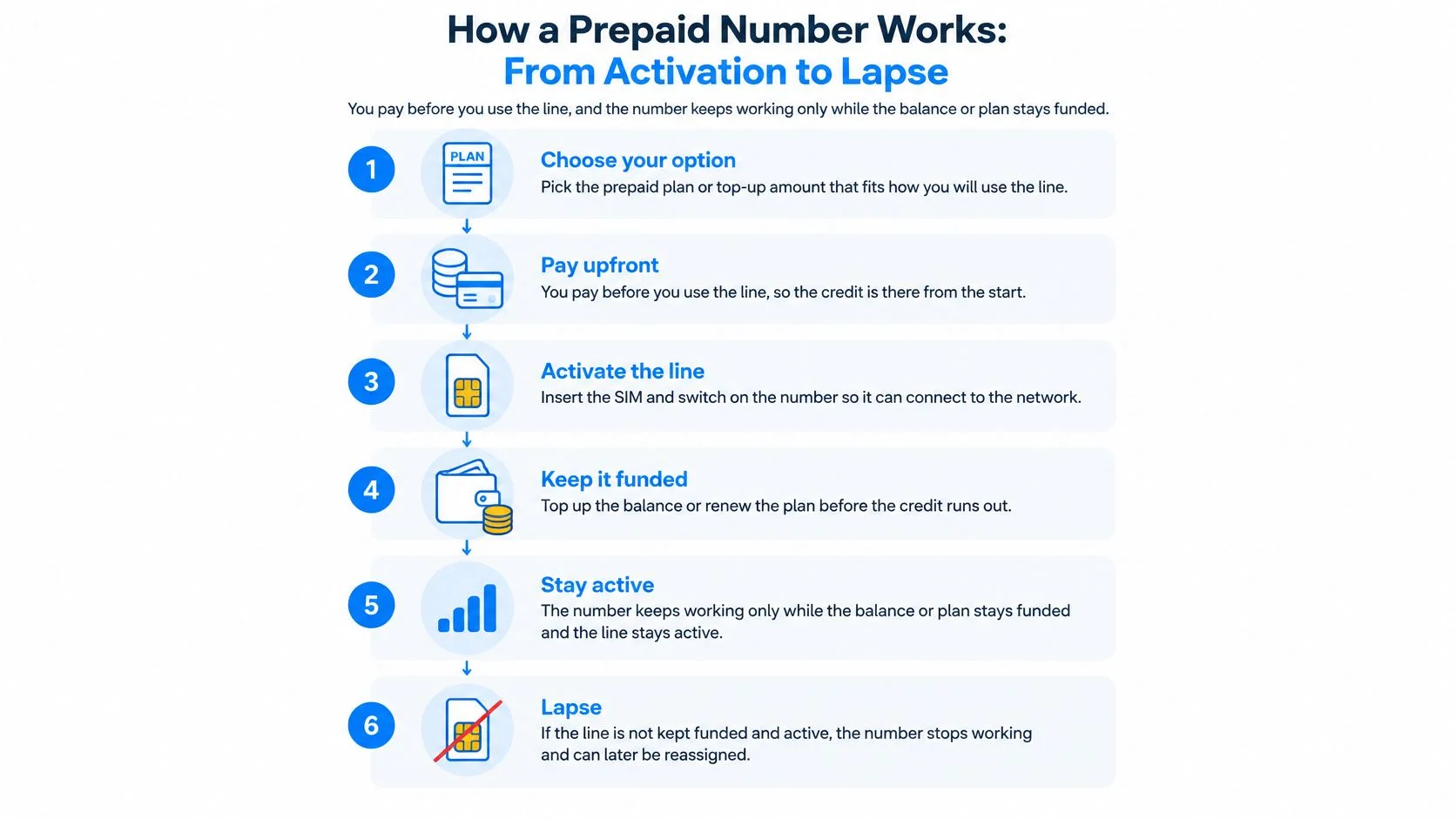
Follow these six steps from setup through renewal or cancellation:
- Match the product to your calling pattern. Confirm whether your purchase includes a number that receives calls and texts, or only credit for outgoing calls. Buying calling credit does not automatically create a return contact number. Check that distinction before sharing a number with clients or attaching it to an account.
- Activate the line and run a live test. Insert the SIM or enable the virtual number, then test the features you expect to use. Place an outgoing call and, if the service includes them, test an incoming call and text from another device. An outgoing connection alone does not confirm that incoming messages work.
- Top up before the balance runs dry. Check both your available credit and the deadline for keeping service active. These answer different questions: credit tells you what you can spend, while the provider's rules determine when service may stop. Record any renewal or grace-period deadline rather than assuming a remaining balance protects the number.
- Check the rate before you dial. Look up the destination's per-minute price and the provider's billing increments. If partial minutes round up, a call that runs just beyond a full minute costs more than an exact-second calculation suggests. Use the stated billing method when estimating how much credit a call will consume.
- Generate periodic activity on idle lines. Read the SIM provider's inactivity policy to identify what counts as activity and when it is required. Look specifically for rules about calls, texts, and top-ups; do not assume they are interchangeable. Set a reminder for the action your provider requires, even if you rarely use the line.
- Unlink every account before letting the line lapse. Move email, banking, and messaging recovery details to another contact method before stopping payment; see “Why a Prepaid Number Can Be Risky for Logins” for the recycling risk.
Why Lapse Rules Affect Most Mobile Users Worldwide
Prepaid SIMs represented 5.9 billion connections, or 76% of 7.8 billion mobile connections worldwide, in 2017, compared with an estimated 73% in 2020, according to the GSMA 2020 mobile access report.
Prepaid service therefore supports everyday communication on a large scale. Its funding and expiry rules matter whether the number is your main contact line, a travel SIM, or a spare identity used for occasional messages.
After your test call, compare the balance deducted with the rate and billing increment you checked. That gives you a concrete starting point for budgeting future calls.
Which Option Fits Your Situation
The right prepaid setup depends on who needs to reach you and how often they dial your number. Before buying a SIM card or monthly line, look closely at your actual calling habits across three everyday scenarios.
Calling Family Abroad on Landlines and Mobiles
Say you live overseas and check in with parents or older relatives once or twice a week. They use regular home landlines or basic mobile phones, and walking them through installing a messaging app or creating an account creates unnecessary friction.
Pay-as-you-go calling credit placed from a web browser fits this routine cleanly. You top up when you want to talk, dial their regular number directly, and pay strictly for the minutes used. Because your relatives don't need an app or an account, they pick up their phone when it rings.
Running a Small Business With Overseas Suppliers
Now consider a small importer coordinating shipments with factories and freight agents in another country. Suppliers need one reliable phone number they can call back whenever customs paperwork or delivery schedules shift, without chasing you across different personal devices.
A dedicated virtual number solves this problem by functioning as a clean second phone line. Incoming calls ring in your browser or forward straight to your everyday mobile, missed calls drop into voicemail, and automated shipping alerts arrive via receive-only SMS. You keep business communications separate from personal contacts while paying month to month.
Traveling or Working Remotely for a Few Months
A remote worker spending a season abroad faces a split requirement. Local food delivery apps, transit passes, and apartment Wi-Fi portals often demand a local mobile number for text verification, while calling clients or family back home on a local SIM can burn through international roaming fees quickly.
Combining a local prepaid SIM with browser-based calling credit handles both sides without paying for an expensive long-term contract. The local SIM stays inside your phone for domestic data and local SMS codes, while calling credit covers international calls back home at transparent per-minute rates.
Two Edge Cases Worth Checking Early
One practical boundary separates calling credit from a dedicated number: if a bank, client, or family member must be able to call you back on a number that never changes, outbound calling credit won't work. You need either a dedicated virtual number or a maintained prepaid SIM so your callback identity stays consistent.
Also verify service limitations before relying on any internet-based calling tool as your only phone. Many browser and virtual calling services don't support premium-rate numbers or emergency services, so keep a standard local cellular line or landline accessible for urgent calls.
- Family callers abroad: Pick pay-as-you-go calling credit so relatives can answer on any landline or mobile without installing anything.
- Small businesses with overseas contacts: Pick a dedicated virtual number for one steady inbound line with forwarding, voicemail, and receive-only texts.
- Seasonal travelers and remote workers: Pair a local prepaid SIM for local codes and data with calling credit for international calls.
Why a Prepaid Number Can Be Risky for Logins
A prepaid phone number isn't automatically safe for account recovery or two-factor authentication. Many buyers assume that picking up a low-cost SIM card creates a clean, private barrier between their real identity and their online accounts, when temporary ownership can introduce more identity risk than privacy.
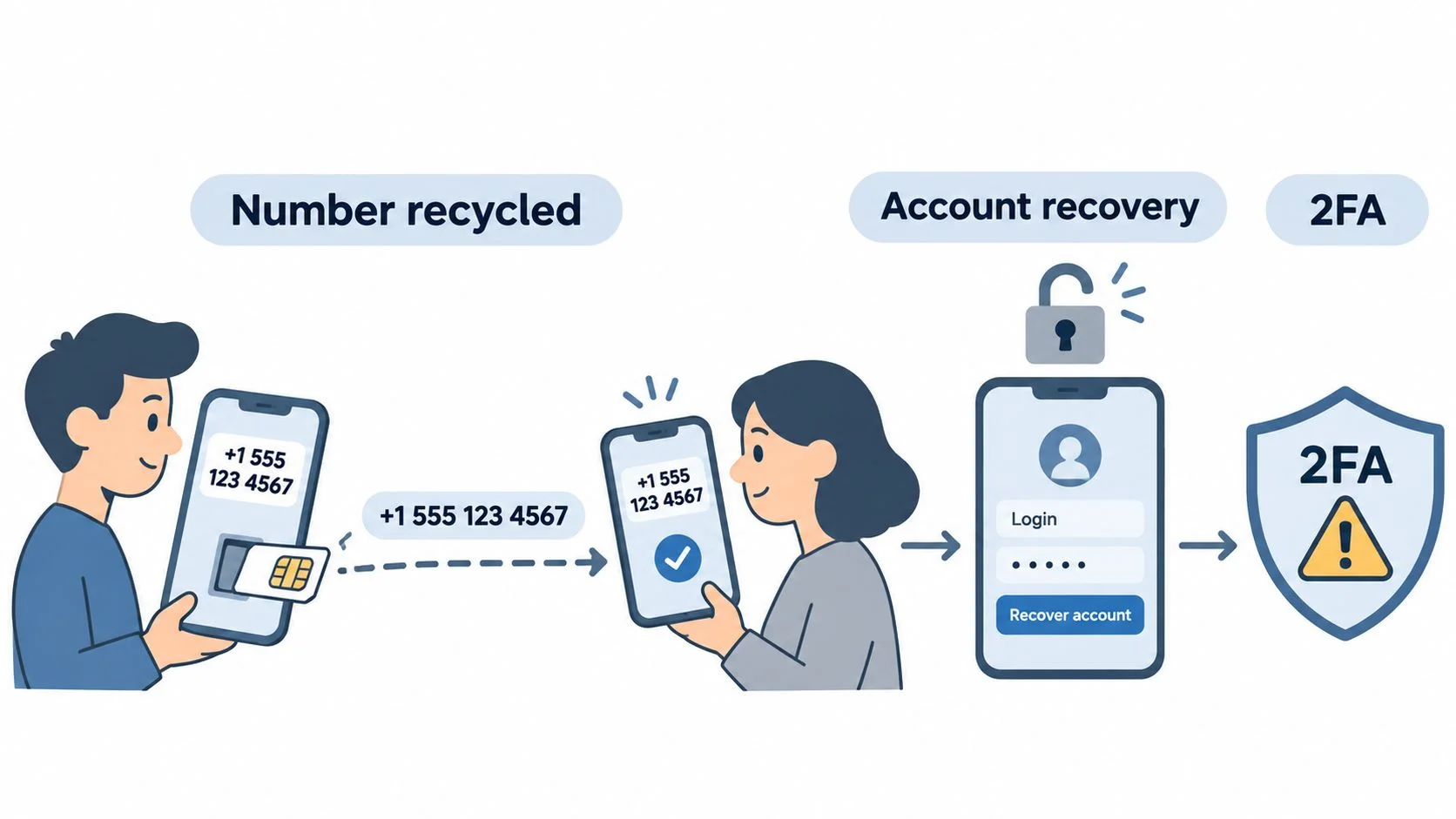
The core issue is number recycling. Phone numbers come from a finite pool, so once a prepaid line lapses from non-payment or inactivity, the carrier eventually returns those digits to circulation and assigns them to a brand-new subscriber. If the previous owner forgot to remove that number from their email, banking, or shopping logins, the new owner can receive password reset texts meant for someone else.
The visual below shows how easily a reassigned prepaid line turns into an unexpected backdoor into an old account.

This isn't a rare edge case. A 2025 Princeton University study sampled 259 U.S. mobile numbers available to new subscribers and found that 215 of them (about 83%) were recycled and vulnerable to at least one low-cost privacy or account-takeover technique. Even more striking, 171 numbers (66% of the sample) were still actively linked to existing accounts across major retail, social, email, and payment services.
Even while you actively hold a prepaid SIM, carrier verification weaknesses create a second vulnerability known as a SIM swap. An IEEE Security & Privacy Workshop study examining prepaid wireless authentication found that insecure verification practices for SIM-swap requests remained widespread, leaving prepaid users exposed with few practical defenses across a U.S. market where prepaid plans made up roughly 21% of wireless connections (about 77 million lines) in Q3 2019. When an attacker persuades a carrier to transfer your number to their SIM, every SMS verification code routes straight to their device.
Before You Link a Prepaid Number to Any Account
Treating any newly acquired number as potentially recycled protects both your privacy and your future access. If you use a virtual line to receive SMS on a virtual phone number or activate a fresh SIM card, run through four habits right away:
- Test the number's history first: Check whether unexpected login alerts, collection calls, or password reset texts arrive during your first week before trusting the line with personal accounts.
- Never make a prepaid line your sole recovery path: Always pair a phone number with a verified email address and offline backup codes so losing the SIM never locks you out permanently.
- Upgrade away from SMS codes: Switch high-value logins to an authenticator app or passkey wherever the service supports them, keeping one-time codes tied to your physical device rather than a telephone network.
- Scrub the number before canceling: Audit your financial, email, and social accounts and delete the prepaid number from every profile before letting the balance lapse.
This short video walks through how SMS-based account takeovers happen in practice and why stronger login factors matter.
Different accounts carry very different consequences if a reassigned number receives a reset code. Match each account type to a recovery method that doesn't depend on keeping the same prepaid line forever.
| Account | Risk if the Number Is Recycled | Safer Recovery Method |
|---|---|---|
| Email or cloud storage | Reset codes may reach a reassigned number | Authenticator app or saved recovery codes |
| Banking login | Bank SMS codes may reach a new owner | Bank app or a hardware key where offered |
| Marketplace or payment account | An old linked number may still receive resets | Verified email plus a passkey |
| Workplace or business verification | Verification codes may go to a stranger | Company-managed number or verified email |
If losing this number would lock you out of an account, the number is the wrong recovery method for that account.
Checklist Before You Buy a Prepaid Number
Choosing the right prepaid option comes down to seven practical checks rather than the lowest top-up price. Running through each test before you pay prevents surprises with sudden expirations, rejected verification texts, or unexpected registration hurdles.
- Lapse rules. Check the exact number of days your balance stays valid and how long the line remains active without a paid call, text, or top-up. Ask yourself whether you'll remember to trigger activity inside that window.
- Receiving capabilities. Confirm whether the option accepts inbound calls and SMS messages, handles receive-only SMS, or only places outbound calls. Never assume a calling balance includes a personal callback number.
- Verification acceptance. Test or confirm whether the banks, government portals, or online marketplaces you rely on accept that type of number for security codes. A phone line can be completely active on the network yet still get blocked by a financial institution's own anti-fraud filters.
- Rate transparency. Verify that exact per-minute prices are published before you dial and check the billing increment, such as rounding partial minutes up to the nearest whole minute. Hidden connection fees can double the cost of short calls.
- Commitment terms. Read whether you're locking into a multi-month prepay bundle or a month-to-month arrangement you can cancel at any time without penalty. True flexibility means walking away without forfeiting months of unused service.
- Identification requirements. Look up whether the country issuing the SIM or number requires a government ID or passport at purchase or shortly after activation. Never assume "prepaid" means anonymous.
- Number portability. Check whether you're allowed to transfer the number to another provider later, how long you must wait before porting, and what happens to leftover credit when you leave.
Country Rules for Registration and Portability
Consumer advice often treats prepaid SIMs as anonymous, plug-and-play products that work identically everywhere, but national telecom laws vary widely. A January 2025 European Union Council discussion highlighted that prepaid-SIM purchase rules aren't harmonized across the EU: some member states place no purchase restrictions on buyers, while others require registering every SIM with an identity document or passport to curb abuse such as fake-account creation, phishing, spam, and fraudulent two-step-verification sign-ups.
Enforcement can directly shut down active lines when registration deadlines pass. Namibia's Communications Regulatory Authority reported that as of June 15, 2023, only 795,991 of roughly 2,760,804 active SIM cards across licensed networks (about 29%) had been registered, leaving unregistered SIMs facing a three-month suspension after December 31, 2023 followed by permanent deactivation if owners failed to register.
Because rules differ so sharply across jurisdictions, always separate three distinct questions before buying:
- Purchase identity: Do you need a passport or local ID card to buy and activate the number?
- Code delivery: Will your target bank, workplace, or portal send verification SMS to that line?
- Cross-border reach: Can the number still receive inbound calls and verification texts once you cross an international border?
Picture a traveler landing in a European city and buying a local SIM at an airport kiosk. Presenting a passport gets the SIM activated on the spot, yet once they fly home two weeks later, that local carrier may block inbound roaming texts unless they keep a roaming add-on funded. Contrast that with an expat keeping a home-country number alive while living abroad: even if registration is complete, letting a domestic SIM sit unused for months can still trigger cancellation right when a tax portal sends a login code.
Portability rules add another layer of local fine print. Under the Telecom Regulatory Authority of India's portability regulations, prepaid subscribers have the same right to port their numbers as postpaid customers, yet any unused prepaid talk-time balance is forfeited the moment the transfer completes. Separate TRAI waiting-period rules also enforce a 90-day wait after initial activation (or after a previously ported number reactivates) before you can port again, along with a seven-day lock following any SIM swap or replacement.
Buying rule: A number that fails the receiving or verification checks is the wrong choice for a bank or government login, even if it costs the least upfront.
Checking a provider's live rate table before you ever add funds lets you verify transparent pricing directly, ensuring you know every per-minute cost before placing your first call.
Make Your First Call Before You Commit to a Plan
The simplest way to evaluate a prepaid calling setup is to place a single real call before committing to a monthly line or SIM contract. Testing call clarity, setup speed, and billing transparency with a small top-up tells you more in two minutes than reading a dozen plan brochures.
BubblyPhone offers a straightforward browser-based way to call regular landlines and mobile phones across 222 countries over enterprise-grade global carriers. Everything runs directly inside your web browser with no app downloads, no SIM swaps, and no account required for the person you're calling.
Pricing stays simple and predictable. Calling is strictly pay as you go with no subscription, and the only monthly charge is an optional US phone number that runs month to month with no contract and cancels whenever you choose. Credits start at $5, never expire, and bill per minute rounded up to the nearest whole minute so you pay only for the minutes you use at the rate shown.
Before dialing, check the exact destination price on the BubblyPhone live rate table so there are zero surprises on your balance.
Three Steps to Test Your First Call
- Open BubblyPhone in your browser. Sign in from any desktop or mobile browser without installing software or changing your SIM card.
- Add calling credit. Load a starting balance from $5, delivered immediately to your account.
- Enter the number and press call. Dial any landline or mobile worldwide and confirm voice quality and remaining balance right after you hang up.
If you later decide to pair your outbound credit with a prepaid SIM or a dedicated monthly line, keep your checklist handy and track every lapse rule so your number stays active for as long as you need it.
Ready to test pay-as-you-go international calling without buying a new SIM or signing up for a monthly subscription? Make your next call straight from your browser to any landline or mobile worldwide with BubblyPhone, where the person you're calling needs no app or account and credits start at $5 and never expire.