Pay as You Go VoIP: How Per-Minute Billing Works
Table of Contents
You pay per minute from a prepaid balance, calling needs no subscription, every call is rounded up to the whole minute, and a call nobody answers costs nothing.
That's the whole model, and it's usually where explanations stop. Which leaves the questions people ask unanswered. Why does a three-minute twenty-second call appear on the statement as four minutes? Why do eight thirty-second check-in calls to the same mobile cost twice what one four-minute conversation does? And why is the number in your head so rarely the number the balance shows?
None of that comes from a hidden fee. It comes from one rule applied call by call, and once you've watched it work through a few examples you can predict a month of pay as you go VoIP spending to within a minute or two. The rounding is the price of a model with no contract, no monthly line rental and no charge for a call that never connects.
How Per-Minute Billing Rounds Up Your Charges
Pay as you go VoIP charges per minute against a prepaid balance, and the calling itself carries no subscription. You add credit when you need it, you talk, and the balance falls by the minutes you used. The billing clock starts when the person you called answers, not when you press the call button, so a number that rings out, returns a busy tone or fails to connect is free. There's no connection fee to absorb either, which is why a failed call leaves your balance exactly where it was.
Every call that connects is billed in started minutes, rounded up to the whole minute. Three minutes and twenty seconds bills as four minutes. Four minutes and one second bills as five. Those extra seconds aren't a surcharge; they're the unit of sale, the same way a parking meter charges for the hour you've entered rather than the minutes you stayed in the space.
Where the rounding actually costs you money
The rule is invisible on a long call and decisive on a short one. Say you check in with a relative abroad eight times in a month, thirty seconds each. That's four minutes of conversation and eight billed minutes. Replace those eight calls with a single four-minute conversation and you pay for four. Same talk time, half the bill, because the unused part of each started minute stops being billed.
Billed minutes by call length
A ten-minute fifteen-second call is the other side of the story. Eleven billed minutes against ten and a quarter minutes of talk is a rounding cost of 45 seconds. Nobody notices that. Everybody notices eight short calls billed at eight minutes for four minutes of conversation.
Estimate the bill before you top up
Count the minutes for each call, round each one up to the next whole number, then multiply by the per-minute rate for that destination. Rates differ by country and by number type, mobile versus landline, so take the figure from the published table at BubblyPhone's live rates rather than from memory.
If arithmetic isn't how you want to spend an evening, drop a typical week of calls into the call cost calculator and compare its estimate with what you spent.
The habit that pays for itself: for frequent short calls, test whether two longer conversations would do the same job. Rounding punishes frequency far more than it punishes length.
The confirmation takes a minute. Open your call history after the next call and compare the duration with the amount deducted. If a 3:20 conversation shows four minutes billed, the model is behaving exactly as described, and your estimate for next month will land close.
Prepaid Credit Compared With Subscriptions and Contracts
Prepaid credit suits irregular calling. A monthly bundle suits steady, heavy calling to a single destination. Those are different problems, and buying the model that doesn't match your pattern is where most of the money leaks.
A prepaid balance behaves like a fuel tank. You fill it when you need to, you burn what you burn, and whatever's left stays in the tank for the next trip. A monthly bundle is closer to a commuter pass: cheaper per journey if you travel every working day, poor value the week you stay home.
Payment models compared
The break-even test
Divide the monthly plan fee by what a minute typically costs you on your routes. The answer is the number of minutes the plan must cover before it beats paying as you go. If your real monthly total sits below that figure, the subscription is a donation.
Run it on two real shapes of caller. A family calling a relative abroad two or three times a month, mostly for a few minutes, will rarely reach the break-even point, and prepaid leaves the unused balance sitting there for the month they call for an hour. A small business booking international supplier calls every weekday has the opposite profile, and predictable volume is exactly what a bundle or a postpaid contract prices well.
The choice mirrors an older contracting question: pay for what you use, or commit to a fixed fee for a lower unit price. Galliot's comparison of time-and-materials and fixed-price contracts makes the decisive variable clear, which is how confidently you can forecast volume. If you can't forecast it, the fixed fee is a bet you lose every month.
The mechanics behind each side, including how a balance is authorised and deducted while a call is still live, are set out in this explainer on prepaid versus postpaid billing.
Bundles also expire. A plan with a fixed monthly allowance usually takes back whatever you didn't use when the period closes, so a quiet month is a full-price month. Pull the last three months of call records and count how many months you used more than the bundle would have covered. If it's one in three, prepaid wins on arithmetic alone, before you count the months you barely called at all.
How to Dial an International Number Step by Step
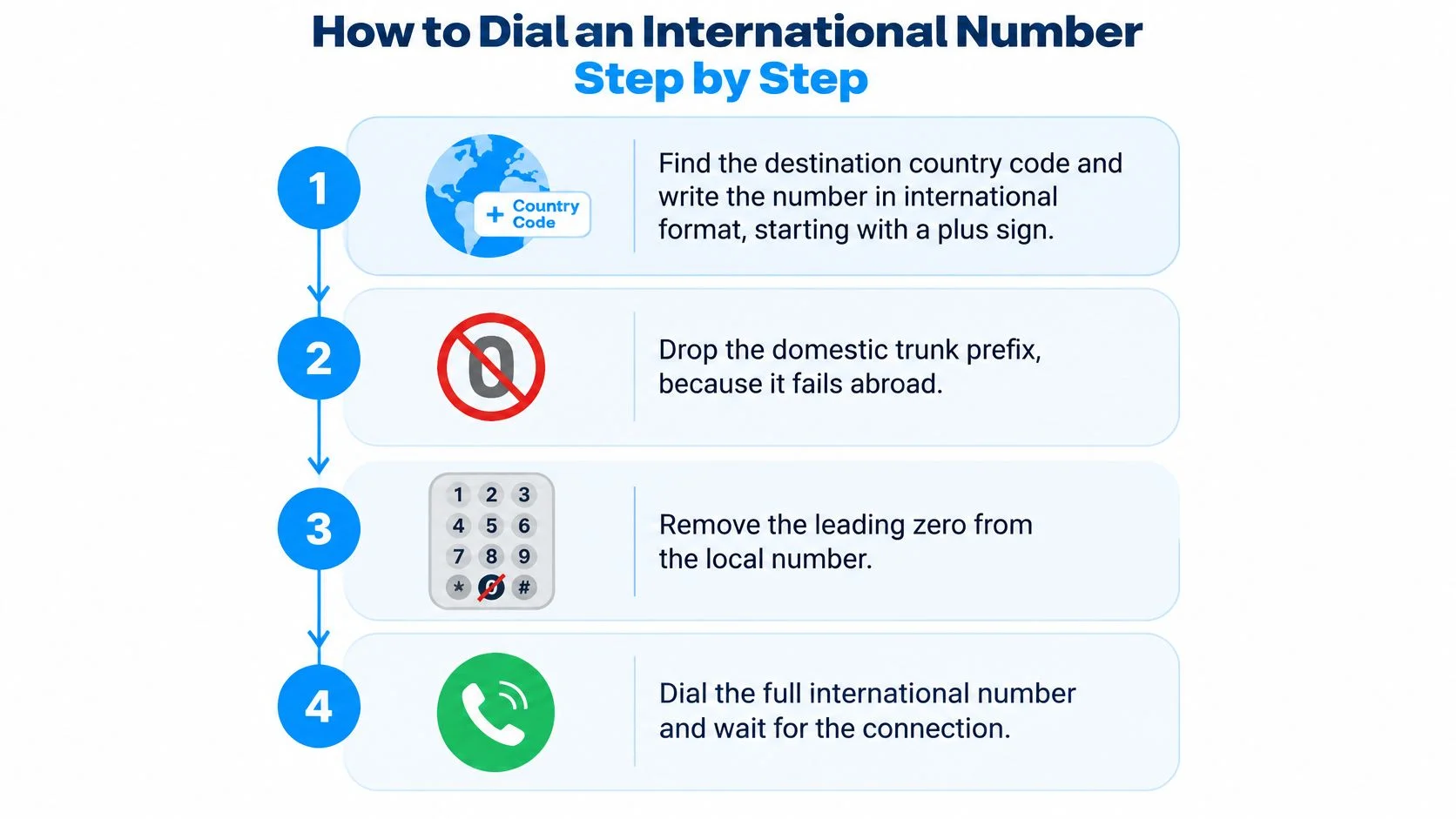
Dial the country code first, then the subscriber number with the leading zero removed, and begin the whole thing with a plus sign, because a domestic dialing pattern usually fails once the call crosses a border. The steps below cover the full sequence, including the checks that stop a mistyped number from becoming a paid call to a stranger.

International numbers follow the International Telecommunication Union's E.164 numbering plan, which caps a complete international telephone number at 15 digits. Country codes take one to three of those digits, and the remainder identifies the national destination and the subscriber number. That ceiling is why an entry field can reject a number before you finish typing it.
The seven steps
- Write the number in international format. A plus sign followed by the country code tells the platform the call is leaving the country. The common slip is typing the exit code you'd use from a landline, such as 00 or 011, into a field that already expects a plus.
- Drop the domestic trunk prefix. Most countries use a leading zero for calls made inside the country and drop it for international ones. Keeping that zero is the single most common reason a number that works locally comes back as invalid.
- Add the country code and the subscriber number. Read the result back once. A country code with a digit missing still dials somewhere, and that somewhere is usually a stranger's phone.
- Watch the rate appear as you type. The per-minute price for that specific number shows before you commit, and mobile and landline rates within one country often differ. The mistake here is checking a country-level figure and assuming every number in that country costs the same.
- Confirm the balance covers several minutes. A balance that runs dry mid-call ends the call, and a conversation cut off halfway is worse than a short one. Topping up early costs nothing extra, since unused credit stays on the account.
- Press call and wait for the answer. Because billing starts at the answer, a busy line costs you nothing but time. Redialing a number that never picks up is free.
- Check the call in history. The record should show the destination you intended and the cost you predicted. A mismatch almost always means the trunk prefix survived or the country code was mistyped.
Quick sanity check: if the destination shown in the app doesn't match the country you meant to call, hang up before the other end answers. A wrong number that connects is billed like any other call.
If the screen shows no rate as you type, look up the destination in the published rate table before you dial rather than after.
How a Browser Call Reaches a Phone and Why It Sounds Bad
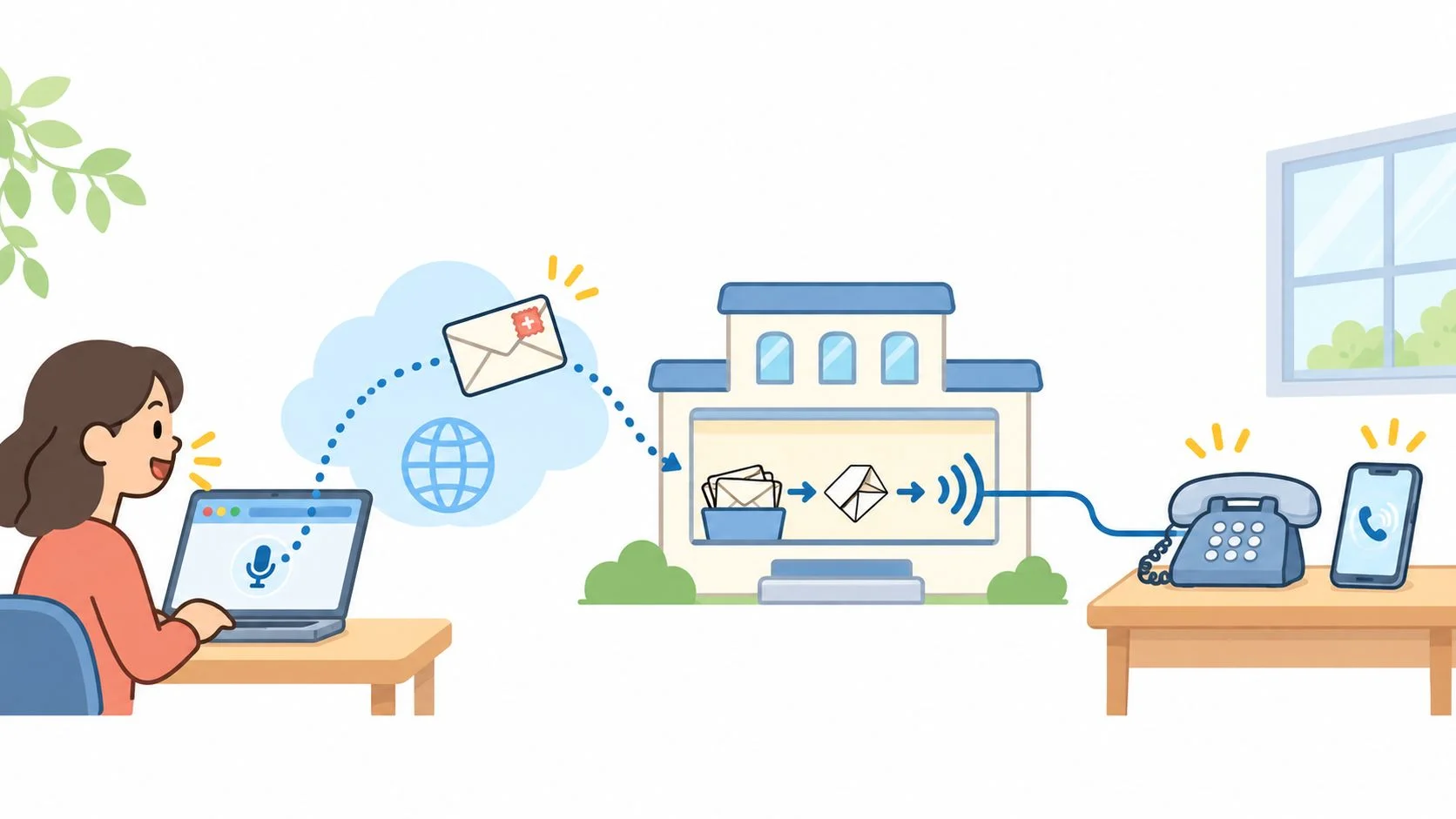
A browser call carries your voice over the internet to the calling platform, which hands it into the ordinary phone network, and that network rings the landline or mobile on the other end like any other call. The recipient installs nothing and creates no account, because from their side the call arrives.
The delivery analogy holds up better than most. You write the letter in your browser, the platform handles the international sorting, and the local network puts it through the door. Nothing about that chain requires the person receiving it to own the same software you do.

What you control and what you don't
Your half of the path is yours to manage: the Wi-Fi network or mobile signal, the microphone, the background apps competing for bandwidth, and whether you're on a headset. A headset alone removes most echo complaints, because it stops the other person's voice travelling from your speaker back into your microphone.
The other half isn't yours. You can't fix the destination carrier's routing or the handset on the far end, and you can't guarantee your caller ID will display there. Some destinations show the platform's number instead of yours, which matters if the person you're calling screens unknown callers.
When something goes wrong, the useful question is which half of the chain degraded. That's where measurement beats guessing.
The three causes of a call that sounds bad
Three impairments do almost all the damage. Delay is the gap between one person speaking and the other hearing it, and past a certain point both parties start talking over each other. Packet loss removes slices of audio, which sounds like words clipping or dropping out. Jitter is uneven arrival, packets bunched and then absent, and it's what makes speech sound robotic even when nothing is missing.
Reported measurements cited alongside the ITU-T G.107 E-Model put average voice round-trip latency at 263 ms, against 467 ms on calls rated unacceptable, with delay responsible for the larger share of the damage. Average jitter moved only from 6.1 ms to 9.9 ms between acceptable and unacceptable calls, which is why an average jitter figure on its own tells you very little about whether a call will sound good.
Fixing a bad call in the right order
Work through the fixes in sequence rather than trying them all at once. Move to a stable network or a stronger signal first. Close the applications eating bandwidth, especially video calls and cloud backups running in the background. Put on a headset third.
If the first minute was clear and the trouble starts later, the network changed underneath you, and billing had nothing to do with it. That distinction matters when a call drops mid-conversation and you're looking at the charge.
For a dropped call, note the time, open the call history and check the billed duration against what you experienced. If the minutes look wrong, contact support with the timestamp and the amount, since that record is the evidence both sides work from. Before any long call, run a short test call to a number you know answers, then check its cost in history.
The wider set of fixes, from router settings to codec behaviour, is covered in this guide to improving VoIP call quality. For the bigger picture of how media paths and phone networks fit together when you're diagnosing one, MR2 Solutions' guide to unified communications technologies maps the pieces clearly.
Emergency Calls and Account Safety Limits
Don't treat a pay as you go VoIP service as your only emergency line. In the United States, interconnected VoIP services that connect to the public switched telephone network carry specific 911 obligations: they must provide 911 as a standard feature, can't let customers opt out, must obtain the customer's physical location before activating service, and must offer a practical way to update it, according to the FCC's guidance on VoIP and 911. Covered calls must reach the appropriate emergency call center with a callback number and the registered physical location attached.
Those obligations apply to interconnected VoIP services, not to every browser-based calling tool. An international calling service you use for overseas conversations isn't a replacement for a local emergency line, and you shouldn't assume it behaves like one in a crisis.
The practical rule is simple: keep the local emergency number on a phone that works without internet, and if you use VoIP for home or office calls, tell the provider your registered location and update it when you move. A location on file from two addresses ago is worse than useless.
Protecting a prepaid balance from theft
A prepaid balance is money sitting in an account, and anyone who gets into that account can spend it. Use a strong, unique password rather than one reused from another site, and turn on two-factor sign-in where it's offered. If the service lets you set a spending limit or a top-up threshold, set it, because it caps the damage from a compromised login.
Read the call history now and then. You're looking for destinations you never dialed and durations you don't recognise, particularly short calls to premium or international numbers, which is the pattern automated fraud leaves behind.
Scam calls deserve their own warning. A caller who pressures you to ring an international number urgently, or to call back on a number you weren't expecting, is running a known play. Hang up and verify the claim through an official number you looked up yourself. Caller ID can be spoofed, so an incoming call asking for money or an urgent callback is unverified until you confirm it independently.
If the balance drops unexpectedly, change the password first, then contact support and keep the call history records for the dispute. The timestamped entries are your evidence, and they're easier to use in the same week they happened.
Pick a Provider and Make Your First Call
Check the terms before you top up, starting with whether the rate for your destination is published before you dial. A rate you can only discover on the invoice is a rate you can't budget for.

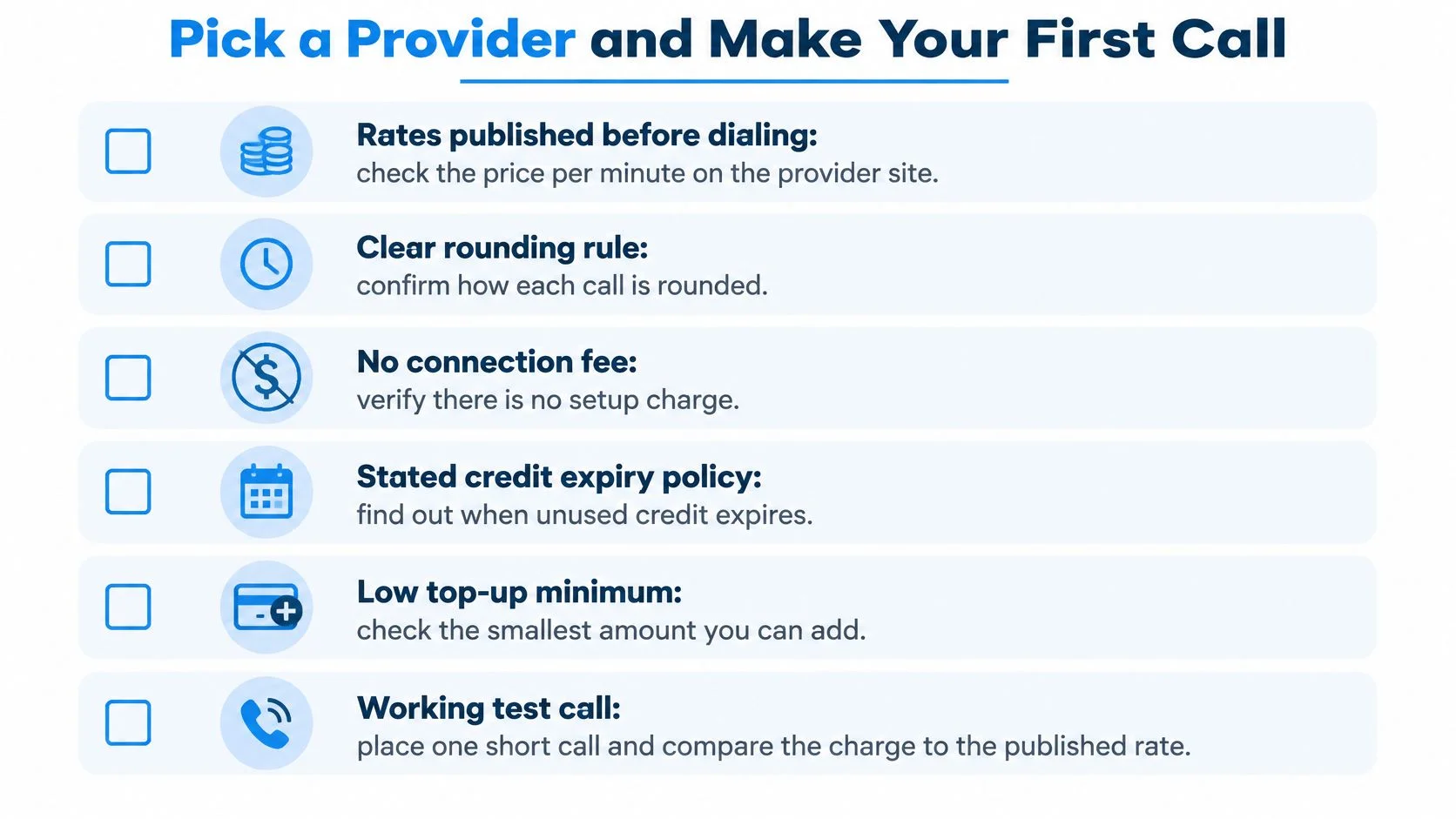
Rates published up front. You should see a per-minute figure for your country and number type before the call connects, not after the month closes.
A stated rounding rule. Whether billing runs per started minute, per second or in blocks of sixty seconds changes what a month of short calls costs. Ask for the rule in writing.
No connection fee and no minimum. A per-call surcharge outranks the per-minute rate on short calls.
A clear credit expiry policy. Non-expiring credit and credit that dies after 90 days are different products at the same headline price.
A low top-up minimum. The smallest amount you can add decides how much money sits idle in the account.
A per-call cost in history. If each entry shows what it cost, you can verify the rounding rule yourself within a day of signing up.
A dispute process that uses those records. Support should be able to look at the same timestamped entry you're looking at.
An honest statement of emergency calling limits. A provider that doesn't mention 911 or its local equivalent is telling you something.
Then the criterion people skip: recipient access. If the person you're calling has to install an app or create an account before your call reaches them, the service is fragile exactly when it matters, calling a grandparent abroad, a supplier on a mobile, a hospital reception desk. A call that lands on an ordinary phone has no such dependency.
BubblyPhone works on that model. Calling is pay as you go with no subscription, credit is bought from $5 when needed and is spent only on minutes you talk, and the person you're calling needs no app or account because the call arrives on their landline or mobile. There are no contract terms, dedicated numbers run month to month if you want one, and the rate appears as you type the number.
Start with one short call, compare the billed minutes in your history against the length you remember, and you'll have verified the whole model for yourself.
The fastest way to test everything in this guide is a single short call. BubblyPhone works in any browser, the person you're calling needs no app or account, credits start at $5 and never expire, and every call is billed per started minute from that balance. Dial a number you know, check the rounded duration in your call history, and you'll know exactly what your international calling costs before you ever top up again.