Prepaid vs Postpaid Calling: How to Choose
Table of Contents
Prepaid means you pay before you call, and postpaid means you call first and pay on a monthly cycle; in India, prepaid accounted for 90.63% of mobile subscribers in 2025, compared with 9.37% for postpaid. For international callers, the more important question isn't the headline price, it's whether you can start small, avoid a contract, and qualify without a credit check.
The popular advice says to compare cents per minute and pick the lower number. That's incomplete. Your real choice is between control and commitment. Prepaid lets you fund only the usage you expect, while postpaid gives you a recurring billing relationship that may suit heavier, predictable use.
That distinction matters even more when you call across borders. You might need to reach family abroad only occasionally, test a new business workflow, or make calls from a browser while traveling. In those situations, a monthly contract can create more friction than value.
What Prepaid and Postpaid Actually Mean
Prepaid charges you before usage, while postpaid lets you use the service first and sends an invoice afterward. That single billing distinction determines who controls the spending, who carries the usage risk, and how easily you can stop.
With prepaid, you purchase credit before making a call. A $20 refill gives you a defined balance, and each call reduces that balance according to the applicable usage rules. When the credit is gone, calling stops until you add more. Prepaid billing is commonly based on real-time charging, without a monthly invoice, which keeps the account easy to monitor. The telecom billing distinction between prepaid and postpaid follows this same structure.
Postpaid reverses the sequence. You use the service during the billing period, then receive an invoice, such as a bill generated on the 5th of each month. The provider collects payment after the usage occurs, so the arrangement depends on invoice generation, payment collection, and some form of credit-risk management.
The terms now cover more than mobile plans
You'll see prepaid and postpaid used for:
- Mobile service: Prepaid accounts use an advance balance, while postpaid accounts usually follow a monthly plan.
- VoIP calling: A user may buy calling credit in advance or accept a recurring invoice based on usage.
- Calling apps: The same choice can determine whether you top up when needed or maintain an active monthly plan.
- International calling platforms: Prepaid can separate occasional overseas calls from your main phone bill, while postpaid may bundle them into an ongoing account.
The labels matter because contract terms, minimum top-ups, credit checks, and cancellation rules vary sharply between providers. A caller who can't qualify for a credit-based account, or who doesn't want another monthly obligation, needs a different setup from a business that requires formal invoices for every department.
Practical rule: Choose prepaid when the ability to stop matters more than the convenience of one recurring bill. Choose postpaid when predictable, frequent usage justifies an ongoing billing relationship.
That makes this less of a price contest than a flexibility and qualification decision. The rate still matters, but it shouldn't be the first question.
How the Two Models Split Across Global Markets
Prepaid dominates subscriber volume in many cost-sensitive markets, while postpaid usually produces more revenue per user in mature contract-based markets. That pattern reflects banking access, credit infrastructure, device financing, and income predictability as much as personal preference.
The GSMA reported a benchmark of more than 5.5 billion mobile subscribers worldwide, with 75% prepaid, or about 4.1 billion prepaid accounts, in its 2014 analysis of real-time billing. That benchmark captures the operational reason prepaid grew so widely: customers pay first and consume later, so operators must monitor usage transaction by transaction. The GSMA explanation of real-time billing also shows why prepaid remains a foundational mobile-market model rather than a niche option.
South Asia, Sub-Saharan Africa, and parts of Latin America tend to have strong prepaid adoption. In India, prepaid represented 90.63% of mobile subscribers in 2025, while postpaid represented 9.37%. Yet monthly ARPU was Rs 194.12 for prepaid and Rs 199.05 for postpaid, a narrow difference despite the overwhelming subscriber imbalance, as reported in the India prepaid and postpaid market data.
Market maturity changes the winner
Postpaid is stronger in wealthier, contract-based markets, including North America, Western Europe, and parts of East Asia. The UK illustrates the revenue pattern. Ofcom data cited in the same market reporting showed 2025 pre-pay revenue per subscriber at GBP 5.45 per month, compared with GBP 15.98 for post-pay. Postpaid users often generate more revenue where credit checks, device financing, and long-term contracts are established.
These patterns matter for international calling because migration corridors often connect prepaid-heavy markets with postpaid-heavy markets. A person calling family abroad may use a prepaid mobile line at home, while the recipient relies on a contract-based service elsewhere. The caller's practical needs still center on access, balance control, and the ability to call without entering a new long-term billing arrangement.
For a deeper explanation of how destination, connection method, and billing structure affect international calling, review this guide to international calling rates explained.
Core Differences Between Prepaid and Postpaid
Prepaid gives the customer spending control before a call begins, while postpaid gives the provider payment assurance after usage occurs. That difference shows up in billing, commitment, qualification, visibility, and risk.
Billing and commitment
Prepaid makes the payment decision explicit. You add funds, place calls, and watch the balance decline. If you stop calling, you can stop adding credit.
Postpaid is smoother for regular users because the service continues through the billing period. That convenience comes with a recurring obligation. A monthly invoice can include base service, usage, add-ons, device payments, and charges that weren't obvious when you started.
Qualification and credit
A credit check can be the decisive barrier for international callers, students, new arrivals, and people who don't want to establish another credit-based account. Prepaid removes that gate in many setups because the provider receives payment before allowing usage.
Postpaid shifts more responsibility to the provider. The provider allows service before payment, then manages collection risk through qualification, account controls, deposits, or other terms. If your circumstances make approval uncertain, don't build your calling workflow around postpaid access.
Visibility and usage risk
Prepaid gives you a hard operational limit. That doesn't make every prepaid offer transparent, because rounding, expiry, and other rules still require attention, but the balance itself is visible.
Postpaid offers convenience but can delay the financial consequence. A short period of heavier calling can become an unexpectedly large invoice. The provider carries the initial usage risk, but the customer ultimately carries the bill.
The operational test: If you need a predictable ceiling, prepaid is the safer default. If you need uninterrupted service and formal monthly accounting, postpaid may justify the added commitment.
Which Model Fits Each Type of Caller
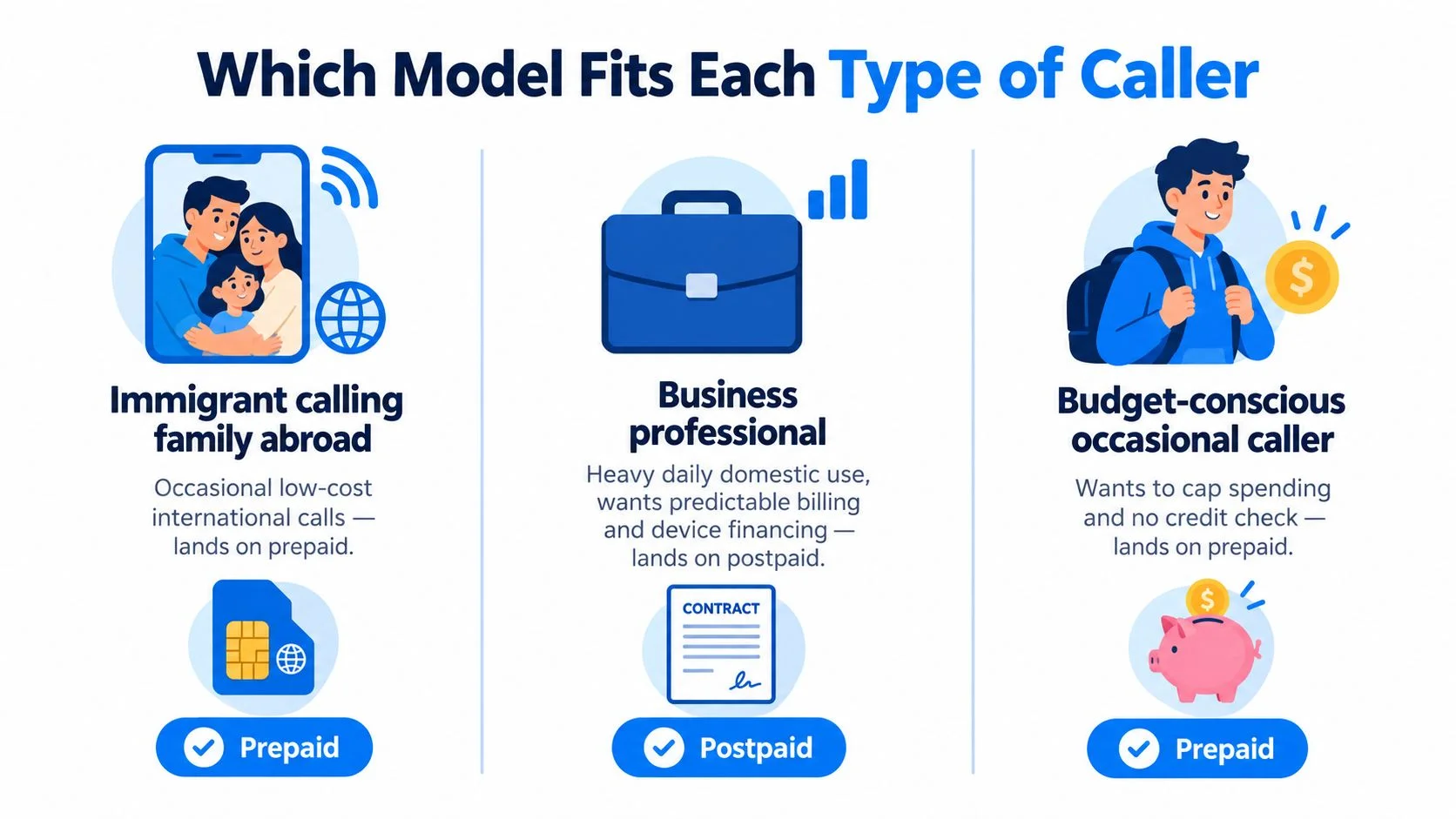
Immigrants and occasional international callers usually fit prepaid, small businesses often fit postpaid, and developers need prepaid-style controls even when they operate at scale. The right model follows the usage pattern, not the user's job title.
An immigrant calling family abroad may place a handful of calls during the month, then go quiet. A contract adds little value if the primary need is occasional access without a credit check. Prepaid lets the caller add a small balance, make the call, and avoid paying for a dormant monthly service.

Three practical caller profiles
A small business with overseas clients has a different problem. The owner may need predictable monthly invoicing for expense reporting, shared access for staff, and a stable service relationship. If the business can pass a credit check and uses the service consistently, postpaid can reduce administrative work, particularly when bundled minutes or consolidated invoices are genuinely useful.
A developer running voice agents or outbound notifications needs another kind of predictability. The key requirement isn't a traditional monthly bill. It's the ability to set a controlled starting balance, inspect usage, and increase volume only after the workflow behaves as expected. Prepaid credits provide a natural guardrail for prototypes and low-volume launches.
These aren't rigid categories. A family may keep a postpaid household line for everyday domestic use and add prepaid international calling when relatives are abroad. A business may begin with prepaid testing, then move its stable production workflow to postpaid invoicing.
The right question is simple: Does the account need to stay active every month, or does the caller need the freedom to activate usage only when required?
Hidden Costs and Billing Mechanics to Watch For
The advertised rate isn't the complete cost. Prepaid users need to inspect rounding and credit-expiry rules, while postpaid users need to understand invoices, overages, device financing, and roaming.
Prepaid risks
Minute rounding deserves attention. If a service rounds every call up to a whole minute, a brief 12-second call can consume a full billed minute. That rule isn't automatically bad, but you should know it before comparing offers.
Check whether credits expire and whether the provider charges an inactivity fee. Travelers should prioritize non-expiring credit, especially if they call only during trips or occasional family events. An account that drains while unused isn't flexible in practice.
Postpaid risks
Postpaid makes delayed costs easier to miss. Device financing can keep you tied to a plan for 24 to 36 months, while international roaming may add charges on top of the regular service. Overage costs also arrive after the usage decision, when it's too late to prevent them.
Small businesses should require itemized invoices before approving a recurring account. The invoice should distinguish base service, international usage, add-ons, device payments, and any overage. Developers should look for per-second billing where available, plus webhook-based spend alerts before scaling an automated workflow.
For account-specific explanations of credits, billing, and usage, consult the BubblyPhone billing help page. Read the actual terms rather than assuming every prepaid service handles balances the same way.
Why Flexibility Has Overtaken Price as the Real Question
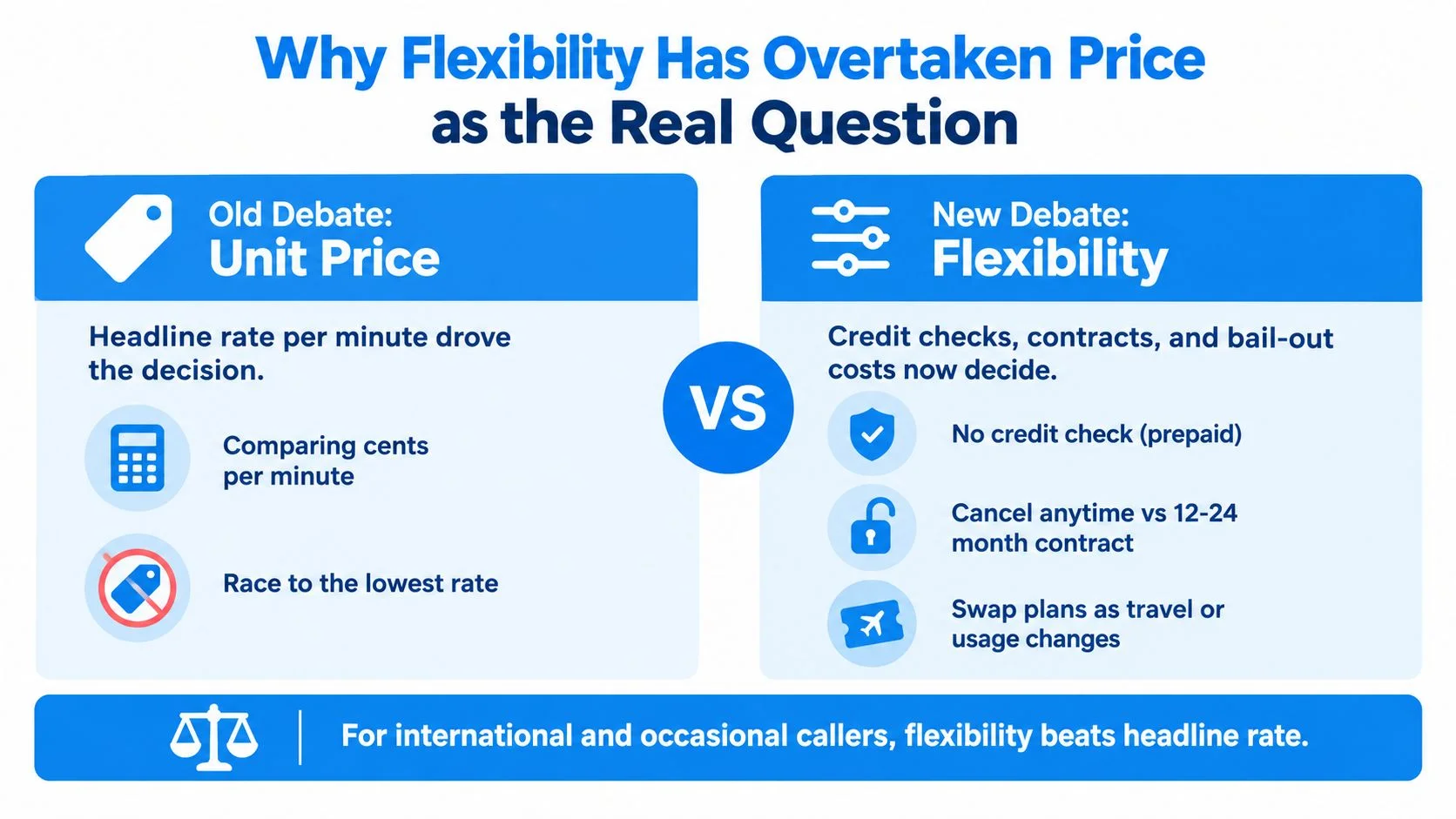
For most occasional international callers, flexibility is a better tiebreaker than a small difference in the unit rate. The winning setup lets you start small, avoid a credit check, stop when you stop calling, and return when you need access again.
The old comparison focused on cents per minute. That approach still has a place, but it ignores the cost of being locked into a monthly cycle. A slightly lower unit price doesn't help much if you pay for unused service, finance a device you don't need, or spend time disputing an invoice.

What flexibility looks like in practice
Ask four direct questions:
- Can you start small? Prepaid lets you test your calling pattern without committing to a full billing cycle.
- Do you need a credit check? If approval is uncertain or undesirable, prepaid removes a major source of friction.
- Can you stop immediately? With prepaid, you can pause top-ups when calling stops. Postpaid generally continues on its billing schedule.
- Will your usage change? Travel, family needs, client work, and software experiments rarely follow a perfectly stable monthly pattern.
Postpaid remains useful for heavy, predictable calling. A business that needs consolidated monthly accounting may rationally accept the commitment. But that is a bookkeeping requirement, not proof that postpaid is better in every case.
My recommendation: If your use is occasional, international, or device-free, start with prepaid. Earn the complexity of postpaid only when regular usage and invoicing make it worthwhile.
The broader market is moving in the same direction. In the US, prepaid returned to growth in Q1 2025 for the first time since Q3 2022, while major providers also reported prepaid gains alongside postpaid migration, according to this analysis of prepaid and postpaid movement. That doesn't make prepaid the universal winner. It does show that flexibility, qualification, and financing now matter alongside price.
How BubblyPhone Fits the Prepaid Side of the Decision
BubblyPhone uses prepaid credits for browser-based international calling, with a minimum top-up of $5 and credits that never expire. There's no subscription for calling, no contract, and no credit check required for the pay-as-you-go calling setup.
You can call from a modern browser to a landline or mobile, so the person receiving the call doesn't need an app or account. That directly addresses a common international-calling problem: the caller may want a flexible tool, while family members, clients, or suppliers just want an ordinary phone call.
Match the setup to the use case
An immigrant calling family abroad can add a small balance, place a call, and stop without maintaining a monthly plan. A traveler or remote worker can use the browser from a device already available to them instead of obtaining another SIM or activating a long-term service.
A small business can use prepaid calling to test overseas outreach before committing to recurring invoicing. A developer can prototype voice agents and automated calling workflows with a controlled balance, then monitor usage before increasing spend.
Calls are billed per minute and rounded up to the whole minute, so that mechanic should be included in your cost calculation. Country-specific pricing is shown before dialing in the live international rates, and calling credits can be topped up through supported payment methods.
The model also avoids device financing and bundled minutes. That's a limitation only if you specifically need a financed handset or a packaged mobile plan. For users who already own a device and want international access, the absence of those extras keeps the decision focused on actual calling.
BubblyPhone also offers optional dedicated numbers for receiving calls and receiving SMS. Those numbers are separate from the pay-as-you-go outbound calling balance, and the dedicated-number plan is the only recurring product. If you need a separate phone identity for work or travel, see the guide on getting a dedicated number.
Choosing Your Model and Making the First Call
Choose prepaid if you call internationally only sometimes, want no contract, or need to avoid a credit check. Choose postpaid if your usage is heavy and predictable, you need formal recurring invoices, and device financing or bundled service matters.
Use this checklist before opening an account:
- How often will you call? Occasional calls point to prepaid. Daily, stable usage may support postpaid.
- How much of your usage is international? If overseas calling is a separate, variable need, prepaid keeps it from becoming another permanent monthly commitment.
- Do you need a physical device? If you already have a phone or computer, browser-based or app-based prepaid calling may be enough. If you need a financed handset, postpaid is more likely to fit.
- Can you tolerate a monthly commitment? If the answer is no, don't choose a plan that depends on recurring billing.
- How predictable must the budget be? Prepaid gives you a visible ceiling before usage. Postpaid gives you a predictable invoice format only if your usage stays predictable.
Mostly occasional, international, and device-free answers point clearly to prepaid. Mostly heavy, regular, invoice-driven, and device-financed answers point to postpaid.
My direct advice is to start small with prepaid credits and place a test call. Check the billed duration, confirm that the recipient can answer normally, and review the balance afterward. That short operational test tells you more than an hour spent comparing promotional claims.
Make your first international call through BubblyPhone from any browser, using pay-as-you-go credits that start at $5 and never expire. The recipient needs no app or account, and you can call a landline or mobile without a subscription.