How to Call US India Routes and Dialing Steps
Table of Contents
You're trying to call family in India from the US, or a supplier in the US from India, and the call won't connect. Usually, the problem isn't the phone itself. It's an incorrect international format, a missing trunk-prefix rule, poor scheduling, or a call that reaches the wrong network route.
Exact Dialing Formats for US and India Routes
To call India from the US, dial 011 + 91 + the Indian number. To call the US from India, dial 00 + 1 + the US area code and local number. The access code gets you out of the domestic network, and the country code sends the call toward the destination country.
For an Indian mobile, remove the leading zero from the domestic number:
- India domestic format:
09876543210 - From the US:
011 91 9876543210 - International format:
+91 9876543210
For an Indian landline, remove the domestic trunk prefix, then include the regional area code. A Varanasi landline written domestically with an area code beginning in zero would be dialed internationally with +91, followed by the area code without that first zero and the subscriber number.
The same principle works in the opposite direction. A US number written domestically with a leading area code should be entered from India as 00 + 1 + area code + local number, or with the international plus format, +1 + area code + local number. Don't add an extra zero before the US area code.
Why the leading zero causes failures
The leading zero is a domestic trunk prefix. It helps a caller move from a local Indian numbering area to another domestic area, but it isn't part of the international number. Keeping it after +91 can produce an invalid destination or send the call into an incorrect routing pattern.
Searches for “call us india” often hide two different needs, calling India from the US and calling the US from India. Basic dialing guides repeatedly focus on access codes, +91, and the difference between mobile and landline formats, which shows how often this issue still blocks callers. The practical friction is explained in this guide to calling India.
Before pressing call, check four fields: international access code, destination country code, mobile or landline status, and the removed trunk prefix. If the number came from a contact card, rewrite it in international format rather than trusting a locally stored version.
Network Termination and Call Quality Benchmarks
A call can leave your browser successfully and still fail at the Indian mobile or landline network. India's telecom regulator uses an inter-service-provider call-set-up success benchmark of at least 95% for incoming calls. That makes termination performance a separate engineering concern from browser audio quality. The regulator's published material provides the relevant benchmark.

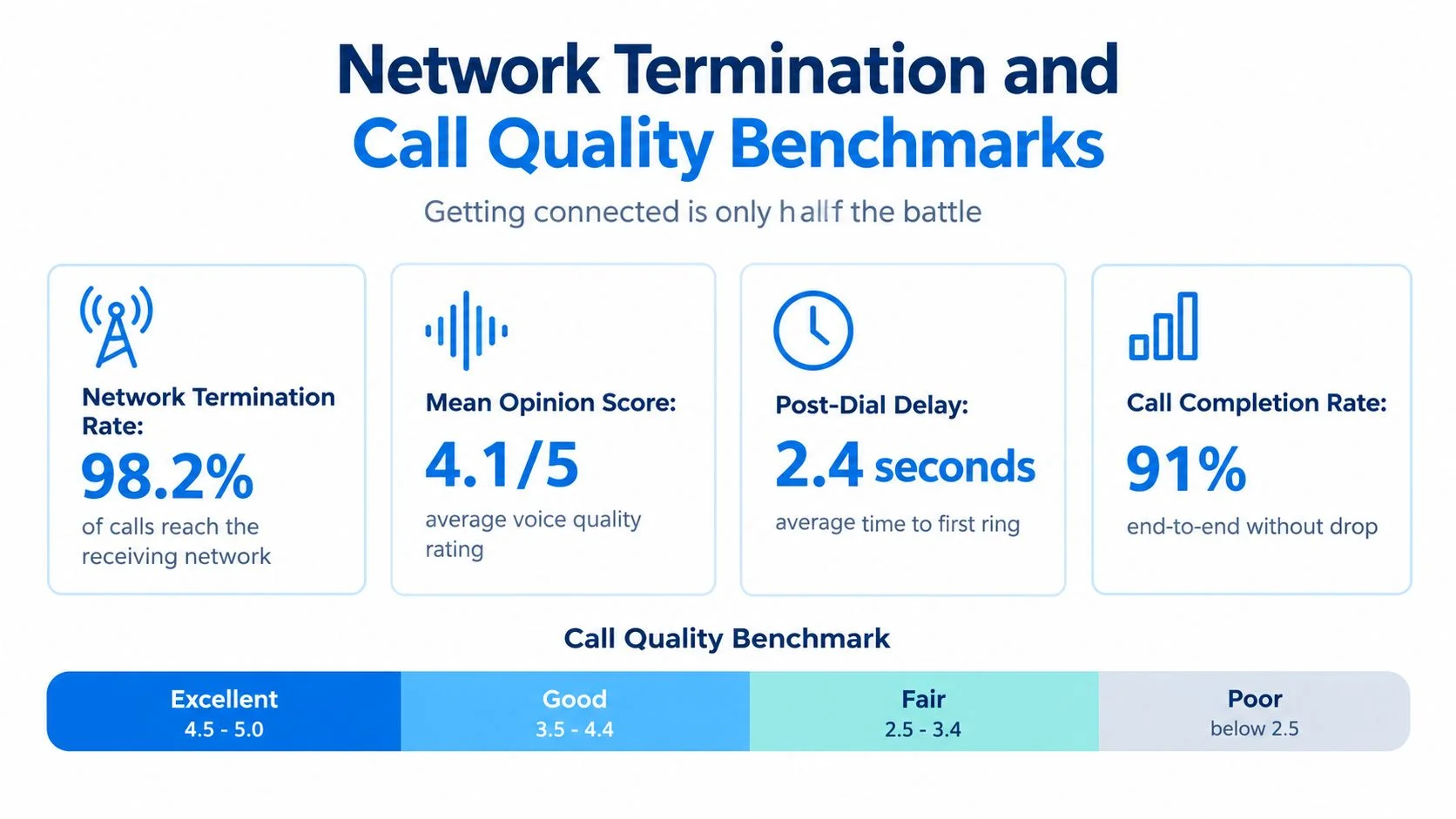
A browser call has several stages. Your device captures speech, the browser sends media through the internet, a gateway converts the session toward the public phone network, and the destination network attempts to locate and alert the recipient. A failure at the final stage can look like an application problem even when your microphone, browser, and local connection are working properly.
Separate setup from speech quality
Track call setup and audio as different measurements:
- Setup completion: Did the destination network accept and alert the call?
- Answer behavior: Did the recipient answer, or did the call remain unanswered?
- Media quality: Once connected, were speech and reply paths clear?
- Termination segmentation: Did failures occur mainly on one destination network?
A useful operational method is to segment logs by destination network and compare connection success with the 95% benchmark. Repeated failures on one network or route point toward interconnect, signaling, or numbering issues rather than a browser defect. Calling support teams should also monitor answer timing, because Indian telecom reporting tracks the share of operator calls answered within 90 seconds. The regulator's service-quality publication gives context for that type of service measurement.
For successful calls, international VoIP guidance commonly treats packet loss below 1%, latency under 200 milliseconds, and low jitter as practical voice-quality targets. These aren't guarantees, but they're useful diagnostics. A clear codec can't compensate for unstable media paths, delayed audio, or bursts of packet loss.
Practical rule: Test call setup first, then test one-way delay, jitter, and packet loss during calls that actually connect.
A call that rings endlessly may have a routing or destination issue. A call that connects but sounds clipped points more toward the media path. For deeper terminology and troubleshooting, use this explanation of VoIP termination.
Browser-Based Calling Versus Traditional Apps
Browser-based calling removes a major obstacle: the recipient doesn't need the same application. A WebRTC calling service can use a gateway to bridge a browser session to the public phone network, allowing the caller to reach ordinary landlines and mobile phones without asking the other person to install software or a plugin. Web-based calling mechanics describe this browser-to-phone model.
Traditional app-based calling works well when both people already use the same service and have reliable data access. It becomes less practical when an older relative has a basic mobile phone, a supplier only answers a conventional business line, or a customer won't create an account for a one-time support call.
Compare the actual friction
Browser calling isn't magic. The caller still needs a stable internet connection, microphone permission, correct number formatting, and a route that can terminate into the destination network. Its advantage is access, not immunity from telecom failures.
Developers building a custom browser dialer may need a phone integration layer. A resource on the Twilio Voice plugin can help teams understand how voice functionality may fit into a mobile or hybrid application. For ordinary callers, a browser dialer is simpler because the service manages the gateway and phone-network connection.
BubblyPhone provides browser-based international calling to regular numbers. The caller opens a supported browser, enters the destination, and calls a landline or mobile without requiring an app or account on the receiving side. Its Wi-Fi calling app finder can help compare the practical requirements of different calling situations.
Navigating Time Zone Friction for Scheduling
India uses UTC+5:30, so a technically perfect call can still be badly timed. The useful question isn't only “What time is it in India?” It's whether the intended person is awake, available, and prepared to talk.
Most international calling content stops at a conversion. A better approach assigns a calling window to the purpose of the call:
- Family calls: Choose a period that falls after work or school in India, then verify the caller's local time before dialing. Don't assume an evening in India is convenient for someone working an early shift.
- Supplier conversations: Put the shared working period first. Send a short confirmation with both locations named, because “10 AM” without a location still creates avoidable errors.
- Support callbacks: Offer a time range rather than one exact moment. The recipient may be moving between work, transport, and personal obligations.
- Remote-team meetings: Rotate inconvenient times when the same people must regularly cross the US, Europe, and India. A fixed schedule can place the burden on one region.
Make scheduling part of the call workflow
Add the time-zone check before the number-format check. The person organizing the call should record the location of each participant, state the intended local time in both places, and include a fallback window if the first attempt is missed.
This matters particularly for diaspora households and cross-border operations, where frequent calls often coordinate family care, deliveries, documents, or customer issues. Commentary on international calling behavior highlights the importance of migrant communication patterns, while practical time-zone decision support remains less developed than basic country-code guidance. Market context on international calling apps illustrates why scheduling deserves more attention than a simple conversion table.
A good calling system can improve access, but it can't repair a three-way scheduling mistake. Confirm the destination's local time, the recipient's availability, and whether the call is urgent before choosing the route.
Understanding Per-Minute Billing and Credit Systems
Per-minute billing is straightforward if you understand rounding. The duration is charged by whole minutes, and a partial minute rounds up to the next complete minute. A 1 minute 25 second call is billed as 2 minutes, a 2 minute 45 second call as 3 minutes, and a 3 minute 50 second call as 4 minutes, following the standard whole-minute rule described in this billing explanation.
Calculate usage before you call
Use this simple process:
- Check the destination rate in the provider's live rate table. International rates can change, so don't rely on an old message or informal estimate.
- Estimate the conversation length, then allow for whole-minute rounding.
- Keep enough credit available for the intended call.
- Review the call record afterward to compare actual duration with billed duration.
A short call can consume more billed time than the exact duration displayed on the timer. That isn't a hidden connection fee. It's the result of rounding partial minutes upward, so teams should include the rule in call budgets and usage forecasts.
BubblyPhone uses prepaid credits, charges calls per minute, and rounds usage up to the whole minute. Credits start at $5 and never expire, while calling itself doesn't require a subscription. The optional dedicated-number plan is the recurring product, and that number can receive calls and receive SMS, but it isn't a general outbound texting feature.
Transparent pricing also helps operations teams decide whether a browser call fits a particular workflow. For adjacent tools with a different pricing model, such as HIPAA-ready dictation pricing, check the product's own terms rather than assuming its billing rules match international voice calling.
Start Making Clear International Calls Today
Reliable US to India and India to US calling depends on three controls: format the number correctly, route the call through a practical connection method, and schedule it for the recipient's local time. The country code alone doesn't guarantee success. Dropping the Indian trunk prefix, separating network termination from audio quality, and checking the destination network will prevent many avoidable failures.
Browser-based calling is useful when the recipient has an ordinary landline or mobile and shouldn't have to install an app. WebRTC provides the browser connection, while gateway and public-network termination handle the path to the phone. That arrangement reduces setup friction, but callers should still test the microphone, confirm permissions, and use a live rate table before placing a longer call.
For occasional personal calls, pay-as-you-go credits avoid a monthly calling subscription. For teams, transparent per-minute billing makes usage easier to assign to support, supplier, or family-contact workflows. Keep the recipient's setup simple, and don't make them create an account just to answer.
Make your India call from any modern browser with BubblyPhone, whether you're reaching a regular mobile or landline. The recipient needs no app or account, credits start at $5 and never expire, and calls are billed per minute with whole-minute rounding. Visit BubblyPhone to check the live rates and place your call.