How Do You Call India: Complete 2026 Dialing Guide
011 91 98765 43210 from the United States reaches an Indian mobile, while a landline call uses the exit code, 91, the Indian area code, and the local number with the leading 0 removed. From any country, the pattern is your exit code, then 91, then the Indian national number.
You may already be staring at a contact that looks correct, wondering why the call rings once and disconnects. Usually, the problem is small: you kept the domestic 0 from an Indian landline, missed your own country's international exit code, or copied a local format into an international dialer. The steps below make each part clear, with strings you can copy and adapt.
What Dialing India Actually Looks Like
From the United States, dial 011 91 98765 43210 for an Indian mobile, or 011 91 11 2345 6789 for a Delhi landline. The format follows the international pattern of the caller's exit code, India's country code 91, and the Indian mobile or landline number, consistent with India's E.164 dialing format.
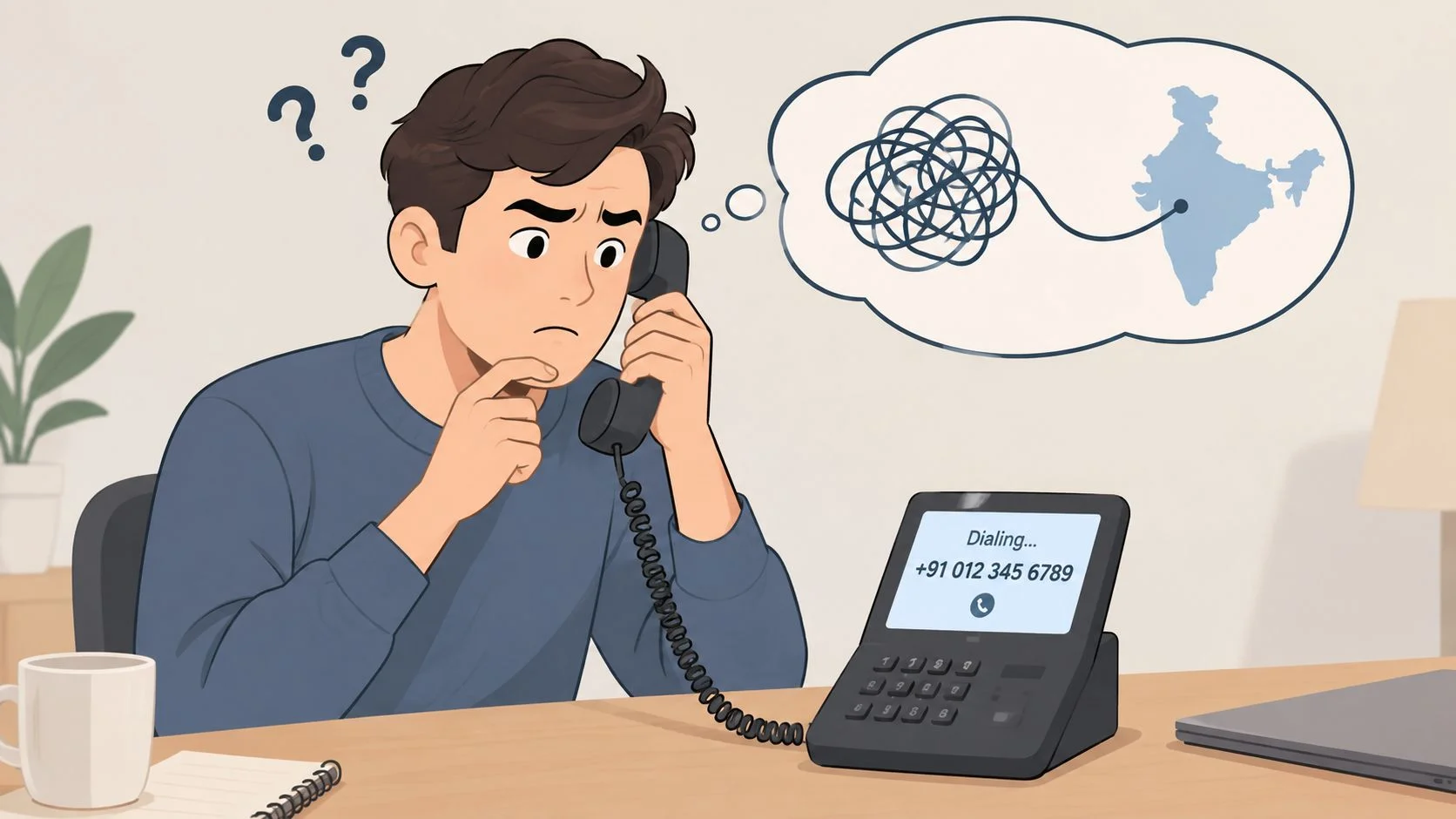
A failed call often comes from treating an Indian landline number as though you're calling from inside India. A number written domestically as 011 2345 6789 includes the domestic trunk prefix 0. From abroad, that 0 is removed, leaving the Delhi area code 11 after 91.

Read the number in clusters
- 011 is the United States exit prefix. It tells the telephone network that the call is leaving the country.
- 91 is India's fixed international country code, assigned under the ITU E.164 numbering plan.
- 98765 43210 is the complete Indian mobile number.
- 11 is Delhi's geographic area code when written internationally.
- 2345 6789 is the Delhi landline subscriber number.
The country code stays the same wherever you call from. The first cluster changes with your origin country, and the destination portion changes depending on whether you're calling a mobile or a fixed line. Once you separate those jobs, the string stops looking like one long unfamiliar number.
Practical rule: If you're calling an Indian landline from abroad, remove the domestic 0 before adding the country code. If you're calling a mobile, use the full 10-digit number after 91, without adding a 0.
The Building Blocks of an International Call to India
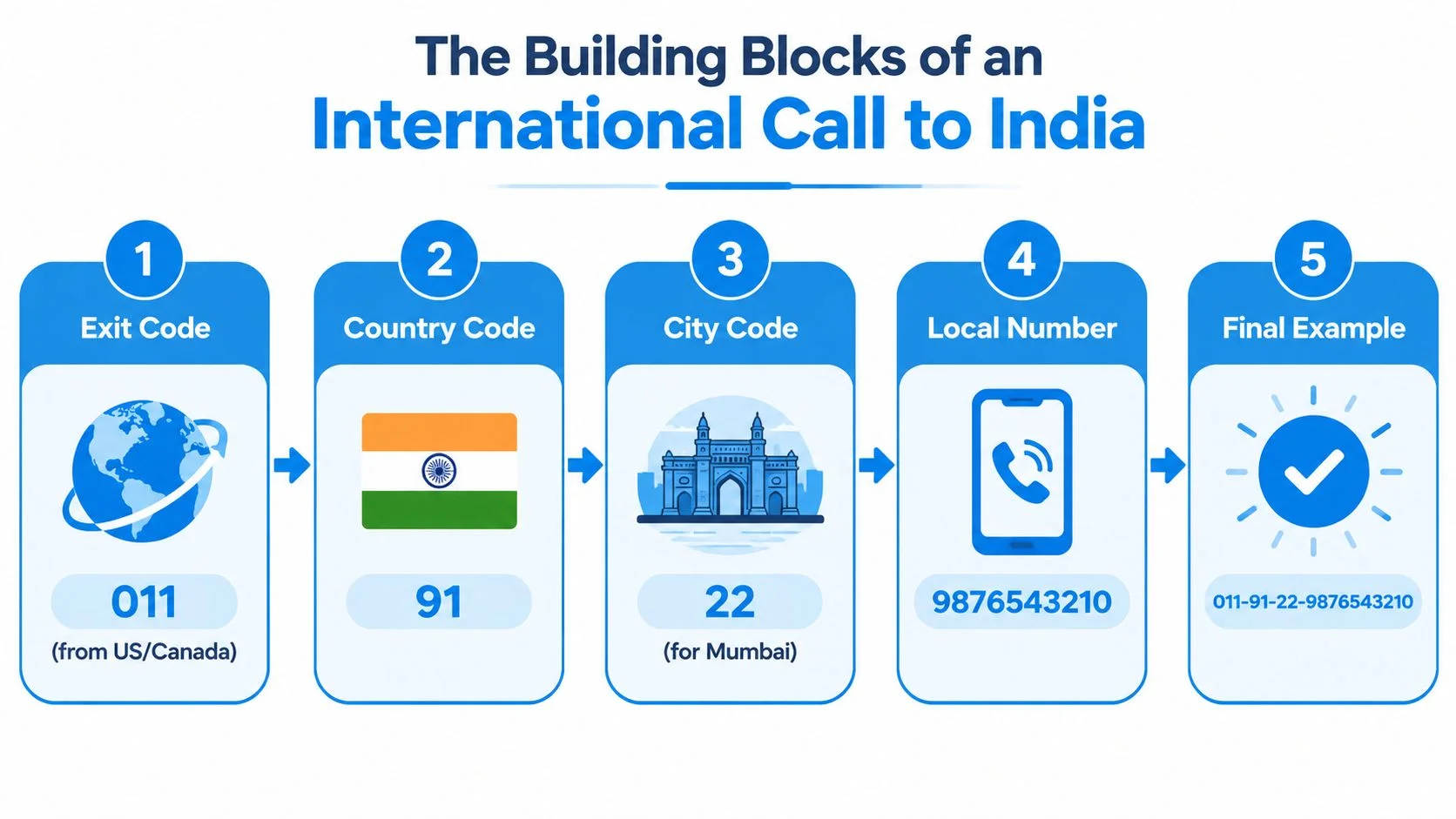
The universal structure is exit code + 91 + Indian national number. For a Mumbai mobile, that means the caller's exit code, 91, and the full 10-digit mobile number. For a Mumbai landline, it means the exit code, 91, the Mumbai area code, and the local subscriber number.
Use this worked example for a Mumbai landline written domestically as 022 9876543210 only if the destination number has been supplied in that form. Internationally, the domestic trunk 0 is removed, so the city code becomes 22. Indian numbering uses geographic area codes paired with subscriber numbers, and public numbering references describe area codes of 2, 3, or 4 digits paired with subscriber portions of 8, 7, or 6 digits respectively, as summarized in this overview of Indian telephone numbers.
Five pieces to check
- Exit code: Use the international access prefix for the country where you're calling. The United States and Canada use
011, the United Kingdom and most of Europe use00, and Australia uses0011. - Country code: India is always
91. - Domestic trunk digit: The
0belongs to domestic Indian dialing. Drop it when calling internationally. - Area or STD code: A fixed line uses its geographic code, such as
22for Mumbai or11for Delhi. - Subscriber number: Add the remaining local digits exactly as provided.

For a mobile, there's no separate city code. The international version is the exit code, 91, and the 10-digit mobile number. You can also save the contact in plus format, such as +91 98765 43210, which lets a mobile device substitute the appropriate international access code. The India country code guide gives you another quick reference when you're checking a number before dialing.
Indian Mobile Numbers vs Landline Numbers
Indian mobiles and landlines both use a 10-digit national numbering format, but you assemble them differently. A mobile takes 91 plus the full 10-digit number. A landline takes 91 plus the area code and subscriber number, with the domestic leading 0 removed.
An Indian mobile number commonly begins with 6, 7, 8, or 9 after +91. The number doesn't need a city code, so don't insert Mumbai's 22 or Delhi's 11 before a mobile number. Enter the complete 10-digit mobile number immediately after 91.
Landlines create the more frustrating error. Delhi's domestic format may appear as 011 2345 6789. Inside India, the first 0 is the trunk prefix and 11 identifies Delhi. From abroad, use +91 11 2345 6789, or replace the plus sign with your country's exit code.
A mobile number identifies the subscriber. A landline number identifies a geographic line. That's why only the landline needs an area code.
Mobile recipients can receive calls wherever their service works, while a landline remains associated with a fixed handset and location. If someone sends you a number with spaces, parentheses, or a domestic 0, first decide which type it is. That single check prevents most formatting mistakes.
How to Dial India From Common Countries
Use your own country's international exit code, then 91, then the Indian destination. The examples below show the same Mumbai mobile and Delhi landline from different origins.
The United States and Canada use 011 in the examples above. Start with 011, add 91, and then paste the Indian number. A mobile becomes 011 91 98765 43210. A Delhi landline becomes 011 91 11 2345 6789.
From the United Kingdom and most of Ireland, use 00. The mobile string is 00 91 98765 43210, and the landline string is 00 91 11 2345 6789. The domestic Indian zero still stays out.
From Australia and New Zealand, use 0011. That produces 0011 91 98765 43210 for the mobile example and 0011 91 11 2345 6789 for the landline. Some Australian GSM services may also accept 0014, while some Canadian long-distance plans may require 102, so check your plan if the standard prefix fails.
On a mobile phone, the plus sign is usually simpler. Save the number as +91 98765 43210 or +91 11 2345 6789. The device handles the exit code for the country where it's currently registered, following the international format specified by India's Department of Telecommunications.
What Calling India Really Costs
The cost depends on the calling route and the plan you use, so check the live destination rate before dialing. A transparent rate table should show the per-minute charge, whether there's a connection fee, and the rounding rule, rather than presenting one vague promise about cheap international calls.
Three factors usually shape the final bill:
- Termination cost: The destination network and route affect what it costs to complete the call.
- Retail markup: The service you use adds its own margin and may package calls through an add-on or prepaid balance.
- Voice path: A browser call over internet data and a traditional switched voice call can use different pricing structures.
The billing details matter as much as the headline rate. A service that bills every started minute will charge a partial minute as a whole minute, while a service using a different interval can calculate the same conversation differently. Read the displayed rounding rule before you compare options, and confirm whether a connection fee appears separately.

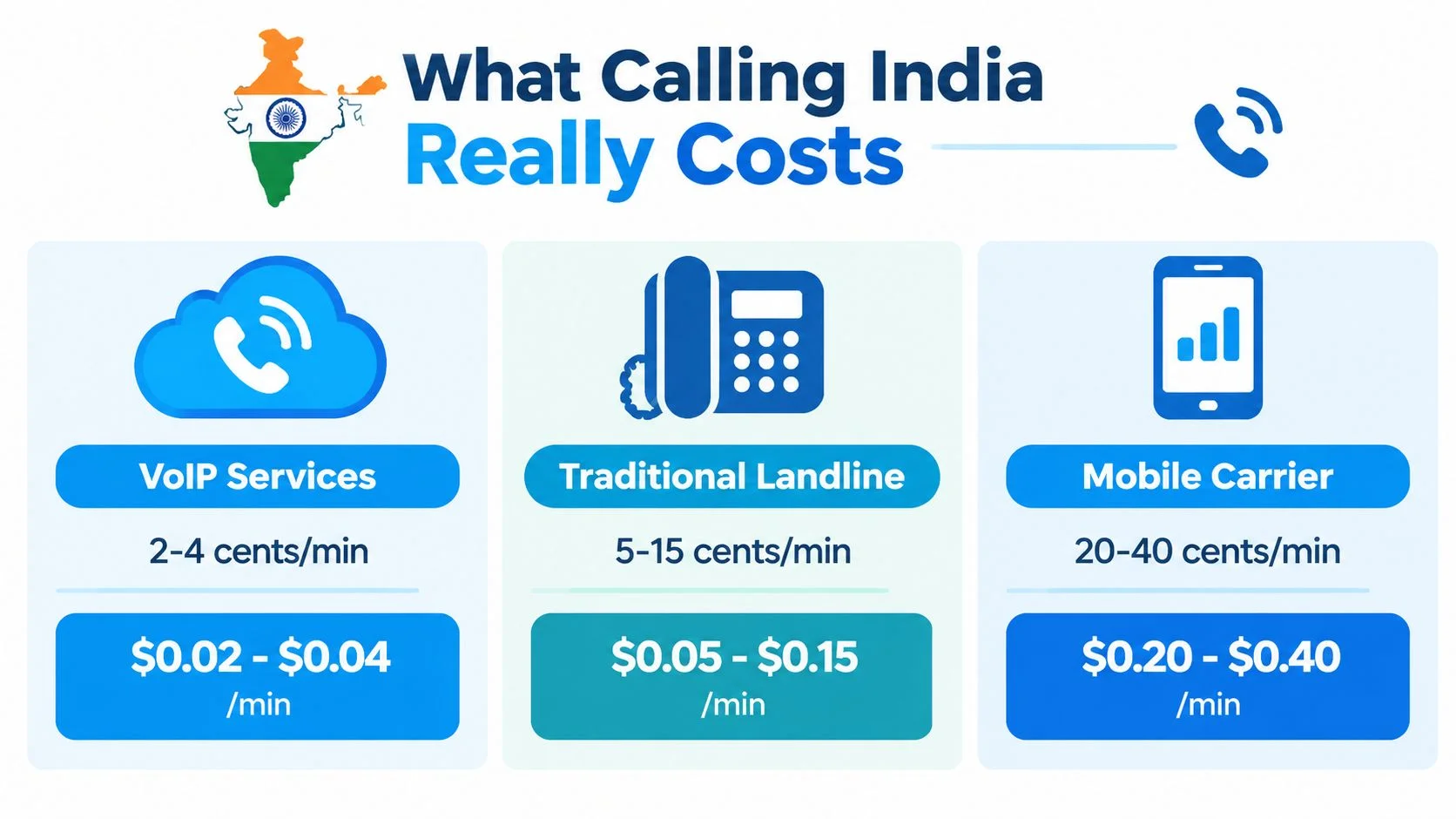
For a quick estimate, enter the destination and expected duration into the India call cost calculator. BubblyPhone's pay-as-you-go model bills by the minute, rounds up to the whole minute, requires no calling subscription, and lets users start with credits from $5 that don't expire. The optional recurring product is a dedicated-number plan, not a requirement for ordinary outbound calls.
The person receiving a call on an Indian mobile generally doesn't pay an international calling charge for answering. Your originating service and plan determine what you pay, so verify the caller-side terms before pressing the call button.
Calling India From a Browser Without an App
You can call an Indian mobile or landline from a browser without asking the recipient to install anything. A browser dialer sends your audio over the internet, then connects the call to the recipient's ordinary telephone line, so the other person answers normally.

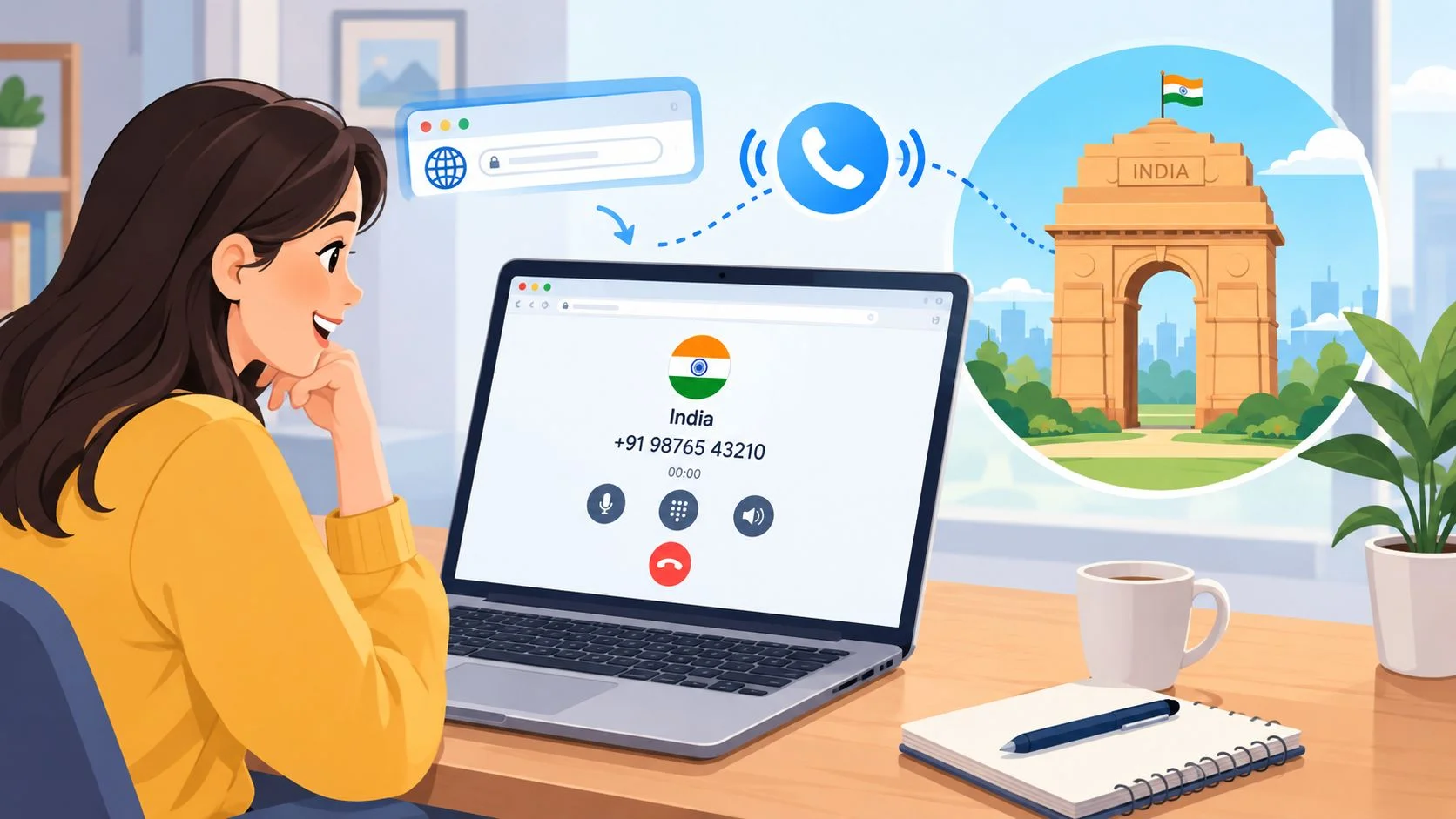
A simple browser setup
- Open the web dialer and sign in.
- Enter the Indian number in international form, such as
91 98765 43210. - Check the destination and displayed rate.
- Select an available caller ID option if the service provides one.
- Allow microphone access, then press call.
The recipient doesn't need an app, account, SIM swap, or compatible smartphone. That's useful when you're calling a relative with an older feature phone, a supplier's office landline, or someone who doesn't want another communication service. The browser calling guide for India covers the same no-app recipient approach.
Browser audio depends on your own setup. Use a stable internet connection, approve microphone access, test your speaker or headset, and choose a quiet room. If the call sounds broken, move closer to your Wi-Fi access point or switch to a more stable connection before blaming the Indian number.
The browser route is especially practical for a one-off call because you don't need a handset application or a second device. You enter the international number once, confirm the destination, and let the dialer handle the connection.
Quick Troubleshooting and Your First Call
Most failed calls to India come from four checks: remove the landline's domestic zero, confirm your exit code, inspect the caller ID setting, and account for India's local time. Fix those before changing devices or assuming the number is disconnected.
- The call rings or ends quickly: Remove the leading
0from an Indian landline. Use+91 11 2345 6789, not+91 011 2345 6789. - A network-busy recording plays: Recheck the complete international string, then try again on a stable connection.
- The recipient sees “Unknown”: Review the caller ID option in your dialer. Some destinations or routes may not display the number you expect.
- Nobody answers at a sensible hour: Check the time in the recipient's Indian city before calling, especially if you're several time zones away.
- The number looks too short or too long: Ask whether it's a mobile or landline, then rebuild it using the correct format rather than adding digits at random.
For your first browser call, open the dialer, enter a full international mobile string such as +91 98765 43210, and verify the destination before pressing call. Confirm the live rate, add prepaid credits starting from $5, and listen for audio quality during the opening moments.
If you're speaking with family, a few simple words can make the conversation warmer. Keep a reference for practical Hindi phrases from ChatPal nearby, then focus on a clear connection and a comfortable calling time.
Use BubblyPhone to call an Indian mobile or landline directly from any browser. The recipient needs no app or account, credits start at $5 and never expire, and you can place a pay-as-you-go call without a subscription.