Transparent Prices for International Calls

Table of Contents
Transparent prices for an international call mean you can see the destination rate, whether the number is a mobile or a landline, the per-minute billing unit, and any extra charge before the call starts. A single undated headline number isn't enough, because it doesn't tell you what this call, to this number, will debit.
The popular advice is to hunt for the lowest advertised minute. That's the habit to drop. A lower headline can cost more once rounding, per-call fees, and your pattern of short calls are counted.
What Transparent Prices Mean Before You Dial
Transparent prices mean the country, the number type, the per-minute unit, and any separate fee are visible together before you dial. You shouldn't have to infer the cost from a slogan or work it out backwards from a smaller balance.
Take a simple scene. You're about to call a parent overseas on their mobile. You pause, check the row for that country and that number type, and confirm the call is charged per minute. If you've turned on an optional extra, such as live translation, that charge sits on its own line rather than hiding inside the call rate.
The pieces that belong together
- Destination and number type: A mobile and a landline in the same country can carry different rates, so a country name alone isn't a price.
- Billing unit: You need to know the charge is per minute and how partial minutes are handled.
- Optional add-ons: Translation or a dedicated number should be priced separately from ordinary calling.
- Commitment: Ordinary outbound calling shouldn't require a subscription.
That last point matters for businesses too. A small team that works across sites still needs each charge tied to a call it can identify, much as managers think about keeping office extensions accessible to remote teams without losing track of who can be reached and at what cost.
A clear price answers one question before you commit. What will this call, to this number, cost for each billed minute?
This article won't quote a destination rate. Rates change, and a printed figure can be out of date by the time you dial. Instead, it shows how to read a live rate table at the moment of the call, how rounding changes short calls, and how to spot a setup you can check afterward. The test throughout is simple. Could you predict the debit before dialing, and could you match it to a record afterward?
Why a Posted Number Is Not a Clear Price
A posted number isn't a clear price if you can't tell what it covers, which number it applies to, or whether it's current. Publication and usability are different things, and confusing them is where most surprises start.
Other regulated markets have learned that distinction the hard way. In the United States, hospital price transparency became a formal requirement on January 1, 2021, when the Centers for Medicare and Medicaid Services required hospitals to publish standard charges in two forms, a detailed machine-readable file and a consumer-friendly display of at least 300 shoppable services, as described in the 2024 study of hospital price disclosure. By January 2023, 5,162 of 6,692 hospitals, or 77.1%, had disclosed pricing information in that same study, and 2,794 of those hospitals, or 54.1%, began within the first six months.

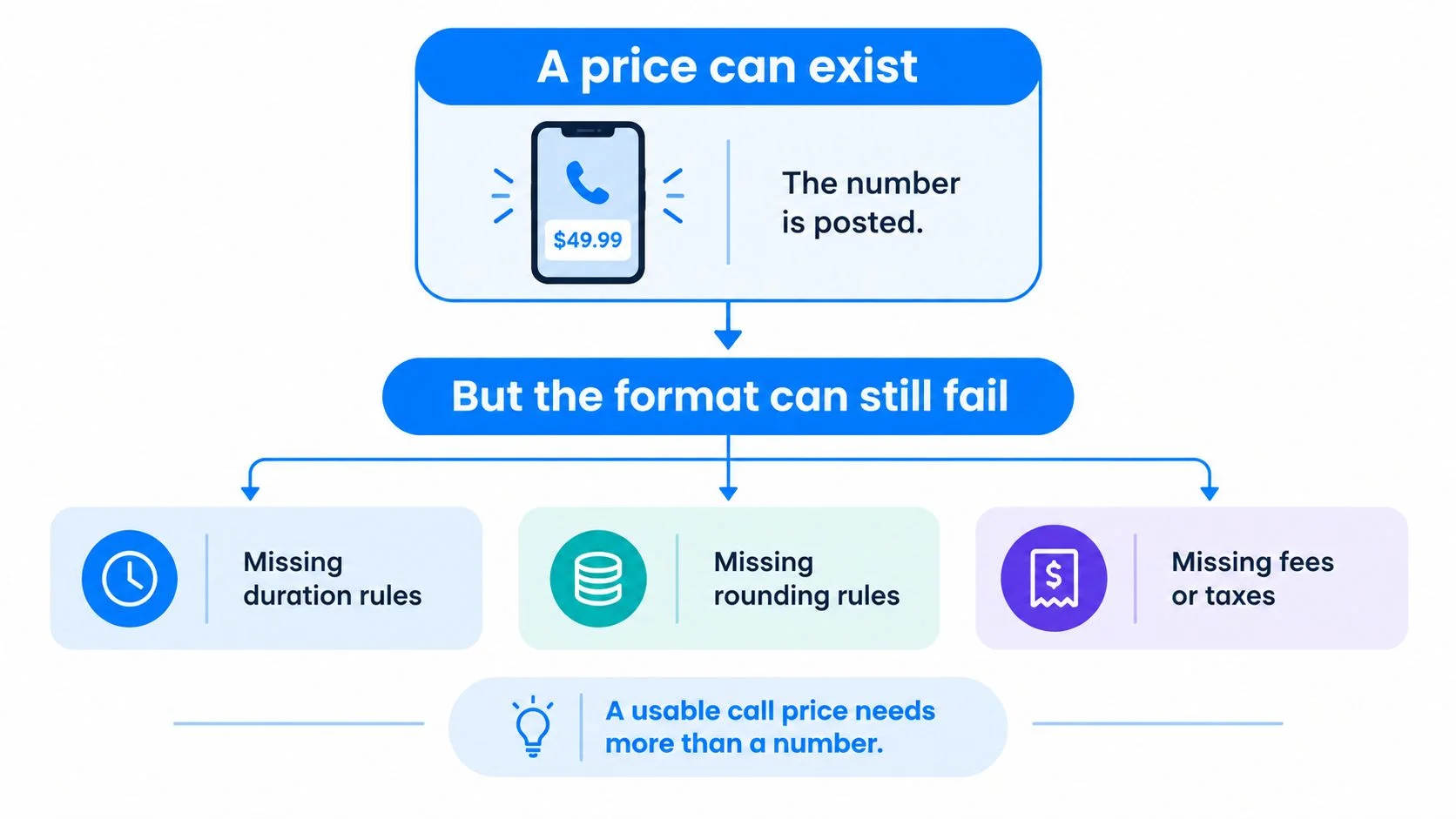
Those hospital rules don't govern phone calls. They are useful here only because they separate complete data from a decision-ready price. A huge file can hold every charge and still leave a person unable to answer a basic question at the moment of choice.
The same split in calling
A giant, undated sheet of countries is the calling version of raw data. It may be complete, but you can't act on it confidently if it doesn't say which row fits a mobile, which fits a landline, or when the figure was last checked. A decision-ready price is narrower and more useful. It names the country you're calling, matches the number type you're about to dial, states the per-minute unit, and reflects the rate in force now.
Keeping published data accurate is also work, not a one-time upload. From 2021 through 2023, CMS reviewed 1,746 hospitals and initiated enforcement actions against 1,287 of them, or 74%, and it issued more than $4 million in civil monetary penalties to 14 hospitals, according to the Government Accountability Office report on hospital price transparency enforcement. In a CMS sample, 70% of hospitals published both required formats in 2022, compared with 27% in 2021.
You don't need hospital policy to call family abroad. You do need its lesson. Look for a timestamp or a rate-checked cue, a consistent format you can compare, and a record that matches what you expected. If the number is posted but the unit, date, or number type is missing, you have data. You don't yet have a price you can rely on.
How Per-Minute Billing and Rounding Work
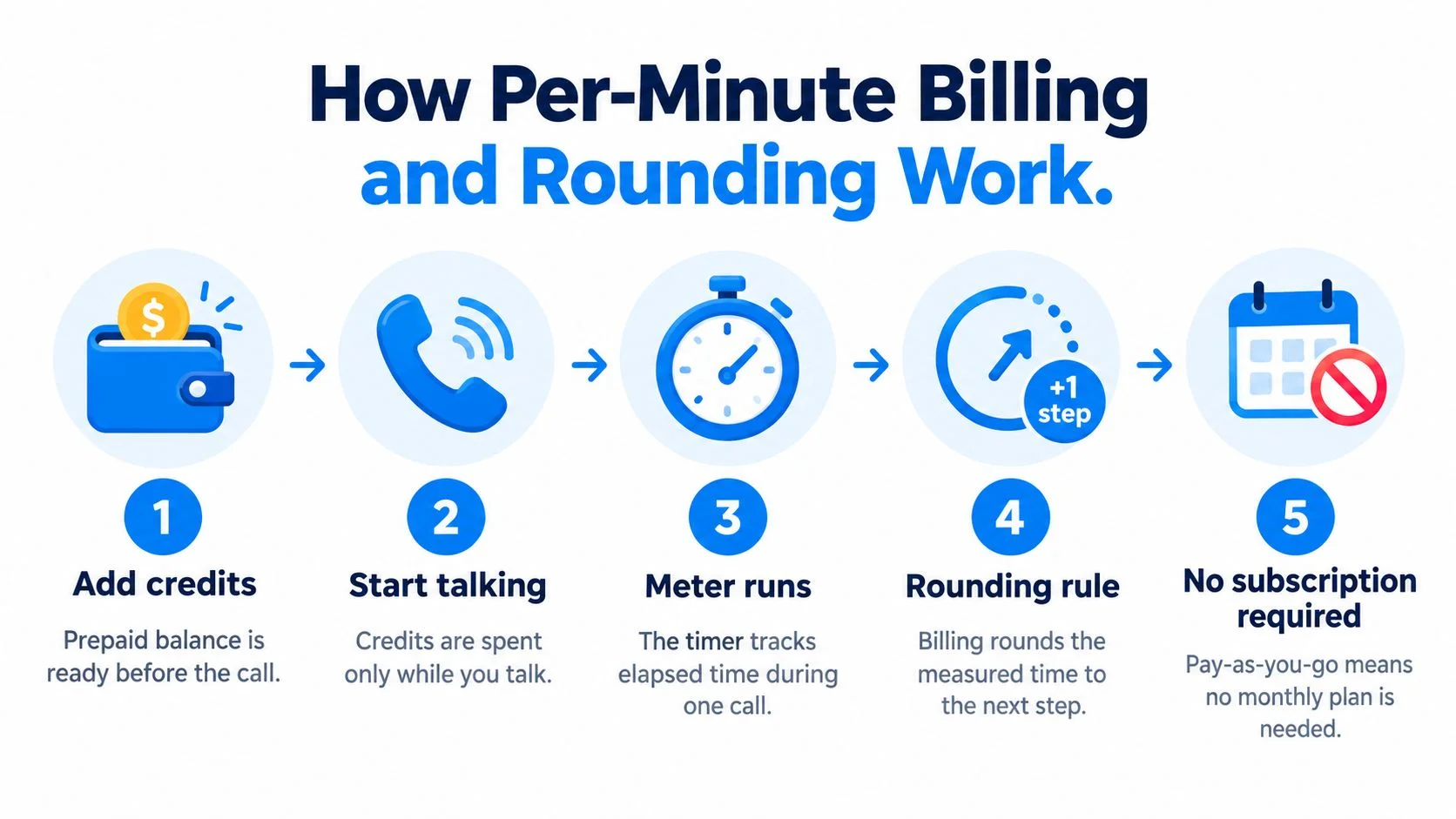
With pay-as-you-go calling, you add prepaid credits first and spend them only while you're connected, and ordinary outbound calling needs no subscription. Calls are billed per minute, rounded up to the next whole minute, so there's no separate monthly plan to decode before you dial.
Follow one call in order. You connect and talk for part of a minute, then keep talking into the next minute. At one minute and one second, you've used two billed minutes, a rounding effect explained in the discussion of why short calls can distort a headline rate. When you hang up, your balance falls by whole minutes only, never by the exact second.

Keeping the base call separate from extras
The base call is only the connected conversation. Live translation is an optional per-minute add-on that works across 62 languages, shows bilingual captions during the call, and saves a transcript afterward. It isn't folded into the destination rate, so you can leave it off and pay only for the call itself.
A dedicated number is separate again. It's the only recurring product in this model, and it's optional. It can receive calls, forward calls to another number, take voicemail, and receive SMS. None of that changes how an ordinary outbound call is metered.
Credits can be added by card, PayPal, Apple Pay, or Google Pay. The minimum top-up is $5, credits never expire, and there's no connection fee and no minimum commitment attached to calling itself.
Check the record, not just the balance: A balance drop tells you money left. A useful record tells you why.
That standard has a long history in telephone billing. The Federal Communications Commission requires each charge to carry a brief, clear, non-misleading description and identify the provider responsible, as set out in the FCC truth-in-billing policy. Bills must also show a toll-free number for questions and place third-party charges in a separate section with their own subtotal. For your call history, apply the same test. You should see the destination, number type, billing unit, any add-on, and the total debit. If you can't match each amount to a service you requested, the billing isn't transparent, even if the rate was posted.
How to Read a Live International Rate Table
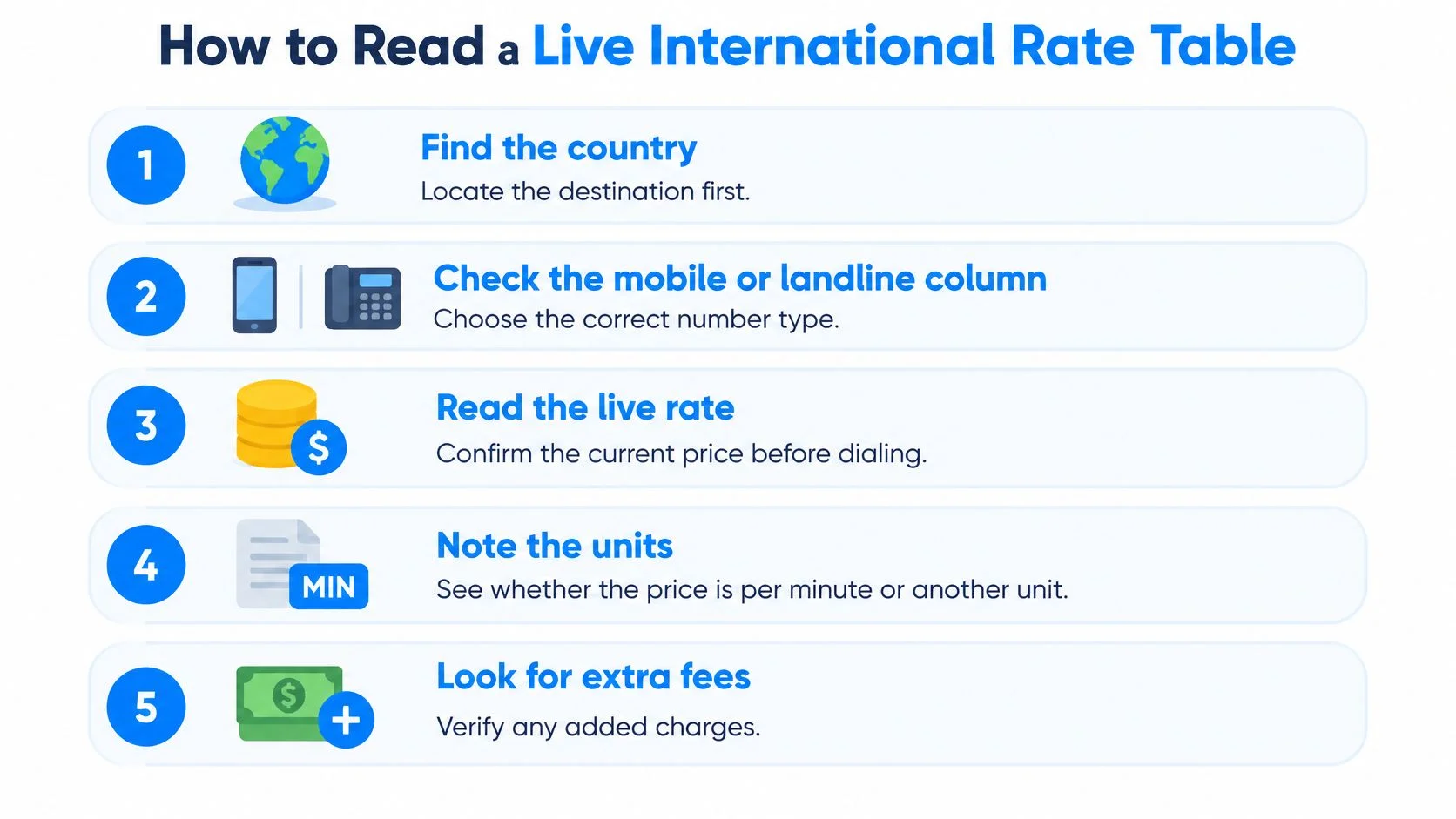
Read a rate table in a fixed order. Find the country, check whether the row is for a mobile or a landline, confirm the unit is per minute, and only then look at the amount. Reading the number first is how people land on the wrong row.
Start with the destination, because everything else hangs off it. Then move to number type. The mobile row and the landline row for the same country can differ, so picking the country's first row you see can give you the wrong expectation. Next, confirm the unit and look for a cue that this is the live rate, not an old screenshot copied into an article months ago.

A reading order you can reuse
- Find the country you're dialing, not a neighboring one with a similar name.
- Match the number type to the phone in front of you, mobile or landline.
- Confirm the unit is per minute before you treat the figure as comparable.
- Check for separate lines covering optional features, rather than assuming they're included.
- Estimate billed minutes from how long you expect to talk, allowing for the round-up.
You can work through that order on the live rate table covering 200+ countries and number types. This article doesn't print a destination rate, because a fixed figure in prose can't stay current.
Notice how differently a precise price reads when a regulator writes one. EU Regulation 2022/612 set a wholesale cap for regulated roaming calls at €0.022 per minute from July 1, 2022, falling to €0.019 per minute on January 1, 2025, and running through June 30, 2032, as shown in the EUR-Lex summary of Regulation 2022/612. That's a wholesale limit with dates, not a consumer calling price. Its value here is the discipline. It names the service, the currency, the unit, and when each amount applies.
Apply that discipline to your own reading. A vague promise of low-cost calls, with no destination and no date, fails the test. Clear labeling helps in other billing tools too, as the Centipid lead tracking improvements show for readable sources and prices in a local currency. In calling, the equivalent habit is simple. Reject the undated claim, open the live table, and check the exact row for the number you're about to dial.
What Short Calls Do to the Real Cost
The same rate produces very different totals depending on how you call, not just where you call. Short, frequent calls waste more of each billed minute than one longer conversation, so your pattern can matter more than a small difference in the headline rate.
Consider three habits. A person makes ten separate calls of about 20 seconds to check in with family. Each one rounds up to a full minute, so they're billed for far more time than they spent talking. Another person makes one five-minute call at the same rate. Almost every billed minute is a minute used, and the rounding loss is a small share of the total.
How Call Pattern Changes the Bill
The third pattern needs care. Don't assume an unanswered call is free, and don't assume it's billed. Read the service's own rule for failed calls before you rely on either idea. That's part of the price, even though it never appears in a headline.
The contrarian result appears here. A higher visible per-minute rate with no per-connection fee can cost less overall than a lower advertised rate that adds a fee every time you dial or rounds in a coarser way. If you dial often and talk briefly, you pay that fee again and again. Immigrants making quick family check-ins and small businesses placing short supplier calls feel this first, because the fixed cost per connection is spread over very little talking time.
You can sketch your own estimate before dialing. Take the billed minutes you expect, after rounding, and multiply by the live rate for that number type. Add an optional per-minute extra only if you'll turn it on. The call cost calculator helps you run that estimate without guessing.
Currency adds one more layer if you're comparing prices quoted in different units. Reading wholesale currency rates explained is a useful reminder that a converted figure is only as clear as the rate and moment behind it. Keep the comparison in one currency, for one number type, over your real pattern. That's the only comparison that predicts your bill.
When Rates Change After You Add Credits
A rate checked today can change before your next call, so a static table isn't full transparency. Clear pricing also needs a sense of when the rate was checked, advance notice of changes where possible, and a history you can open and audit.
Regulators have started treating future changes as part of the price itself. In January 2025, UK rules began requiring telecom providers to present future price rises in clear monetary terms at the point of sale rather than tying them to an inflation formula, as reported in ITV coverage of the pounds and pence billing rules. In the United States, proposed 2025 legislation similarly sought a total price including mandatory fees at the first moment a price is shown.

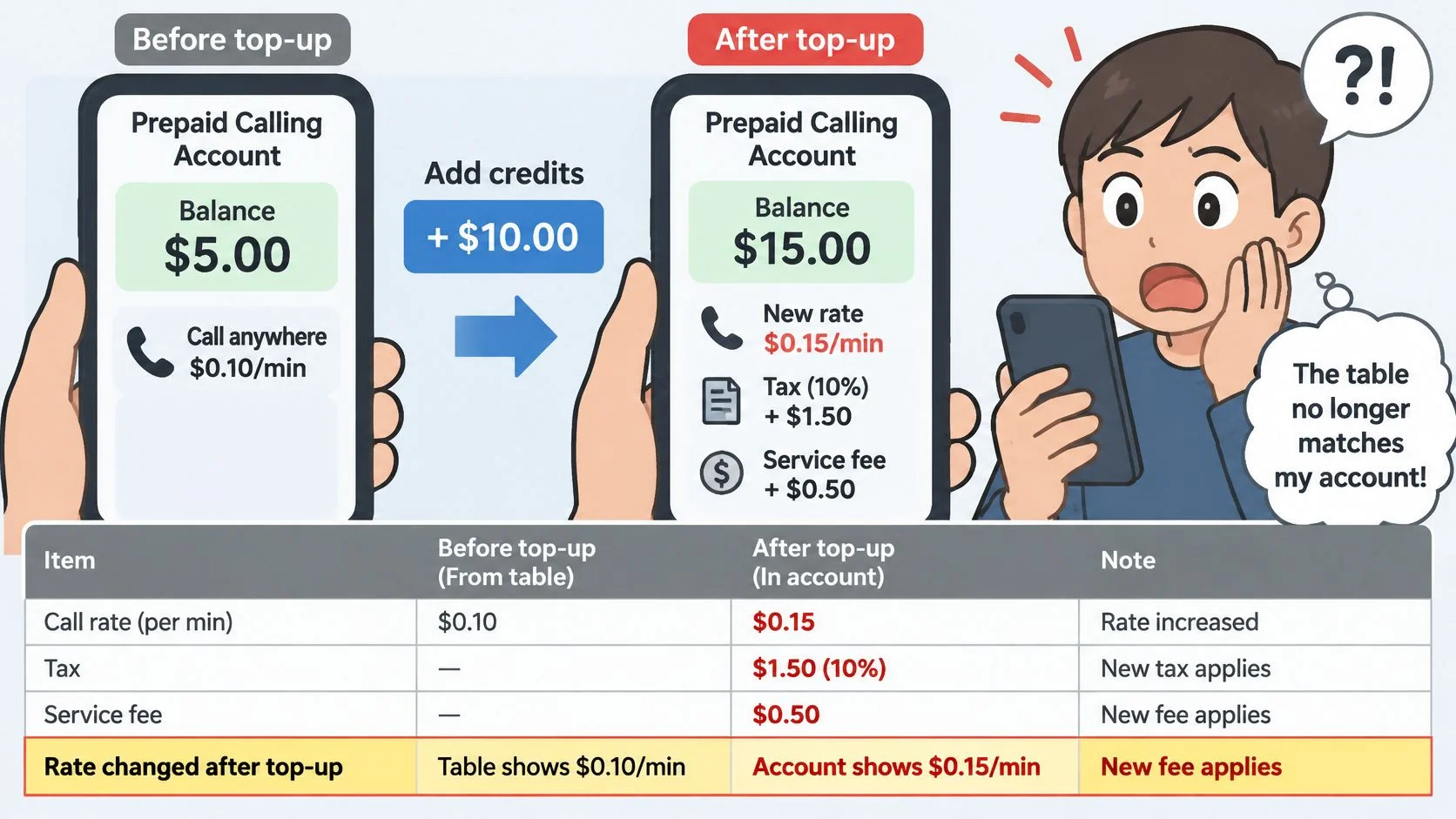
Pay-as-you-go changes your position compared with a long contract. You're not locked into paying a future rise for months, because you can stop after any call. But the opposite assumption is just as risky. Money already on your account doesn't freeze today's destination rate forever.
A personal rule for changing prices
- Recheck the live row on the day you dial, especially for a destination you haven't called in weeks.
- Separate usage from extras so a change in translation or a dedicated-number plan doesn't look like a change in the call rate.
- Keep the history open and compare the debit with the rate you saw.
- Watch for taxes or mandatory fees appearing apart from the base usage charge.
The FCC expects bills to be organized so you can tell whether a service was requested and received and whether the amount matches the price you understood, as stated in the FCC document on clear billing disclosure. Use that as your standard for a call record too. If a charge changed, you should be able to see which element moved.
Travelers, diaspora callers, and small businesses gain the most from this habit because their destinations shift. A rate you remember from a trip last season may not describe next month's call to a different number type. The billing help pages are the place to confirm how charges are recorded before a surprise forces the question. Credits that never expire remove one deadline. They don't remove the need for a fresh look at the rate on the day you dial.
How to Choose a Calling Setup You Can Check
Choose a calling setup by access and auditability, not by who advertises the lowest minute. You want to reach the person easily, see the price before you commit, and verify the debit afterward.
A traditional international plan can bury the cost inside a bundle, so you pay for allowance you may not use and still can't see the price of one call. A service that requires both people to install the same app fails at the first step when the other person has only an ordinary mobile or landline, which is common with older relatives and small suppliers. Neither problem shows up in a headline rate.
A browser dialer fits a different need. You call from Chrome, Safari, Firefox, or Edge, and the person you call needs no app and no account. They just answer a normal phone.
What to verify in any setup
- Reach: It connects to ordinary landlines and mobiles in the countries you call.
- Price visibility: The live rate for that number type appears before dialing.
- Billing record: Each call shows its destination, duration in billed minutes, and debit.
- Commitment: Calling itself doesn't require a subscription you didn't choose.
BubblyPhone sits in that browser slot. It places outbound calls to 200+ countries on pay-as-you-go credits with a $5 minimum top-up that never expires, bills per minute rounded up to the whole minute, and charges no connection fee. Calling needs no subscription, while live translation is an optional per-minute add-on and a dedicated number is an optional plan that can receive calls and SMS. Web, iOS, and Android dialers share a synced balance, calls use encryption in transit and aren't recorded unless a feature such as transcription is turned on, and voice is routed through enterprise-grade global carriers.
The standard to borrow comes from Ofcom. Its 2025 rules require providers to state contractual price increases upfront in pounds and pence, prominently at the point of sale, and explain when they will occur, as set out in Ofcom guidance on protecting consumers from uncertain price rises. Show the money amount before the person is committed. Any setup that meets that test, and lets you check the record afterward, is one you can trust with a short call and a long one.
Check the live rate for your destination, add credits from $5 that never expire, and make your next international call in any browser with BubblyPhone, where the person you're calling needs no app or account. You'll see the per-minute price before you dial, so the debit afterward holds no surprise.