International VoIP Phone Service: Costs & Features Compared

Table of Contents
- Start with the recipient's situation
- Why both number types matter
- Audio capture and the locked envelope
- The number is the delivery address
- Questions that expose meaningful differences
- Translate features into trade-offs
- Side-by-Side Pricing and Plan Structures
- Read the bill before making the call
- Turn network measurements into expectations
- Diagnose the problem before blaming the service
- Verify the person before sharing sensitive details
- Know what processing creates
- Match the interface to the conversation
- Evaluate failure handling as carefully as dialing
- Make a decision from evidence
- Keep emergency calling separate
You're about to call a parent, supplier, or client abroad, and they've given you a regular phone number rather than an app username. An international VoIP phone service lets you make that call using internet transport, then connects it to the recipient's ordinary landline or mobile network.
The important questions aren't just what a minute costs. You need to know whether the number is supported, how the call reaches it, what happens when audio breaks up, and which optional features affect your bill or privacy.
What International VoIP Phone Service Actually Does
International VoIP phone service carries your voice across borders as internet data and connects it to a telephone number. The recipient doesn't need to use internet calling software when the service supports termination onto ordinary phone networks.
Termination sounds technical, but it means delivering the call to its destination network. Your internet connection handles your end of the conversation; the recipient answers through their existing telephone service.
That distinction matters when you're calling a relative who prefers a landline or a supplier whose published contact number is a mobile. You're not asking them to change how they communicate.
Start with the recipient's situation
Different callers need different things from the same technology:
- Family callers: Reach the phone someone already uses, without asking them to install software or manage another password.
- Travelers and remote workers: Make occasional overseas calls from an internet-connected device, while checking local connectivity before relying on it.
- Small businesses: Contact suppliers and clients through their published numbers, with understandable billing and a workable callback arrangement.
- Support teams and developers: Connect cross-border conversations to workflows, call records, or automated systems.
The practical dividing line is app-to-app versus internet-to-phone calling. An app-to-app conversation depends on both participants using compatible software. Internet-to-phone calling adds a connection to the public telephone network, so a phone number becomes the destination.
Why both number types matter
A country appearing on a coverage page isn't enough. Check whether the service reaches the particular fixed-line or mobile number you need.
The distinction reflects real calling demand: the FCC recorded 49.4 billion U.S.-billed international minutes terminating on foreign fixed networks and 35.3 billion on foreign mobile networks in 2014, in its international telecommunications traffic report.
Those are historical figures, not a current market estimate. Their useful lesson is that international calling has never been only about connecting internet users to other internet users.
For your own decision, begin with the destination and the conversation. A working connection to your parent's phone matters more than a feature list designed for a contact center.
How a Browser Call Reaches an Ordinary Phone
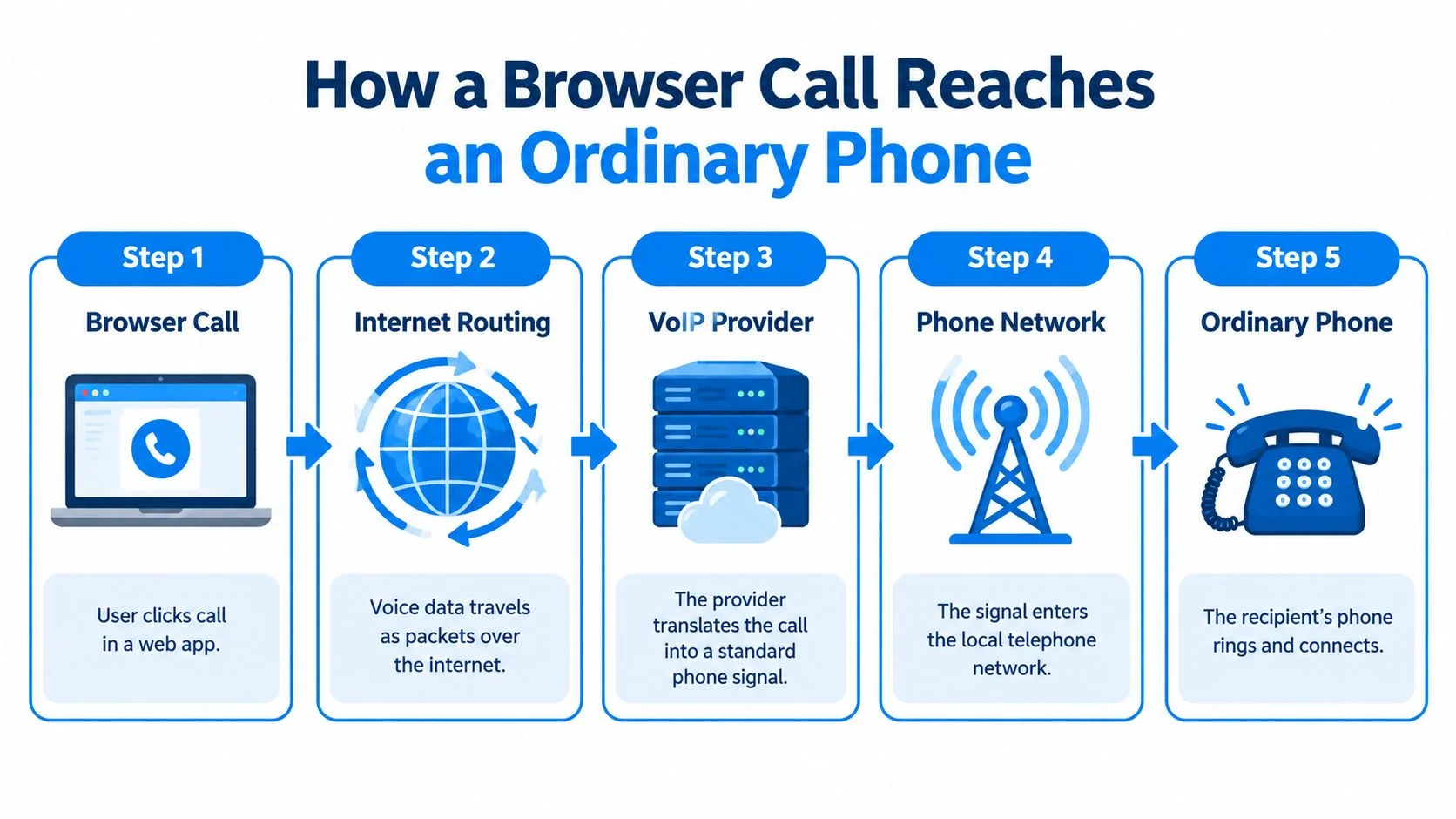
A browser call reaches an ordinary phone when the calling service carries your audio over the internet and hands it to the destination telephone network. Think of your browser as the letter writer, the service as the delivery organization, and the recipient's number as the address.
The journey looks like this:

Audio capture and the locked envelope
WebRTC provides the online media handling used for browser calling. After you permit microphone access, the browser captures speech and sends it as small packets rather than waiting for a complete audio file.
Those packets need protection. WebRTC requires SRTP for media encryption and uses DTLS-SRTP to negotiate encryption keys, as explained in the WebRTC media encryption documentation.
In the mail analogy, encryption is the locked envelope. It protects the browser media connection, but it doesn't tell you everything about what happens after the service hands the call to a telephone network.
A current, compatible browser, microphone permission, and a stable connection are the caller's starting requirements. The guide to calling a phone from a computer provides a practical starting point for that setup.
The number is the delivery address
E.164 is the international numbering framework used to organize telephone addresses. It limits an international number to 15 digits, excluding the international dialing prefix, according to the ITU's E.164 numbering recommendation.
The service must interpret the country code and the remaining national number correctly. Placing a plus sign before a locally formatted number isn't reliable number normalization.
- Confirm the country: Don't assume a saved local contact already includes the correct international code.
- Check national formatting: Follow the dialer's country-specific guidance rather than preserving every local prefix.
- Confirm the actual subscriber: A valid-looking number can still belong to the wrong person.
Once the address is interpreted, the service routes the call toward the destination network. Correct formatting helps identify the destination; it doesn't guarantee that an unreachable, disconnected, or blocked phone will ring.
Features Worth Comparing Across International VoIP Providers
Compare features by asking what they change for your actual calls, not how impressive they sound. Browser access, payment flexibility, inbound numbers, translation, and developer controls solve different problems.
For someone calling family, easy dialing may be essential while automation is irrelevant. For a business, receiving a callback may matter more than placing the original outbound call.
Questions that expose meaningful differences
Treat these as separate decisions. Having outbound access doesn't automatically give you an inbound number, and a dedicated number doesn't establish that every messaging or verification use case will work.
Translate features into trade-offs
Live translation can help callers who don't share a language, but it adds another processing step to the conversation. Ask whether the service provides captions, whether it retains a transcript, and whether translation has a separate usage charge.
For a delivery discussion, readable captions can help you confirm names or instructions. For sensitive or high-stakes decisions, you should still confirm important details independently rather than assuming translated speech is exact.
Dedicated numbers address a different need: a consistent way for others to contact you. Check voicemail, forwarding, number availability, and receive-only SMS separately.
Buying rule: Choose the smallest set of capabilities that removes a real obstacle from your calls.
Native mobile apps may be convenient, but they're optional if browser calling meets your needs. Likewise, programmable calling is useful when you're building a workflow, not merely because an API appears on a features page.
My recommendation is to separate must-haves from optional conveniences before comparing services. That prevents an advanced business feature from distracting you from missing coverage, unclear billing, or an awkward calling interface.
Pay-As-You-Go Pricing, Dedicated Numbers, and What Bills Look Like
Pay-as-you-go calling uses prepaid credit to pay for calls as you make them, while a dedicated-number plan pays for an ongoing inbound identity. They're different products, so don't assume you need a subscription just to call abroad.
For the browser-based option discussed here, calling is billed per minute, rounded up to the whole minute, with no calling subscription required. Unused prepaid credits don't expire, and the optional dedicated-number plan is the recurring product.
Side-by-Side Pricing and Plan Structures
Read the bill before making the call
Begin with the live destination rate table, not a rate copied into an old comparison article. Check the selected country and number type, then account for any enabled add-on.
Rounding matters most when you make many short calls. If a connected conversation runs beyond a whole-minute boundary, the next whole minute is billable under this model.
Use the international call cost calculator to estimate your intended conversation before dialing. Keep a separate note of optional translation or transcription costs rather than treating the base calling rate as the entire bill.
A dedicated-number plan includes monthly calling credit and inbound functions, but its value depends on whether you need people to reach you consistently. Someone making occasional outbound family calls may have no reason to maintain that extra service.
- Check the balance: Know what credit is available before a long conversation.
- Review add-ons: Disable processing features you don't need.
- Read number terms: Confirm inbound usage, forwarding charges, and cancellation conditions.
SMS on dedicated numbers is receive-only. Don't confuse receiving messages with sending texts, and don't assume every account-verification system accepts a dedicated number.
Call Quality, Reliability, and What HD Voice Really Means
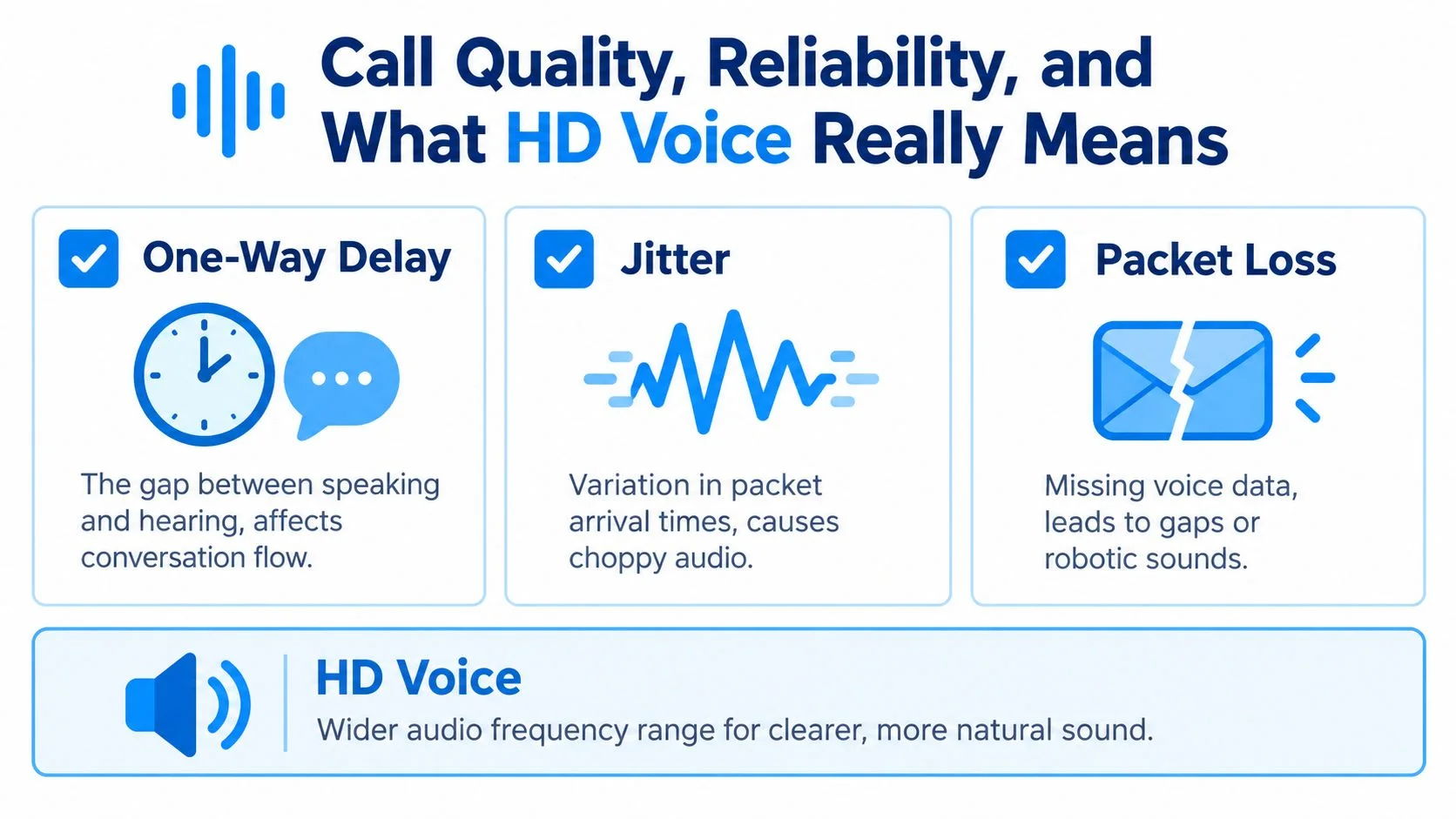
International VoIP quality depends on delay, jitter, and packet loss, not just your connection's advertised speed. HD voice describes an audio capability, not a promise that every route will sound clear.
A fast connection can still deliver voice packets unevenly. That's why a speed reading alone can't explain every awkward pause or clipped syllable.
These are the impairments you can hear:

Turn network measurements into expectations
One-way delay is how long speech takes to reach the other person. Jitter is variation in packet arrival times, while packet loss means some voice data doesn't arrive in usable form.
ITU-oriented guidance uses a five-point Mean Opinion Score for perceived quality and gives practical acceptable-performance targets below 150 ms end-to-end delay, 60 ms jitter, and 5% packet loss, with tighter targets below 50 ms, 20 ms, and 1% for higher quality, in its broadband quality guidance.
These are engineering benchmarks, not universal guarantees. A receiver can buffer uneven packet arrivals, but excessive buffering adds delay, so clearer audio and responsive conversation must be balanced.
Diagnose the problem before blaming the service
Before dialing:
- Strengthen your connection: Use wired access or a strong Wi-Fi signal, and avoid moving between networks during the conversation.
- Reduce competing traffic: Pause large uploads and bandwidth-heavy applications.
- Check audio access: Permit the microphone and select the intended input device.
- Use a headset: Reduce speaker feedback and make it easier to hear the other person.
- Consider destination timing: Try another local time if congestion appears to affect a particular destination.
The VoIP speed test can help you assess your access connection, but it can't certify every downstream telephone route.
If unrelated destinations all sound poor, investigate your device and local network first. If problems persist only with a particular recipient after you change connections, give support the destination, call time, and symptoms so they can investigate the route.
Clear audio on one call doesn't prove that every destination uses an equally reliable path.
A no-ring failure also deserves a different investigation from choppy audio. Confirm the number and recipient availability before treating a connection failure as a media-quality problem.
Safety, Caller ID, and Privacy When Translation Is On
Use caller ID as a clue, not proof of identity, and treat translation or transcription as a separate privacy decision. A legitimate overseas call can show an unfamiliar number, while a familiar-looking number doesn't establish who's speaking.
International calls that mimic domestic numbers may face anti-spoofing restrictions. Ask how the service presents legitimate outbound identity and whether destination-country rules can affect delivery; don't expect a chosen display number to override those rules.
Verify the person before sharing sensitive details
For a family call, agree on a safe verification method before discussing a transfer of money. For a supplier, confirm changed payment instructions through contact details you already trust.
- Verify independently: Don't rely solely on the displayed number or a recognizable voice.
- Question urgent requests: Pause before sharing financial details, credentials, or identity documents.
- Avoid unfamiliar callbacks: Investigate an unknown missed international call before returning it.
- Explain your call: Tell an expected recipient that your overseas call may display an unfamiliar number.
Privacy habit: Ask permission before enabling a feature that saves the conversation.
Know what processing creates
Call metadata describes the connection, such as numbers, timing, and duration. Call content is what people say; transcription converts that speech into an additional record that may expose personal information.
Live translation can involve captions and a saved transcript. Ask what is processed, who can access it, how long it remains available, and whether deletion is possible.
For sensitive appointment workflows, TOOLii healthcare automation insights offer relevant context for thinking about automated reception. Evaluate any workflow against your own consent, access-control, and retention requirements rather than assuming automation makes it compliant.
Use explicit consent, retain only what's necessary, and disable recording-dependent features when they serve no purpose. Secure the calling account, especially when other people's transcripts are stored there.
The browser encryption described earlier protects media in transit. It doesn't automatically establish end-to-end protection through downstream telephone networks or tell you whether a processing feature records content.
Developer APIs and Programmable Calling for AI Voice Agents
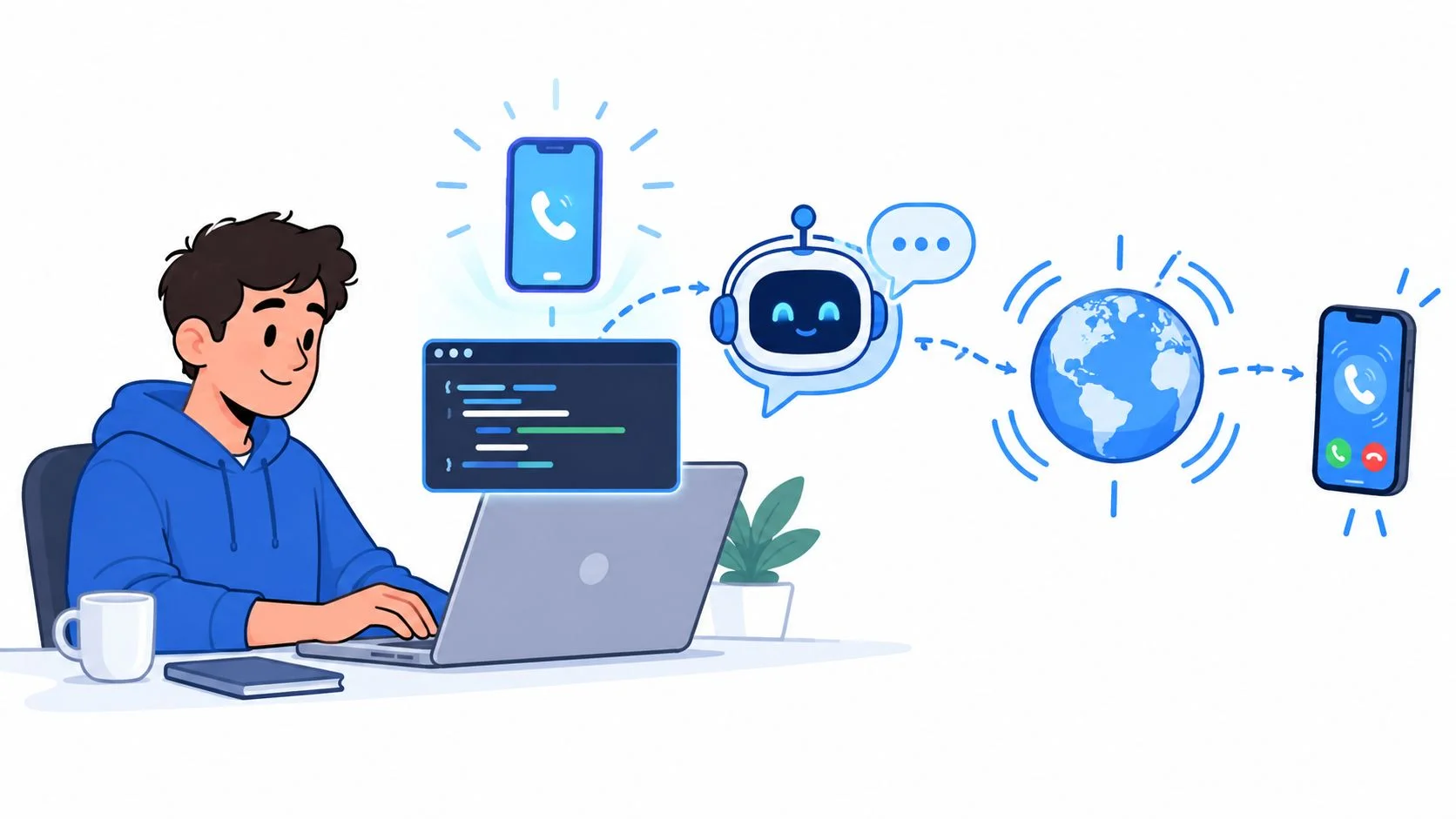
A developer API lets software place and manage telephone calls instead of requiring someone to press the dial button. An AI voice agent, customer-management workflow, or notification system can use it to reach supported landline and mobile destinations.
The developer connects conversation logic to the calling infrastructure:

Match the interface to the conversation
Webhooks notify your software when something happens, such as a call being answered or ending. They suit workflows that need to update a record or decide whether a reminder needs follow-up.
Streaming supports ongoing media exchange during the call. That matters when a voice agent must hear a response and reply while the recipient is still connected.
Bring-your-own-model support lets developers connect their chosen speech or language model instead of rebuilding the telephone connection. Ask which interfaces are supported and where responsibility for audio processing, retention, and failures sits.
For example, an operations team might automate an agreed appointment reminder to an overseas supplier. The workflow needs destination support, answer detection, a clear message, and sensible handling when nobody responds.
For broader workflow considerations, MakeAutomation's outbound voice agent guide is a relevant companion resource. Treat automation scenarios as design possibilities, not evidence that every calling API supports identical controls.
This video provides additional context for programmable calling:
Evaluate failure handling as carefully as dialing
- Documentation: Look for rate limits, authentication guidance, and clear call-state definitions.
- Webhook delivery: Check retries, event ordering, and protection against processing the same event repeatedly.
- Media controls: Confirm streaming behavior, hang-up handling, and optional recording or transcription.
- Cost boundaries: Separate telephone termination charges from model and audio-processing costs.
- Human fallback: Decide what happens when the agent misunderstands, encounters silence, or receives a sensitive request.
The calling service should handle telephone-network interconnection. Your application still needs consent, appropriate calling times, reliable conversation logic, and a way to stop or hand over a call.
How to Choose the Right International VoIP Phone Service
Choose an international VoIP phone service by testing your real destination, understanding the full bill, and checking its privacy and reliability practices. A long feature list isn't a substitute for a call that connects clearly and behaves as expected.
Start with the person you originally wanted to reach. Their number type, availability, and willingness to answer an unfamiliar caller are more useful selection criteria than a broad marketing claim.
Make a decision from evidence
- Access: Prefer a calling method that fits your device and doesn't create unnecessary setup for the recipient.
- Coverage: Verify the actual destination number rather than relying only on a country list.
- Cost: Read billing increments, add-on charges, credit terms, and any optional recurring plan.
- Quality: Look for useful diagnostics and destination-specific support, not just an HD voice label.
- Privacy: Require clear disclosure of recording, transcription, translation, retention, and account access.
- Business fit: Add inbound numbers or programmable calling only when they solve a defined workflow problem.
My practical recommendation is to try an ordinary conversation before moving an important business process to the service. Note whether the call connected, whether you could comfortably take turns, and whether the charge matched your expectations.
Keep emergency calling separate
Don't assume international outbound access replaces a locally registered emergency telephone service. The FCC explains that VoIP emergency calls can be handled differently and that E911 involves callback and location information in its VoIP and 911 consumer guidance.
Check the service's emergency-calling support, location requirements, and country-specific limitations before depending on it. International number formatting and ordinary calling coverage don't answer those questions.
For occasional callers, straightforward access and understandable usage charges are usually the sensible starting point. Businesses and developers should add a second test: can staff diagnose failures, control sensitive data, and manage callbacks without improvising?
Make an international call with BubblyPhone, which works in any browser and connects to ordinary landlines and mobiles without an app or account for the person you're calling. Credits start at $5 and never expire, so check your destination's rate, add credit, and call when you're ready.