How to Call to Germany from Abroad

Table of Contents
- Follow the four-part sequence
- Avoid the common formatting failures
- Read the prefix before you dial
- Treat special-service numbers separately
- Compare the setup, not just the headline price
- Understand what the browser is doing
- Start with the number category
- Account for whole-minute rounding
- Use a short, repeatable process
- Match the tool to the conversation
To call Germany from abroad, dial your country's exit code or +, followed by 49, the German area code without its leading 0, and the local number. A Berlin landline written as 030 12345678 becomes +49 30 12345678, while 0170 1234567 becomes +49 170 1234567 for a mobile call.
You may be trying to reach family, a German supplier, a hotel, or a customer support desk, and the number in front of you may still be written in Germany's domestic format. The dialing rule is straightforward, but billing and routing aren't. German landlines, mobiles, and special-service numbers can be treated differently by international providers, so entering the number correctly is only the first part of making a reliable call.
The Exact Format for a Call to Germany
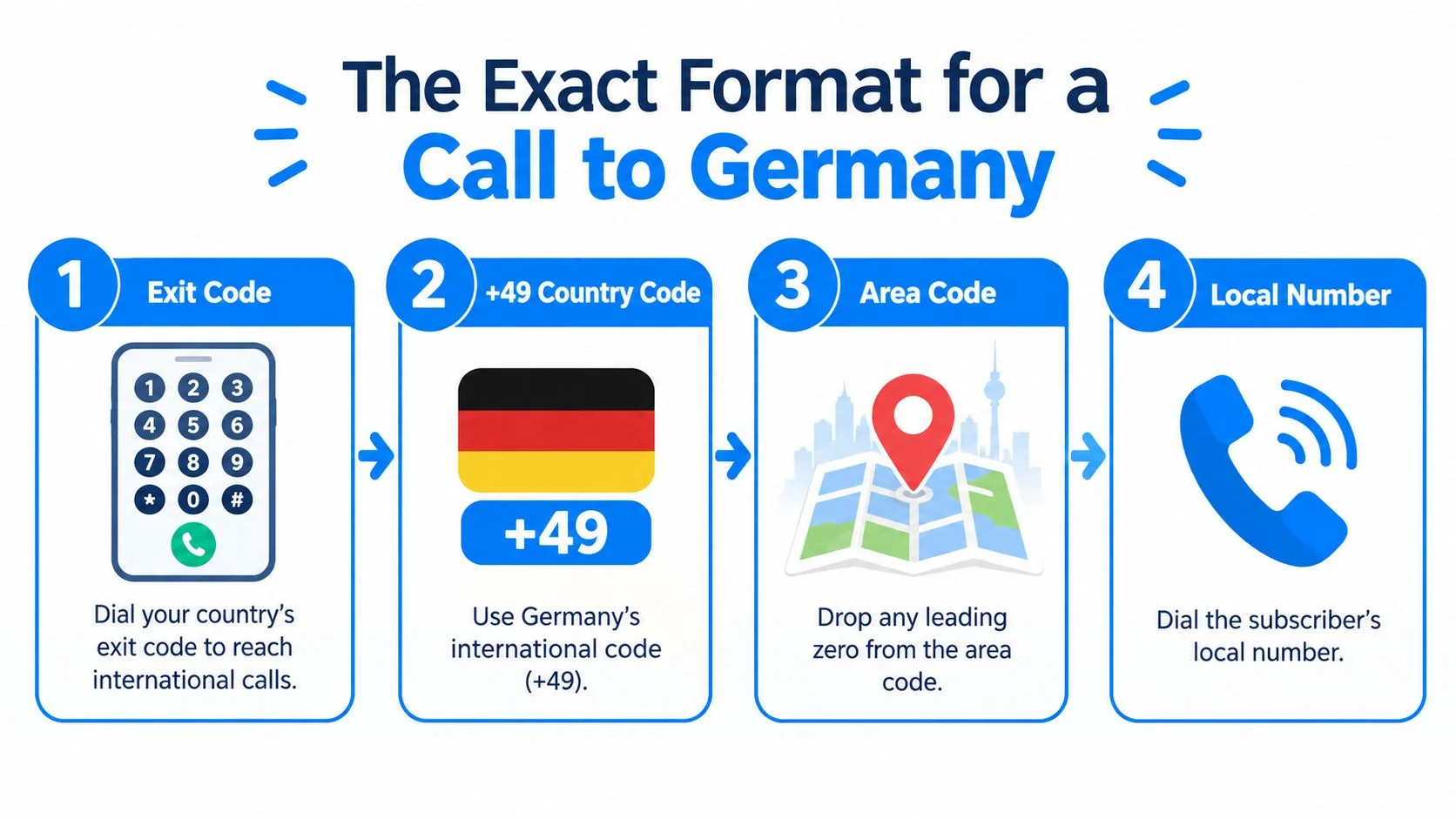
The exact sequence is exit code or +, 49, the German area code or mobile prefix without the first 0, then the subscriber number. Germany's international calling code is +49, and the domestic trunk prefix must be removed when you call from outside the country, as documented in this German phone number guide.

Follow the four-part sequence
- Start with your exit code. Use your country's international access code, or press and hold 0 on a compatible phone to enter the plus sign.
- Add Germany's country code. Enter 49 immediately after the exit code or plus sign.
- Remove the domestic zero. German numbers commonly show a leading 0 before a geographic area code or mobile prefix. That zero is used inside Germany, not after +49.
- Enter the remaining digits. Finish with the subscriber number exactly as provided.
A Berlin landline demonstrates the conversion clearly. The domestic number 030 12345678 becomes +49 30 12345678 internationally. You keep 30, the Berlin area code after removing the domestic 0, and then enter the local number.
The same rule applies to a mobile. Domestic 0170 1234567 becomes +49 170 1234567. You don't add another zero after 49, and you don't remove digits from the subscriber number.
Practical rule: If the German number is written with +49 already, don't add the domestic zero back in. Enter the number as shown.
Avoid the common formatting failures
The most frequent errors are adding both 0 and +49, leaving spaces that a restrictive dialer can't process, or treating a German mobile like a city landline. If a call fails, first compare the number with the international pattern rather than repeatedly redialing the same format.
For a more detailed reference, see this guide to the Germany country code and dialing format. The key point remains consistent across the Federal Republic: international callers identify Germany with +49, then enter the relevant geographic or mobile prefix without its domestic zero.
Identifying German Landline and Mobile Prefixes
German number prefixes tell you whether you're calling a geographic line, a mobile, or a service range, and that distinction can affect routing and cost. The international structure remains standardized: use your exit code or plus sign, add 49, remove the initial 0 from the area code or mobile prefix, and then dial the subscriber digits, as described in this overview of Germany's numbering system.
Read the prefix before you dial
Geographic landlines use area codes associated with cities or regions. Berlin numbers commonly begin domestically with 030, while Munich numbers commonly begin with 089. Internationally, those become +49 30 and +49 89 respectively.
Mobile numbers use mobile prefixes rather than city codes. Domestic examples commonly begin with 015, 016, or 017, and the international version removes the first zero. That means a number beginning 0170 is entered internationally with +49 170.
The table helps you classify the destination before you place the call. It doesn't tell you the final price, because providers may distinguish between geographic, mobile, and service destinations in their rate tables.
Treat special-service numbers separately
Special-service and toll-free ranges need more caution than ordinary geographic numbers. Some are designed primarily for domestic use, while others may carry different international charges or be unavailable from foreign networks. A number that looks like a normal German contact may therefore behave differently once routed internationally.
Ask the recipient for an alternative geographic or mobile number when a service number fails, particularly if you're calling from a business line or trying to reach a public support desk. Don't assume that a successful connection to one German number proves every German prefix will route the same way.
The number type also matters for budgeting. A caller reaching a German landline, a German mobile, and a special-service range may be making three technically valid calls with three different billing outcomes. Identify the destination category first, then check the applicable rate.
Browser Calling vs Traditional Carrier Add-Ons
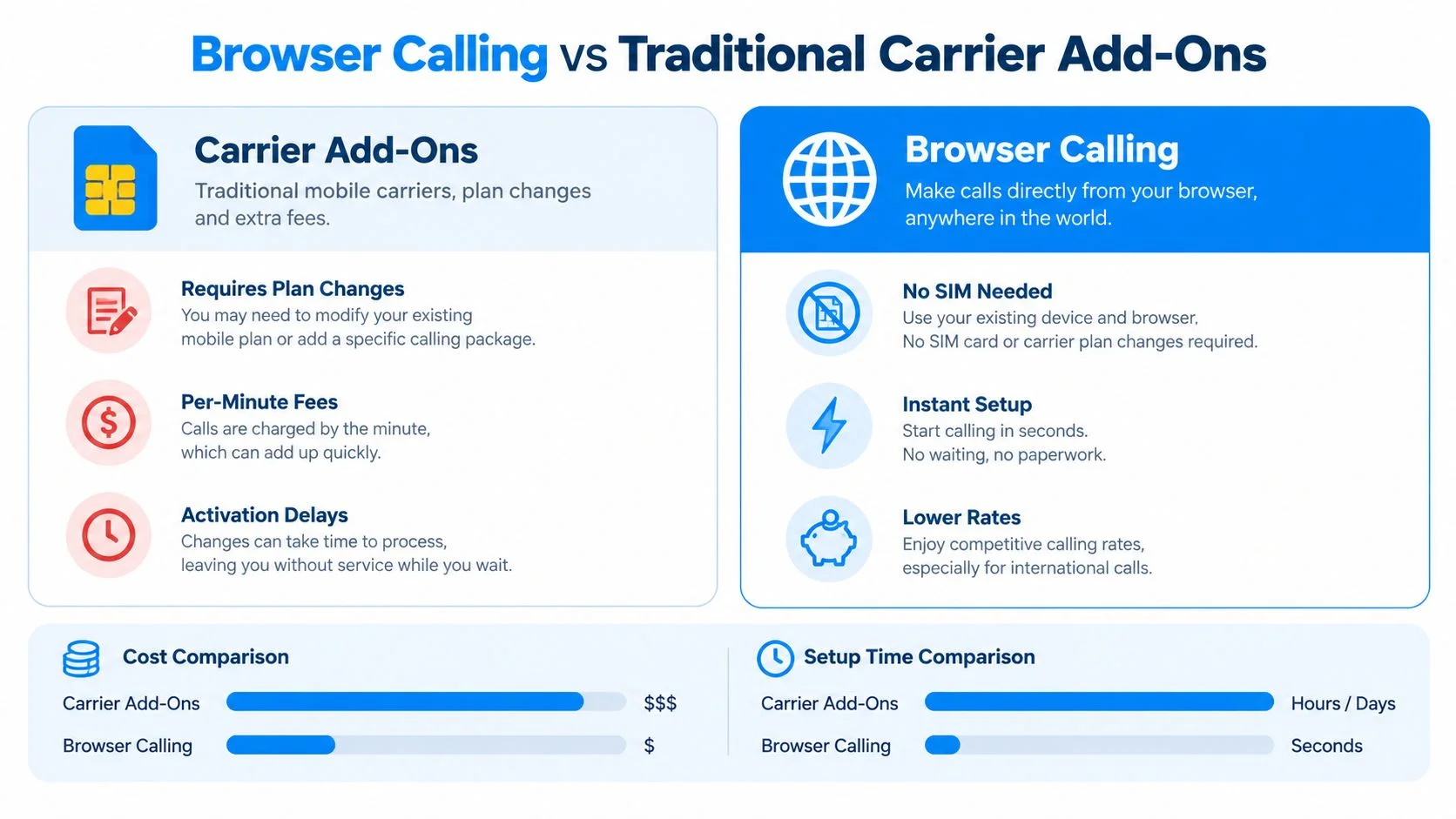
Browser calling removes much of the setup involved in traditional international add-ons. You can place a real call to an ordinary German landline or mobile from a supported browser, while the recipient answers on a normal phone without installing an app or creating an account.

Compare the setup, not just the headline price
A carrier add-on can make sense for someone who calls Germany frequently from the same mobile plan. But occasional callers often face a different set of decisions: whether to change a plan, activate a feature, wait for it to take effect, and understand how the added charges appear on the bill.
Browser calling follows a simpler path:
- No new SIM required. The caller uses a device with a supported browser and an internet connection.
- No recipient installation. The person in Germany answers the call on an ordinary landline or mobile.
- Direct phone-number reach. The call doesn't depend on both parties using the same application.
- Cross-device access. Modern browsers including Chrome, Edge, Firefox, Safari, Opera, and Brave support the relevant WebRTC technology on desktop and mobile, according to this browser calling explanation.
The practical advantage is reduced coordination. You don't need to ask a parent, customer, supplier, or client in Germany to download software before the conversation can begin.
Understand what the browser is doing
WebRTC captures audio through the browser, while connected telephony infrastructure routes the outbound call into the public telephone network. That route can reach ordinary landlines and mobiles rather than limiting the conversation to browser users.
This is different from browser automation. If you're researching browser workflows for testing or operations, browser automation without fingerprints is a separate technical topic and shouldn't be confused with placing a telephone call. For ordinary international calling, the important question is whether the calling service can terminate the call to the intended German number.
A browser-based option also suits travelers, remote workers, and small teams that don't want to modify a primary mobile plan for an occasional call. For broader context on app-based and browser-based workflows, review this guide to an international calling app, while keeping the recipient requirement in mind: a direct phone call works even when the recipient uses no app at all.
Managing International Calling Costs and Billing
Calling Germany isn't one flat-cost activity. The destination type, provider, plan, and billing increment all matter, so check the live rate for the specific German landline, mobile, or special-service range before dialing.
Start with the number category
Independent rate tables show a wide spread between German landlines, mobiles, and special-service numbers. One major US carrier lists Germany at 3.00 per minute** without an add-on, while another major US provider lists **0.08 per minute for landlines and $0.25 per minute for mobiles, as documented in this comparison of international calling costs. These figures illustrate why a single “call Germany” price can mislead, even though the rates themselves may change.
Don't budget from the country name alone. Check three details:
- Destination type. Confirm whether the number is geographic, mobile, or special-service.
- Current rate table. Use the provider's country-specific pricing page immediately before calling.
- Billing increment. Determine whether the service bills by whole minutes and rounds partial minutes upward.
Account for whole-minute rounding
International plans commonly round up to the next whole minute. A call lasting 1 minute and 1 second can therefore be billed as 2 minutes, according to this international call billing guidance. Some business voice services also round a fractional cent up to the nearest whole cent.
That rule changes how you should estimate short calls. A conversation that ends just after a minute boundary may consume another full billing minute, so keep enough prepaid balance for the rounded duration rather than the exact timer reading.
Billing discipline: Check the destination rate, then estimate the call in whole-minute blocks. Don't use the visible duration alone to predict the final credit deduction.
For a practical explanation of rate structures and rounding, use this guide to international calling rates. Transparent pricing is especially useful for small businesses making repeated supplier calls, families managing prepaid balances, and anyone dialing a number whose type isn't obvious.
The Best Way to Make a Call to Germany Today
For an occasional call to Germany, a browser-based pay-as-you-go service is usually the most practical route because it avoids carrier-plan changes and recipient setup. BubblyPhone lets you call regular German landlines and mobiles from a browser, with no calling subscription required and credits starting at $5 that never expire.

Use a short, repeatable process
Before dialing, prepare the number in international format and identify its category. Then:
- Convert the number. Replace the domestic leading zero with +49 and keep the remaining area or mobile prefix.
- Check the live rate. Look up the exact German destination type before starting the call.
- Use the browser dialer. You don't need to install software on the calling device when using a supported browser.
- Keep the recipient unchanged. The person in Germany answers on their normal landline or mobile, without an app or BubblyPhone account.
- Watch rounded usage. Calls are billed per minute and rounded up to the whole minute, so end short calls with the billing rule in mind.
Browser-based outbound calling can connect ordinary phone numbers worldwide, including landlines and mobiles, by capturing audio in the browser and routing the call through PSTN-connected infrastructure, as explained in this WebRTC outbound calling documentation.
Match the tool to the conversation
A straightforward voice call is enough for most family, supplier, and client conversations. If you expect a language barrier, arrange support before the call, or consider an on-demand phone interpreter service when the conversation requires professional interpretation.
The browser approach also works well when the other person isn't comfortable with technology. They don't have to install an app, register, or learn a new interface. You only need the correctly formatted German number, a supported browser, and sufficient prepaid credit.
Check the live rate before you dial, especially for a mobile or special-service number. Then place the call using the international format above rather than copying the domestic zero into the dialer.
Use BubblyPhone to call Germany from any browser without requiring an app or account from the person you're calling. Credits start at $5, never expire, and pay-as-you-go billing lets you reach a German landline or mobile without a calling subscription.