How to Call USA from Saudi Arabia in 2026

Table of Contents
From a Saudi landline, dial 00 1 plus the 10-digit U.S. number. On a mobile or browser dialer, dial +1 plus those same 10 digits.
That's the whole dial string for how to call USA from Saudi Arabia. What breaks calls usually isn't the country code. It's an added 0, a toll-free number that won't connect from abroad, a call placed at 3:00 a.m. in the recipient's city, or an app that rings with no audio on a local network.
The mobile first pattern makes sense in the Kingdom. The International Telecommunication Union country profile recorded 132 mobile-cellular subscriptions per 100 inhabitants in 2022, compared with 19 fixed-telephone subscriptions per 100 inhabitants. A rate above 100 doesn't mean everyone owns a phone. People and organizations hold multiple SIMs and subscriptions, but the direction is clear. Most calls start on a mobile or an internet connection, not a fixed line.
The Number You Actually Dial
A U.S. number is ten digits. The prefix in front of it changes with the handset. That split is the whole dialing rule: an exit signal, country code 1, then the area code and local number.
Take a New York number written as (212) 555-0123. From a Saudi landline it becomes 00 1 212 555 0123. On a mobile keypad or browser dialer it becomes +1 212 555 0123. Use the form that matches the handset in your hand.
The three pieces
Every normal call has three parts. Mixing them up causes most failed dials.
- International access: 00 from a conventional Saudi line, or + on a mobile or internet dialer. The plus sign replaces the country-specific access code, so it travels well between networks.
- Country code: 1 for the United States.
- U.S. number: all 10 digits, a three-digit area code plus a seven-digit local number.
Country code 1 serves the North American Numbering Plan, which the North American Numbering Plan entry lists as 25 regions across 20 countries and territories. Inside that plan, the area code selects the U.S. region. The digits 212, 310 and 713 are routing parts of the address.
The code number for the United States page explains +1 as a standalone country code. Keep it separate from your own Saudi number. A Saudi mobile is saved internationally as +966 5 plus eight digits. A U.S. destination never starts with +966.
A leading 0 before the area code breaks the dial string. U.S. geographic numbers use the 10-digit format without a national trunk zero. Adding that zero turns +1 212 555 0123 into a string the network cannot route as a normal U.S. number. Delete the zero and redial.
Copy the right row
How to dial a U.S. number from Saudi Arabia
Choose the row by the handset you are holding. The destination digits stay the same in every U.S. row.
The fourth row covers a common copy error. People see +966 on their Saudi mobile and assume the destination needs a similar prefix change. The destination controls the format, and a U.S. number takes +1.
Toll-free numbers starting with 800 and short codes sit outside this table. They are not ordinary geographic numbers, and the dial string alone will not make them connect from abroad. For an ordinary U.S. landline or mobile, confirm exactly 10 U.S. digits after the 1, then place the call.
How to Place the Call From a Saudi Phone
A normal call comes down to six checks, done in order. Each check removes one failure before the next begins.

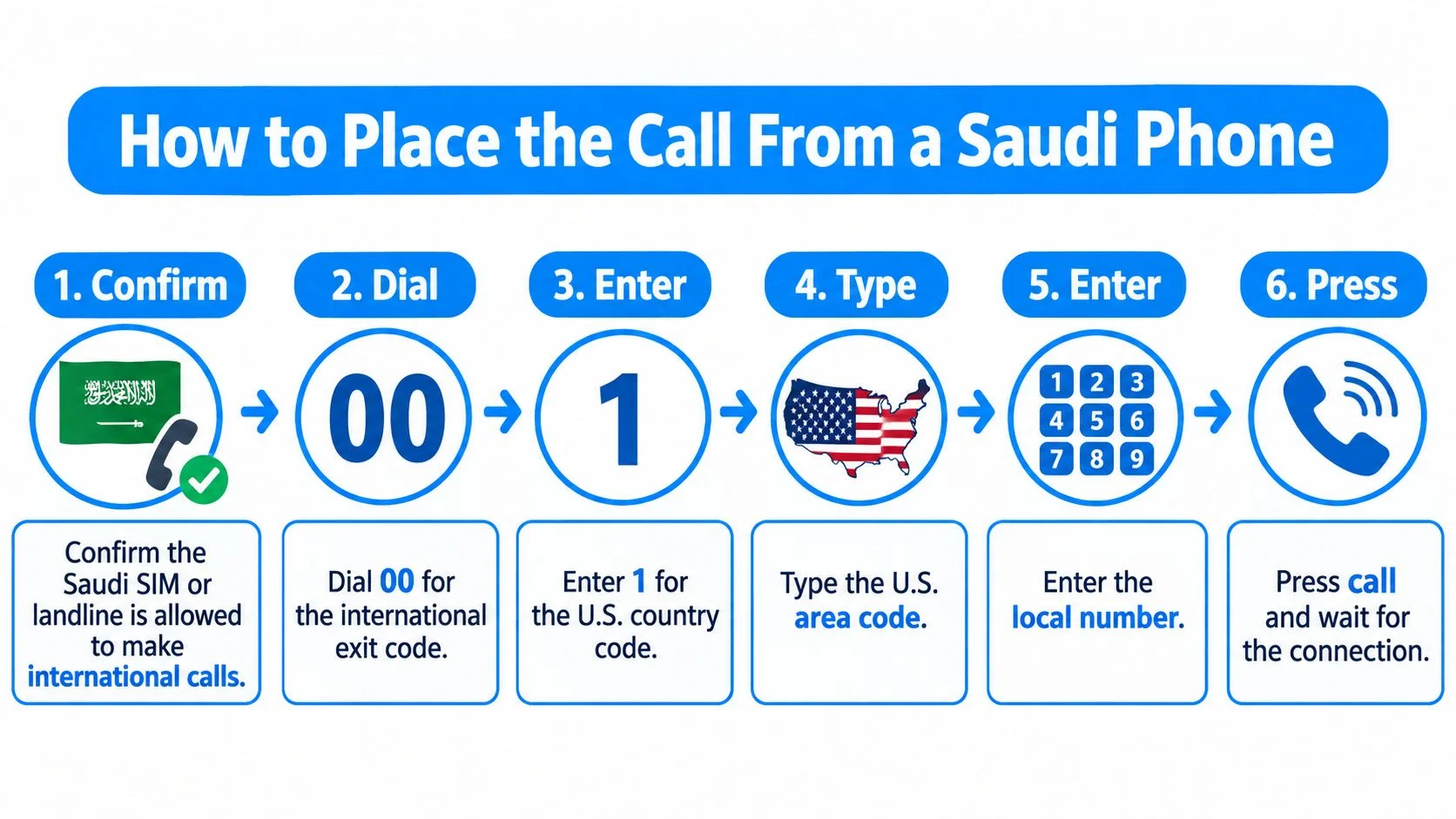
Work through them before the call that matters. A one-minute test on a quiet afternoon costs one minute. A failed call to a bank or an airline inside a fixed appointment window costs the appointment.
Six checks before you spend credit
- Confirm international calling is allowed. A Saudi SIM or landline can be barred from international calls. A prepaid line with no usable balance can fail the same way. This bar sits before the U.S. network, so no change to the U.S. number fixes it.
- Confirm the destination is an ordinary geographic number. Toll-free, premium-rate, short-code and some business routing numbers can be unavailable or billed differently from Saudi Arabia. A failed test against one of those says nothing about your route to normal U.S. phones.
- Match the device to its row in the table above. A Saudi landline handset, a mobile keypad and a browser dialer do not all accept the same opening characters. Use the row for the device in your hand, then stop editing the number.
- Check the rate and caller ID before you connect. A browser dialer usually shows a live per-minute rate for the exact number type. U.S. business systems may also reject anonymous or unverified callers, so send a real caller ID if the service allows it.
- Place a one-minute test. Call a known U.S. landline or mobile, speak, ask the other person to speak back, and end the call. That minute proves signaling, two-way audio and billing in one attempt. A ringing tone proves only that the far end is reachable.
- Test the menu if you are calling an office. Press one keypad option on a real menu. A menu you cannot operate is a failed call even if the system answers.
Saudi telecom numbering documentation in the reference interconnection offer identifies 00 as the automatic international access code and covers the mobile plus form in the same document. Both strings reach the same place because the device handles international access differently.
Step 3 is the one people skip after they have copied a number. The table above is the authority for the opening characters. If the call fails, check balance, microphone permission and network stability before you touch the area code. The area code either belongs to the recipient or it does not, and guessing another one calls a different city.
Step 5 catches the quiet failure that a ringing tone hides. A call can connect and carry audio in only one direction. Speak, ask for a reply, then check the charge for that partial minute so a longer call has no surprise.
The wrong prefix will never connect, no matter how often it is redialed. Recheck the row for your device before blaming the network. If the number type itself is special, handle that as a separate problem from your ordinary route to U.S. phones. If a calling app is patchy, treat it as a test-and-fallback problem: try the phone dialer or browser, and keep the number format unchanged.
Pick a U.S. Hour That Is Still Daytime
Saudi Arabia stays on one clock all year while most of the United States shifts between two, so one country name is never one clock. Convert the recipient's city, then dial.
Start with New York. The U.S. State Department lists Saudi Arabia at UTC+3 with no daylight-saving change, so your side of the gap never moves. Eastern Standard Time puts New York eight hours behind Saudi Arabia, which makes 9:00 a.m. in New York 5:00 p.m. in Riyadh. During Eastern Daylight Time the gap shrinks to seven hours, and that same 9:00 a.m. start lands at 4:00 p.m. in Riyadh.
That one-hour seasonal move is the trap. A recurring call booked in winter lands an hour earlier in Saudi terms once U.S. daylight time begins. In 2026, U.S. daylight time runs from 8 March to 1 November. Put both dates in your calendar if you call the same office every week.
The gaps by zone
Saudi time versus major U.S. zones
Read the table from the recipient's morning outward. Business calls belong in the recipient's 9:00 a.m. to 5:00 p.m. window, not yours. A full Eastern business day runs from late afternoon to past midnight in Saudi Arabia. A Pacific business day starts in your evening and ends in your small hours.
Arizona and Hawaii don't spring forward. Their offset from Saudi Arabia stays put while neighboring zones move. Phoenix matches Denver in winter, but sits an hour behind it in summer, when Denver moves to daylight time. If you call both cities, don't copy one conversion onto the other in March.
If you don't want to do the arithmetic each time, run the city pair through the best time to call tool before you dial. It takes less time than leaving a voicemail at an office that hasn't opened.
Two worked scenes
Say a parent in Jeddah wants to reach a child in Chicago after school. Late afternoon Central time is the natural target, around 4:00 p.m. in Chicago. That's 1:00 a.m. in Jeddah in winter and midnight in summer. The sensible compromise is earlier in Chicago or a weekend, because a daily call at that hour won't hold.
Say a supplier in Dammam needs a New York office at 9:00 a.m. Eastern. Book 5:00 p.m. Saudi time in winter and 4:00 p.m. in summer. Write both times in the invitation with both city names. An invitation that says only 9:00 a.m. invites the other side to guess which 9:00 a.m. you meant.
Don't assume East Coast time works for California. The three-hour spread inside the continental U.S. is the difference between a 5:00 p.m. call and an 8:00 p.m. call from the same Saudi desk. Ask for the city with the phone number. You need both to place a call that lands in daylight.
Landlines Mobiles and Numbers That Fail Abroad
A geographic landline and a U.S. mobile use the same +1 plus 10 digits, but an 800-style number often doesn't behave like a free local call once it leaves the United States. That's the distinction most dialing guides skip, and it's the one that wastes appointments.
A city landline or mobile with an area code such as 212, 310 or 713 is the number to ask for. It routes internationally, it accepts calls from abroad, and its rate can be checked before you dial. Everything else needs a second thought.
Each type gets one action
U.S. number types from Saudi Arabia
Toll-free ranges exist to shift cost to the U.S. business receiving the call. From Saudi Arabia, that arrangement often doesn't apply. Public guidance for staying in touch from the Kingdom, including the expatriate guide to staying in contact from Saudi Arabia, describes operator packages as varying by operator and plan, and the same variability applies to how special numbers are billed. A toll-free number can fail to connect at all, or connect and bill you as an international caller. Neither outcome matches the word free on the website.
The fix is simple and underused. Email or message the office before the appointment and ask for a normal geographic number that accepts international calls. Most banks, airlines, universities and government offices have one. They just print the toll-free number first because most of their callers are inside the U.S.
Where business numbers fail after answering
A business PBX can answer and still fail you. Some U.S. organizations block calls that arrive without caller-ID verification. Others route you into a menu that needs keypad tones, and if your dialer doesn't send tones cleanly, you sit in a loop while the clock runs.
Test both before the actual call. Call the main number, confirm your caller ID appears or is accepted, and press one menu option. If tones don't register, change route while you still have time. Don't discover it during a fraud department call with a reference number that expires.
Cost follows the number type, not just the country. A mobile, a landline and a special number in the same city can price differently, and operator bundles in Saudi Arabia differ by plan. That's why a static cheap-rate claim in an old article is the wrong thing to trust. Open the live rate for the exact U.S. number you're about to call, expect whole-minute rounding, and decide with that figure in front of you.
If the only number on the website is toll-free, get a 10-digit geographic alternative before the appointment, not during it.
Premium-rate lines and short codes aren't a fallback either. They aren't normal 10-digit destinations, they aren't built for a family or supplier call from Riyadh or Jeddah, and they can bill in ways you don't control. Treat them as out of scope. Your default ask, for every U.S. contact, is a geographic area code, seven digits, and the city so you can time the call.
Fix a Call That Rings With No Audio
A connected call with dead audio is usually the Saudi network path or a handset permission, not a wrong U.S. area code. If the number were wrong, it wouldn't ring the right phone at all.
This is a test and fallback problem. Saudi Arabia lifted broad VoIP restrictions in 2017, yet independent coverage such as the TrueTripCosts guide to staying connected in Saudi Arabia still describes app calling as inconsistent on local networks, with some services working normally and others blocked or restored intermittently. That guide says the situation is unstable and recommends testing the service on arrival.
Ordinary mobile voice and SMS generally keep working while app voice wobbles. So a messaging thread that delivers text all day proves nothing about voice. Text and voice take different paths, and only one of them needs to work for your call.

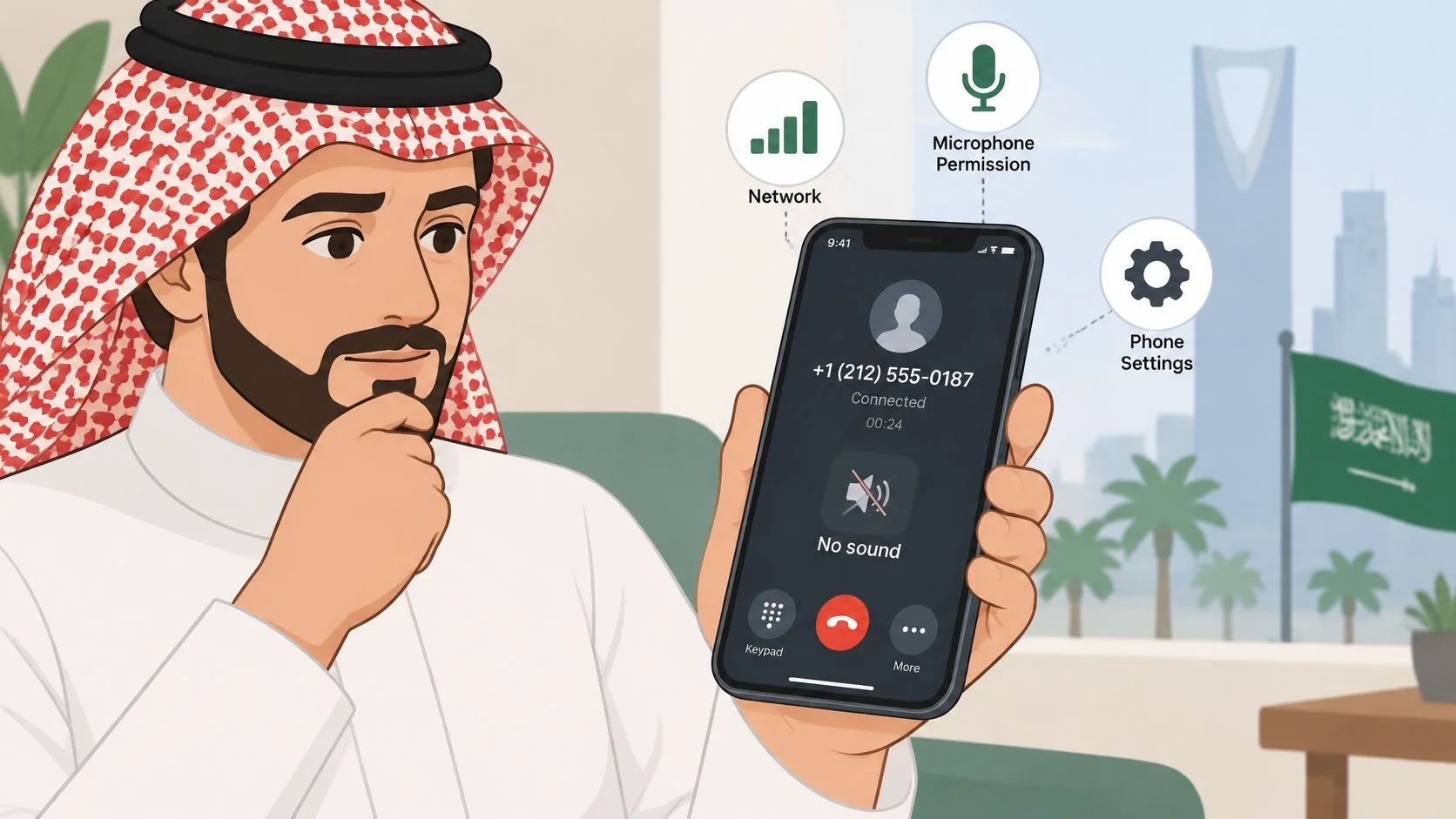
Run the checks in this order
- Confirm the basics first: Make sure international calling is enabled and your balance covers at least one full minute. A call that starts and dies at the point of billing looks like an audio fault and isn't.
- Test against a plain U.S. number: Place the short test to a normal landline or mobile. If a geographic number works and your target doesn't, the target number type is the problem, not your route.
- Switch networks once: If signaling works and audio doesn't, move between Wi-Fi and mobile data and try again. Don't keep redialing the same broken path and expect a different result.
- Check the microphone: Confirm the browser or app has microphone permission and the tab is allowed to use the mic. One-way audio where they can't hear you is a permission fault until proven otherwise.
- Keep the ordinary number ready: Save the recipient's +1 number even if you usually message them. You need a phone network destination when the app route fails.
Order matters because each step isolates one variable. If you change the number, the network and the app at the same time, you'll fix the call without learning what broke. Next time it fails, you're starting from zero.
For an office system, add two tests. Send one keypad tone to confirm menus respond, and confirm the callback number the office sees. Some automated U.S. systems reject anonymous or non-geographic caller ID, and a callback that goes nowhere ends the matter if the call drops mid-queue.
What not to reach for
Don't treat a VPN as the fix. Reporting on Saudi cybercrime rules warns that bypassing legally restricted content or filtering can create legal risk. A calling problem isn't worth that trade, and this guide doesn't suggest it.
If the app route stays unreliable, move the same +1 number to a conventional phone call or to a browser dialer that terminates on the U.S. phone network. The recipient needs no app on that route. The call still needs a functioning data connection on your side if it starts in a browser, so test it on the exact network you'll use for the actual call, at a similar time of day.
Clear speech matters as much as a clear line once audio works, especially on bank and airline calls where names and reference codes get spelled out. If phone conversations in English are the hard part rather than the connection, phone English coaching from Intonetic works on exactly that skill, hearing and being heard accurately without visual cues.
Set a limit for troubleshooting. If two routes fail on two networks, stop testing and use the conventional phone route for the time critical call. You can investigate the app later. The appointment won't wait while you debug a media path.
Call a U.S. Phone From Your Browser
If the person in the U.S. only has a landline or mobile, call that +1 number directly instead of asking them to install anything. That's the decision. Everything else is mechanics.
With BubblyPhone, you type the number in Chrome, Safari, Firefox or Edge, review the rate shown for that U.S. number, and press call. The call goes out over enterprise-grade global carriers and rings their ordinary phone. They need no app and no account. Calls reach over 220 countries and territories, and you can place them by typing a number at the site and pressing call, with no app, SIM card or extension needed. If you want the full picture of calling from a computer first, the guide to calling a phone from a computer covers the setup end to end.
Calling is pay as you go, billed per minute and rounded up to the next whole minute, with no calling subscription. Credits start at $5 and never expire. Don't take a per-minute figure from any article, including this one. Check the current U.S. rate in the live rate table for the exact number you're dialing.
The only monthly product is an optional dedicated-number plan. It's useful if you live outside the U.S. and want a U.S. number that rings in the browser, forwards to a mobile, or takes voicemail. Inbound texts on that number are receive-only.
Teams that handle sensitive calls may also want to compare calling options for privacy-sensitive teams before settling on a route for client work. For a straightforward call to family, a bank or a supplier, the browser route is enough. Confirm the U.S. city hour, enter +1 and the 10 digits, and make the call.
Enter +1 and the 10-digit U.S. number and call from any browser with BubblyPhone, where the person you're calling needs no app or account and picks up on their ordinary landline or mobile. Credits start at $5, never expire, and there's no calling subscription, so a test minute today still leaves your balance ready for the call next month.