Code Number for United States Is +1 and How to Dial It
Table of Contents
- What +1 means in practice
- A copy-ready format
- Why the shared code exists
- Why the misconception causes problems
- Where area codes fit
- Correct format versus readable format
- What not to do
- Two patterns to remember
- The basic sequence
- A quick verification checklist
- A useful example
- Inside a +1 country
- Outside the NANP
- Where people slip up
- Familiar U.S. examples
- Why the original plan still matters
- A quick memory aid
- Why toll-free can be confusing
- What to check before you dial
- Why this matters for businesses and travelers
- Copy-ready examples
- Final check before calling
The code number for United States is +1. It is shared across the North American Numbering Plan, so +1 alone is not enough to reach the right phone in the U.S. without the correct area code and local number.
Code Number for United States at a Glance
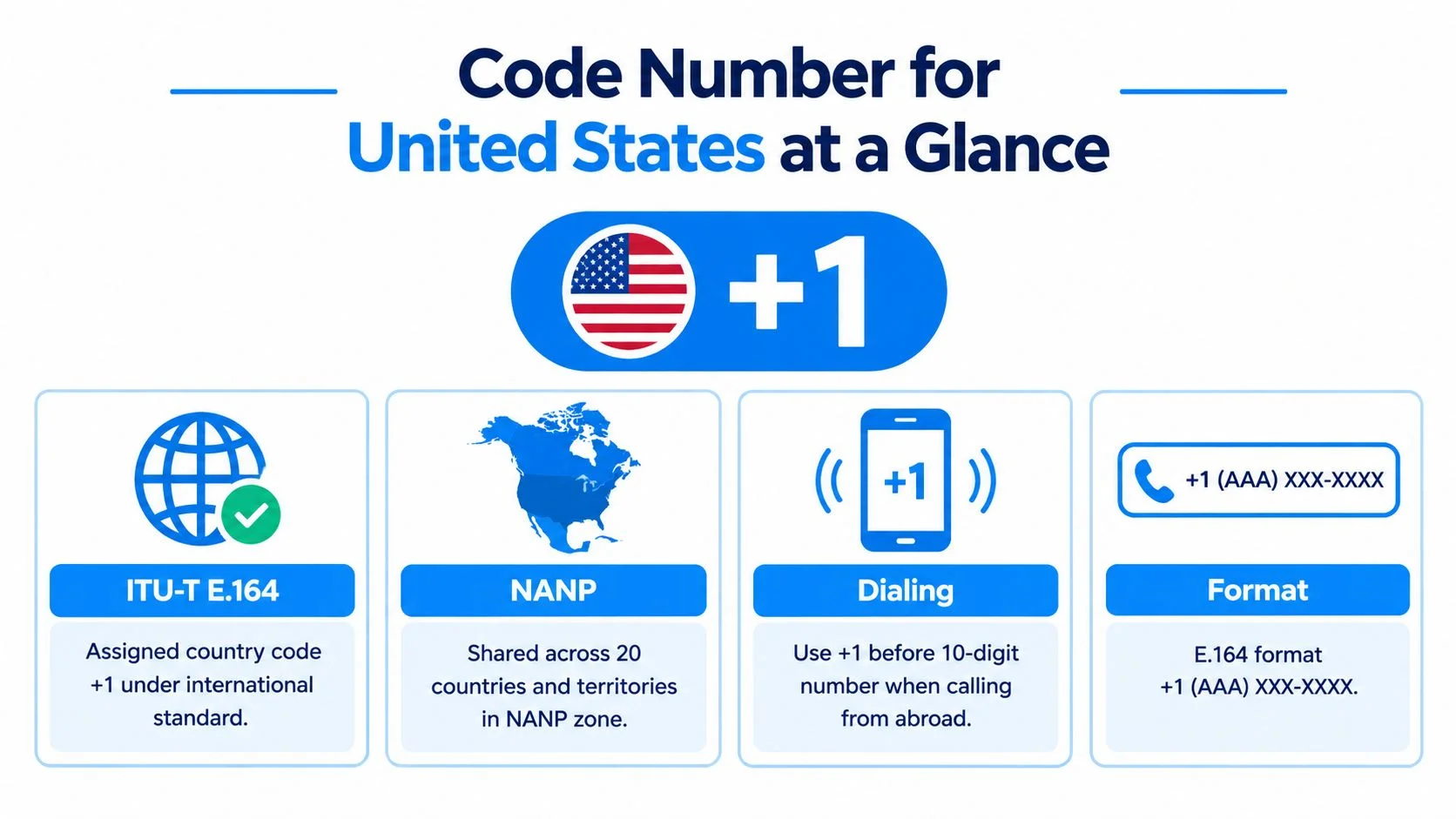
The code number for United States is +1, and in international format it sits under ITU-T E.164. That answer is straightforward. The part that causes confusion is routing, because +1 is shared across the NANP, not reserved only for the U.S. (ITU assigned-code list, FCC overview of the NANP).

What +1 means in practice
+1 works like a shared routing prefix for the NANP. The digits after it tell the network which destination to reach inside that numbering area, which is why a U.S. number still needs an area code and local number to route correctly. In E.164 form, the pattern is +1 plus a 3-digit area code and a 7-digit local number, shown as +1NPANXXXXXX (NANP format reference).
A clear example is +1 212 555 0123. Here, +1 tells the network to enter the shared numbering zone, 212 points to the area, and 555 0123 identifies the line. If the area code is missing, the call cannot be matched to the right destination.
Practical rule: From outside the U.S., or from any device that expects international format, use +1 + area code + local number. Do not stop at +1.
A copy-ready format
For most international callers, the safest pattern is:
- International form: +1 212 555 0123
- E.164 form: +12125550123
- Readable form: +1 (212) 555-0123
These spaces and parentheses are for people, not for the network. The routable version is the compact E.164 form, while the spaced version just makes the number easier to read.
Why +1 Is Shared Across the North American Numbering Plan
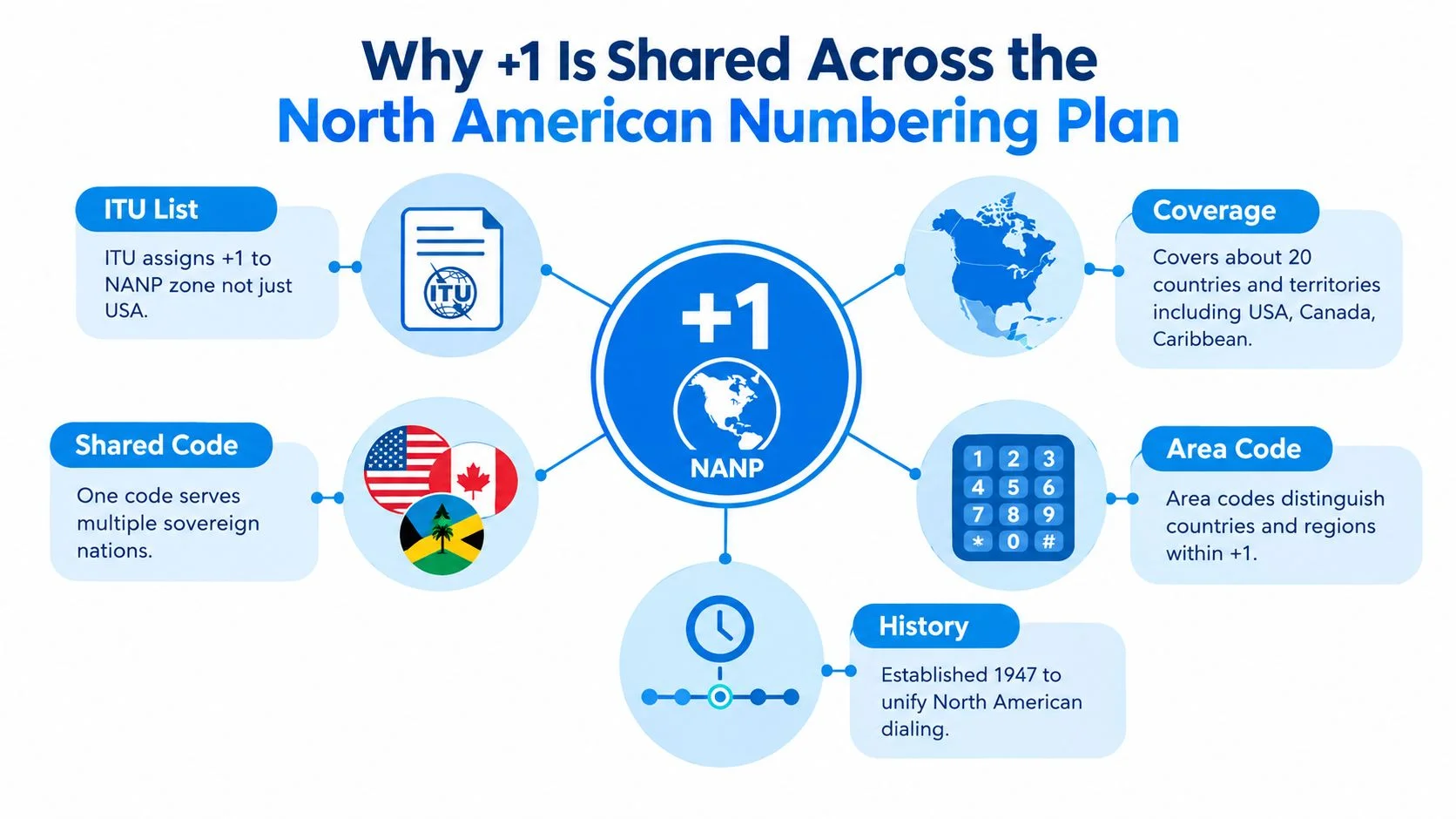
+1 is shared across the North American Numbering Plan, not reserved for the United States alone. It covers the U.S., Canada, and several Caribbean and Atlantic jurisdictions, so the country code only tells you the call has entered the NANP region. The next digits do the routing work. That is why the same +1 prefix can lead to different destinations depending on the area code that follows (ITU country-code list).

Why the shared code exists
The shared code comes from the original numbering plan developed in 1947 by AT&T. It launched with 86 original area codes, with 77 assigned to the United States and 9 to Canada. That early design made long-distance calling easier to standardize across a large region and helped direct-dial calling work in practice (original North American area codes).
That history explains why +1 shows up on numbers outside the U.S. as well. The prefix marks the NANP zone first, then the next digits point to the specific country or region inside that zone.
Why the misconception causes problems
Many callers read +1 as “USA” and stop there. That shortcut leads to misdials, especially for travelers, new immigrants, and small businesses calling across borders. The U.S. appears as code 1 in the ITU list, but that code sits inside a broader shared numbering area, so routing depends on what comes after +1 (ITU assigned-country-code list).
Keep this straight: +1 sends the call into the shared numbering zone. The area code tells the network which part of that zone should ring.
Where area codes fit
Area codes are the part people skip most often, even though they decide whether the call reaches the right place. A U.S. number in California will route differently from one in Alaska, even though both begin with +1. That is why the rest of the number matters just as much as the prefix.
How US Numbers Are Formatted for International Dialing
US numbers are formatted internationally as +1, then a 3-digit area code, then a 7-digit local number. In E.164, the dialing string is kept in one clean sequence, without parentheses or hyphens. That format is easier for networks to route and for calling apps to read.
Correct format versus readable format
The network uses the compact version. People usually prefer the readable version. Both can refer to the same phone number, but only the compact form is the international standard.
The key is consistency. If you are saving contacts, sending numbers to a colleague, or entering a number into a calling system, use the full international version. If you are reading it aloud, the spaced version is easier to say and copy.
What not to do
Do not mix local-style punctuation into the dialing string unless the app specifically allows it. Some systems remove punctuation automatically, while others treat extra symbols as formatting noise. The safest habit is to keep one clean version for dialing and one human-friendly version for display.
Useful habit: Save every U.S. contact in E.164 so the same entry works from abroad, from browser dialers, and from mobile devices that support international format.
If you want a quick check, use a phone number formatter to compare the digits you have with the international form you need.
Two patterns to remember
A California number and an Alaska number can look very different on the surface, but they follow the same structure:
- California: +1 213 XXX XXXX
- Alaska: +1 907 XXX XXXX
That pattern is enough to recognize the shape of a valid U.S. number before you know the specific area code. The area code does the routing work inside the shared +1 zone, while the local digits identify the individual line. Toll-free and special-purpose numbers also use the same country code, but the prefix tells the network to send the call differently, which is why the digits after +1 matter just as much as the prefix.
How to Call the United States From Abroad
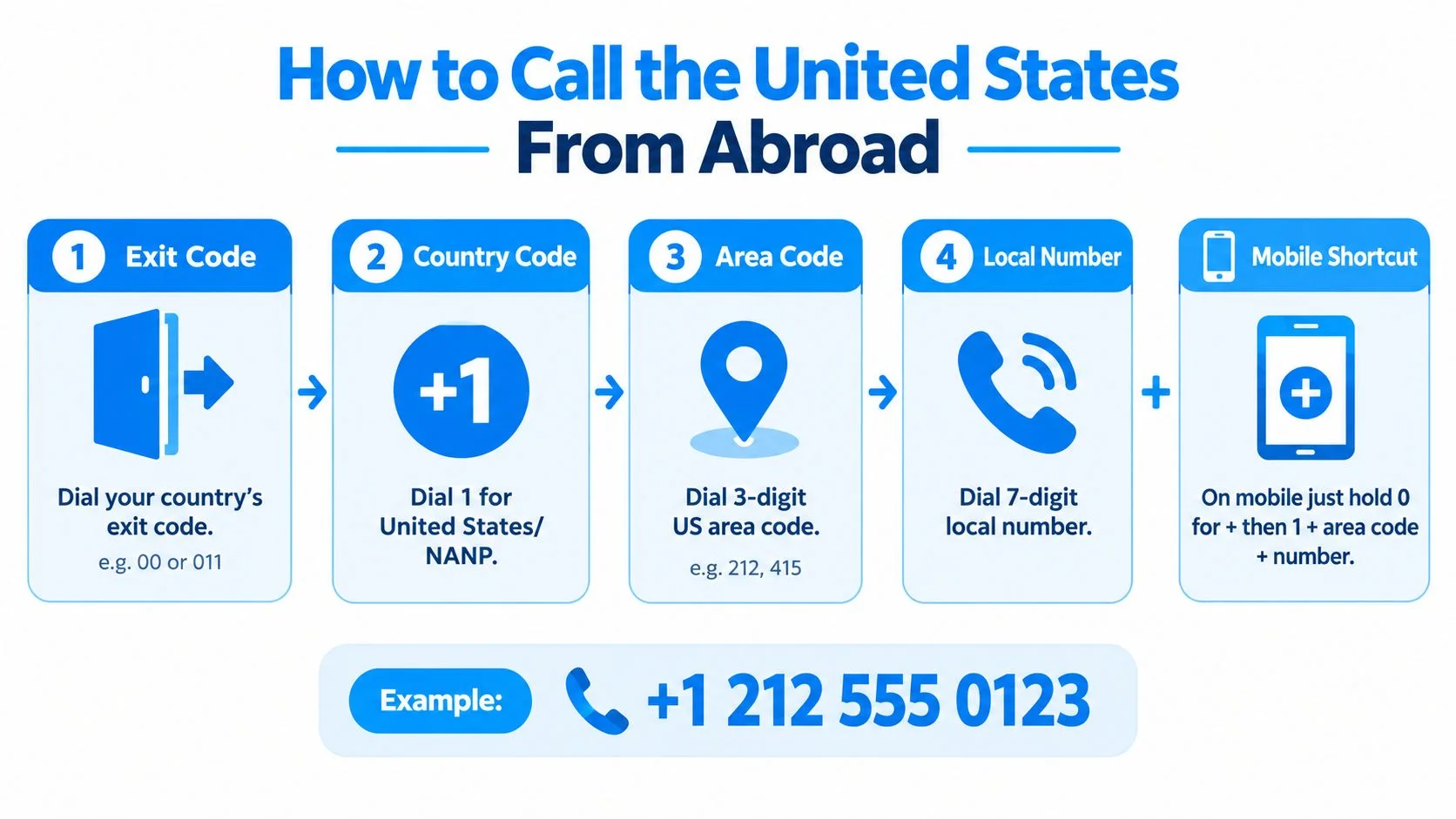
To call the United States from abroad, dial your country's exit code, then 1, then the U.S. area code, then the 7-digit local number. On many mobile phones and browser dialers, you can skip the exit code and use +1 directly instead.

The basic sequence
The dialing order is straightforward:
- Exit code. Use the code your country requires to place an international call.
- Country code. For the U.S., that is 1.
- Area code. Use the correct 3-digit U.S. area code.
- Local number. Dial the final 7 digits.
On a smartphone, the plus sign replaces the exit code. That's why +1 212 555 0123 is the same destination as a full international dial string entered from a country where you would otherwise start with an exit prefix.
A quick verification checklist
Before you press call, check these points:
- Country code: Confirm you used +1, not just a local U.S. number.
- Area code: Make sure the 3-digit area code is included and correct.
- Local digits: Verify the final 7 digits exactly as given.
- Number type: If it's a special-purpose number, confirm it can be reached from your location.
For people working across borders, a browser dialer can be easier than trying to remember country-specific exit rules. One practical place to start is the country-code guidance in BubblyPhone's call-to-United-States guide, which shows the same +1 pattern in a dial-friendly format. If you're comparing coverage for remote work or moving to the U.S., find remote work in USA is a separate resource some readers use when planning contact lists and outreach.
A useful example
If someone gives you 212 555 0123 and you're outside the NANP, don't dial it as-is. Add +1 in front, keep the area code, and enter the rest exactly. The result is +1 212 555 0123 or +12125550123 in compact form.
Dialing Inside the NANP Versus Dialing From Outside
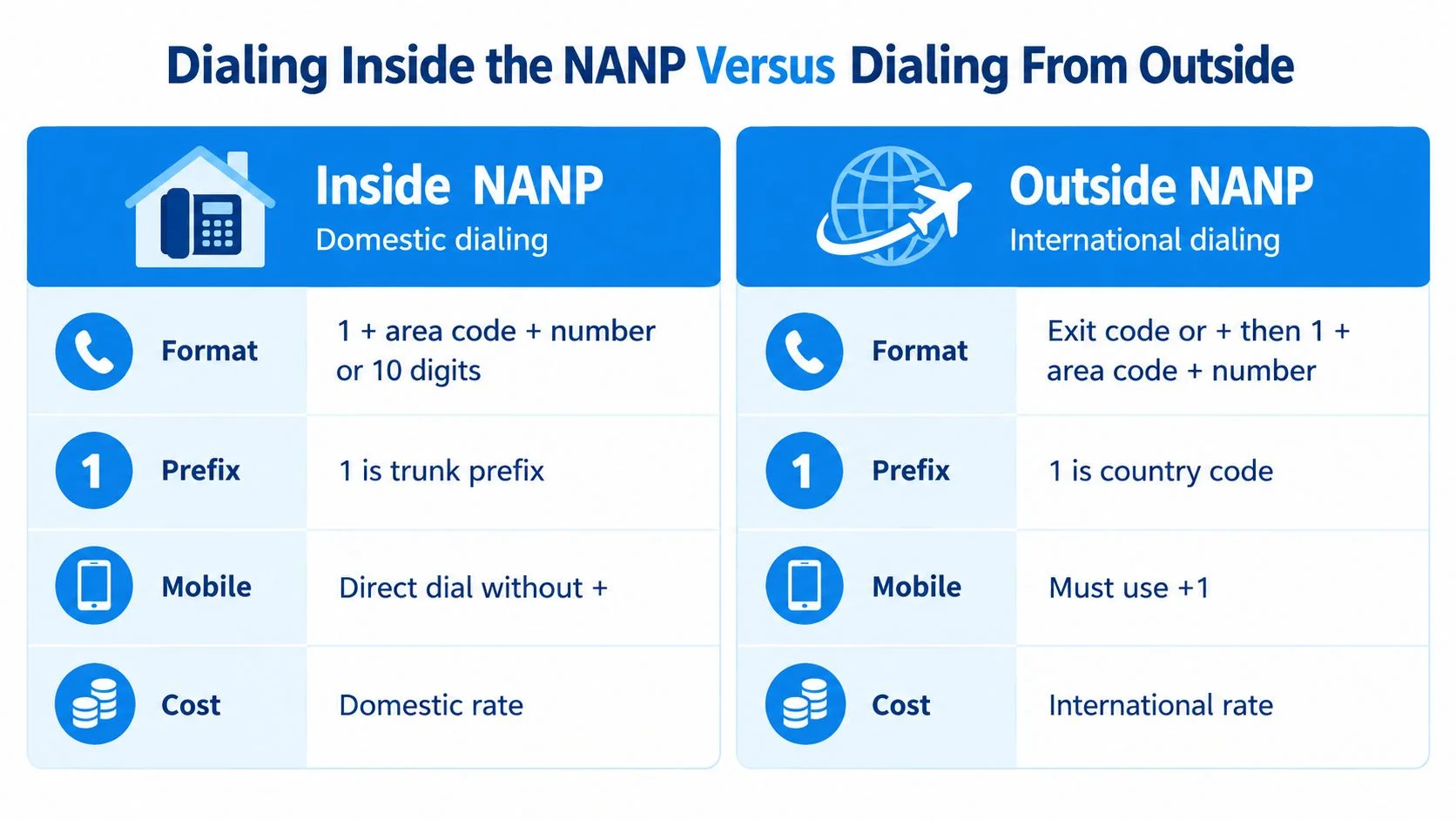
Inside the NANP, the number can be treated as a domestic call. Outside the NANP, you need the international form with +1. That difference matters because the same digits play different roles depending on where the call starts.

Inside a +1 country
If you're already in the NANP, such as in the U.S. or another participating jurisdiction, you often dial the 10-digit number directly, or you may use 1 + area code + number as the domestic long-distance pattern. In that setting, 1 functions as a trunk prefix, not as the international country code.
That's why a traveler in Canada can sometimes dial a U.S. number in a way that feels almost local, while still being inside the same larger numbering region. The digits look familiar, but the dialing rule is domestic rather than international.
Outside the NANP
If you're calling from Europe, Asia, Africa, or most other regions, the number must be expressed as an international destination. Use your local exit code or the + sign, then 1, then the area code, then the local number. In that case, 1 is the country code for the NANP zone.
A simple comparison makes the difference obvious:
- Traveler in Canada: may dial a NANP number in domestic format.
- Caller in Europe: must use +1 or the local exit code plus 1.
Where people slip up
The most common errors are predictable:
- Dropping the area code: The call can't reach the right destination.
- Mixing exit code and plus sign: You only need one international entry method.
- Treating +1 as unique to the U.S.: It's a shared regional code, not a country-exclusive one.
If you need a practical edge case, a person calling a Puerto Rico number should read the rules carefully because it still sits within the +1 region. A focused reference like the Puerto Rico phone guide by Madeira Remote is useful when you're checking how a NANP destination behaves from another country.
Rule of thumb: Use domestic dialing only when you're sure the call stays inside the NANP. Use +1 when you want the number to work cleanly from abroad.
United States Area Codes You Will See Most Often
Area codes identify the destination within the shared +1 numbering zone. They work like regional routing labels. The same +1 can reach a U.S. state, Canada, or a Caribbean destination, so the digits after +1 matter as much as the code itself.
Familiar U.S. examples
Several area codes appear frequently in U.S. contacts. California examples include 213, 310, 415, 424, 510, 650, 714, 818, and 916. Alaska uses 907 (U.S. and NANP area code list).
Routing becomes clearer when you compare the first three digits:
- +1 415 points to a California numbering area.
- +1 907 points to Alaska.
- The shared +1 identifies the NANP zone, while the area code narrows the destination.
The area code is therefore more than a location hint. It is the first routing segment after the shared regional code. A complete number still needs the remaining local digits, because an area code alone cannot identify one subscriber.
Why the original plan still matters
The original North American numbering plan began in 1947 and assigned the U.S. 77 of the 86 original area codes. That early structure supported direct-dial calling across North America and helped establish the regional pattern still used today.
The practical lesson is straightforward. Knowing the first three digits after +1 can help you distinguish California, Alaska, and other NANP destinations. Without those digits, +1 is only a broad regional label, not a precise route.
Scan first, dial second: The area code turns +1 into a destination. Check it before assuming the number belongs to the U.S. mainland.
A quick memory aid
For work or family contacts, group numbers by area code instead of relying only on city names. Several people may share a city while using different exchanges or area codes. This simple check can reveal a copied digit, a mislabeled contact, or an assumption that every +1 number belongs to the United States.
Toll Free and Special Purpose Numbers on +1
Toll-free +1 numbers don't behave like ordinary local numbers when you call across borders. A prefix such as +1-855 may look familiar, but whether it's reachable or free depends on where the call starts and how the network routes it.
Why toll-free can be confusing
Inside the U.S. and Canada, toll-free numbers are built for customer support and similar uses. Outside those countries, the same number may be treated differently by carriers, may not connect at all, or may be charged as a normal international call. That's why you should never assume a toll-free prefix is free just because it starts with +1.
The same caution applies to special-purpose numbers that are part of the NANP but not ordinary local lines. Cross-border handling can vary, so the safe move is to verify reachability before calling and check live pricing instead of guessing.
What to check before you dial
- Confirm reachability: Make sure the number accepts calls from your country.
- Check the prefix: Toll-free ranges can behave differently from geographic area codes.
- Review the route: Carrier handling may affect whether the call completes.
- Inspect live pricing: Don't assume a toll-free number is free from your location.
If you need a practical reference for calling North American toll-free lines from abroad, the guide to calling 1800 numbers from outside the US helps you think through the reachability issue before you dial.
Why this matters for businesses and travelers
An immigrant calling bank support, a traveler checking an airline line, and a small business following up with a vendor can all run into the same problem. The prefix looks familiar, but the call behaves differently across borders. That's why the right question isn't just “What is the code number for United States?” It's also “What kind of +1 number am I calling?”
Don't assume toll-free means free abroad. The only reliable answer is the live route and the live rate.
Quick Reference Examples and Browser Calling With BubblyPhone
The code number for United States is +1, and the two forms you'll use most are E.164 and readable format. Save the number in the compact international form when you want it to work across devices, and keep the readable form when you need to check it quickly.
Copy-ready examples
- New York example: +12125550123, readable as +1 (212) 555-0123
- Alaska example: +19075550123, readable as +1 (907) 555-0123
A simple verification pass catches most mistakes before they turn into failed calls. If the number has +1, a valid area code, and the correct 7-digit local number, you're in good shape. If one of those parts is missing, the call may not route the way you expect.
Final check before calling
- Confirm the destination: Is it a geographic U.S. number or a toll-free/special-purpose number?
- Confirm the format: Does it include +1 + area code + local number?
- Confirm the route: Is the number reachable from your country or carrier?
If you're troubleshooting contact details on a phone, a separate walkthrough like iPhone text delay troubleshooting can help you fix related contact and messaging confusion before you place the call.
For browser-based calling, BubblyPhone lets you place calls in any modern browser, the person you call doesn't need an app or account, and pricing is billed per minute, rounded up to the whole minute. Credits start at $5 and never expire, there's no subscription needed for calling, and you can review live destination pricing at BubblyPhone rates before you dial. Calling is routed through enterprise-grade global carriers, and optional dedicated-number plans can receive SMS, while outbound calling stays pay as you go.
If you need to call a U.S. number right now, open BubblyPhone, enter the full +1 format, and place the call from your browser without asking the other person to install anything.