How to Call 1-800 Numbers From Outside the US (and Why They Fail)
US toll-free numbers — 800, 888, 877, 866, 855, 844, 833 — don’t work from foreign phones: carriers refuse them or bill international rates. The fix: call from a US-based line. Free through our browser dialer, plus verified international lines for SSA, the IRS and major banks. Plus what 1,852 real calls from 40 countries showed.
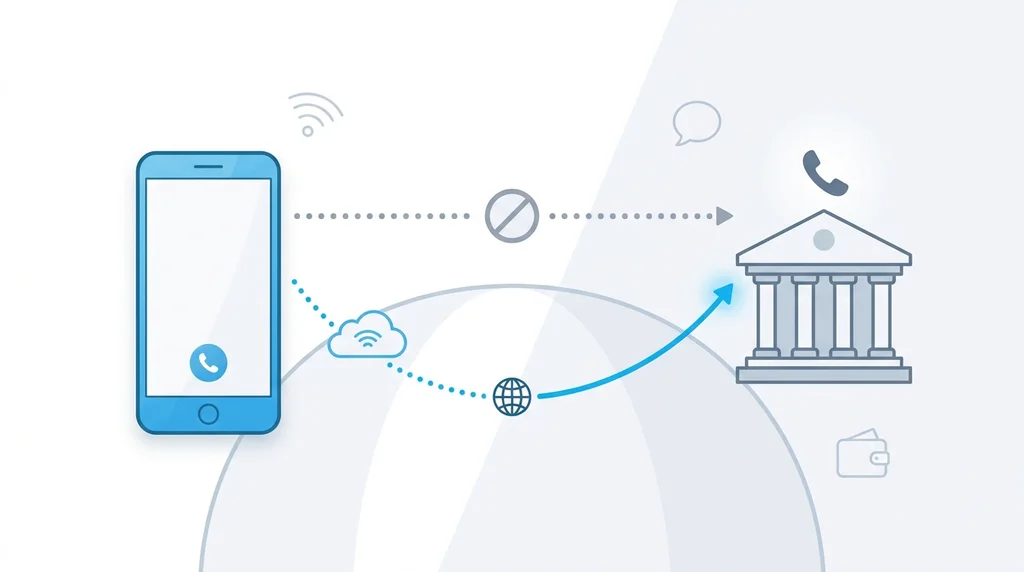
US toll-free numbers — 800, 888, 877, 866, 855, 844 and 833 — generally can't be reached from phones outside the United States: the toll-free billing system only exists inside the US network, so foreign carriers commonly refuse the call or, if they do connect it, bill it at full international rates. The reliable fix is to place the call from a US-based line over the internet. Through BubblyPhone's browser dialer, calls to US toll-free numbers are free — $0.00 per minute. You need an account with a positive balance (any amount) to place calls, and a single call is capped at 2 hours.
This bites almost every expat and traveler eventually, because the numbers America prints on everything — the back of your bank card, IRS letters, Social Security correspondence, airline confirmations — are toll-free. In our own call logs the busiest US toll-free destinations are exactly those: Bank of America's 800-432-1000, Chase's 800-935-9935, Apple's 800-275-2273, Capital One, Amazon, the IRS and Social Security, dialed by people who first spent an afternoon discovering their local SIM won't connect them. Below: what a year of those calls looked like, why the direct dial fails, every workaround ranked honestly, and a directory of real international lines verified on each institution's own website.
What 1,852 Real Toll-Free Calls From Abroad Looked Like
We pulled every answered call our customers placed to a US toll-free number (800, 888, 877, 866, 855, 844, 833) in the twelve months to mid-September 2026, leaving out one account that rang Amazon's account line 1,244 times on its own. That leaves 1,852 calls by 246 people in 40 countries: US expats in Britain, India, Brazil, Pakistan, the Philippines, Thailand, Japan, Spain and Singapore, and foreigners with a US bank, a US phone contract or a US tax return.
- Most calls are short. The median call was two minutes: a card activation, a balance, a “yes, that was me” to a fraud check. The average was 6.7 minutes because of the tail.
- The tail is long. 177 calls ran over 20 minutes and 78 over 30. The longest were a 124-minute call to Qantas's US line, two IRS business-line calls of 105 and 102 minutes on consecutive days, and an 82-minute call to Fidelity. All of it on hold, all of it at $0.00 a minute; the same four calls on a roaming mobile would have cost a few hundred dollars.
- The international lines get used, and work. The IRS's +1 267-941-1000 was dialed 175 times by eight people, averaging seven minutes; Bank of America's +1 315-724-4022 and Chase's +1 713-262-3300 both connected first time. That is the evidence behind the directory below.
- What failed: 604 attempts never connected. 291 died on the caller's own connection before the call left the browser (weak Wi-Fi or a blocked microphone), 174 got a busy tone from the company, and 92 were hung up by the caller while it rang. Almost none were rejected by the toll-free system itself, which is the whole point of calling from a US-based line.
Why Don't 1-800 Numbers Work From Outside the US?
Because a toll-free call isn't free — it's paid by the business you're calling, per minute, under a billing arrangement that only covers calls originating on US networks. When you dial 1-800-432-1000 from Ohio, your carrier hands the call to the bank's toll-free provider, which bills the bank for the minutes. When you dial the same digits from a German or Indian mobile, your local carrier has no contract with that toll-free system and nobody has agreed to pay for your call. It has exactly two options, and both are bad for you:
- Refuse the call — you hear dead air, a reorder tone, or a “this number cannot be reached” announcement. This is the most common outcome on European and Asian networks.
- Route it as a paid international call — some carriers connect +1 800 numbers but bill them like any other US call, at international or roaming rates. AT&T's own travel documentation tells its customers exactly this: toll-free numbers often won't complete abroad, and when they do, they're billed as international calls. “Toll-free” quietly becomes the most expensive number on your bill.
This isn't an American quirk — every country's freephone range works this way in reverse. UK 0800 numbers and Australian 1800 numbers are just as unreachable from a US mobile. Toll-free is a domestic billing agreement wearing a phone number as a costume, and the costume only fits inside its home network.
How Can I Call a US Toll-Free Number From Abroad?
Make your call originate in the US. The toll-free system doesn't care where your body is — it cares which network the call enters from. A call placed through a US-based internet phone service enters the US network like any domestic call, the toll-free routing accepts it, and the business (not you) pays for it, which is why we can price US toll-free at $0.00/min. Every realistic option, ranked:
| Method | Does it work? | What it costs | Fine print |
|---|---|---|---|
| Call from a US-based internet line | Yes — the toll-free system sees a US call | Free on BubblyPhone ($0.00/min to US toll-free) | Account needs a positive balance to dial; single calls cap at 2 hours |
| The company’s international line | Yes — ordinary +1 number, dialable anywhere | Normal US per-minute rate ($0.025/min from our dialer) | Most big banks have one; see the directory below for verified numbers |
| International collect via operator | Sometimes — where operator service still exists | Free to you if accepted; operator surcharges otherwise | Legacy option; many mobile carriers no longer offer operator-assisted collect |
| Dialing +1 800 from your foreign mobile | Unreliable — often refused outright | If it connects, commonly billed at international rates | The one thing most people try first, and the reason this guide exists |
To be precise about the free route, since “free” usually hides an asterisk: on BubblyPhone, US toll-free destinations are genuinely billed at $0.00 per minute — the receiving business pays for the call, as toll-free intends. Two honest conditions apply. Your account must hold a positive balance — any amount — to place calls at all (an anti-abuse rule, not a charge; nothing is deducted for the toll-free call itself). And any single call disconnects at the 2-hour mark, which in practice you'll only meet on the very worst government hold queues — hang up and redial if you do.
A word on the missing option: for years the default answer to this problem was Skype, which connected US toll-free numbers for free from anywhere. Microsoft retired Skype in May 2025, which is why so many forum threads full of “just use Skype” advice now lead nowhere — and why this question is suddenly being asked all over again. Operator-assisted collect calling, the other classic, still technically exists for some of the bank numbers below, but finding a live international operator on a modern mobile network is its own odyssey.
Which Companies Have Real International Lines?
Most large US institutions quietly run an ordinary geographic +1 number for exactly this situation — they just print the toll-free one everywhere. The trick when you can't find it: search for “[company] international collect call number”, because these lines are usually published on lost-card and travel pages under the collect-call framing. Here are the ones we verified on each institution's own website in August 2026:
| Institution | US toll-free (fails abroad) | International line | Notes |
|---|---|---|---|
| IRS (US tax authority) | 800-829-1040 | +1 267-941-1000 | International Taxpayer Service Call Center, Mon–Fri 6 a.m.–11 p.m. ET |
| Social Security Administration | 800-772-1213 | 1-855-522-6936 | International Operations line, 7 a.m.–5 p.m. ET — itself toll-free, so call it from a US-based line |
| Bank of America | 800-432-1000 | +1 315-724-4022 | Published as an international collect line; Mon–Fri 8 a.m.–11 p.m., weekends 8 a.m.–8 p.m. ET |
| Chase | 800-935-9935 | +1 713-262-3300 | Chase’s own “outside the U.S.” line, 24/7; the number on the back of your card also works from a US-based line |
| American Express | the 800 number on your card | +1 336-393-1111 | Published as a collect number for overseas cardmembers; direct-dialing it also connects |
| Citi (cards) | the 800 number on your card | +1 605-335-2222 | Outside-the-US line, 24/7; also the number Citi lists for fraud reports from abroad |
| Capital One | the 800 number on your card | +1 804-934-2001 | Collect-call support line; Capital One says to give your name as “Capital One Customer” |
| Verizon | 800-922-0204 | +1 908-559-4899 | Verizon’s international support line, 24/7; toll charges apply from non-Verizon phones |
| T-Mobile | 800-937-8997 | +1 505-998-3793 | Free from a T-Mobile phone anywhere in the world; from other phones it is an ordinary US call |
| Amazon | 888-280-4331 | +1 206-266-2992 | Amazon’s number for customers outside the US and Canada |
| Fidelity Investments | 800-343-3548 | +1 801-534-1910 | Collect line with Fidelity accepting the charges; Fidelity also publishes per-country toll-free access codes |
| British Airways (US reservations) | 800-247-9297 | +44 344 493 0787 | No US geographic line; BA’s UK 0344 line and its overseas number are covered in our UK 0344/0345 guide |
All international numbers checked against the institutions' own contact pages in August 2026. Numbers change — if one fails, the search trick above finds the current one. The IRS entry is covered in depth in our dedicated IRS-from-abroad guide.
Two things worth noticing in that table. First, the “collect” labels are historical: these are ordinary, directly dialable US numbers. You don't need an operator or a collect arrangement — dialing them from a cheap US-rate line costs a few cents a minute and skips the whole ritual.
Second, look at the Social Security row. SSA's published line for people outside the United States is 1-855-522-6936 — an 855 number, which is itself US toll-free. SSA's own website warns that foreign carriers may apply charges to it. An international helpline that's hard to reach internationally is the whole problem in one row — and also the cleanest illustration of the fix: called from a US-based internet line, it's both reachable and free.
What Does It Cost?
Hold time is the real cost driver — bank and government queues run 20 to 60 minutes, so judge every option by the hour, not the minute:
| How you call | Rate | 1-hour call |
|---|---|---|
| BubblyPhone browser call to any US toll-free number | $0.00/min — toll-free stays toll-free | $0.00 |
| BubblyPhone call to a regular +1 international line | $0.025/min (our live US rate) | about $1.50 |
| Foreign mobile dialing +1 800 directly (when it connects) | commonly $0.50–$3/min at international or roaming rates | $30–$180 |
| Hotel room phone | often $2–$5/min plus connection fees | $120–$300+ |
The pattern: toll-free through a US line costs nothing because the business is paying, and the geographic international lines cost US-domestic money, not international money — $0.025/min buys an hour on hold with Bank of America for $1.50 (full price list on the rates page). The direct-dial-from-abroad row is the trap: it combines the worst connection odds with the highest price, and it's the default thing everyone tries. One practical bonus of calling over the internet: bank and government phone trees run on touch-tones, and a proper dialer sends them reliably — a common failure point for calling cards and bargain apps that connect the call but can't navigate the menu.
Do 833, 844, 855, 866, 877 and 888 Numbers All Behave the Same?
Yes. They're one family: 800 launched in 1967 and filled up, so the numbering plan added 888 (1996), 877 (1998), 866 (2000), 855 (2010), 844 (2013) and 833 (2017). All seven prefixes ride the same toll-free routing and billing system, which means everything in this guide applies identically — an 833 number is exactly as unreachable from a Mumbai mobile as an 800 number, and exactly as free through a US-based line. On BubblyPhone, all seven prefixes are zero-rate destinations.
Don't confuse them with lookalikes: 900 numbers are premium-rate (you pay, heavily), and 822/880-series codes are reserved or historical oddities. And a toll-free number tells you nothing about geography — “1-800” also fronts Canadian businesses, since Canada shares the North American numbering plan and its toll-free space. Those behave the same way: free from US networks, awkward from everywhere else.
Frequently Asked Questions
Can I call a 1-800 number from outside the US?
Why is a toll-free number charging me from abroad?
How do I call 800 numbers from Europe, the UK or India for free?
How do I call my US bank from overseas if its 800 number won't connect?
How do I call Social Security (800-772-1213) from another country?
Are 888, 877, 866, 855, 844 and 833 numbers also free to call?
Didn't Skype used to solve this?
Call Any US 1-800 Number — Free
Your bank, the IRS, Social Security, an airline — dial their toll-free number from your browser and pay $0.00/min, from any country.
Start CallingWorks on any device, no app needed. Positive balance required to dial; see all rates.