International Call to the Philippines: How to Dial
Table of Contents
- Mobile numbers keep the 9 after +63
- Landlines keep the area code
- Exit codes for common calling countries
- Check the full string before calling
- Check the clock before you dial
- The conversion order that prevents misdials
- Malformed numbers you'll meet in real lists
- A pre-call checklist for bulk lists
- Budget for a month, not a test call
- Read the failure in the order it happens
- Verify before you call back
Dial your country's exit code, then 63 for the Philippines, then the Philippine number with its domestic leading 0 removed. From the US, a mobile written locally as 0917 123 4567 becomes 011 63 917 123 4567; from the UK the same number starts 00 63 917 123 4567.
A contact list is where this usually goes wrong. One row says 0917 123 4567, another says +63 917 123 4567, a third has 02 8123 4567 with a note that it's a Manila office, and a fourth has a 00 in front because someone copied it from an old email. You don't need a telecom background to sort that out. You need one conversion rule, a number type check, and a way to catch the rows that break the rule before you pay for a failed call.
An international call to the Philippines is mostly a formatting job. The network part is routine. The mistakes happen in the digits you paste into the dialer.
Dial Format for Calling the Philippines
A mobile number saved as +63 917 123 4567 is already in international format. The same number may appear in a local contact list as 0917 123 4567. Knowing which format you have helps prevent a misplaced digit when you copy numbers between a spreadsheet and a dialer.
Mobile numbers keep the 9 after +63
Philippine mobile numbers have no area code. In international format, the domestic 09 prefix becomes 9, so 0917 123 4567 is written as +63 917 123 4567. The pattern applies to Globe, Smart, DITO, Sun and TNT numbers.
Landlines keep the area code
For a landline, retain the area code and remove the domestic trunk prefix 0. For example, Metro Manila's area code is 2, and Cebu's is 32. That gives +63 2 8123 4567 for a Metro Manila number and +63 32 412 3456 for a Cebu number.
Philippine number formats, domestic and international
Treat the leading 0 as part of the domestic format. Leave it out when preparing the international number.
On a mobile phone, the + key replaces the exit code used to dial internationally. See the Philippines country code and dialing format for a quick reference. For teams handling other destinations, this guide to fix PBX errors calling French numbers covers a related formatting problem.
How to Dial a Philippine Number Step by Step
A UK caller has the Philippine mobile number 0917 123 4567 in a contact list. The exit code depends on where the call starts, so check the table before entering the full string.
Exit codes for common calling countries
Your exit code is the prefix your network uses to send the call abroad. On a mobile phone, the + key can stand in for that prefix.

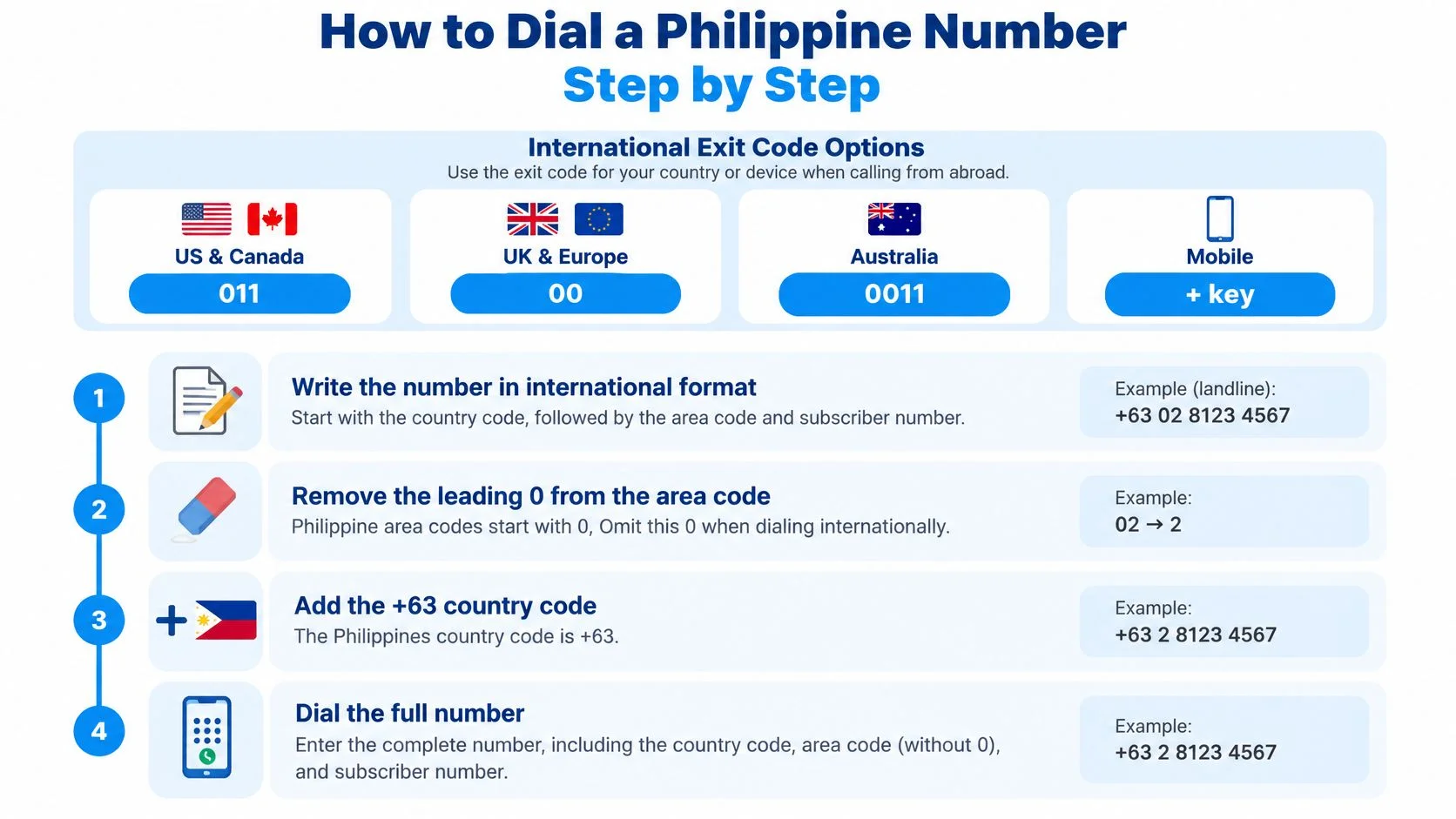
Check the full string before calling
For the UK example, enter 00 63 917 123 4567. On a mobile, enter +63 917 123 4567 instead. Check the digits against the original contact before you call; an extra or missing digit can send the call to the wrong number or prevent it from connecting.
Check the clock before you dial
The Philippines uses Philippine Time at UTC+8, so Manila, Cebu and Davao share the same clock, as the Philippine time zone guide explains. A call planned for 9:00 a.m. in the Philippines is 8:00 p.m. the previous day in New York during standard-time conditions. The time difference changes when the other country observes daylight-saving time.
Normalizing Mobile and Landline Numbers in Contact Lists
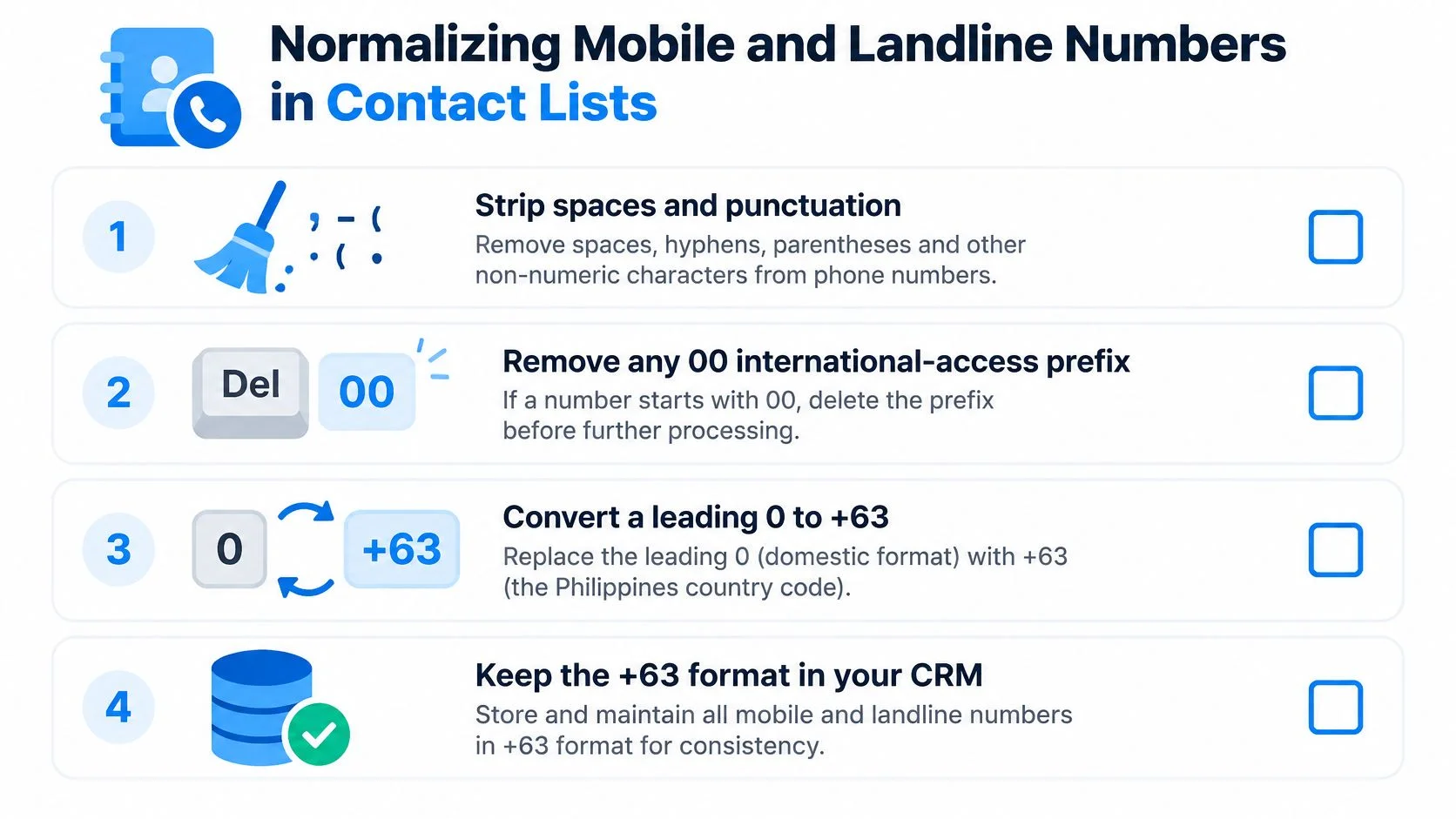
Convert every number before it leaves your spreadsheet or CRM. The conversion itself is simple, and that's why bulk errors are so easy to miss.
The conversion order that prevents misdials
The ITU-T E.164 numbering plan sets the Philippines country code at 63 and calls for the domestic trunk prefix 0 to be removed. Follow the same order for every row.
Strip spaces, punctuation and any international-access prefix such as 00. Convert a leading 0 to +63. Preserve the mobile prefix or geographic area code.
Reject numbers with unexpected lengths. Test termination without exposing the normalized number in user-facing error logs.
Start by deciding the number type. A mobile begins with 09 domestically and with 9 after +63, and it has no area code. A landline begins with an area code such as 2 for Metro Manila, 32 for Cebu or 82 for Davao, and the local number length varies by area. The 09 series reference at Philippine 09 number series helps confirm mobile prefixes before you convert a whole column.

Malformed numbers you'll meet in real lists
- Stray zero after +63. 0917 123 4567 becomes +63 0917 123 4567, which keeps the domestic 0 in the international string. The correct form is +63 917 123 4567.
- Country code pasted in front of a domestic string. 02 8123 4567 becomes +63 02 8123 4567. The 0 after 63 makes the destination unusable. It should be +63 2 8123 4567.
- International prefix left inside. A row that reads 00 63 00 917 123 4567 has two access prefixes fighting each other. Keep one international form and remove the rest.
Bulk rule: Convert first, validate second, dial third. Reversing that order is how one bad row becomes a paid failed call.
A pre-call checklist for bulk lists
- Every row starts with +63.
- No domestic 0 sits directly after +63.
- The length matches the type. Mobile numbers carry 10 digits after 63. A Metro Manila landline carries the 2 plus eight subscriber digits, and other area codes can differ.
- A sample of ten numbers has been test-dialed. Include one mobile, one Metro Manila landline and one provincial landline.
What Affects What Your Call Costs
The cost depends on the destination number type, the billing unit and your prepaid balance, and the live rate table is the only reliable source for current prices. A rate you remember from last month is not a quote.
Mobile and landline routes can price differently. A Globe mobile is not the same route as a PLDT landline, and provincial landlines can sit on their own route. Check the exact route before you dial. Open the live rate table and then the Philippines rate page for the number type you're calling.
Billing is per minute and rounded up to the whole minute. A call of 61 seconds bills as two minutes, so a conversation that runs a few seconds past the hour costs more than the clock suggests. Calling doesn't require a subscription, so the per-minute charge is the charge.
Budget for a month, not a test call
For a family or business budget, list the numbers you call most often and estimate minutes per month. One short test call tells you whether the line connects. It doesn't tell you what a weekly call will cost.
Cost factors and where to check them
Fixing Calls That Fail to Connect
A call to a Philippine number can fail at several points: the number may be rejected, the line may ring without an answer, or the call may connect and then drop. Check what happens first; the symptom helps narrow down the cause.
For example, a Philippine mobile number written domestically as 0917 123 4567 appears internationally as +63 917 123 4567. The overview of Philippine telephone numbers explains that the initial domestic zero is dropped in international format. A leftover zero is one possible formatting mistake, but connection problems can also involve the recipient's line or the call session.
Read the failure in the order it happens
If the call is rejected immediately, compare the number with the international format you prepared earlier. If someone else answers, check whether a landline area code was mistaken for a mobile prefix, or vice versa. If the call rings and then drops, retrying on another network or at another time can help distinguish a temporary connection issue from a number-format mistake.
A busy signal or no answer usually means the recipient is unavailable. A call that cuts off mid-conversation may also end when the prepaid balance runs out.
Call symptoms, causes and fixes
Verifying a +63 Number Before You Call Back
A +63 number is not proof of who is calling, because caller ID can be spoofed. The country code tells you where the number is registered, not who owns the handset or whether the person on the other end is honest.
The classic setup is a one-ring call. Your phone rings once, the caller hangs up and hopes you return the call. The return call can expose you to unexpected charges or fraud, and scammers can manipulate caller ID to make the number look familiar, as LegalClarity's explanation of the 63 country code warns. The pattern to recognize is simple.

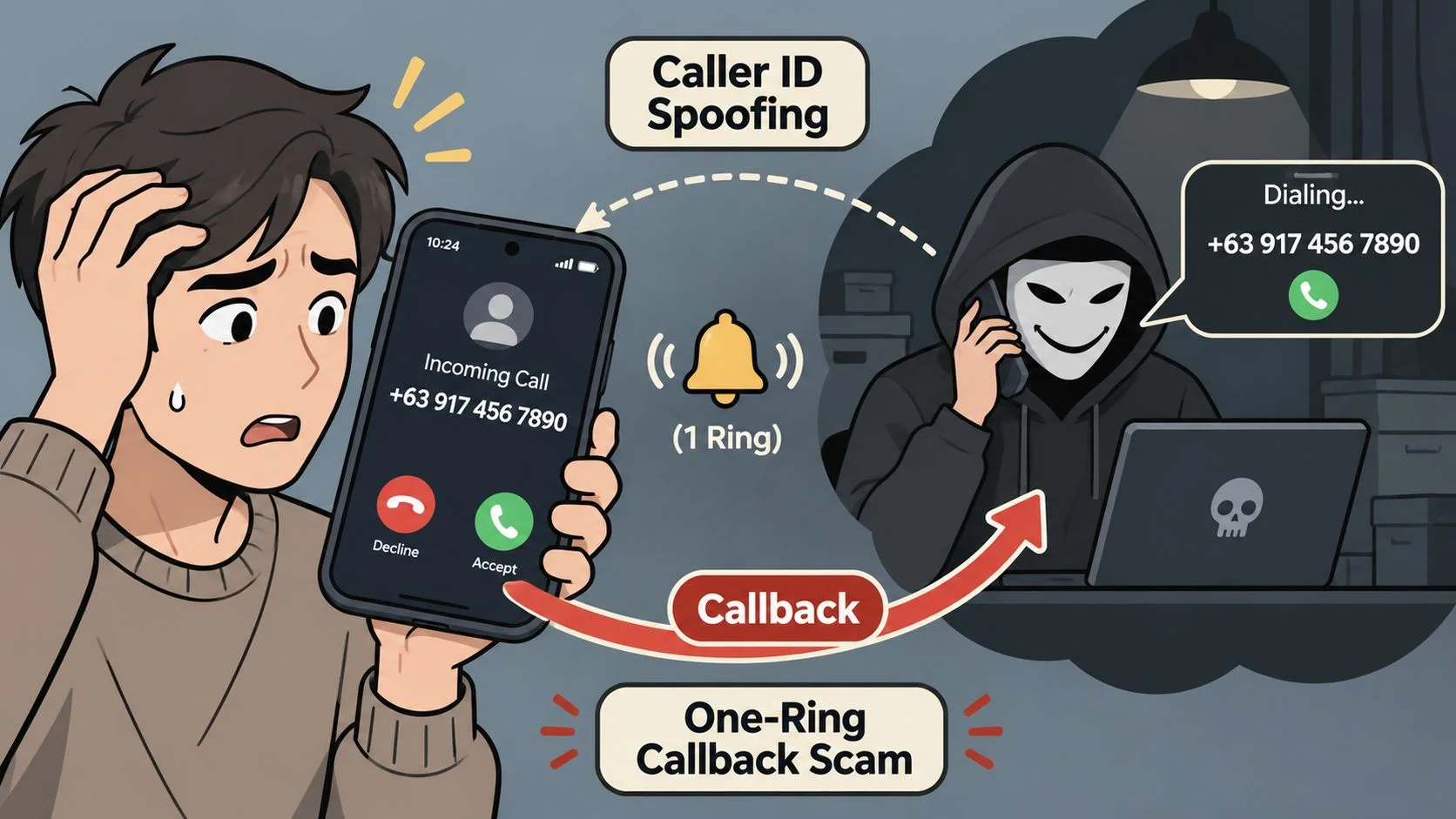
Verify before you call back
- Verify through an existing channel. Reply to an email or message you already trust, not to the missed call.
- Look up the organization. Find the official number on its website and call that.
- Do not return one-ring calls. A single ring from an unknown +63 number is not a missed conversation.
- Keep secrets off unexpected calls. Never give passwords, one-time codes or financial details to a caller who reached you first.
- Save known numbers in +63 format. Then caller ID matches a name you already know.
Legitimate callers can also appear as unfamiliar +63 numbers. Family members, recruiters, suppliers and support teams may all call from numbers you haven't saved, so blocking every overseas call can cut you off from people you need.
Businesses that call Philippine numbers need their own safeguards. Confirm consent before you call, identify your organization at the start, limit the sensitive data you collect and document the caller's identity.
Report scam calls and texts through the CICC hotline 1326 or the eGov PH app.
Place Your First Call to the Philippines
Dial the number in the +63 format, check the rate for its number type, and top up enough for the call you plan. The format is the part you control. The rate check takes a few seconds and stops a long call from ending early.
BubblyPhone runs in any modern browser, so there's no app to install for the call itself, and the person you're calling needs no app or account. It reaches any Philippine number, including Globe, Smart, DITO, Sun, TNT, PLDT landlines and provincial landlines. Calls are billed per started minute, and calling needs no subscription. The dialer is outbound only and doesn't receive calls by itself; the optional dedicated-number plan is the only recurring product. Credits start at $5 and never expire, so you can top up for one call or keep a balance for the next.
Make your first international call to the Philippines from the browser tab you already have open. BubblyPhone connects you to ordinary mobile and landline numbers, with no app or account needed on the receiving end, and credits start at $5 with no expiry. Visit BubblyPhone to check the live rate, enter the +63 number and start the call.