How to Call Colombia from US: Step-by-Step Guide 2026
Table of Contents
From a US landline, dial 011, then 57, then the Colombian number. From a US mobile or a browser dialer, dial +57 and leave 011 out entirely.
So why does the call still die on the first ring for someone who has those digits memorized? Because callers often treat 011 and the plus sign as interchangeable decoration, when they're two different instructions aimed at two different parts of the network. Get that wrong and the digits never reach Colombia at all.
Dialing Formats for Colombian Landlines and Mobiles
From a US landline, dial 011, then 57, then the Colombian number. From a US mobile or a browser dialer, dial +57 and skip 011. The ITU's published numbering reference sets out both paths: the U.S. exit code 011 plus Colombia's country code 57 plus the Colombian telephone number, with the plus format +57-[number] generally substituting for 011 on a mobile device.
The two numbers do different jobs, and that's the whole trick.
- 011 describes you. It tells the network the call starts in the United States, and only a caller outside Colombia uses it.
- 57 describes them. It identifies Colombia as the destination country, assigned under the international E.164 numbering framework.
The same 57 applies whether the person answering has a landline or a mobile. Only the national digits that follow change. The FCC's international calling guide describes the same general pattern, exit code then country code then area or city code then local number, and notes that dialing details can vary by service provider, so the sequence is standard even when the handling around it isn't.
A Colombian mobile typically carries 10 digits after 57 and starts with 3. A landline follows an area-code structure instead, which changes what you type after the country code even though 57 stays exactly where it is.
The rule to carry with you: 011 for a landline, the plus sign for a mobile, and never both in the same dial string.
If you remember one line from this page, make it that one. Adding 011 to a plus-format call hands the network two exit codes where it expects one, and it has nowhere sensible to send the leftover digits. Our Colombia country code reference works the same prefix from the opposite direction, starting from the number rather than from your device.
How to Dial a Colombian Number Step by Step
Write the number as +57 followed by ten digits, then dial it from a mobile or a browser dialer. On a US landline, swap the plus sign for 011 57 and keep everything after it identical.
The five steps below are what to follow the first time. They're also what to check the tenth time, because every mistake in this sequence is silent. The phone accepts the digits and the network declines to connect.

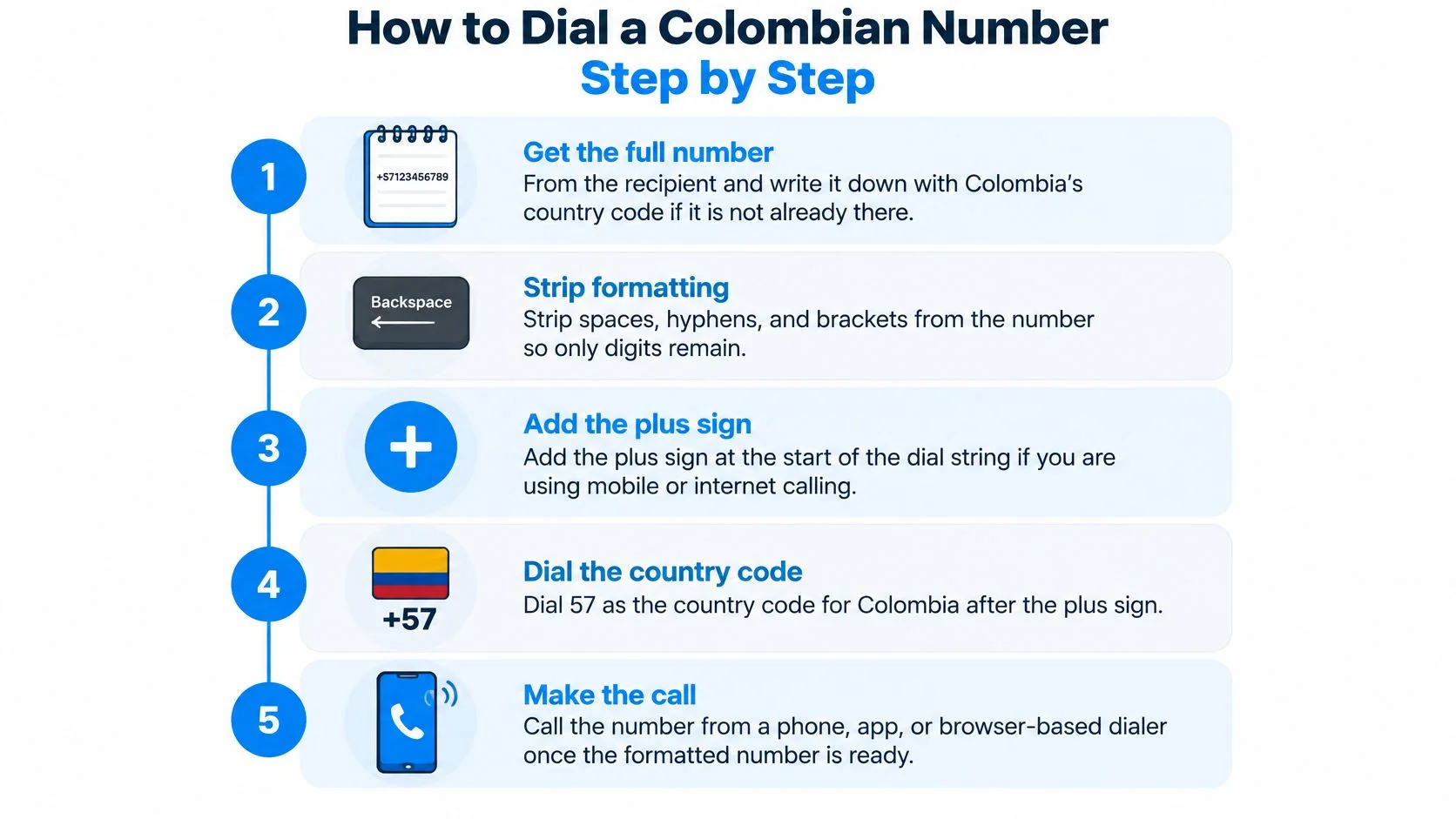
- Get the full number in writing. Ask the recipient to send it as a message rather than read it aloud over a poor line. If the country code isn't attached, you add it, and having it on screen means you aren't rebuilding twelve digits from memory at the moment you dial.
- Strip the punctuation. Spaces, hyphens, parentheses and brackets all have to go. Some handsets read a bracket as a separator and drop whatever sits after it, so a formatted number can lose its last four digits without any warning tone.
- Remove the leading 0 if there is one. A 0 in front of a Colombian number is a domestic trunk prefix, the signal that the call stays inside the country. Once 57 is in front, that instruction is obsolete, and leaving it in shifts every later digit one position to the right.
- Choose the prefix that matches your device. From a US landline that's 011 then 57. From a mobile, a browser dialer or an app, it's the plus sign then 57. You never need both, and no device needs three digits of exit code plus a plus sign.
- Dial the rest as one continuous string and check it first. For a mobile, plus 57 and ten digits beginning with 3. For a landline, plus 57, a 60X code and seven more digits. Read the whole string once against the message you were sent.
A successful dial rings within a few seconds. A recorded rejection instead of a ring means the format failed, not that the person's phone is off.
The international number format reference puts the same instruction in standard terms. Normalize the destination into E.164 before dialing, 011 57 XXXXXXXXXX from a landline or +57 XXXXXXXXXX from a mobile or internet dialer, with Colombian mobiles holding ten digits after +57 and normally beginning with 3, and fixed lines using the newer ten-digit national structure that generally begins with 60X. Its practical advice for browser callers is to enter the number in +57 form, because that sidesteps device-specific exit-code handling and validates the same way across browser, iOS and Android dialers.
If you'd rather watch the sequence than read it, this walkthrough runs through the same digits on screen.
For teams that keep a record of conversations with Colombian suppliers or clients, transcribing client calls across borders is a sensible companion to these steps, since it handles the language and the numbering on the far side of the connection rather than just the dial string.
Check the Number and Fix Failed Calls
A failed call to Colombia is a number problem far more often than a phone problem. Before you blame the handset, the SIM or the balance, count the digits.
Count the digits before anything else
After +57, a Colombian mobile number has exactly 10 digits and starts with 3. A nine-digit string is short and an eleven-digit string carries something extra, and both get rejected at the network. Ask the recipient to resend it rather than guessing where the spare digit belongs.
That rule comes from a real change in the numbering plan. Colombia moved to a nationwide 10-digit dialing scheme for fixed and mobile calls, which retired the former 03 mobile prefix from relevant domestic call paths, and from abroad the mobile number sits directly after +57 with nothing inserted, as the reference entry on Colombian telephone numbers sets out.
Landlines validate on a different pattern. A fixed line uses a 60X code plus a seven-digit subscriber number, so ten digits again but a different opening three.
Why one landline can appear in three formats
A local Colombian format such as (601) 2345678 and the international +57 601 2345678 describe the same line. Converting one into the other means dropping the brackets and keeping the digits in order, with nothing added after 57, according to the Colombia dialing reference from country-codes.org.
The 2019 numbering change is the other half of that confusion. Contacts saved before it may still hold formats that no longer route, which is common for immigrants and US businesses calling older Colombian contacts whose numbers were stored years ago. When a landline that used to work stops working, the number is usually what changed, not your connection.
A rejected call is information. It means your digits reached the network in a shape the network couldn't route, which narrows the problem to the number itself rather than your account.
Toll-free numbers that are not reachable from abroad
Colombian 01800 numbers may not be reachable internationally at all, and retrying the same string won't change that outcome. Ask for the recipient's ordinary geographic or mobile number instead. This is the one failure where you did nothing wrong: the number type doesn't accept international traffic, so a correct dial still fails.
The prefix doesn't tell you who the carrier is
It's tempting to read a mobile prefix like 310, 315 or 319 as a network label and adjust your dialing accordingly. Don't. Number portability means the original prefix may no longer identify the subscriber's present network, so any assumption you build on it is stale before you finish dialing. Nothing in the dial string changes based on carrier anyway.
Three of those five fixes cost you a retry and nothing else. The other two need a new number from the human on the other end, and no amount of redialing will substitute for asking.
Before you spend a call finding out, run the digits through a phone number validator to catch a wrong shape while it's still on screen. Then place a short test call, thirty seconds is enough, and confirm the number directly with the recipient if it still won't connect.
Check Current Rates Before Each Call to Colombia
There's no fixed price to quote here, because the rate depends on whether you're dialing a Colombian mobile or a landline and it can move, so the only figure worth trusting is the one on the live rate table at the moment you dial. Read both rows before you assume they match.
Billing runs per minute, rounded up to the whole minute. A call lasting 2.3 minutes bills as three minutes. That's how the meter works, making the whole minute the practical unit for budgeting.
Estimate the cost in three steps
- Find the right row. Mobile and landline sit on separate lines on the rates page, and the two can be priced differently, so pick the one matching the number you're about to dial.
- Round your call length up. A conversation you expect to run 12 minutes is 12 minutes. One you expect to run 12 and a half is 13.
- Multiply, then add the calls up. Rate times rounded minutes, repeated for each call you plan this month, gives you a total you can hold against your balance.
Run a worked example. Say a landline call runs 7.2 minutes and bills as eight, so you multiply eight by the listed per-minute rate. If that total sits comfortably inside your prepaid balance, make the call.
The minute is the unit. Estimate in whole minutes and the balance never surprises you.
Calling needs no subscription. The only recurring product is the optional dedicated number, so there's no monthly commitment to weigh before a single call. Practical habits that save money: place a short test call before a long conversation, plan lengthy calls in whole-minute blocks, and recheck the rate whenever you switch between a mobile and a landline. When you're ready to compare, the Colombia rate page lists the destination-specific pricing.
Start Your First Call to Colombia
Place the call from a browser, using the +57 format you've already checked. BubblyPhone runs in any modern browser, the person you're calling needs no app and no account, and the call lands on an ordinary landline or mobile in Colombia.

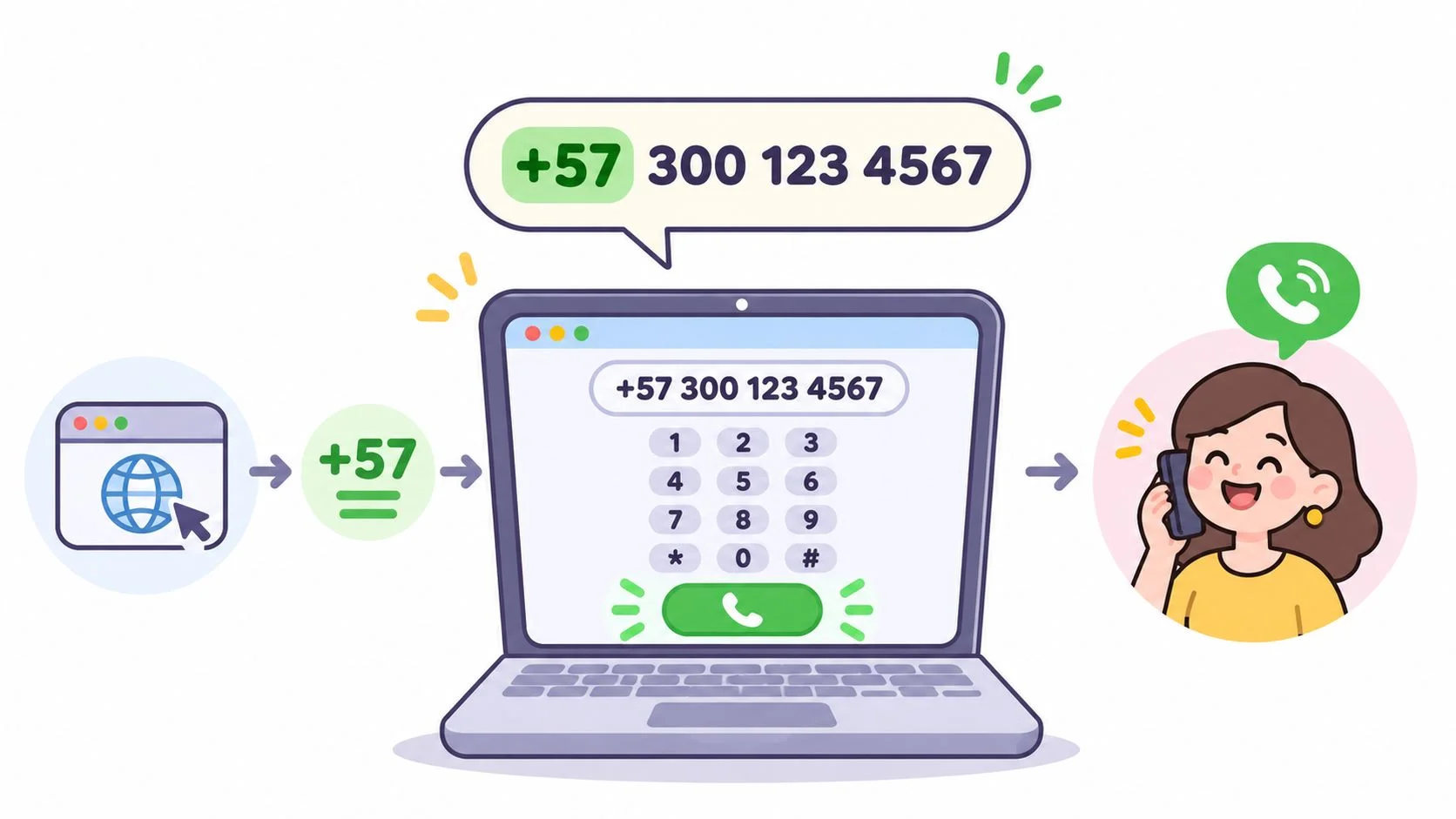
Billing stays simple. Calling is pay as you go, credits start at $5 and never expire, and the only monthly charge is an optional US phone number if you want a separate line for family or business. The same dialing steps reach more than 220 countries and territories, so the sequence you just learned isn't a one-off.
Before you dial, confirm three things.
- The number, in +57 form, punctuation stripped, no leading 0.
- The rate, from the live table, on the row matching mobile or landline.
- The balance, topped up so the call doesn't cut short mid-sentence.
That checklist takes about a minute. The call takes one more.
BubblyPhone dials Colombian landlines and mobiles from a browser tab, with no app for you to install and no account for the person answering, billed per minute from prepaid credits that start at $5 and don't expire. You can check the live rate for the exact number type before you connect, then redial the same way for every other country on your list. Visit BubblyPhone and make that first call to Colombia.