Call to Iran from US: Dial Codes and Step-by-Step Guide
Table of Contents
From a US phone, dial 011, then 98, then the Iranian number with its leading 0 removed. For example, an Iranian mobile written as 09XXXXXXXXX becomes 011 98 9XXXXXXXXX, but even a correctly dialed number can fail if the receiving network blocks incoming calls.
That distinction matters when you're trying to reach family or confirm an urgent business detail. The US Treasury's Iran sanctions guidance distinguishes access to telecommunications from other restricted transactions, but legal permission doesn't establish whether a particular route is available. Check the number first, then investigate connectivity without repeatedly changing a number you've already verified.
Dial Codes and Number Formats for Iran
To call Iran from a US phone, use 011 + 98 + the Iranian number without its leading 0. For a Tehran landline, keep the city code and subscriber digits, removing only the domestic prefix.
The ITU numbering plan assigns Tehran the geographic code 21 and lists 11, 13, 17, and 23 for areas including Mazandaran, Gilan, Golestan, and Semnan, respectively. These destination codes identify the geographic area; they aren't digits you can omit because the recipient lives in a familiar city.
Dial strings by Iranian number type
In this table, X represents a digit supplied by the recipient. The plus signs between components mean “followed by,” not a keypad character you need to enter.
Mazandaran can look confusing because its domestic prefix uses the same digits as the US international exit code. Read the components separately: the exit code comes first, Iran's country code follows, and the geographic code comes after that.
On a mobile phone, holding the zero key usually produces +, which can replace the US exit code. Use either the plus-format number or the US exit-code format, not both together.
Preserve the number the recipient gave you
Don't shorten a subscriber number to make it resemble another contact's number. Geographic numbering ranges can have different lengths, so preserve the actual subscriber digits rather than assuming every landline follows an identical local pattern.
If someone sends only a local landline number, ask for the city and complete area code before dialing. Guessing can produce an invalid destination or reach someone else.
- Read it back in groups. Separate the country code, city or mobile prefix, and remaining digits when confirming it with the recipient.
- Check the original message. Copying from a signature, screenshot, or handwritten note can introduce missing or duplicated digits.
- Save the international version. A contact stored with the plus sign is easier to reuse when you're calling from another country.
Practical rule: Change the dialing prefix, not the recipient's subscriber digits.
How to Dial Iran from the U.S. Step by Step
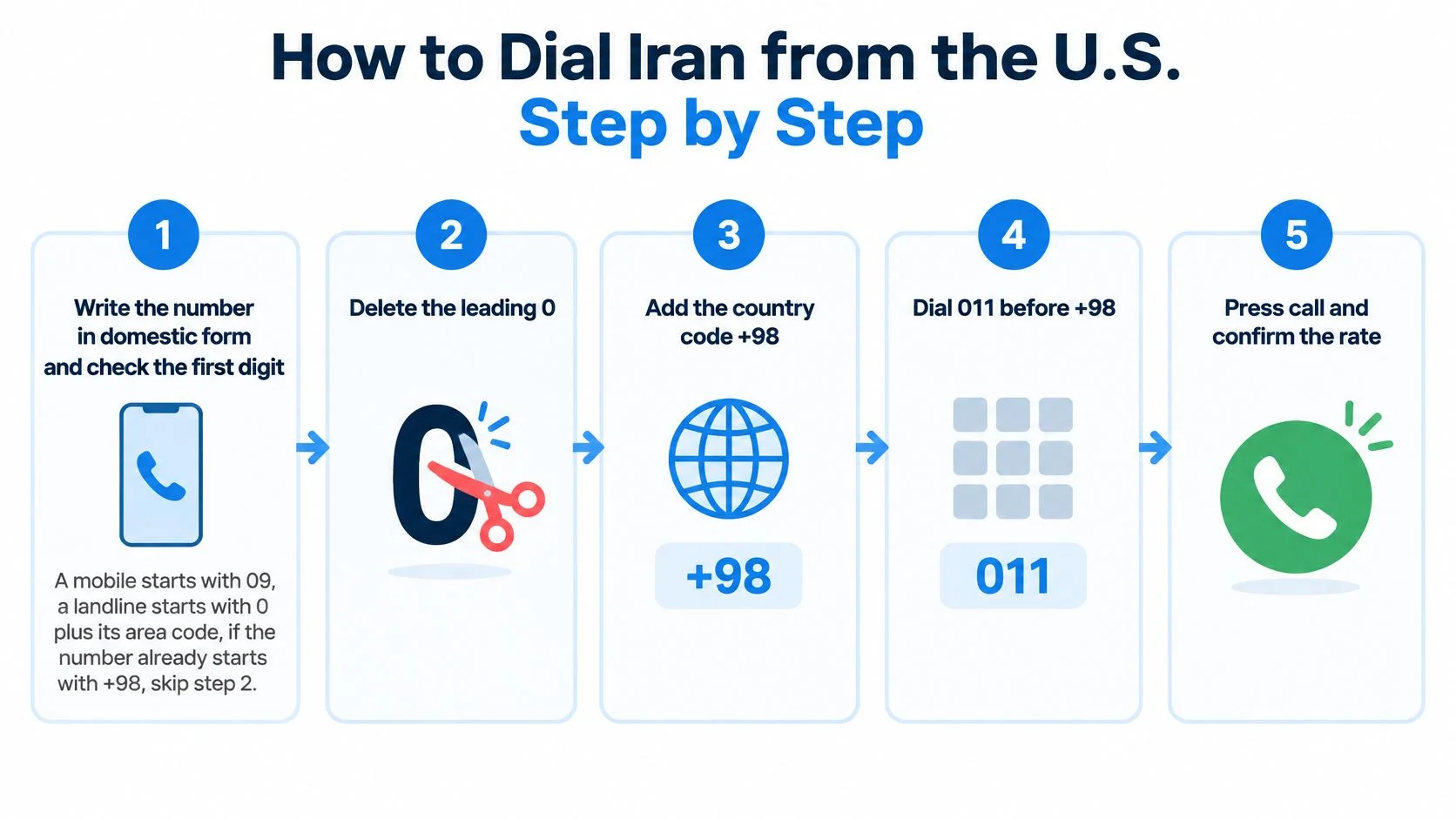
Prepare the Iranian number in international format before you open the dialer. Then choose either the plus sign or the US exit code, enter the destination, and check it before placing the call.
The ITU's Iranian numbering document specifies country code +98 and national prefix 0; its formats convert a domestic mobile such as 09XXXXXXXXX to +989XXXXXXXXX, and a Tehran landline such as 021XXXXXXXX to +9821XXXXXXXX.
- Start with the complete domestic number. Check whether it's a mobile or a landline with an area code. If it already begins with the correct international country code, don't add another prefix.
- Delete the domestic leading zero. Remove only that first national-prefix digit. Leave zeros elsewhere in the number untouched.
- Choose your international dialing method. On a conventional US phone, enter the US exit code followed by Iran's country code. In a browser dialer or compatible mobile dialer, use the plus-format destination.
- Enter the remaining digits without pauses. Remove punctuation when pasting into a dialer that expects a continuous number. Don't paste explanatory text, an extension label, or formatting characters along with it.
- Inspect the displayed destination. Compare the final digits with your original contact information. A mobile should retain its mobile prefix, and a landline should retain its geographic code.
- Check the price before pressing call. Confirm the destination type and the billing terms before starting a potentially expensive conversation.
- Listen and note the outcome. Ringing, a recorded announcement, silence, and an immediate failure are different observations. Don't treat a short setup silence as proof that the number is wrong.
This visual summarizes the preparation process.

Check the prefix before retrying
Use either the international plus sign or the US exit code. Don't enter an exit code followed by a literal plus sign, even if a diagram presents those components separately.
The common formatting failure is attaching the country code directly to a domestic number while leaving its national prefix in place. Correct that error before retrying, but don't keep editing a verified number just because the network hasn't completed the call.
Checking Whether a Call Will Connect Today
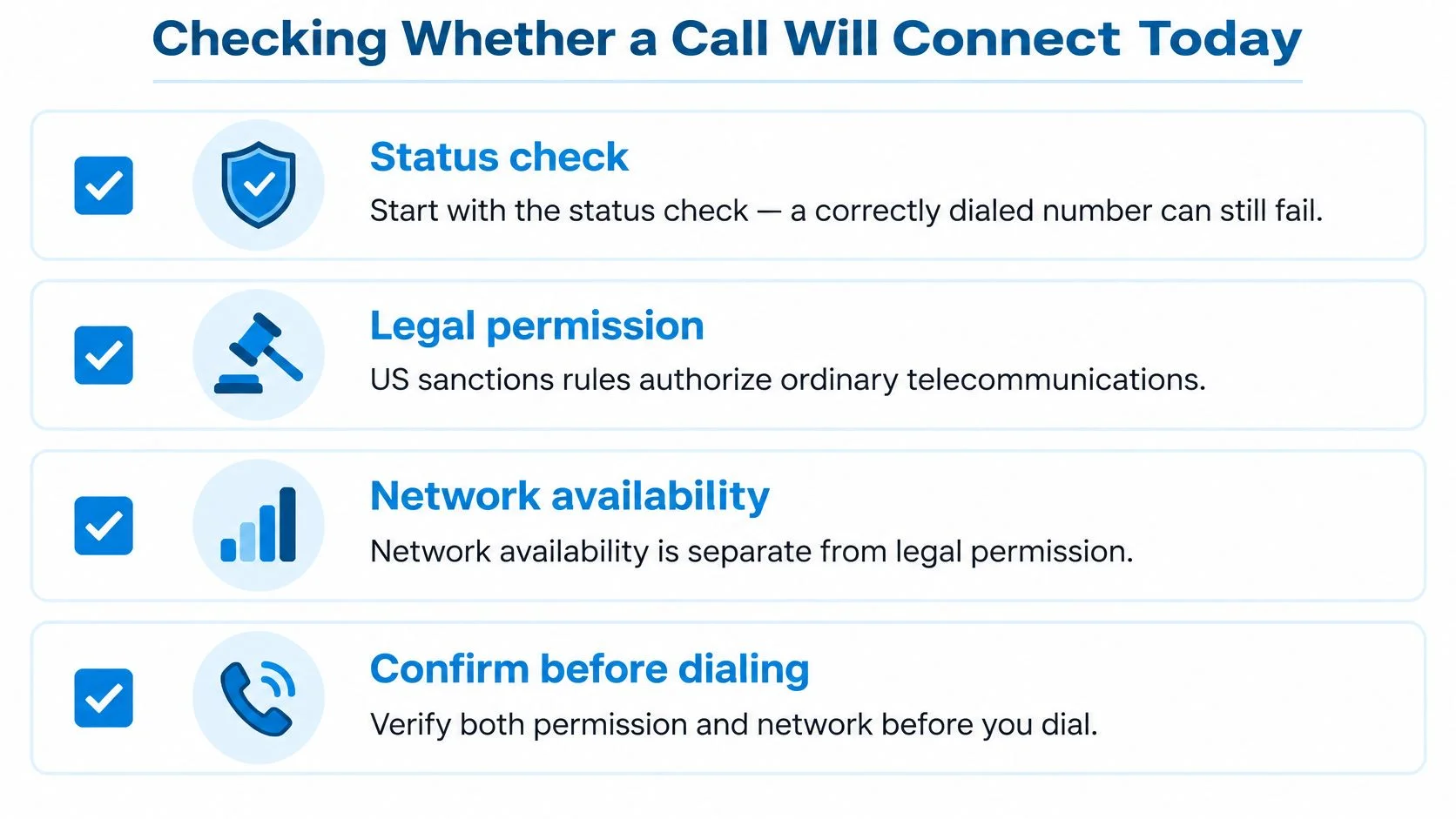
Start by confirming the recipient's number type and testing the current connection. A correctly formatted number and legal authorization don't guarantee that an incoming call will reach Iran today.
The US Treasury regulation governing Iran transactions authorizes receipt and transmission of telecommunications involving Iran while distinguishing those communications from supplying certain equipment or network capacity. Separately, independent reporting during the 2026 blackout described international incoming calls to Iranian mobiles and landlines as systematically blocked, with connections near-impossible.
Use this checklist to separate a dialing problem from a connection problem.

Run a controlled connection check
- Confirm the destination type. Ask whether you're reaching a landline or mobile. If an alternate number is available, record its type rather than assuming both will behave alike.
- Test at different times. Space attempts apart instead of repeatedly pressing redial. Use the best-time-to-call tool to choose a window when the recipient can answer.
- Record what happened. An immediate busy signal or no ringing indicates an unsuccessful setup. Ringing followed by silence may indicate a connection without usable audio, while a dropped conversation points toward instability.
- Compare available channels. If internet messaging works but direct voice doesn't, the services may face different network conditions. That alone doesn't prove where the fault lies.
- Agree on a fallback. Arrange an alternate number or messaging channel only where it's legal, available, and safe for the recipient.
- Check before scaling up. Review the live rate table and confirm route availability before planning business calling.
No calling service can guarantee a way around government restrictions. Plan for the possibility that the recipient is temporarily unreachable.
Keep a brief record of the destination, attempt time, announcement, and outcome. That gives support something actionable without requiring you to disclose the conversation's contents.
What Failed Attempts Really Cost and How to Cap Them
A published per-minute rate describes connected time, not every expense involved in reaching someone during disruption. Your effective cost can rise through repeated short connections and third-party workarounds, even when unsuccessful setups aren't billed.
BBC reporting on wartime calling blocks described attempts that initially failed and connected calls lasting only two or three minutes; one reported workaround cost about £28, approximately $38, for a four- or five-minute call after money-transfer fees. That was a particular workaround, not a normal calling tariff or a benchmark for your call.
Separate the charges
Billing covers connected minutes only, rounded up to the whole minute. A failed setup should show no billed minutes, but a connection with unusable audio needs closer inspection because it may have registered as connected.
Check the Iran calling rates before setting your budget. Don't infer the final charge from a brief conversation alone; inspect the billed duration too.
Put a ceiling on retries
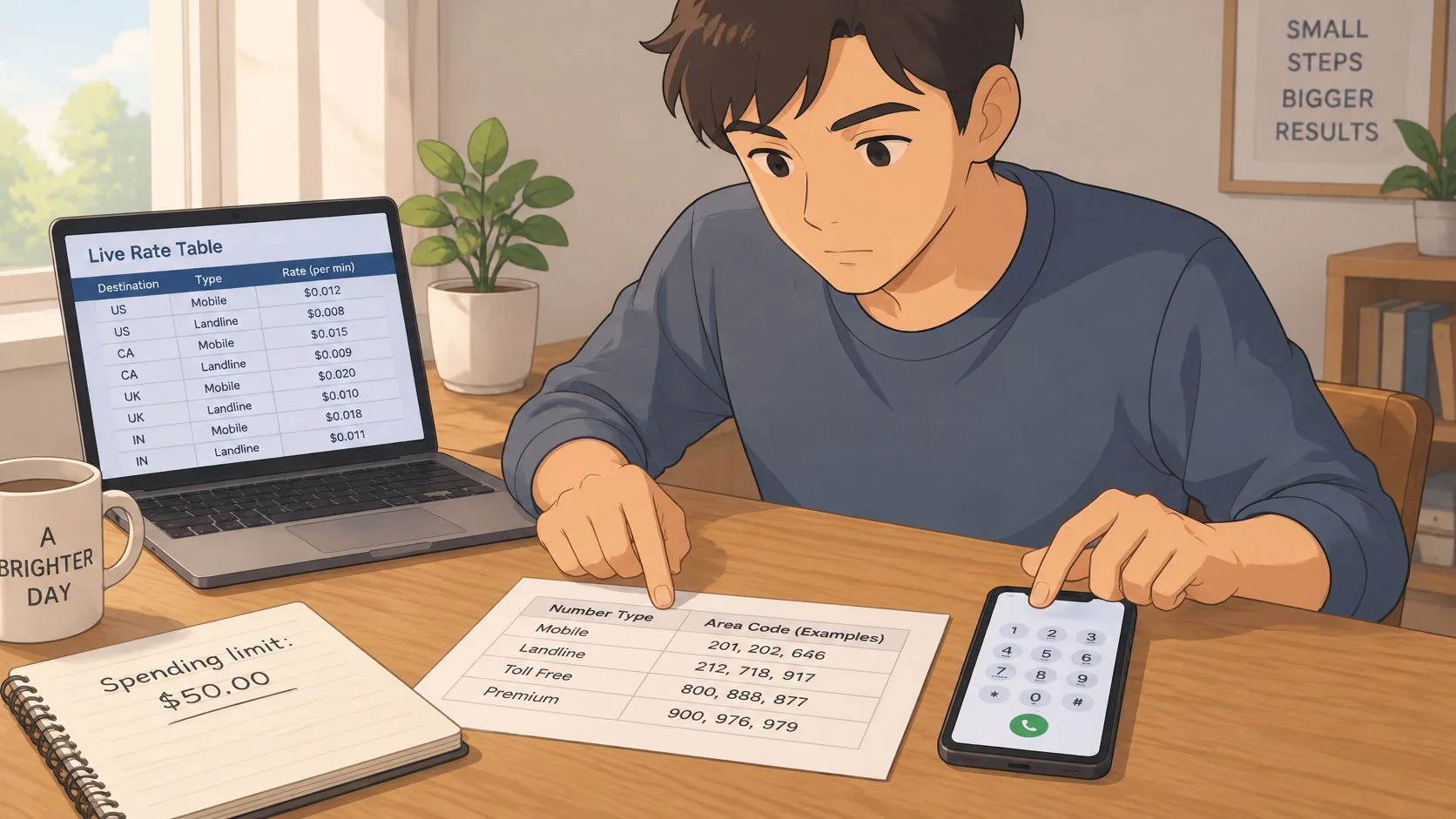
- Set a spending limit before dialing. Decide the most you're willing to spend that day, including any independent workaround costs.
- Top up conservatively. Keep enough credit for the intended conversation without funding an open-ended retry cycle.
- Inspect history after each problem. Compare the outcome with the billed minutes, and retain separate receipts for costs outside the calling service.
For a business verifying supplier details, a completed conversation with a clear billing record is more useful than an attractive nominal rate on a route that won't connect. Stop retrying when nothing changes, and use the agreed fallback instead.
Time Zones, Call Quality and Translation Tips
Tehran is ahead of the main US time zones, so confirm the recipient's local time before dialing. Iran stays on UTC+3:30 year-round, while most US locations change their clocks seasonally.
Time difference between US zones and Tehran
Use the location's actual clock setting rather than assuming every place within a named zone changes seasonally. Friday is Iran's main weekly day off, so confirm business availability instead of treating it as a routine working day.
Prepare the audio and language setup
Use a wired internet connection or strong Wi-Fi, pause background uploads, and choose a quiet room. A headset helps you hear interruptions and reduces the chance that your microphone picks up speaker audio.
- Test permissions first. Make sure the browser can access the intended microphone and speaker.
- Speak in complete, short thoughts. Pause between points rather than speaking over the other person.
- Verify consequential details. Repeat names, addresses, amounts, and appointment times before acting on them.
For a Persian-English conversation, Translate AI's real-time Persian voice translation tips offer useful preparation. The phone-call translator comparison guide can also help you distinguish captions, translated speech, and transcript features.
Optional live AI translation can provide real-time captions and a transcript saved to call history. Enable it before starting, tell the recipient it's running, and obtain any required consent.
For urgent conversations, agree on a call window and what happens if the call is missed.
Make Your First Call to Iran from the U.S.
Confirm the destination, set your spending ceiling, and choose a time the recipient expects your call. Make the first attempt a short connection test rather than committing immediately to a long conversation.
Keep the number and the purpose of the call beside your computer so you can focus on the audio and outcome.

Start with a manageable test
BubblyPhone lets you type a number and press call in a modern browser, with no app, SIM card, or extension needed. Our service places calls to landlines and mobiles in 222 countries, subject to destination availability; the receiving person doesn't need an app or account.
Calling is pay as you go, with no subscription required. The only monthly product is an optional US dedicated number, whose SMS capability is receive-only.
After the attempt, check whether the recipient answered, whether both sides could hear clearly, and whether the call history matches what happened. If the audio failed or the route wasn't available, keep the outcome rather than adding more credit immediately.
- If it works: Arrange the longer conversation and confirm the preferred number.
- If it fails: Save the error or announcement and use your prearranged alternate contact.
- If billing looks wrong: Retain the call entry and request a review before further attempts.
Make your call to Iran with BubblyPhone directly in any browser, with no app or account needed by the person answering. Credits start at $5 and never expire, so you can begin with a short call to an Iranian landline or mobile when the route is available.