Alternate Phone Numbers: What They Are and How to Get One
Table of Contents
What's the part of getting a second phone number that goes wrong? Not the sign-up. That takes minutes. The trouble arrives later, when nobody answers the new number because it looks unfamiliar, or when a verification code fails on the one account you can't get back into.
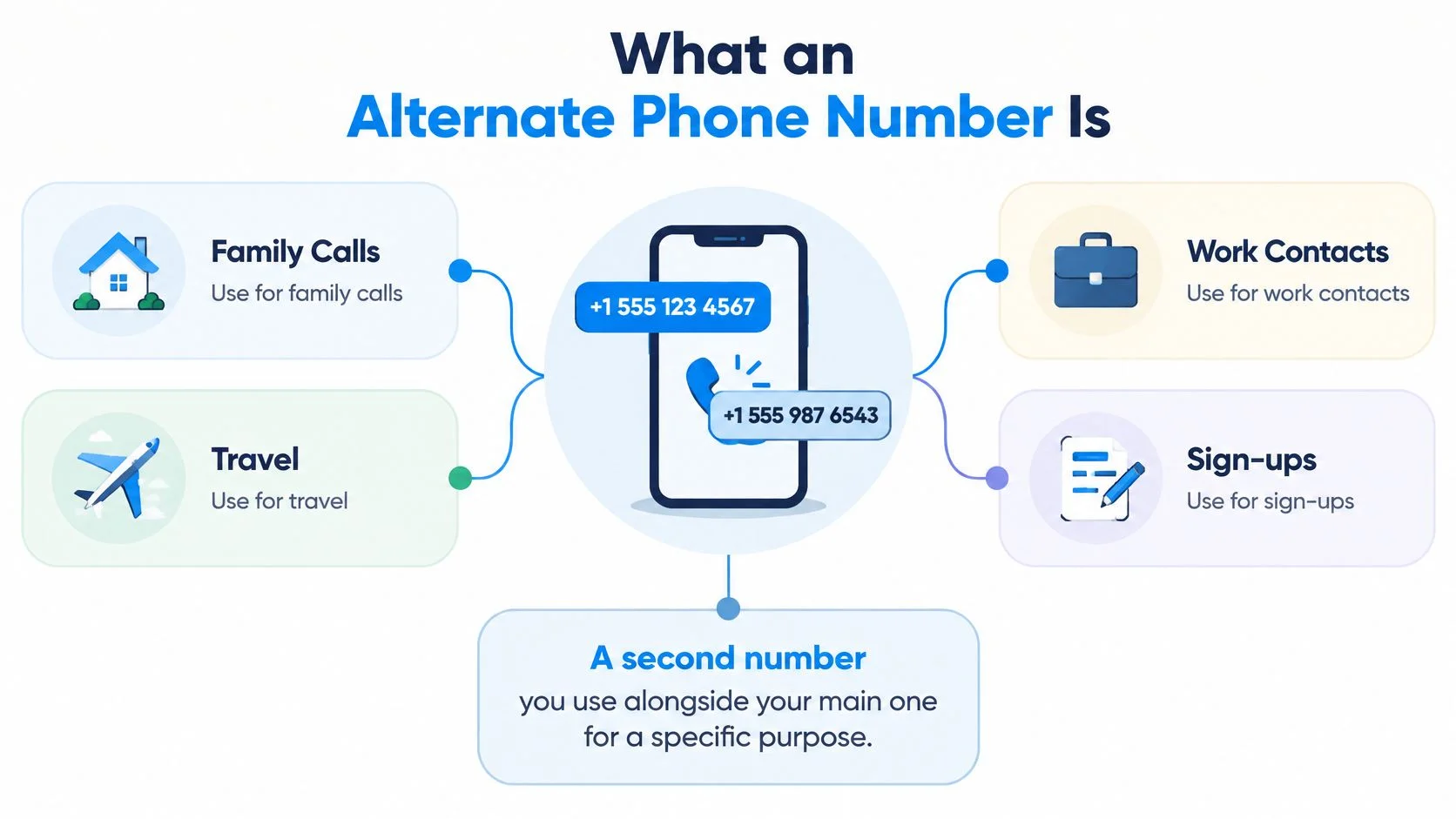
An alternate phone number is a second number you use alongside your main one for a specific job: family calls, client enquiries, travel bookings, marketplace listings or one-off sign-ups. It rings on the phone you already carry, in a browser tab, or in an app. The decision that matters is how long the number has to stay answerable, and how hard it will be to recover if you change devices, move country or stop paying.
What an Alternate Phone Number Is
An alternate phone number is a second number kept for one purpose and answered on the phone you already own. It sits beside your main number rather than replacing it, so callers reach the right part of your life without you handing out the number your bank knows.
Second numbers are mainstream, not a niche trick. In 2024 the world reached about 9.1 billion mobile-cellular subscriptions, equal to 112 subscriptions per 100 inhabitants, which works out at 12.1% more subscriptions than people, according to the ITU's mobile subscription figures. The ITU is explicit that this doesn't mean every person owns a phone or holds a unique number: plenty of people keep more than one, and some connections serve tablets, vehicles and other connected equipment.
One building, two mailboxes. Same address, same front door, but letters from clients land in one box and letters from family land in the other. An alternate number works the same way: one phone, two inlets, each for a different set of senders.
Here's how the main uses split.

Three things people mix up
- A second SIM or eSIM line. Another mobile line issued by a network, with its own plan and its own monthly bill. It's the sturdiest option for daily use inside one country.
- A number rented from a calling service. No plastic, no SIM. Calls ring in a browser or an app, forward to your mobile, or drop into voicemail, and you keep it for as long as you keep paying.
- A temporary number. A browser page or throwaway app hands you a number long enough to receive one code, then the number expires or goes back into circulation. It isn't a number your family can call next month.
A number only earns its keep if people can reach it, which means someone has to find it, dial it from wherever they live, and hear it answered. Run two questions on your own situation: who needs to call this number, and from where?
Why People Keep a Second Number
A second number is common because one identity can't do two jobs at once. Three situations cover most of the cases.
Three situations that come up constantly
Say a care assistant moves from Cebu to Toronto. Her mother at home still uses a landline and never took to messaging apps. The daughter can call Manila from her Canadian mobile, but it's the costliest, most awkward ten minutes of her week, and her mother can't easily call a Canadian mobile back.
Now consider a freelance illustrator in Leeds who visits client sites. She prints one number on quotes and invoices and answers it between nine and six. Her personal mobile stays off the invoices, the marketplace listings and the school parents' group.
Then there's the traveller who lands in Bangkok at midnight with no working local SIM, an airport transfer to confirm and a hotel that wants a number to call back.
The reasons haven't changed
Those three choices rest on habits older than any app. The ITU's 2010 report on mobile access counted roughly 4.6 billion mobile-cellular subscriptions worldwide by the end of 2009, about two for every three people, and set out why individuals carried more than one: separating work from personal calls, paying less for calls inside a particular network, holding service across areas with uneven coverage, and keeping separate SIMs for voice and data. Where number portability didn't exist, changing operator meant buying a new SIM and taking a new number, and the report points to India as an example of that.
Two more reasons show up constantly. People keep an older number alive because their voicemail, their verification codes and a decade of contacts point at it. And plenty of services still expect a fixed number you can be called back on, from a tax office to a pension provider to an embassy.
The pattern to notice: the number isn't there to hide from people. It's there so the right people reach the right part of your life, and the wrong ones don't reach the rest of it.
The calls we handle fall into recognisable groups: people living abroad who need to call US or UK banks, tax offices, pension services and embassies; families calling relatives in another country; and travellers without a working local SIM card.
Match yourself to one of the three stories. The diaspora caller needs a number that reaches a landline abroad. The freelancer needs one that keeps a personal mobile private. The traveller needs one that works before the local SIM does.
Ways to Get a Separate Number Compared
Pick the route that stays reachable for as long as your callers need it, and that they can dial as an ordinary phone number. Monthly cost is the least useful way to compare them.
Three checks that decide which row you want
- Do texts arrive? A route that carries calls but drops texts will fail the first time a bank or a marketplace sends a code, and you'll discover it at the worst possible moment.
- What happens if you go quiet? Numbers get reassigned after long inactivity or an unpaid balance. Ask how long the number survives a quiet month before you build anything on it.
- Can a caller abroad dial it with no app and no account? If the person you're calling has only a landline, anything that needs an app on their side is a dead end.
If you're weighing a service-issued number against a SIM, this walkthrough of how to get a virtual phone number covers what sign-up asks of you.
Match the route to the longest period you need the number, not to the lowest first payment.
Whether the Number Will Be Answered
A private number is often the one nobody answers. Unfamiliar, foreign and heavily recycled numbers get filtered, tagged as spam or ignored, and that single fact undoes most of the privacy you gained.
Networks increasingly check whether the number on screen was signed by the provider that sent the call. In 2025 the FCC proposed closing the non-IP network loophole that can strip STIR/SHAKEN authentication from a call, and asked for stronger verification of caller identity plus clearer indicators when a call starts outside the United States. Authentication feeds the blocking and labelling decisions made on the receiving handset, so it shapes whether your call rings or slides into a spam folder.
More privacy can cost you recognition. A number you swap every few weeks protects your personal line and makes every legitimate call look like it came from a stranger.
A number you own and keep is a better callback identity than a shared public inbox. Give clients, relatives and marketplace buyers a dedicated number you'll still control in six months, and save a short-lived browser number for a code that expires today.
Before publishing the number anywhere, write it in international form. ITU-T Recommendation E.164 caps a public international number at 15 digits, excluding the dialing prefix, built from a country code, national destination information and the subscriber number. A missing country code, or one digit too many, means a caller abroad can't connect.
Test the display on two mobile networks and one landline before you share the number. Name and number presentation differ by network and by handset. If the number exists to take bookings, Japanese restaurant booking tips make the same point: what matters is whether the number you leave is one you'll answer when it rings back.
How to Set Up a Dedicated Number Step by Step
Setup takes about ten minutes and the same five decisions every time. Take them in this order and the number works on the first day you share it.

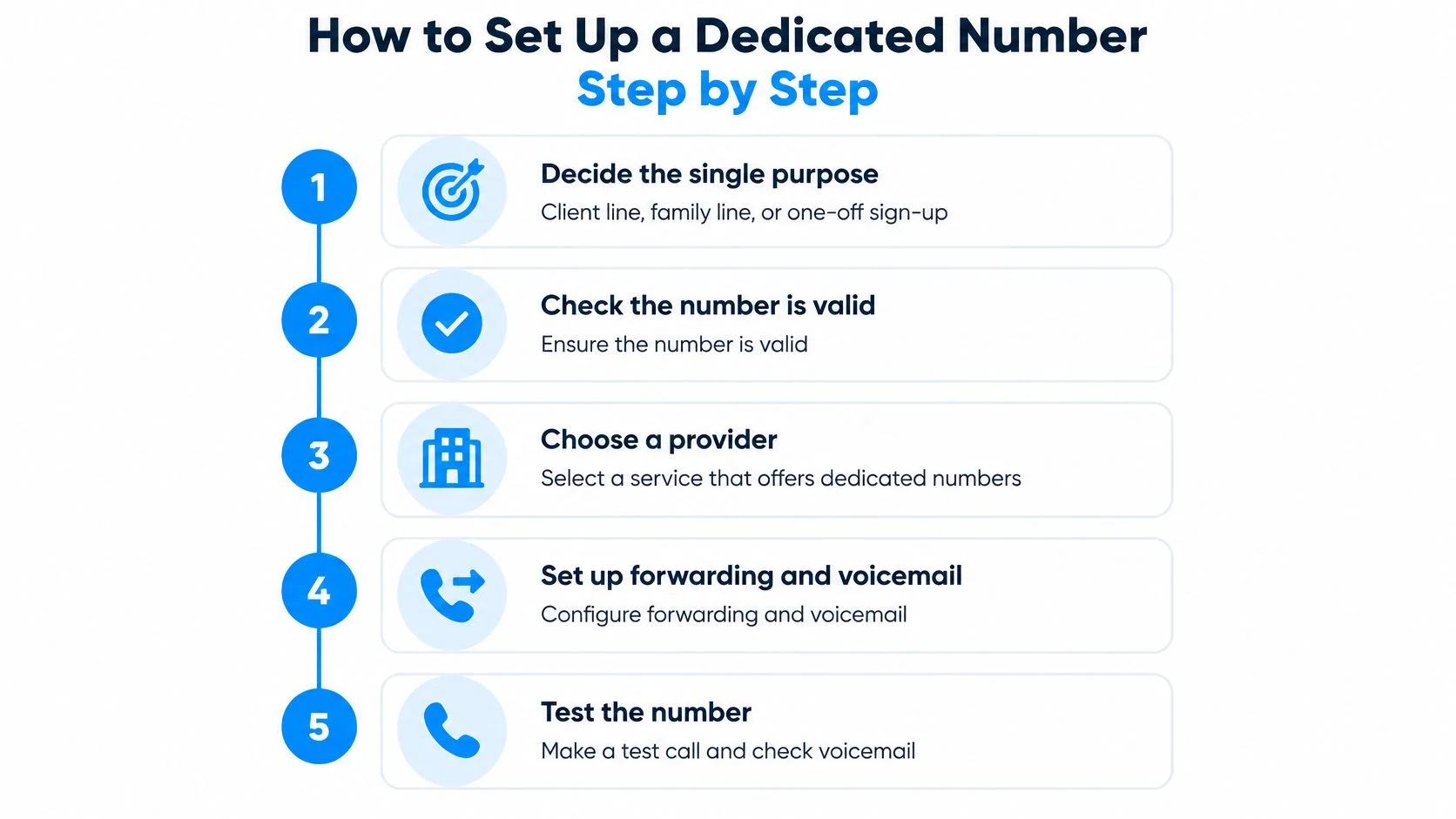
- Decide the single purpose. A client line, a family line and a one-off sign-up need different forwarding and voicemail settings. The common slip is buying one number and using it for all three, so you can never tell whether a missed call was a paid job or a marketplace code.
- Choose who issues it, then the country code your callers recognise. A supplier in Texas reads a +1 number differently from a +44 one, and recognition decides whether they dial at all. Check the number is valid before you publish it, because a mistyped country code looks fine to you and is unreachable to everyone else. We publish free tools that check whether a number is valid and look up country codes, with no account required.
- Set where calls land. Browser, mobile, or voicemail, and record a greeting that names you or the business. Skipping the greeting is the usual slip: a caller who hears a default tone has no evidence they reached the right place, and many hang up rather than leave a message.
- Check how it displays before you trust it. In the United States, FCC rules require providers to offer straightforward per-line blocking and unblocking so callers can choose whether their number is transmitted on interstate calls, and the line between privacy and spoofing comes down to ownership and intent, as the FCC's consumer privacy guidance explains. Test on two mobile networks and one landline, since caller-ID display and name presentation vary by carrier and device.
- Announce it and keep a list. Put the number in the places people already contact you, and write down which clients and accounts use it. The slip here is silent loss: a number nobody has saved looks like a stranger calling, and you'll spend months re-introducing yourself.
If the number becomes one line among several in an office, setting up phones for small businesses covers the handoffs, extensions and who picks up when.
Caller ID Rules and Emergency Limits
Showing a different number is legal when the number is yours to show, and illegal when the display is built to mislead. The distinction is ownership and intent, not technology.
In the United States, the FCC prohibits transmitting misleading or inaccurate caller ID information when it's done with intent to defraud, cause harm or wrongfully obtain something of value, and an illegal spoofing violation can carry a penalty of up to $10,000 per violation. The same guidance gives two legitimate cases: a doctor displaying an office number instead of a personal mobile, and a business displaying a toll-free callback number.
- Legitimate. A number assigned to you or your organisation, shown on your own calls, with a record of who owns it and who configured it.
- Not legitimate. Someone else's number, a made-up number, or a real number chosen because it resembles a bank or a government office.
The workable test: if the person who received your call looked up the number on screen, would they reach you, or someone who has never heard of you?
If the screen looks wrong, check two things: that the number is yours, and that the caller-ID setting matches the number you meant to show. Providers must also offer straightforward per-line blocking and unblocking so a caller can decide whether the number is sent on interstate calls.
Automated calls raise the bar further. FCC rules on caller ID and automated calling say that autodialed or prerecorded calls to wireless numbers generally need prior express consent, telemarketing can require written consent, and a caller-ID number should never be displayed unless it belongs to the caller. That's a compliance question and a deliverability question at the same time.
Emergency calls are the hard limit. This kind of line isn't a substitute for traditional phone service, so dial 911, 999 or 112 from an ordinary mobile or landline. If your goal is to keep a personal mobile off the screen, this guide to hiding your number when calling walks through the settings.
Keeping the Number for Recovery and Long-Term Use
Never make an alternate number the only way back into an account you can't afford to lose. Some services treat numbers from calling services differently from a mobile SIM number, and the code that arrives perfectly for a year can fail the week your balance lapses or the number is reassigned.

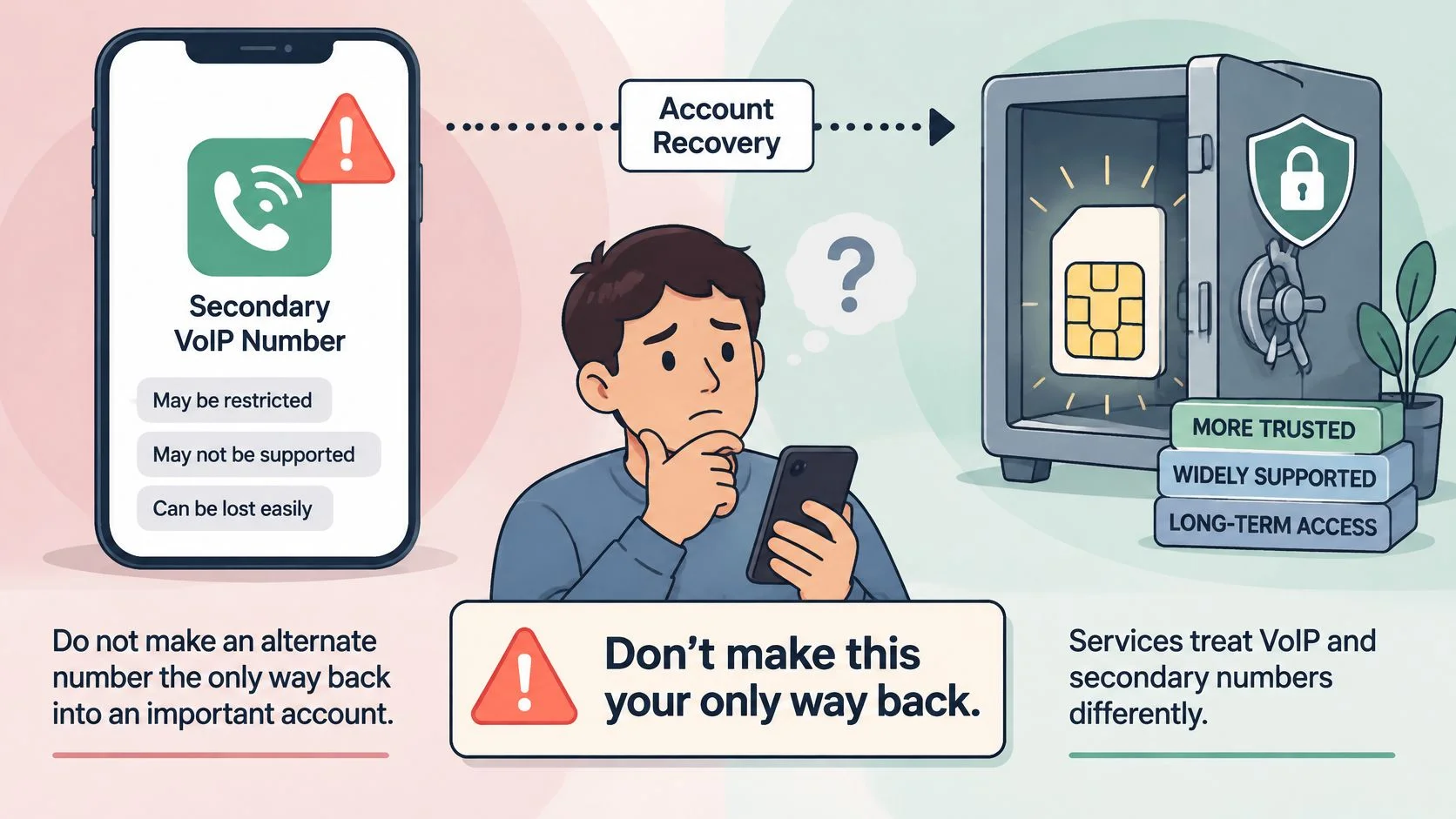
What to set up instead
- An authenticator app for the accounts that matter most, so the login doesn't depend on a text arriving at a number you might lose.
- Saved recovery codes stored somewhere offline, printed or in a password manager, not in the inbox you might also be locked out of.
- A stable mobile number as the second route for banking, email and marketplace accounts, kept active and paid even if you barely use it.
A number can outlive the provider that issued it. Ofcom's number portability rules let UK customers keep their landline or mobile number when they switch providers, and providers must follow conditions covering portability and switching, with the aim of cutting the cost and inconvenience of changing numbers. Porting still depends on the provider's process and national rules, so confirm it applies before you treat any number as permanent.
Inactivity is the quieter risk. Numbers get reassigned or disconnected when they sit unused or unpaid, so put a reminder in the calendar to confirm the line still rings and still receives.
A second number lowers your exposure. It doesn't make you anonymous: the provider, the apps and the payment records still connect the activity to your account. If codes are the reason you want a second line, this guide to receiving SMS on a virtual phone number sets out what does and doesn't arrive.
Choose the Setup That Fits Your Next Call
Use a temporary number for a code that expires today, and a dedicated number for any caller you need to hear from next year. Everything else follows from that split.
Write down the people and accounts that will use the new number, finish forwarding and voicemail before you share it, then place one inbound test from a different network and confirm it rings, displays correctly and reaches the greeting you recorded.
For the long-term case, calling runs in your browser at BubblyPhone. You type a number, press call, and reach any phone in 222 countries, with no app, SIM card or extension, and the person receiving the call needs nothing installed either. Credits start at $5 and never expire, calls are billed per minute rounded up to the next whole minute, and no calling subscription is needed.
The optional dedicated-number plan is the only recurring product. A US local number starts from $3 a month, paid from your account balance, and texts to that number are receive-only. Current per-minute rates are published before you dial.
BubblyPhone puts the number and the call in the same browser tab, so you can reach a landline or mobile abroad without an app on either side. Credits start at $5 and never expire, and no calling subscription is required to use them. Open BubblyPhone and make your first call today.