Getting a New Phone Number in 2026: Options and Steps
Table of Contents
Two decisions shape everything about getting a new phone number this week: which type of number you need, and whether you keep the one you already have. Activation, verification, and the security cleanup all follow from those two choices, and the second one carries more consequences than expected.
Many people spend their time on the first and skip the second. That's a mistake, because the number you're handed isn't always a blank slate. It can arrive still attached to someone else's password resets, delivery alerts, and two-factor codes, and it can be taken from you later if you don't lock it down. What follows is the order I'd work in: pick the type, port or buy, activate, then check the number before you hand it to a bank, an employer, or a government portal.
Choose the Number Type That Fits Your Need
Four number types cover almost every situation, and the one you need is set by where you'll physically be and who pays to reach you.
- Local SIM from a mobile provider: the answer for daily life inside one country. You get data, outbound calls, and the ability to receive bank codes, and the line stops working when you stop paying. You'll need ID and a payment method at the counter.
- Local area-code number: the choice when customers, clients, or family expect to see a number from a specific city or region. The area code does real work. A plumbing company with a number from three states away gets fewer answered calls than one that looks local.
- Toll-free number: use it when the caller shouldn't pay to reach you, which in practice means a support or sales line for a small business. The prefix signals national service rather than a local presence.
- Dedicated or virtual number: a second line for travel, privacy, or sign-ups, without a second SIM or a second handset. It lives in a browser or an app instead of on a plastic card, and it follows you across borders.
What the digits actually tell callers
The system you're joining is enormous and mature. ITU mobile subscription statistics for 2024 count roughly 9.1 billion mobile-cellular subscriptions worldwide, or 112 subscriptions per 100 inhabitants, which is 12.1% more subscriptions than people. High-income countries averaged about 138 per 100 inhabitants against 71 in low-income countries, so multiple numbers per person is normal in some markets and rare in others.
In the US and the rest of the North American Numbering Plan, the number itself is a 10-digit sequence: three digits of area code, then seven local digits, a structure described in the NANPA numbering report and in use since 1947. The area code carries geography. Toll-free prefixes such as 800 and 888 carry the opposite signal: the business pays, the caller doesn't.
Three questions settle the choice faster than any comparison chart. Where will I be standing when this number rings? Who is most likely to call it, and does that caller care about geography? Must it receive verification codes, because if the answer is yes, a line that can't take SMS is unusable for banking. If a memorable digit pattern matters to you, you can pick your phone number from the pool available for an area code, though what's free changes daily.
Keep Your Current Number or Get a Fresh One
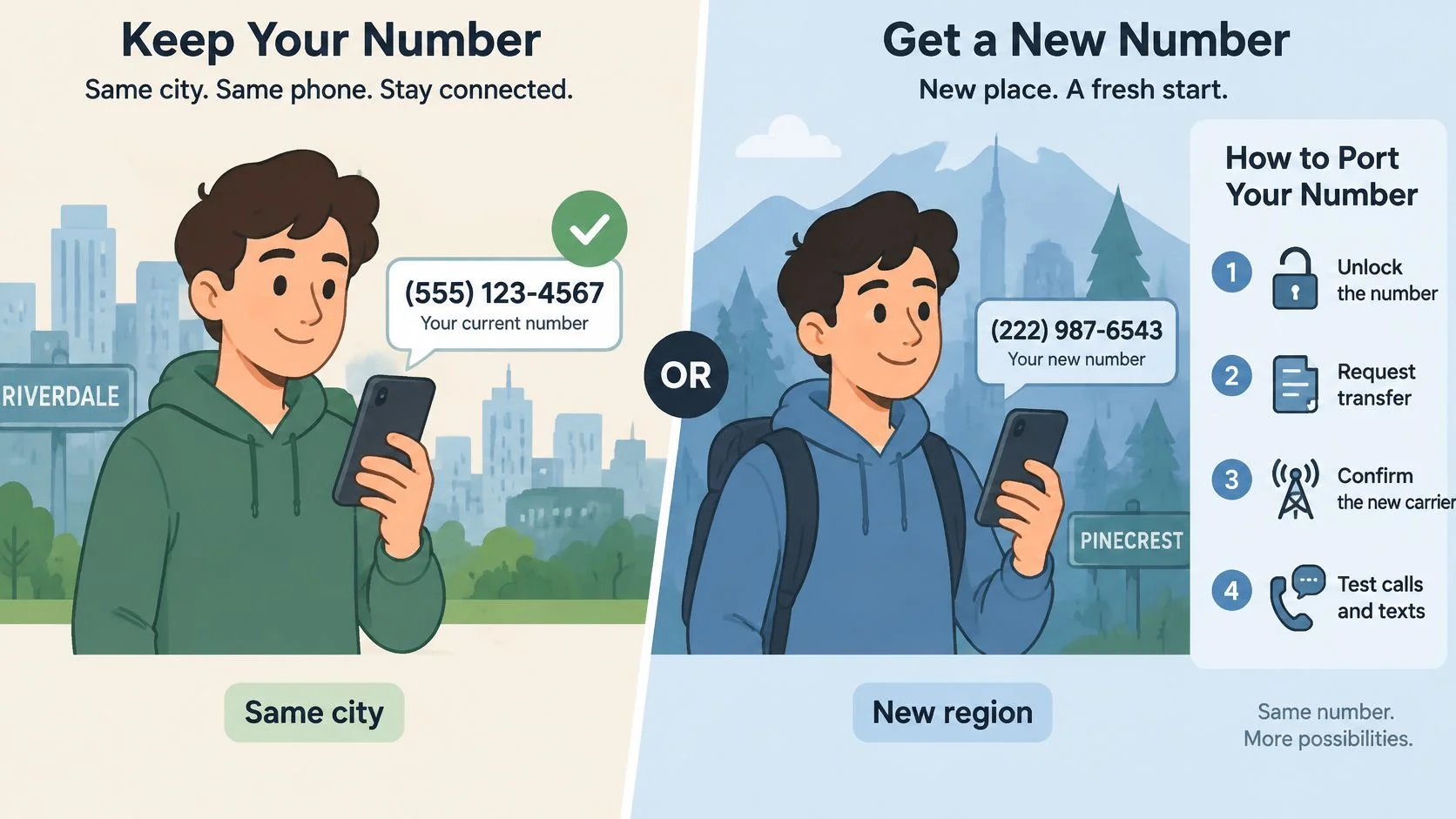
Keep your existing number if you're staying in the same geographic area, and take a fresh one only when you're relocating to a different region or never had a number there. A port costs nothing extra and preserves every account recovery link you've built over the years, which is why it's almost always the better move for anyone who isn't crossing a border.
The two paths look similar on a signup form and behave very differently in practice.

The porting sequence that doesn't break
- Start with the receiving provider. Sign up for the new service before you touch the old account. Cancelling first is the most common way people lose a number they meant to keep.
- Gather the exact record. Your current 10-digit number, the account holder name and address exactly as the old provider has them, any account PIN, and a recent bill. A middle initial mismatch can stall a request for days.
- Confirm you're staying put. Same area, same number. A move across area codes makes the old number ineligible more often than people realize.
- Price the exit. Termination charges and unpaid balances stay payable even though the old provider can't refuse a valid port, as the FCC's porting guide sets out.
- Submit the request and leave the old line running. Live service is what the port rides on.
- Test both directions. Inbound calls, outbound calls, and a text message each way. SMS is the part that fails most often.
- Close the old account only after the test passes. Not before, not during.
Under FCC rules, a simple port, normally one line with no complex switching changes, must generally complete within one business day. Porting is routine rather than exotic: Poland's Office of Electronic Communications recorded 1,691,303 mobile numbers ported in 2025 alone.
The pitfall that catches people is confusing a port request with a new-number request. They are different processes with different eligibility rules. Rural wireline numbers can also sit outside mandatory portability. If geography blocks the port, a fresh number is the honest fallback, and you should budget an afternoon to update accounts rather than pretending the old digits will follow you.
Practical rule: keep the old line alive until a test call and a test text both land on the new one, then cancel.
How to Activate and Verify Your New Number
A new number usually activates in one sitting if you have identification and a payment method ready before you start. Missing documents, not missing technology, is what turns a ten-minute job into a week of email.
The flow is short when the paperwork is in order.

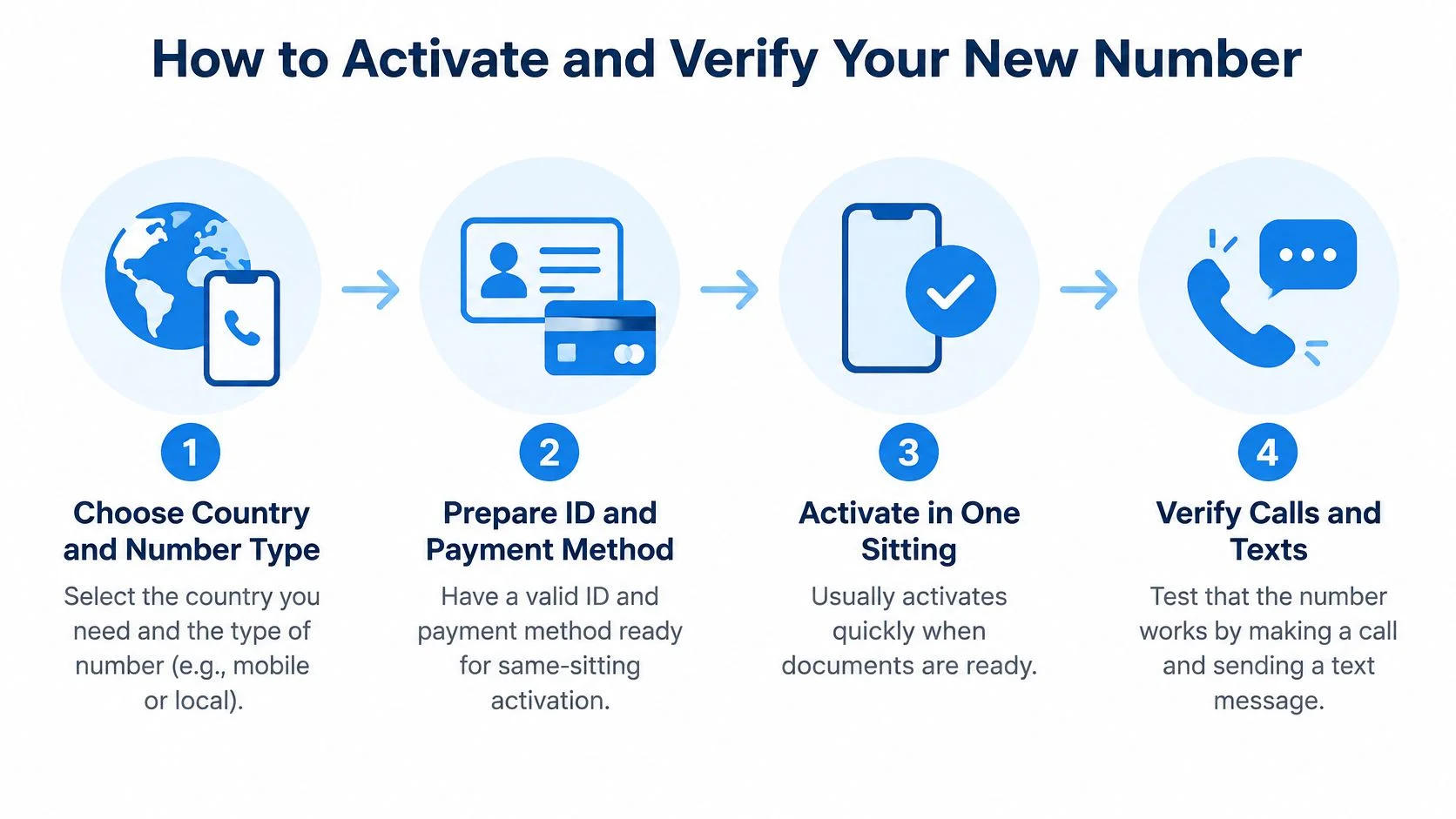
Seven steps from zero to a working line
- Pick the country and number type. That decision is already made, and it drives everything else, including which documents get requested.
- Choose the region and check availability. Pick the area code first, then accept whichever digit combination is free. Insisting on a pattern is how people waste a day.
- Create the account. An email address, a Google account, or an Apple account is usually enough to open it. Use an address you'll still control in five years.
- Add credit or a payment method. Prepaid credit keeps the line predictable. A stored card invites automatic renewals you may not want on a travel number.
- Complete identity verification. Here's where jurisdictions diverge sharply. A compiled review of SIM registration laws by country reports that 162 of 190 surveyed countries and territories require identification before a SIM can be activated, while 27 require no documents. Australia added accredited Digital ID as an extra verification route for prepaid activation in December 2025, and Kazakhstan began requiring biometric identification for mobile contracts in January 2026. Ask before you pay whether a passport is accepted, because a visitor without local ID can otherwise buy nothing.
- Confirm with a test call and a test text. Call the number from another phone, then send a message to it. One pass on one network proves very little.
- Call in from outside the country. A landline and a mobile on different networks will tell you whether inbound routing really works, or only works from the network that issued the line.
An ordinary mobile SIM and an app or browser-based number sit under different rules. A physical SIM is tied to a national registration regime. A browser-based number is tied to the account you opened and the identity documents that provider asked for, so the requirements, the availability, and occasionally the ability to receive short codes can differ between the two even inside the same country.
If the line is an eSIM rather than a card, most of the trouble shows up after you land, when the phone displays signal bars but nothing loads. These eSIM data troubleshooting steps cover the network reset and access point settings worth trying before you join a queue at an airport counter.
Write the number, the account email, the PIN, and the date of activation in one place you'll find again. Recovery of a lost line starts with proving you own the account, and that's much easier with the details in hand.
Secure the Number Against Recycled Links and SIM Swaps
A new number isn't a clean identity until you've checked it. Assume the digits belonged to someone else first and test them before you trust them with a login.
The evidence on recycling is worse than most guides admit. A Princeton study summarized in this analysis of recycled number fraud found that 66% of sampled recycled numbers kept active links to a previous user's accounts, and 100 of 259 numbers were tied to credentials already exposed in data breaches. So the account-recovery text that arrives on day one may be somebody else's front door, not a wrong number.

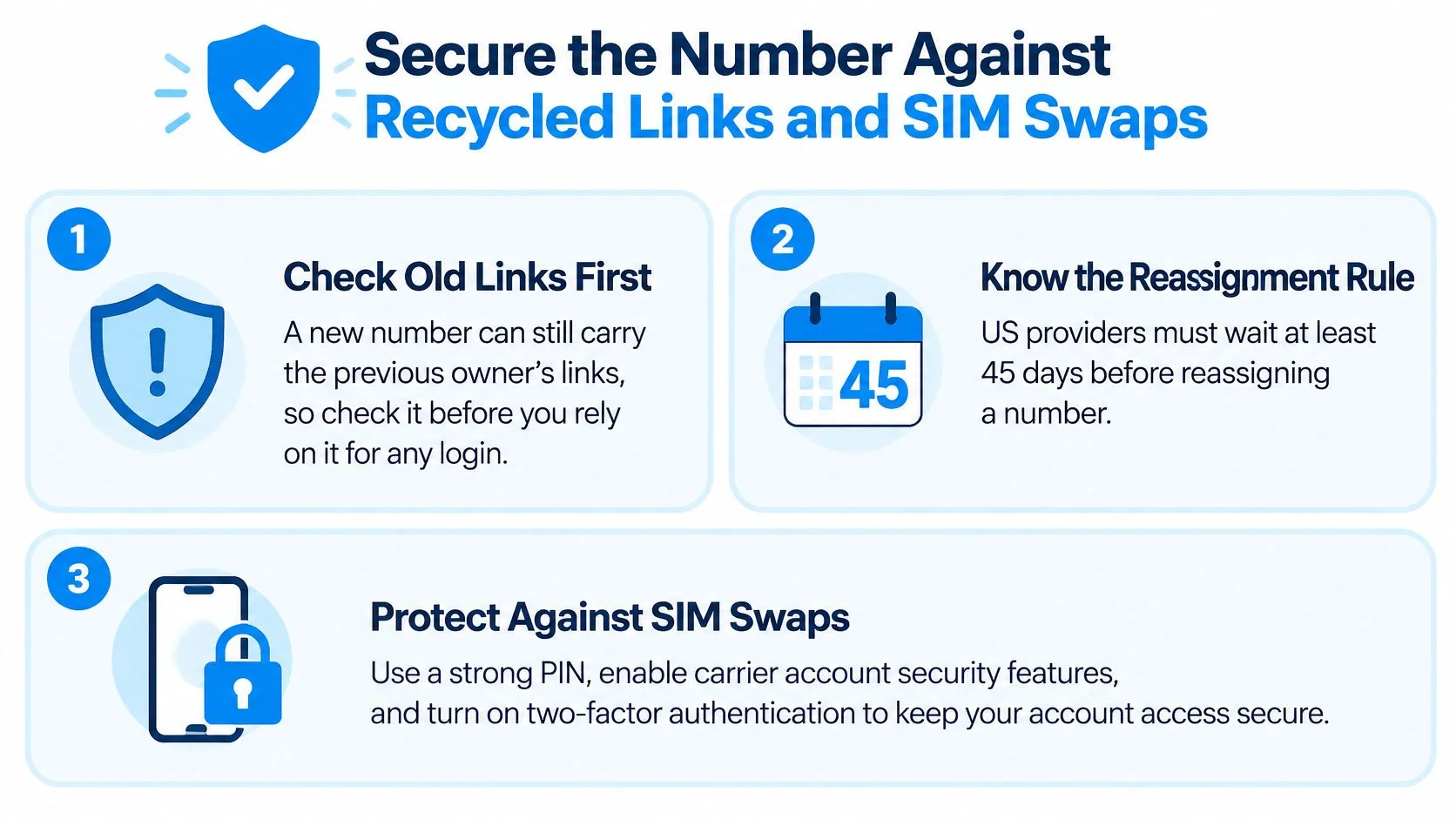
Know the reassignment rule
US rules give you a buffer, not a guarantee. Providers must report permanent disconnections and wait at least 45 days before reassigning a disconnected number, and since July 27, 2020 they've had to maintain the most recent permanent-disconnection date for numbers they hold, according to the FCC's Reassigned Numbers Database guidance. That database lets callers check whether a number was permanently disconnected and later reassigned. It does nothing to stop a stranger's bank from sending a code to your handset.
A recovery code you didn't request isn't a wrong number. It's a live account that still points at your line.
Send yourself a recovery test on the new number before you attach banking or primary email to it. If a code arrives that you didn't trigger, treat that service as compromised and fix it that day. Move high-value accounts to an authenticator app or a hardware key now, not after a scare.
Protect against a port-out
The other half of the risk is someone taking the line from you. A Princeton finding cited in FCC consumer guidance on phone fraud puts the success rate of US SIM-swap attempts at four out of five, which is exactly why text codes alone are weak authentication. Set a carrier account PIN and ask for port-out protection, and know how to find the transfer PIN your carrier requires so a legitimate move doesn't stall while a fraudulent one slips through. For a deeper walkthrough of the attack pattern, this guide on preventing SIM swap account takeover is worth twenty minutes.
Your first week with the number has three jobs: update the accounts that matter, tell the people who call you regularly, and stop responding to messages aimed at the previous owner. Nothing else on this list matters if those three slip.
Set Up Forwarding, Voicemail and Text Receiving
Set forwarding and voicemail before you test anything, so an inbound call reaches you wherever you are rather than wherever the number is registered.
- Forward to your mobile: the line rings on the handset in your pocket even when you're nowhere near a browser. This is the setting that saves a business number from going dark during a commute.
- Ring in the browser or app: good for desk hours, and better for a shared team line, since several people can answer without passing a handset around.
- Voicemail with a purpose-built greeting: name what the line is for. "You've reached the parts counter" tells a caller they've got the right place before they leave a message.
- Notifications on: an inbound message you never see is the same as one that never arrived, particularly for a line used to receive verification codes.
Text on a dedicated number runs one way in a specific sense: the line receives messages, and outbound texting isn't part of the service. Destination and carrier restrictions also apply, so some services and some countries won't deliver a short code at all. If a code fails, don't assume the number is broken; check whether that sender delivers internationally. There's a useful walkthrough on receiving SMS on a virtual phone number that explains the practical limits.
The five-minute test routine
- Call the number from two different networks, ideally one mobile and one landline.
- Leave a voicemail and confirm it appears where you expect it, with transcription if you've enabled it.
- Call the number while forwarding is on and confirm the forwarded leg rings.
- Send one text from a service you already use, such as your own bank or email provider, and see whether it lands.
- If a team shares the line, agree quiet hours so nobody answers a 3 a.m. call meant for another time zone.
A forwarded number is only as reliable as its last test call.
Recommended Setup for Travel, Business and Privacy
Match the number to the situation before you buy: a local line in the country you're visiting for travel, a local or toll-free number that routes to a shared inbox for business, and a separate number kept well away from personal accounts for privacy.
The account update that protects every case
Changing a registered phone number is not a profile edit. NIST's digital identity guidance treats a new registered telephone number as binding a new authenticator, and it tells verification systems to weigh risk indicators such as a device swap, a SIM change, or a port before sending a secret over the public telephone network. Work through banking first, then primary email, then government portals, then work accounts, then social, removing the old number from recovery settings as you go and generating backup codes wherever they're offered. Keep the old service running until every one of those is done, because losing access mid-sequence is what turns a routine change into a support ticket with a three-week queue.
The habit gap is real. A 2024 Which? survey of more than 15,000 members found that 1 in 10 had changed their mobile number within the previous decade, and among those who changed, half hadn't updated it with all relevant accounts and organisations, per the Which? phone number recycling investigation. Being in the other half takes about an hour.
Protection steps worth ten minutes
- Carrier PIN and port-out lock: the single highest-value setting on any mobile account, and it takes one call to enable.
- Authenticator app or hardware key for email and banking: removes the text message as the weakest link in your recovery chain.
- A written record: which number is attached to which account, and when you changed it. Future you will not remember.
Confirm the Number Works and Make Your First Call
Once forwarding and inbound tests pass, place one short call from a browser to a number you already know, and use the balance as the proof. BubblyPhone runs in any browser on a computer or phone with nothing to install, and the person you reach needs no app and no account, whether they're on a landline or a mobile. You can reach any phone in 222 countries by typing the number and pressing call, and signing up takes an email address, a Google account, or an Apple account. A US number is available even if you live outside the US.
Calling needs no subscription. Credits start at $5 and never expire, billing is per minute rounded up to the whole minute, and the only recurring product is the optional dedicated-number plan. Don't guess at cost: open the live rate table, pick the destination, and read the per-minute price before you dial. Then place a one-minute call to your own mobile, hang up, and confirm the balance dropped by exactly one rounded minute. If you hold a dedicated number, make one inbound call afterward to be sure outbound use didn't disturb receiving.
Getting a new phone number is mostly a verification job, and a call is the fastest verification there is. BubblyPhone lets you dial any landline or mobile in 222 countries straight from your browser, with no app for you and no account for the person answering, so you can test a new line or reach family abroad in the next five minutes. Credits start at $5 and never expire, and you pay only for the minutes you use. Open BubblyPhone, sign up with an email or a Google account, and make that first call today.