Can You Pick Your Phone Number? a 2026 Guide
Table of Contents
- Picking, porting, and keeping aren't interchangeable
- What determines whether you can reserve it
- How to widen an unsuccessful search
- Toll-free selection still starts with inventory
- Check the record before paying
- Follow the order that prevents a bad purchase
- Test the function, not just the digits
- Secure the account that controls the number
- Investigate reputation problems before replacing the number
- Match the ongoing commitment to the need
Yes, you can often pick a phone number from unassigned inventory or keep one you already control by porting it, but you can't invent any digit string you like. International phone numbers must fit a numbering plan with a maximum of 15 digits.
But if a number looks local and memorable, does that mean you can keep it, receive verification codes on it, and expect people to answer? Those are separate questions. The useful choice isn't a set of digits, it's a number that's available, supports your needs, and stays under your control.
Can You Pick Your Phone Number
Yes, you can often pick your phone number, but your choices are an unassigned number in a provider's inventory or an existing number you're eligible to port. You can't create a new number just because you like the sequence.
Ways you can choose a phone number
A new local or mobile number comes from stock within a real area code or mobile range, rather than from an unrestricted number generator. A vanity pattern narrows that search to digits that spell a word or follow a memorable sequence.
A US toll-free number comes from a separate inventory, with its own administration and service rules. Porting preserves an existing number instead of selecting a replacement, while a dedicated line gives inbound calls a separate identity, with receiving texts available only where supported.
Picking, porting, and keeping aren't interchangeable
Picking happens when you select an available number. Porting happens when you transfer an existing number between services. Keeping it means maintaining the account, authorization, and service conditions that let you continue using it.
The FCC's number-porting guide says consumers can generally retain a number when switching between wireline, internet-based, and wireless providers within the same geographic area; moving to a new area can make the number unavailable for porting.
Say you run a small repair business. If customers already know your number, a successful port may be more valuable than finding a clever new pattern. If you're starting a separate business, an ordinary available local number might be sufficient.
Choose the job before the digits: Decide whether you need a fresh identity, a memorable pattern, a toll-free line, continuity, or a separate inbound line.
A familiar area code doesn't automatically make a number trustworthy. Nor does receiving ordinary calls establish that every app will accept it for verification.
Before searching, commit to a route: new stock, vanity, toll-free, port, or dedicated line. Otherwise, you can spend time comparing attractive numbers that don't solve the same problem.
Why Only Free Numbers in Eligible Ranges Can Be Chosen
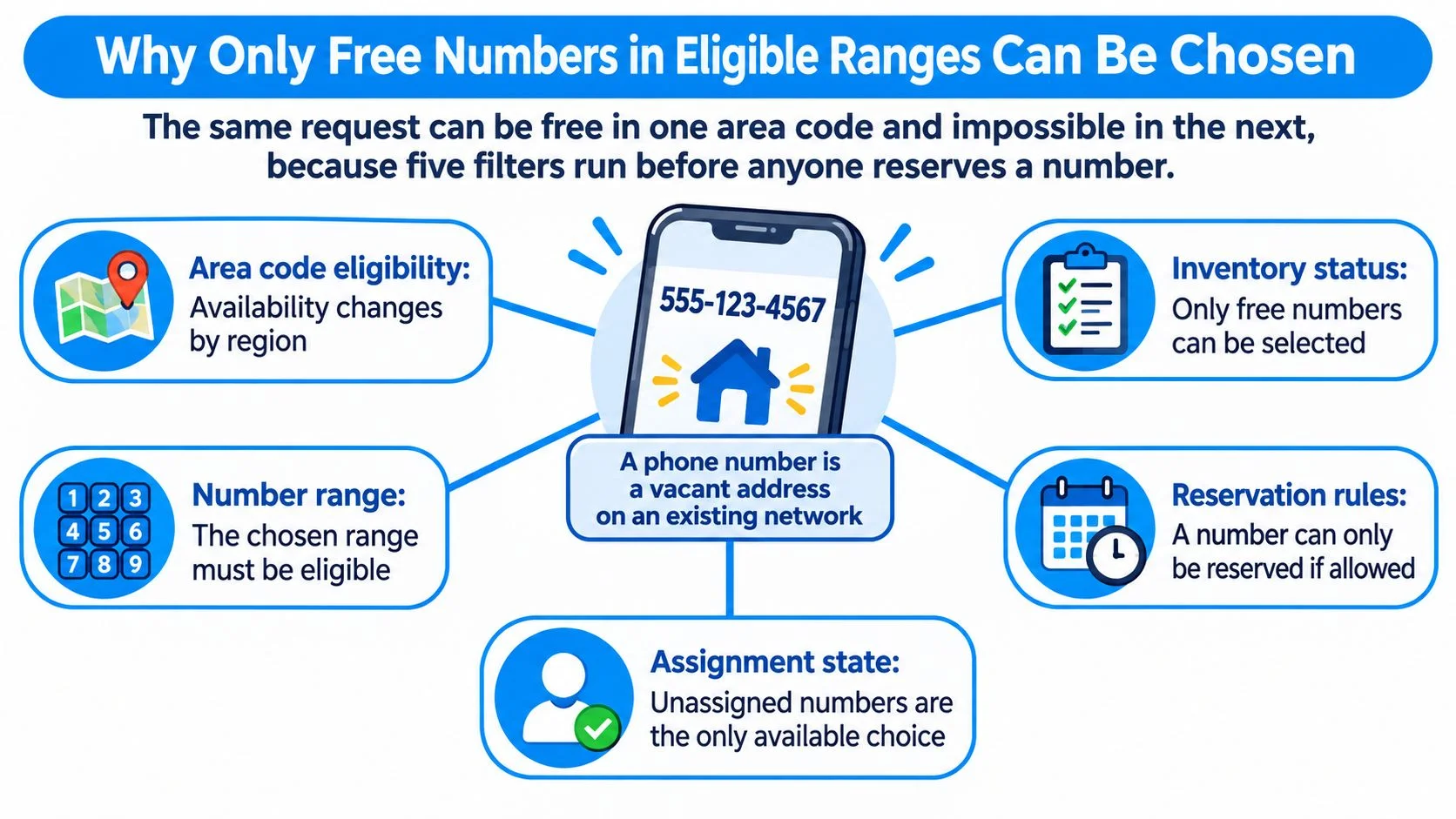
The same requested pattern can be available in one area code and impossible in another because providers must check the country, range, assignment status, capabilities, and eligibility before reserving it. Here, free means unassigned, not necessarily free of charge.
Think of a phone number as a vacant address on an existing block. You can choose an available address that meets the rules, but you can't invent a building number and expect the network to deliver calls there.
The scale of the numbering system makes those rules important: the FCC's numbering material reports approximately 41 million working toll-free numbers. Those are managed telephone resources, not an unlimited collection of customizable usernames.
The availability filters are easier to understand as a connected system.

What determines whether you can reserve it
- Country and number type. Geographic, mobile, toll-free, and non-geographic numbers belong to different ranges. A number intended for one service category isn't automatically usable for another.
- Area or city code. A provider must have suitable stock within the code you select. The code describes the numbering area, not proof that the person using it is physically there.
- Assignment status. A number already assigned to someone else, or reserved for another purpose, isn't available for your order.
- Required capabilities. Voice availability doesn't establish receive-SMS support. Forwarding, voicemail, and other features also need checking.
- Eligibility rules. A range may require local presence, documentation, business use, or a particular service class.
These checks explain why an attractive search result can still be unsuitable. The digits may be unassigned, but the number might not support the service you need or be available to someone in your circumstances.
How to widen an unsuccessful search
Say you live outside the United States and want a US number for family calls. Your location doesn't necessarily rule that out, but you still have to choose from the states and area codes the service stocks.
For our available US inventory, you can search local numbers by area or city. Naming a city doesn't create stock there.
A word pattern could already be allocated in a London range while its corresponding digits remain available in a US toll-free range. Those are separate searches, not interchangeable versions of the same number.
If your preferred choice is taken, try a neighboring area code in stock, a less exact digit pattern, a toll-free line, or an eligible number you already hold.
Ask for the complete match: country, number type, area, unassigned status, inbound voice, receive-SMS support, and residency requirements.
Don't accept “available” as the whole answer. Confirm that it means available to you, for your intended use, rather than merely visible in a database.
Vanity Numbers and Toll-Free Patterns
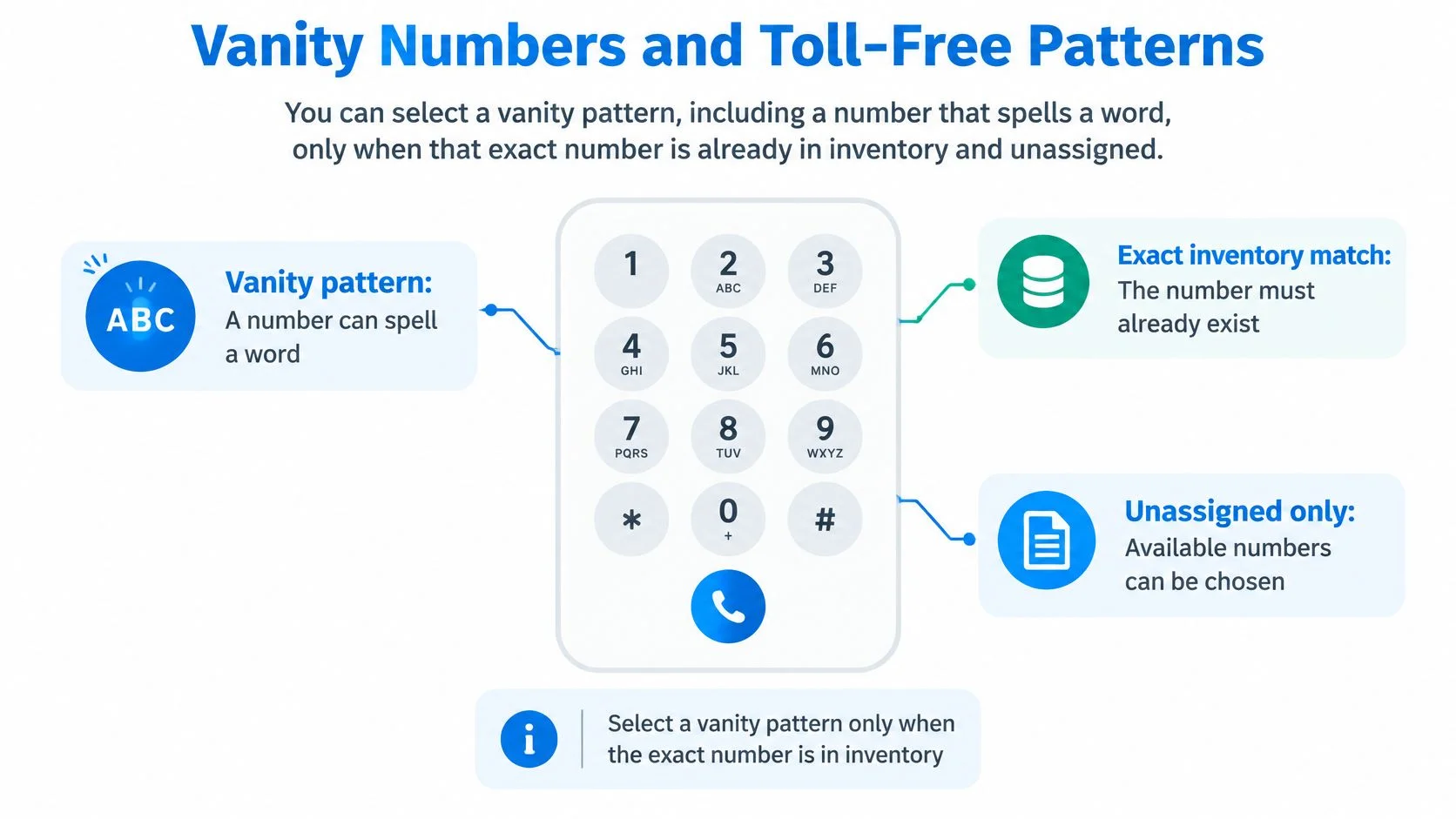
You can select a vanity pattern, including a number that spells a word, only when the exact corresponding number is in inventory and unassigned. A word makes the number easier to remember, but it doesn't give you a right to the digits.
The keypad mapping shows what you're searching for:
- FLOWERS corresponds to 3569377.
- CAKE corresponds to 2253.
- CALL corresponds to 2255.
Several letters share each keypad key, so different words can produce identical digits. A short word also supplies only part of a complete number, leaving the prefix or remaining digits to determine the full match. You can use our vanity-number converter to turn a proposed word into a search pattern.
This illustration shows the distinction between choosing a pattern and creating a number.

Toll-free selection still starts with inventory
The FCC's toll-free-number guide explains that most US toll-free numbers are assigned first-come, first-served through Responsible Organizations, which reserve and administer the records, and that subscribers can move their numbers to another Responsible Organization.
That separates two decisions. Finding a new pattern requires an available inventory match. Keeping a pattern you already use requires an eligible transfer and the correct account documentation.
Don't assume a local vanity number makes calls free. Likewise, a US toll-free label doesn't guarantee free access for someone calling from abroad.
For a visual explanation of memorable number patterns, watch the following video.
Check the record before paying
Before committing, confirm the service class, whose details appear on the subscriber record, and the process for a future port-out. Check inbound voice and receiving SMS separately rather than treating them as a package.
Memorable patterns can carry a premium above an ordinary local number, either as an upfront charge or a higher monthly fee. Get the exact inventory record's price in writing, including any continuing charges. A quote for a desirable pattern isn't evidence of what all vanity numbers cost.
Keep the order confirmation, account details, and authorization records somewhere you can access without using the number itself. If you later need to recover or transfer it, remembering the word won't substitute for proving that you control the account.
How to Search Reserve and Confirm a Number
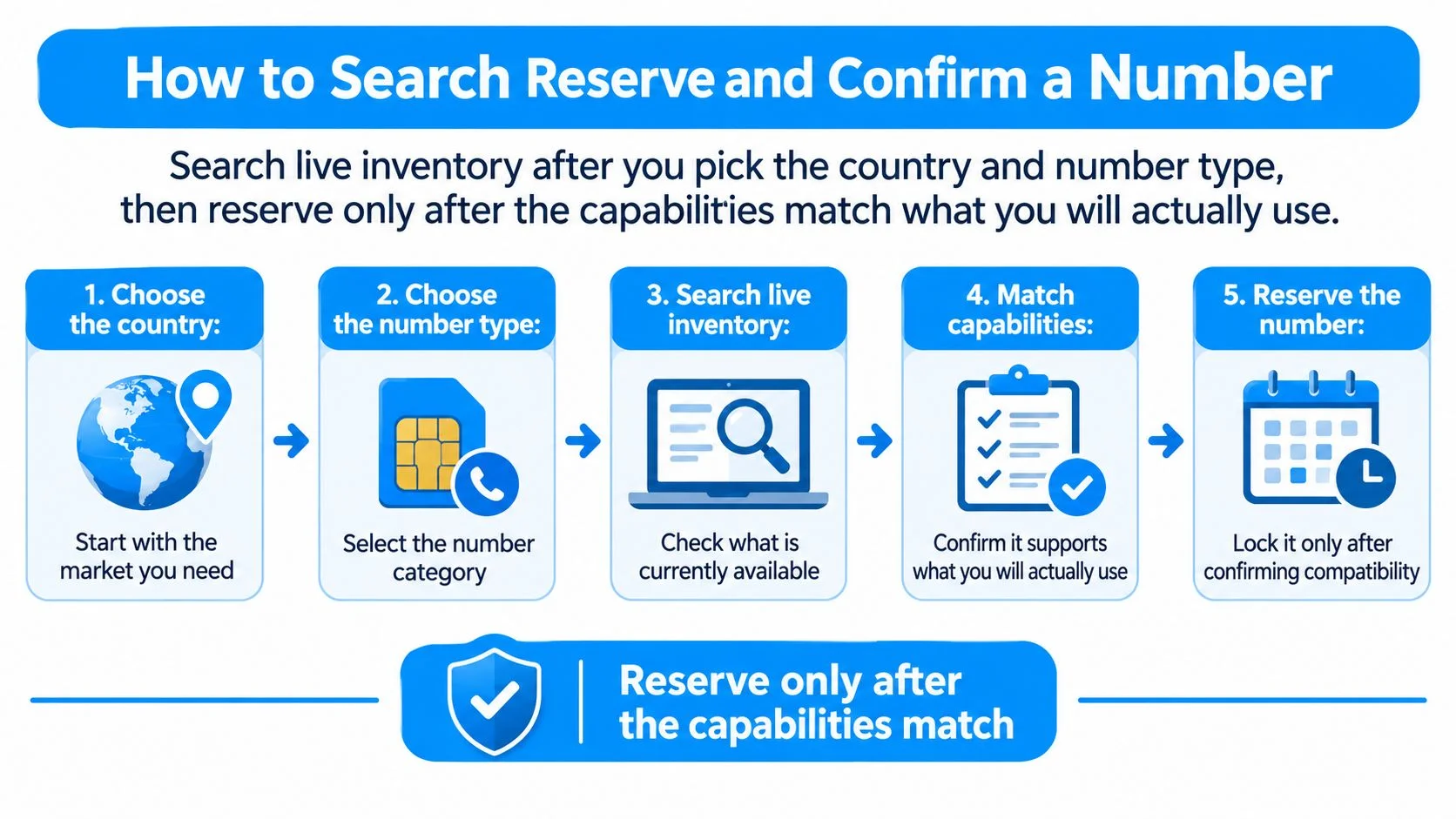
Search live inventory after choosing the country and number type, then reserve only when the capabilities match your intended use. A search result is a candidate, not proof that the number is ready for your calls or messages.
Under the ITU-T E.164 numbering recommendation, an international number's country code and national fields must fit within a maximum of 15 digits, excluding the international dialing prefix. That's a format boundary, not permission to choose any sequence within it.
The basic process is to narrow the market, check stock, verify compatibility, and then reserve.

Follow the order that prevents a bad purchase
- Choose the country and number type. Select local, mobile, toll-free, or non-geographic according to the job. Don't start with a word pattern and postpone the service requirements.
- Narrow the area if needed. Choose the area or city code that matters to your audience. Keep another acceptable code ready if the first search returns nothing suitable.
- Search current inventory. Look for a complete number or digit pattern. A saved screenshot doesn't reserve anything, and an old availability list isn't a current offer.
- Open the capability details. Confirm inbound voice, forwarding, voicemail, and receiving SMS for the destination. An unassigned number can still fail this check because of its service category or geographic eligibility.
- Use the porting route for an existing number. Start a transfer request instead of searching new stock. Keep the existing service active while the receiving service checks eligibility and arranges the transfer.
- Reserve and save the records. Retain the confirmation, subscriber details, account PIN, and any transfer authorization. Store them outside the telephone account so a login problem won't hide your evidence.
- Test before relying on it. Call the number from another phone and check the intended answering route. If receiving texts matters, send a test message to it from a normal phone.
Test the function, not just the digits
For a business line, let a test call reach voicemail and listen to the greeting. If you need forwarding, answer the forwarded call and check that it reaches the intended mobile.
A successful ordinary text establishes that basic receiving works; it doesn't establish that every verification service will accept the number. Test any essential service separately, without removing your existing recovery method.
Before publication: Complete the test call and any required SMS test before putting the number on a website, printing it, or assigning it to account recovery.
Risks After the Number Is Yours
Protecting a number matters more than finding a perfect pattern because a number can be spam-labeled, spoofed, or transferred without your consent. Choose something you can secure and retain, not just something that looks good on a business card.
What can go wrong after you choose a number
Secure the account that controls the number
The FCC's warning about port-out fraud explains that scammers can transfer a victim's number to a device they control, and notes that providers commonly use account PINs or passwords as safeguards.
Set a unique PIN or password rather than reusing one from another account. Protect the email account associated with the service, too, because an attacker who controls recovery messages may gain another route into your telephone account.
Keep authorization records and an alternative recovery method. You shouldn't need access to the missing number to prove that it belongs on your account.
Investigate reputation problems before replacing the number
A recycled number may bring unwanted calls or a reputation left by a previous user. Check how it appears to recipients before distributing it widely.
If someone reports calls you didn't make, inspect your call history and account access first. A spoofed caller-ID display doesn't necessarily mean an attacker entered your account, but you should establish that before treating it only as a labeling problem.
Using an authorized business callback number is different from falsifying caller ID to defraud, cause harm, or obtain value. Don't copy suspicious behavior in an attempt to make your own calls look more credible.
You also don't own the digits forever. Cancellation or failure to maintain a monthly number plan can lead to release, so check retention terms before ending service.
For banking or government access, retain an accepted recovery method that doesn't depend solely on an optional internet number. A plain, monitored number with a strong PIN is more useful than a memorable number you can't protect or keep.
Choose a Dedicated Number or Just Call
Choose a dedicated number when you need people to call or text you back on a stable, separate identity. If you only need to reach someone, you can skip number shopping and place the call.
What Each Route Costs
Match the ongoing commitment to the need
A separate line can make sense for family abroad, a small business, or travel when you want a consistent callback number. Porting is the better starting point when continuity matters and your existing number is eligible.
Our phone-number rental guide explains the dedicated-line approach. We can issue US numbers to people living outside the United States, with stock in California, Delaware, Florida, Georgia, Illinois, Nevada, New York, Texas, Washington, and Wyoming.
Our optional US number starts at $3 a month, paid from your account balance, with no contract and cancellation at any time. Calls can ring in the browser or app, forward to your mobile, or go to voicemail; texts are receive-only, subject to number and destination restrictions.
For an occasional outbound call, open the browser, enter the destination, check the live calling rates, and call. The recipient answers an ordinary landline or mobile and needs no app or account.
Calling is pay as you go with no subscription; the optional dedicated-number plan is the only recurring product. Billing is per minute, rounded up to the whole minute, so check the destination and number type before dialing rather than assuming a universal rate.
The decision is practical: pay for a stable inbound identity when you need one. Otherwise, spend your time making the call, not selecting a number.
Make a call with BubblyPhone from any browser, whether or not you need a dedicated number. The person you call needs no app or account, and credits start at $5 and never expire.