How to Call United States from Brazil: 2026 Dialing Guide

Table of Contents
From a Brazilian landline, you call a United States number by dialing 00, then your carrier's two-digit selection code, then 1, then the area code and the seven-digit local number. From a mobile phone or a browser dialer, you dial +1, the area code and the seven-digit number, with no carrier code at all.
If you've already tried and got an invalid-number message, a recorded announcement, or a call that died after two rings, the number itself is probably fine. The problem sits in the sequence, and it's usually one of three things: a missing carrier code, a stray Brazilian zero, or a landline format typed into a mobile phone. The mechanics of how to call United States from Brazil come down to one variable most guides skip, which is the phone or line you're dialing from, not the country you're dialing to.
Dialing Sequence for Each Phone and Line
A traditional Brazilian landline needs 00, then the two-digit carrier-selection code, then 1, then the ten-digit US number. A mobile phone or a browser dialer takes +1 and the ten-digit number, and nothing else. The table below shows every combination against one worked example, 212-555-0123.
| Phone or line | Format to dial | Example for 212-555-0123 |
|---|---|---|
| Traditional Brazilian landline | 00 + carrier code + 1 + area code + number | 00 21 1 212 555 0123 |
| Mobile phone, plus format | +1 + area code + number | +1 212 555 0123 |
| Mobile, operator requires exit code | 00 + carrier code + 1 + area code + number | 00 41 1 212 555 0123 |
| Browser or app dialer | +1 + area code + number, no 0 | +1 212 555 0123 |
That middle step is the part people miss. A Brazilian international call is routed through a long-distance provider the caller selects, which is why the network expects a two-digit code between the exit code and the destination country code, as Telephone numbers in Brazil explains. Published examples include 21 and 41. Neither is universal, and neither is issued by the United States: your operator and your long-distance plan decide which codes your line accepts. Confirm yours before the first call, and again after you change plans or move house.
The eight steps in order
- Write the US number as ten digits first. Strip the spaces, brackets and hyphens from whatever you were given. A number pasted from an email often carries formatting characters that a phone keypad translates into a pause or drops entirely.
- Check that the first three digits are a real area code. Under the North American Numbering Plan, a US number is +1 plus ten digits, split into a three-digit area code and a seven-digit subscriber number, per the North American Numbering Plan Administrator. Toll-free codes such as 800 and 888 also sit on +1, so they follow the same rule.
- Confirm your operator's carrier-selection code. This is the step that fails. A wrong code doesn't produce a warning; it produces silence or a generic error.
- Enter the exit sequence. On a landline, dial 00. On a mobile using the plus format, press and hold 0 until the + appears on screen.
- On a landline, type the carrier code next. Two digits, immediately after 00, with no pause between them.
- Then 1, the area code and the seven-digit number. Read the whole string back once before pressing call.
- Never insert Brazil's domestic 0 before the area code. That prefix belongs to calls inside Brazil. On an international call it corrupts the number and the network either rejects it or routes it somewhere you didn't intend.
- Press call and read the response. A ringback tone means the call is routing and you've done it right. An automated message, a fast busy tone or silence means recheck the digit count before you redial.
The rule that fixes most calls: the correct format depends on the phone or line you're dialing from, not on the destination. Two people in the same city calling the same US number may need two different sequences.
If you only remember one thing, remember that the number never changes and the prefix always might. Our guide to the US country code and number format covers the destination side in more detail when you need to check a number you've been given.
Why Calls Fail and How to Fix Them
Most failed calls come from one of five format mistakes, and you can work through them in a fixed order before you redial. The symptom you heard tells you which one you made.
| Symptom | Likely cause | Fix |
|---|---|---|
| Invalid-number message on a mobile | Landline format copied onto the mobile | Switch to +1 + area code + number |
| No connection on a Brazilian landline | Carrier-selection code missing after 00 | Add the code your operator uses, then redial |
| Unknown recipient or wrong number | Domestic 0 added before the US number | Remove the 0 and redial in the international format |
| Call fails with seven digits dialed | Area code omitted | Enter all ten digits after the country code 1 |
| Valid number still fails | Number status, balance or calling permission | Check balance, then test a second known-valid US number |
The zero that breaks the call
The single most common cause is Brazil's domestic trunk prefix. The International Telecommunication Union lists Brazil with country code 55, international prefix 00 and a national prefix of 0, which is why the domestic zero feels natural to add and why it must not appear before a US number, according to the ITU numbering plan. The zero tells a Brazilian exchange that a domestic call follows. On an international call, the 00 has already done that job.
The second most common is a format mismatch between devices. A sequence built for a landline, with the carrier code in the middle, typed into a mobile keypad can trigger an invalid-number message, because the mobile network is expecting the plus format. It works the other way too: a landline caller who skips the carrier code gets no connection at all, since the network has no provider to route the call through.
A failed call doesn't prove your format is wrong. It proves one part of the chain didn't complete, and the chain has several links.
Why a valid number can still fail
There's no universal success rate for international calls, because completion depends on carrier routing, congestion, number status, fraud controls and the access method you used. That means one bad attempt tells you very little. Run the checks in order: validate the normalized +1 number, retry without formatting characters, check your account balance and whether international calling is enabled on your line, then test a second US number you know is valid. If the second number connects, the fault is the first number, not your dialing.
When you find a sequence that works, save it inside the contact entry rather than in a note or a chat message. The next call takes one tap, and you stop re-deriving the format under pressure. If a call keeps failing after all five checks, our troubleshooting guide for failed calls walks through the remaining causes.
Choosing Between Direct Dialing and Browser Calling
Direct dialing suits occasional calls to a recipient with an ordinary phone when your line connects reliably. Browser calling suits recurring calls, recipients who can't install anything, and callers whose landline, mobile plan or data connection makes the carrier-code route unreliable.
| Criterion | Direct dialing from Brazil | Browser-based calling |
|---|---|---|
| Carrier-selection code needed | Yes on traditional landlines | No, enter the +1 number |
| Recipient needs an app or account | No | No, works in any browser |
| Needs reliable internet access | No | Yes |
| Cost predictability | Varies by Brazilian operator and plan | Per-minute, rounded up to the whole minute, paid from prepaid credit |
| Works if VoIP traffic is blocked | Yes | No, depends on VoIP access |
The cost question nobody answers well
Brazilian operators price international calls differently from one another, and those rates move. Taxes and plan restrictions can apply on top, so a single figure quoted in a guide is not something you should budget against. What you can control is predictability: a prepaid balance with a published per-minute rate tells you the cost of a call before you make it, while a carrier-billed international call tells you afterwards.
The other half of the decision is compatibility. If the person you're calling can't install an app, can't create an account, or is answering on a landline in a rural area, browser calling still reaches them because it terminates on the ordinary phone network. That matters in a country where connectivity is widespread but uneven: Brazil had more than 177.1 million internet users in 2024, with over 94% of the population using the internet, according to the International Trade Administration. High penetration doesn't mean every call happens on a stable connection, which is why the fallback direction matters as much as the primary one.

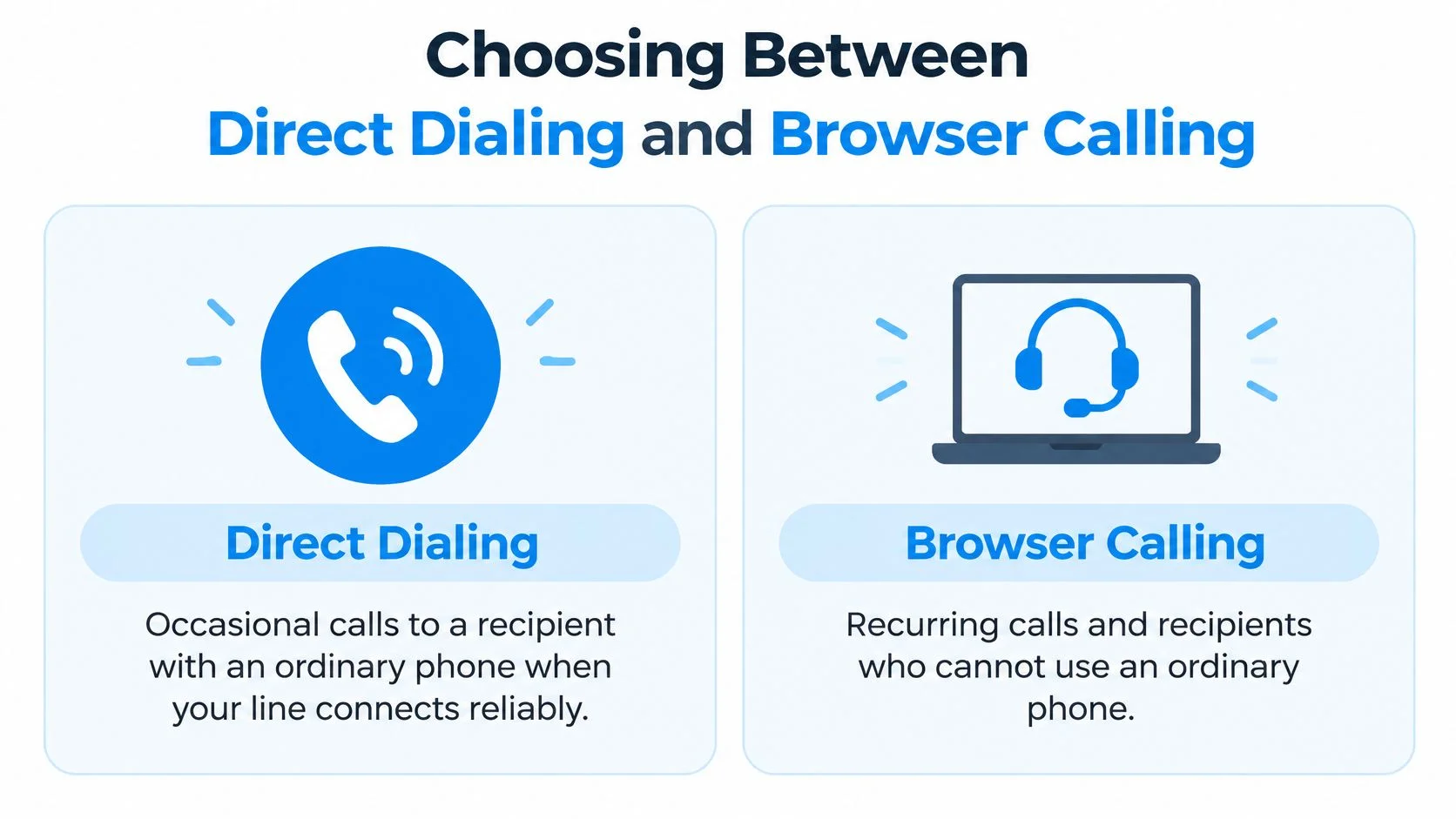
The chart above sets the two methods side by side. Notice that the deciding factor isn't price, it's who answers and how.
A simple way to choose
Keep direct dialing for a stable line and occasional calls, where the carrier code is already saved and the call is short. Use browser calling for family or business calls you make regularly, where the recipient can't install anything, or where you want the same per-minute cost regardless of which Brazilian operator serves your address. If you're still working out the difference between calls you place and calls you receive, compare inbound and outbound calling before you set up a routine.
A browser service such as BubblyPhone is one example of the second path: you type the US number at bubblyphone.com, press call, and the person you're ringing answers on any landline or mobile without installing anything. Our guide to placing an international call covers the setup steps in order.
Tips for Calling US Banks, Offices and Family
For recurring calls, save each contact in full +1 format and add a note with the carrier code your line needs. These five habits prevent most of the problems that show up after the call connects, or fails to.
- Check whether the number is toll-free. Many US toll-free numbers starting 800 or 888 can't be reached from outside the United States. A bank's main switchboard number usually can be, even when its toll-free line can't.
- Find the number on the organization's own website. Numbers from ads, forwarded messages or search results can belong to a third party. Go to the bank, tax office, pension service or embassy site directly and use the contact page there.
- Time the call for the US side. Brasília runs two to three hours ahead of US Eastern time, depending on whether daylight saving is in effect. A call placed at 4pm in São Paulo reaches the East Coast late morning, which is usually the best window for reaching a person rather than a queue.
- Ask whether they publish a separate number for international callers. Banks, tax authorities, pension services and embassies often maintain a dedicated line for callers abroad, and staff on the domestic line may not be able to transfer you.
- Keep a written list of what worked. Note the number, the format you dialed and the time of day you got through. When the same call recurs monthly, that note saves the whole diagnosis process.
For appointments and deadlines: confirm the time zone on both ends before the call. A missed window with a US bank or embassy usually costs more than a redial.
Say a Brazilian living in São Paulo needs to reach her US bank's fraud line after a card alert. From her mobile, +1 followed by the ten-digit number connects on the first attempt. The same number typed with 00, a carrier code and no plus sign fails, because the mobile network treats the carrier digits as part of the subscriber number. Same destination, two devices, two different answers.
Confirm Your Format and Place the Call
Use the format from the table that matches your phone, run the five checks if the call fails, and switch methods if the recipient can't take a direct call. Landline means the carrier code; mobile means +1; a recipient who can't install anything or a line that won't hold means a browser calling service.
Placing the call takes one step at BubblyPhone: type the US number and press call. The person you're calling needs no app and no account, and can answer on any landline or mobile. Calling is pay as you go, billed per minute and rounded up to the whole minute, paid from prepaid credit that starts at $5 and never expires. No subscription is needed for calling, and the only recurring product is an optional dedicated US number. For current per-minute rates to any destination, check the live rate table.
Stop fighting the carrier-selection code on a landline that drops calls halfway through a bank hold queue. At BubblyPhone you type the +1 number in your browser, press call, and the person you're reaching answers on an ordinary phone without installing anything or creating an account. Credits start at $5, never expire, and calls are billed per minute with no subscription, so a monthly call to family or a supplier costs you only the minutes you use.