Calling from Spain to US Made Simple (2026 Guide)

Table of Contents
- Copy the sequence exactly
- Mobile and landline destinations
- The four components
- Why the same number looks different
- Toll-free numbers aren't a guaranteed shortcut
- Choose the number type deliberately
- Use the destination's local working day
- Account for seasonal clock changes
- Budget for the way calls are billed
- Cost and deliverability belong in one check
- Follow the sequence
You've found the US number, but the call still won't connect, the toll-free line rejects you, or the recipient sees “Spam Likely.” For calling from Spain to the US, start with 00 1 followed by the 10-digit US number, or use +1 followed by the same number on a mobile phone. Then check the number type, time zone, rate, and likely call-labeling issues before you dial.
The Exact Way to Dial the US From Spain
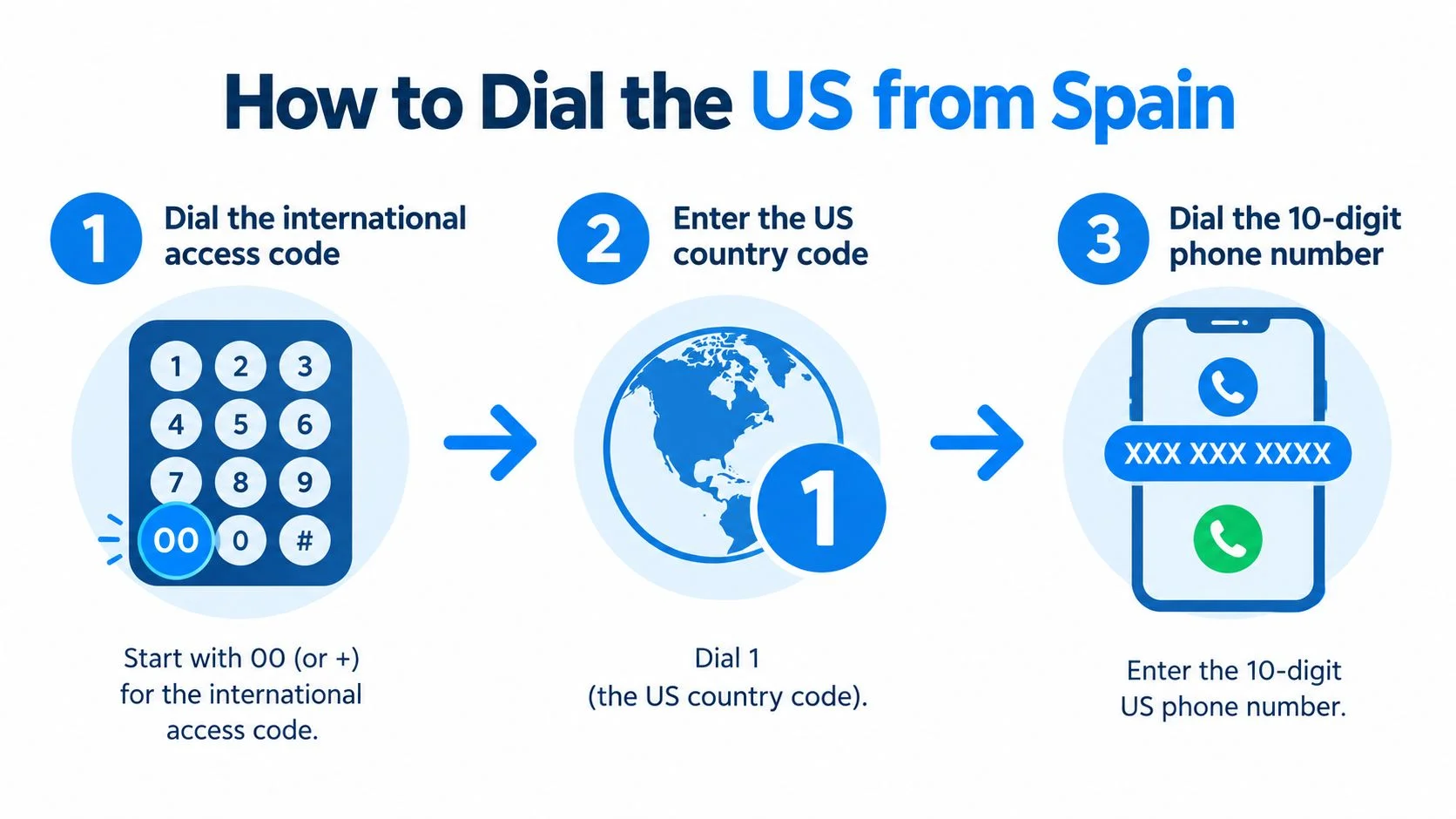
From Spain, dial 00, then 1, then the 10-digit US number. On a mobile phone, you can replace 00 with +, so the complete format is 00 1 XXX XXX XXXX or +1 XXX XXX XXXX. Both formats route to the same US destination. (See the Spain-to-US dialing format)

Copy the sequence exactly
Suppose the US number is written domestically as 212 555 0187. A mobile caller in Spain should enter:
+1 212 555 0187
A caller using a landline should enter:
00 1 212 555 0187
The first part, 00, tells the Spanish telephone network that the call is international. The next part, 1, identifies the North American Numbering Plan, which includes the United States. The remaining digits identify the destination, beginning with a three-digit area code and followed by a seven-digit local number. (Review international country-code conventions)
On a phone with a plus key, press and hold 0 until the plus symbol appears. The plus format is usually easier for contacts, address books, browsers, and international dialers because it travels with the number instead of depending on the caller's local exit code.
Mobile and landline destinations
US mobile phones and landlines use the same +1 format. You don't add a special mobile prefix, and you don't remove the area code. If the person gives you a 10-digit number, preserve all 10 digits after +1.
For a quick format reference, save the BubblyPhone international dialing guide. It's especially useful when you're switching between a phone keypad, a browser dialer, and a contact record.
Understanding Each Part of the Dialing Sequence
A Spain-to-US number has four practical parts: Spain's international access code, the US country code, the area code, and the seven-digit local number. Together, the area code and local number create the typical 10-digit US destination number under the North American Numbering Plan. (See how +1 is used across the North American Numbering Plan)
The four components
00 is Spain's international access code when you're calling from a conventional landline or a service that expects an exit prefix. On a mobile, + commonly replaces 00.
1 is the US country code. It must appear before the area code when the call originates outside the US.
The three-digit area code identifies the US numbering region. The seven-digit local number identifies the individual subscriber within that area code.
Why the same number looks different
You may receive the same destination in three forms:
- 00 1 212 555 0187, intended for a caller in Spain using an international exit code
- +1 212 555 0187, the portable international format
- 212 555 0187, the domestic US format
The bare 10-digit version may work if your calling service already knows you're placing a US call. It's less dependable across networks and browser dialers because the system has to infer the destination country. Entering +1 plus the 10-digit US number removes that ambiguity. (See guidance on normalizing US numbers for calls from Spain)
Practical rule: If you're unsure which format a browser or app expects, use +1 followed by all 10 US digits.
Spain's own country code is +34, which matters when someone in the US calls Spain. A Spanish domestic number is 9 digits long, and callers from abroad add +34 after dropping the domestic trunk prefix. (Check Spain's international numbering format) This is the reverse-direction equivalent of adding +1 to a US number.
Tricky Number Types and Edge Cases
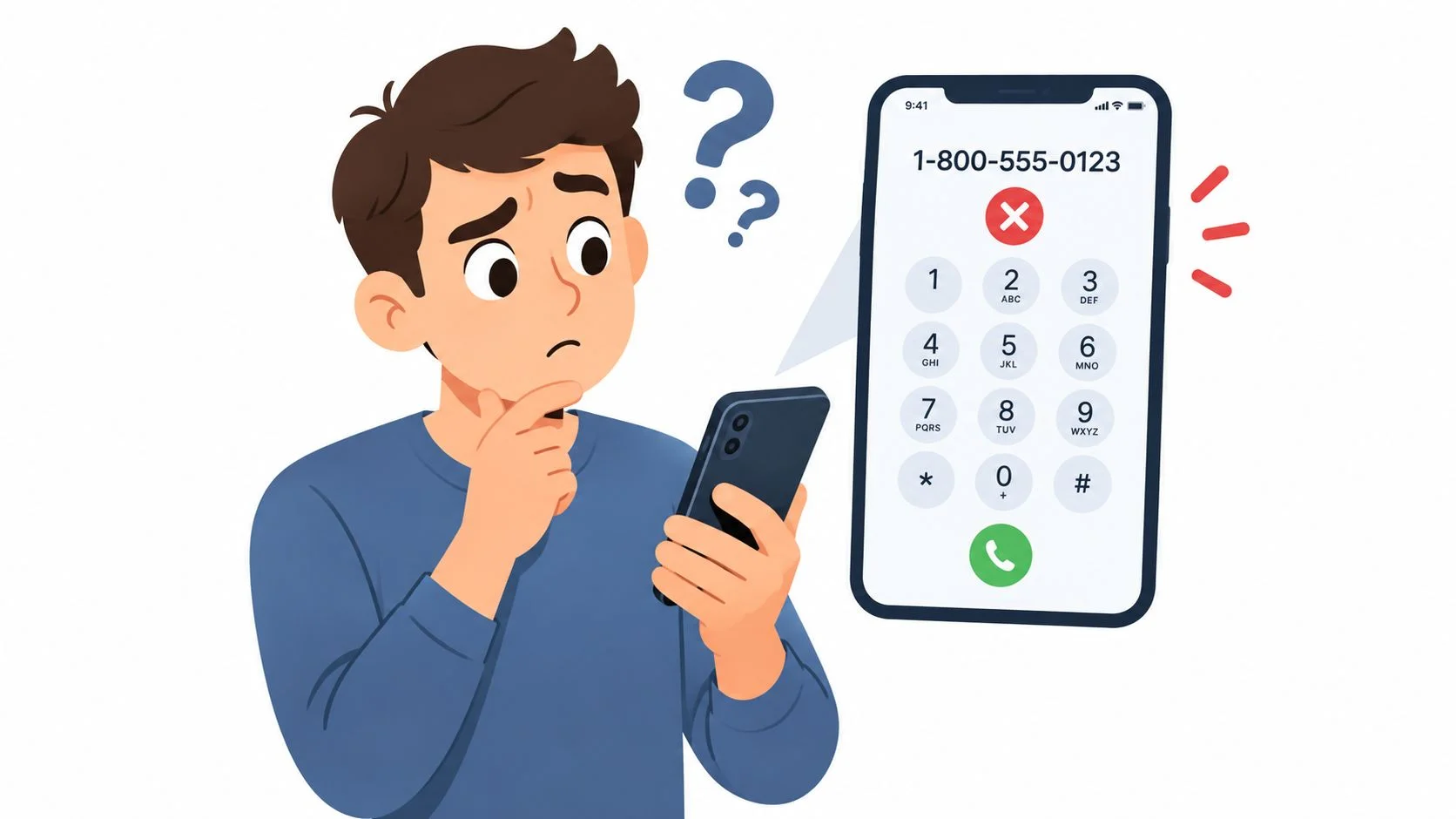
A correctly entered number can still fail when the destination is a US toll-free line, a heavily filtered business number, or a route with different pricing for mobile and landline termination. Toll-free doesn't automatically mean free or reliable for a caller in Spain. (Review toll-free dialing guidance for calls from Spain)

Toll-free numbers aren't a guaranteed shortcut
US toll-free prefixes include 800, 888, 877, 855, 844, and 833. From Spain, the pattern still begins with 00, followed by 1, followed by the toll-free prefix and subscriber number. For example, a US number beginning with 800 would be entered in the form 00 1 800 XXX XXXX or +1 800 XXX XXXX.
The problem is what happens after the number is dialed. Some US toll-free services don't accept international traffic, while others may treat the call as an international call rather than absorbing the cost. A family member calling a bank, airline, or government helpline from Spain can therefore hear an error recording or see charges that weren't expected.
Choose the number type deliberately
If a business provides both a toll-free number and an ordinary geographic number, ask which one accepts calls from outside the US. The regular geographic number may be the more predictable option, though you should still verify its current rate before placing a long call.
A second trap is assuming that every US destination costs the same. Pricing can differ by line type and provider, so a mobile destination and a landline destination may have different charges even on the same Spain-to-US route.
A toll-free prefix describes the recipient's domestic billing arrangement. It doesn't guarantee international access, international availability, or zero cost for the caller.
Best Times to Call the US From Spain
Spain is generally 6 to 9 hours ahead of the continental United States, depending on the US time zone. A Spanish late afternoon is often a workable period for the East Coast, while the same call may reach the West Coast much earlier in the day. (Use a time-zone planning reference for international calls)
Use the destination's local working day
For an East Coast business number, a call at 4:00 p.m. in Spain may arrive during the US morning. A call at 9:00 p.m. in Spain may reach the East Coast during the US afternoon, making it useful for customer support, suppliers, or colleagues who are still at work.
For a West Coast recipient, the same 4:00 p.m. Spanish call lands earlier in the US workday, while a Spanish evening call can arrive around midday or afternoon there. The exact pairing depends on the date and the recipient's location, so don't rely on a fixed mental calculation for an important appointment.
A Spanish morning call is usually risky for US business contacts because it can arrive during the US night or very early morning, especially for western destinations. For family calls, that may be fine if you've agreed on it. For sales, support, or operations, use the recipient's city rather than just selecting “US.”
Account for seasonal clock changes
Spain and US locations change clocks on different schedules, so the offset can shift during the year. That can turn a reliable recurring call into an unexpectedly early or late call twice annually.
For recurring meetings, manage time zones with SyncThemCalendars rather than recalculating every date manually. A practical rule is to target late Spanish afternoon through Spanish evening for the East Coast, then adjust earlier for central and western destinations.
Checking Call Costs Before You Dial
Check the exact destination and line type before calling, because Spain-to-US pricing varies widely between services and can differ for mobile, landline, and toll-free numbers. A headline route price isn't enough if the call is billed differently after the destination is identified.
Budget for the way calls are billed
Pay-as-you-go calling is normally easier to control when you know three things before dialing:
- The destination rate: Check the exact US number and whether the service classifies it as mobile, landline, or toll-free.
- The billing increment: Calls are billed per minute and rounded up to the whole minute, so a call that lasts part of a minute can still consume a full billing minute.
- The credit model: Prepaid credits let you fund a call without taking out a calling subscription. With BubblyPhone, the minimum credit purchase is $5, and credits never expire.

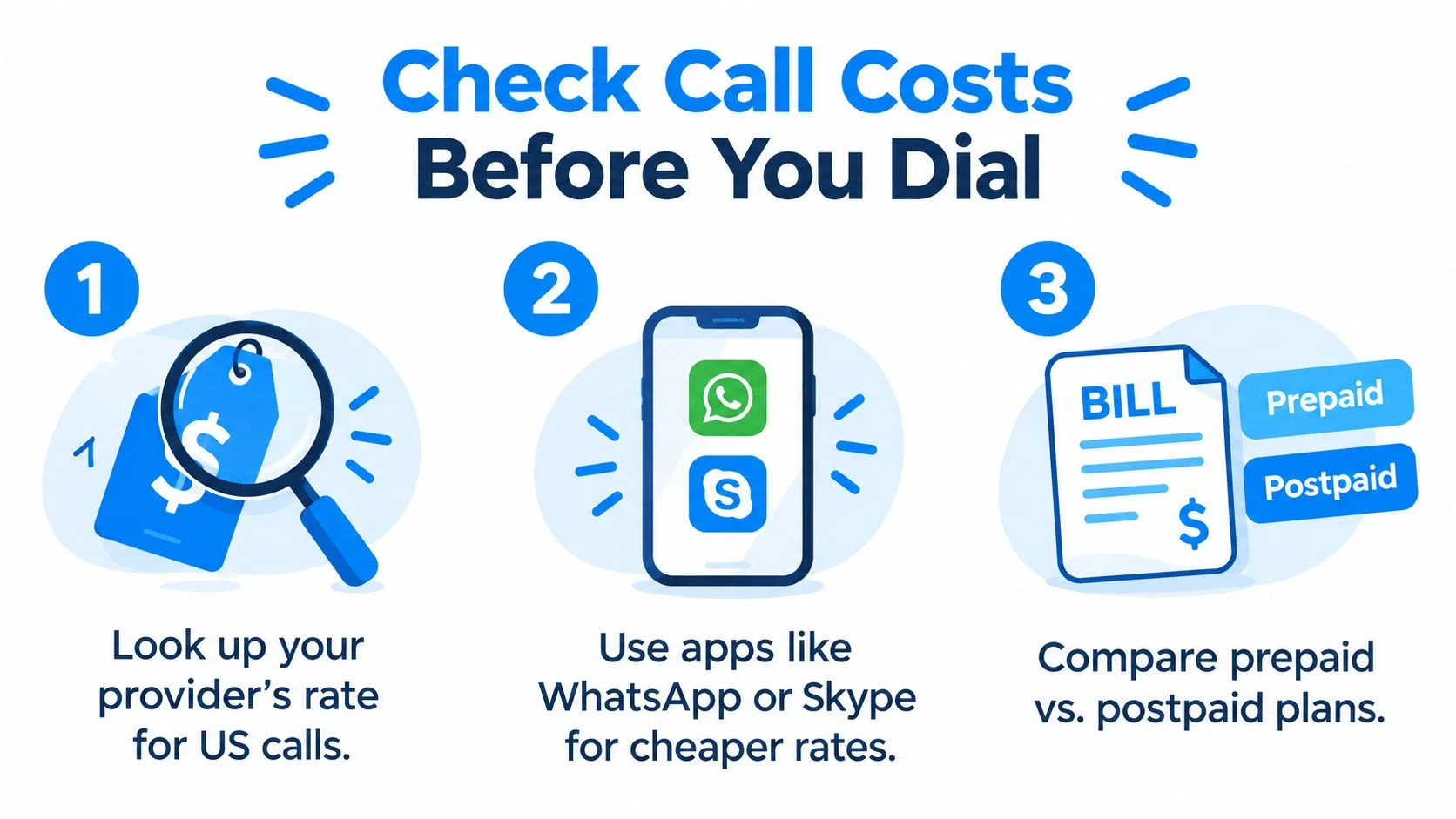
Use the BubblyPhone call cost calculator to estimate a call before you commit. Then confirm the live destination price in the BubblyPhone rates table, since rates can change and the number type affects the result.
Cost and deliverability belong in one check
The lowest displayed rate isn't useful if the recipient doesn't answer. Legitimate international calls entering the US can be affected by gateway attestation and call-labeling rules, which may cause a call to display as “Spam Likely.” (Read about STIR/SHAKEN-related international call labeling)
That problem changes the calculation. If a call concerns a missed delivery, a supplier, a support case, or an urgent family matter, an unanswered cheap call may be less valuable than a slightly different route that the recipient recognizes and answers. Check the rate, use the international number format, call at a sensible local time, and tell the recipient when to expect the call.
Making the Call and Troubleshooting What Goes Wrong
The most reliable workflow is simple: enter +1 plus the 10-digit US number, allow browser microphone access, verify the destination and rate, and use headphones if your surroundings are noisy. If the call connects but the recipient sees “Spam Likely,” the number format wasn't necessarily the problem.
Follow the sequence
- Normalize the number. Convert a domestic US number into +1 XXX XXX XXXX before pasting it into a browser dialer.
- Check the destination. Confirm that the area code and subscriber number are complete, and identify whether the number is geographic or toll-free.
- Review the price. Check the live rate for that exact destination before starting the call.
- Allow microphone access. If the browser blocks the microphone, open the site permissions and allow microphone use, then reload or restart the call.
- Reduce audio problems. Use headphones in a noisy room and check that the correct microphone is selected.
Microphone permissions are a common browser failure point, while a bare 10-digit number can be rejected when the system needs an international destination. If the call reaches the US but shows as spam, explain the expected call to the recipient in advance and consider a follow-up message through an existing trusted channel.
A browser-based calling option can connect directly to US landlines and mobiles. The caller needs only a compatible browser, and the person receiving the call doesn't need an app or account.
Make your Spain-to-US call with BubblyPhone, directly from any browser to a US landline or mobile. The recipient needs no app or account, and credits start at $5 and never expire.