Calling Cards for India from USA: A 2026 Guide

Table of Contents
- A corridor built over decades
- What matters before you buy
- The three-step card workflow
- Why routing matters
- Four charges that change the result
- Worked examples without fake precision
- Mobile numbers
- Landlines and area codes
- Mistakes that cause failed calls
- The trade-offs in plain language
- The browser advantage for ordinary phone numbers
- Improve the first-call experience
You're trying to call family in India from the USA, and the advertised rate looks excellent until the call connects, the balance drops, and you realize the cost was much higher. Calling cards for India from the USA still work, but they're a legacy product class. For most short, frequent calls to Indian mobiles and landlines, the smarter question is what you pay per connected minute after fees, rounding, and expiry, not which card displays the lowest headline rate.
Why Calling India From the USA Is Still Big Business
A first-generation Indian American in New Jersey might still grab a prepaid card from a grocery store before calling her grandmother in Pune on her birthday. The first call drops. She dials again, gets through briefly, and then watches the balance vanish faster than expected. The problem isn't that the corridor lacks demand. The problem is that an old billing model can hide the cost of serving that demand.

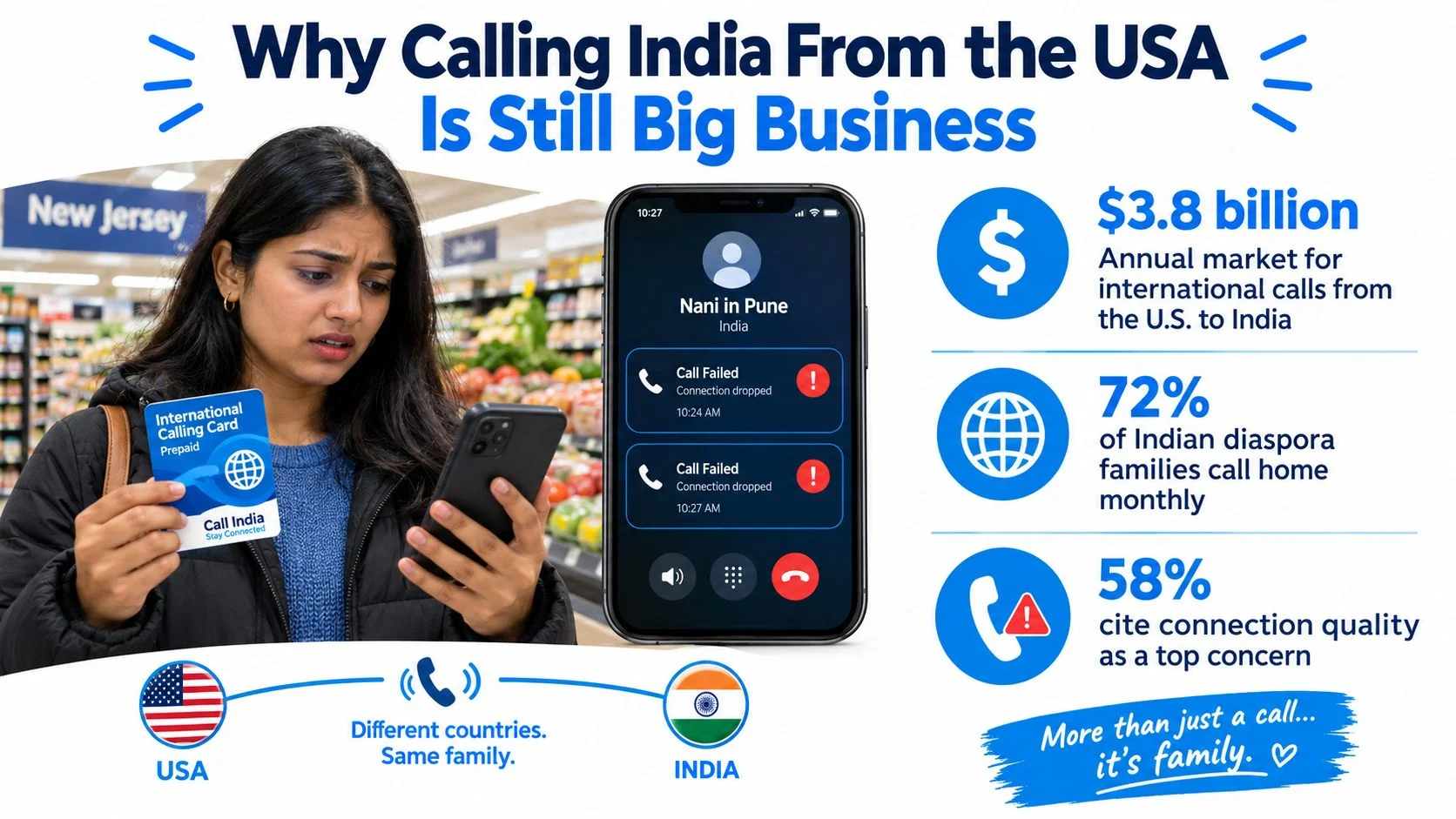
The USA-to-India route is structurally important because migration, education, employment, family support, and business all keep it active. The United States supplied 27.7% of India's inward remittances in FY2023-24, ahead of the UAE at 19.2%, the UK at 10.8%, Saudi Arabia at 6.7%, and Singapore at 6.6%, according to reporting on India's remittance corridor. The same source reports that Indian diaspora transfers reached 135.46 billion in FY25**, while earlier RBI-era data recorded nearly **13 billion from the United States in 2012.
A corridor built over decades
Voice demand arrived long before modern browser dialers. A historical summary reports that calls from the United States to Indian destinations grew from 59 million minutes in 1991 to 1.4 billion minutes in 2001, a 2,349% increase over that decade, as documented in the historical account of USA-to-India calling growth. An ITU-linked case study also recorded 445 million incoming minutes from the United States to India in 1997, including 14% refile traffic and 25% call-back traffic, evidence that the route already supported complicated resale models in the 1990s.
The market then moved from operator-assisted long-distance calling to prepaid cards, access numbers, PINs, mobile dialing, and internet-based calling. Each change reduced some friction, but it also created new billing and routing questions.
What matters before you buy
A calling card can still make sense when the caller has limited internet access, needs a conventional phone path, or wants a prepaid method that works from a basic handset. It's a poor fit when the caller makes brief family check-ins and gets charged a connection fee on every answered call.
This guide focuses on four practical questions: how calling cards work, what they really cost, how to dial India correctly, and whether browser calling fits better than cards or app-to-app calls.
How Calling Cards Work
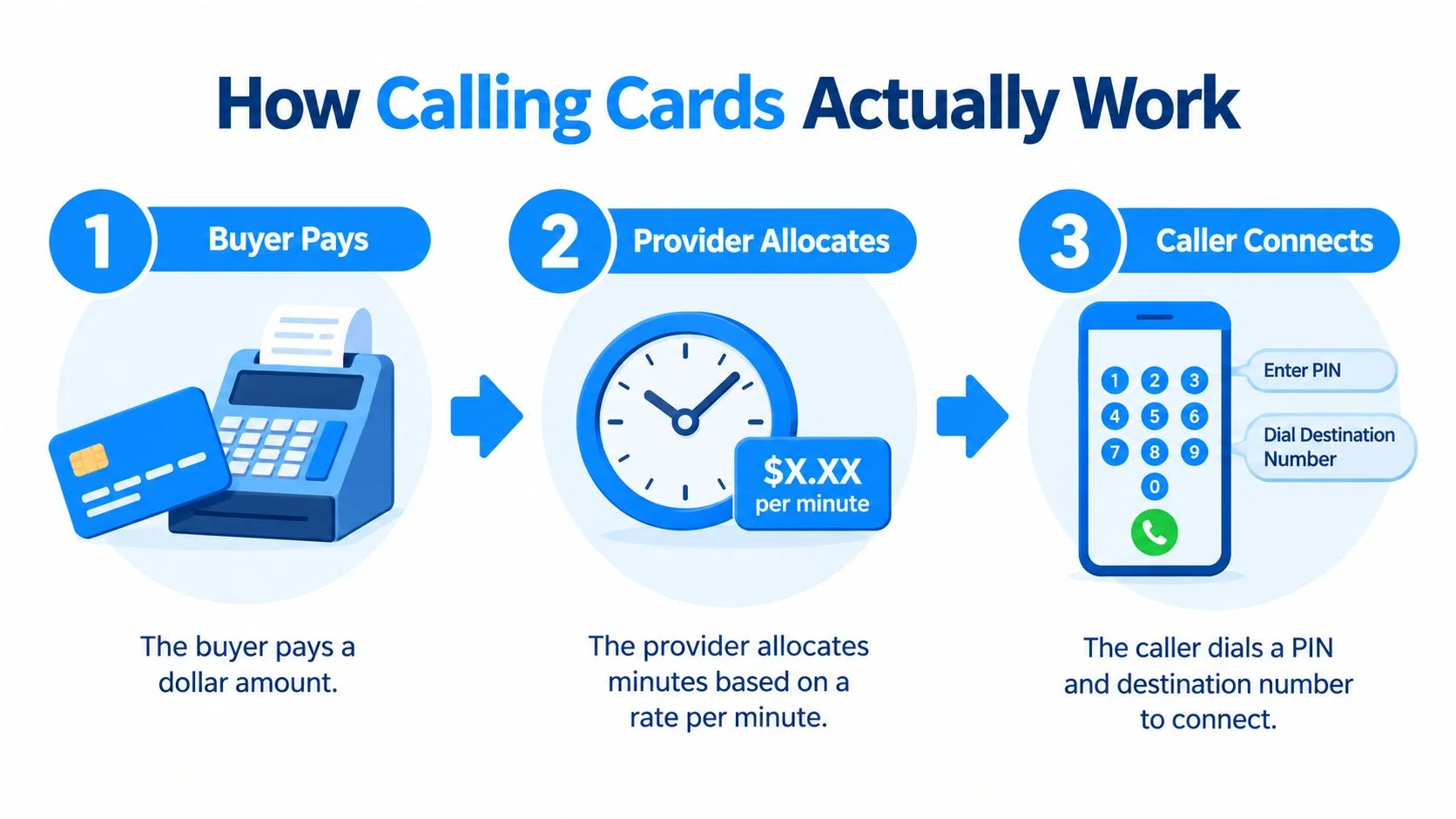
A traditional calling card has three parts: prepaid credit, a PIN, and a US access number. You pay first, authenticate through the access system, then enter the Indian destination number. That model still works, but it belongs to the legacy calling-card category and adds steps that browser calling removes.
The three-step card workflow
- Buy prepaid credit. You pay a dollar amount at a retail outlet or online checkout. The card or digital receipt usually includes the balance and a PIN, printed on the card, shown on the receipt, or sent by email.
- Call the access number. From a US landline or mobile, dial the card's US-based access number. An automated prompt requests the PIN, linking the session to your prepaid balance.
- Enter the Indian number. Dial the international destination in the required country-code format. The service routes the call through its voice network to an Indian mobile or landline and deducts credit while the call remains connected.
The sequence looks simple on paper. In practice, the caller must find the correct access number, enter an intact PIN, listen through prompts, and work out why credit changed after a failed or very short call. A card is convenient only when each step works cleanly.

Why routing matters
Calling a regular Indian phone number differs from an app-to-app internet call. India's regulatory framework covers international calling-card access and access charges, while its historic VoIP rules distinguish internet telephony from PSTN interconnection. A service terminating on an Indian mobile or fixed network therefore needs lawful international termination, compliant numbering, and suitable call routing, as outlined in India's calling-card regulation_legal_vetted.pdf).
For a fuller explanation of the traditional model, see this guide to international calling cards. The practical point is clear: the access path, caller ID presentation, and termination route affect the experience, not only the advertised price.
A browser dialer combines the three card steps into one workflow. Choose the destination, enter the number, and click call. The PIN, access number, prepaid account, and route selection are handled online. The recipient needs no app or account, because the call reaches a normal Indian landline or mobile number. For short, frequent family or business check-ins, that simpler path is usually a better fit than a legacy card.
What an Advertised Rate Doesn't Show
A card advertising a low USA-to-India rate can still cost more than expected once the call connects. Judge it by the effective cost per connected minute, not the headline number. For each call, account for connection fees, whole-minute rounding, maintenance charges, and credit expiry before deciding whether the card suits your calling pattern.
Four charges that change the result
A card may apply a per-call connection fee when the recipient answers. That fixed charge affects short calls most because it is spread across only a few connected minutes.
The billing system may also round each call up to a whole minute or another billing block. A call lasting a few seconds can consume more credit than its duration suggests. Maintenance or weekly surcharges can reduce an inactive balance, and an expiry window can cancel unused credit after a period of inactivity. Consumer guidance on calling-card economics warns that low published rates may be offset by access charges, maintenance fees, and expiry periods ranging from 30 to 90 days in some offers, as explained in consumer guidance on calling-card economics.
Prepaid cards can also include surcharges and minimum charges per call. The FCC's example lists India at 5.00 per minute** for a basic non-plan rate and **0.015 per minute for a lower plan rate. Use its FCC international calling guidance to inspect the full disclosure instead of assuming the first displayed rate applies to your call.
Worked examples without fake precision
You do not need a live destination rate to see how the math works. Let R represent the published per-minute rate and F represent the connection fee. If the service rounds up to whole minutes, calculate:
(F + rounded billable minutes × R) ÷ actual call duration
The fixed fee makes the three-minute check-in disproportionately expensive. A five-minute call spreads that fee across more minutes, and a ten-minute conversation spreads it further. If the call ends just below a whole-minute boundary, rounding raises the billable time before maintenance or expiry enters the calculation.
Short, frequent calls expose the weakness of headline pricing. Several brief family or business check-ins can cost more through repeated connection fees than one longer conversation, even at the same advertised per-minute rate.
Practical rule: Compare the all-in charge for the call length you actually make. Never choose a card from the headline rate alone.
Use the international call cost calculator for a clean estimate, then check the provider's published India rate table before adding credit. Calling cards are now a legacy product class. A browser-based calling service with no connection fee, straightforward billing, and credit that does not expire removes several variables that make cards hard to assess. That model fits short, frequent family and business check-ins to India better than a prepaid card workflow.
Dialing India From the USA the Right Way
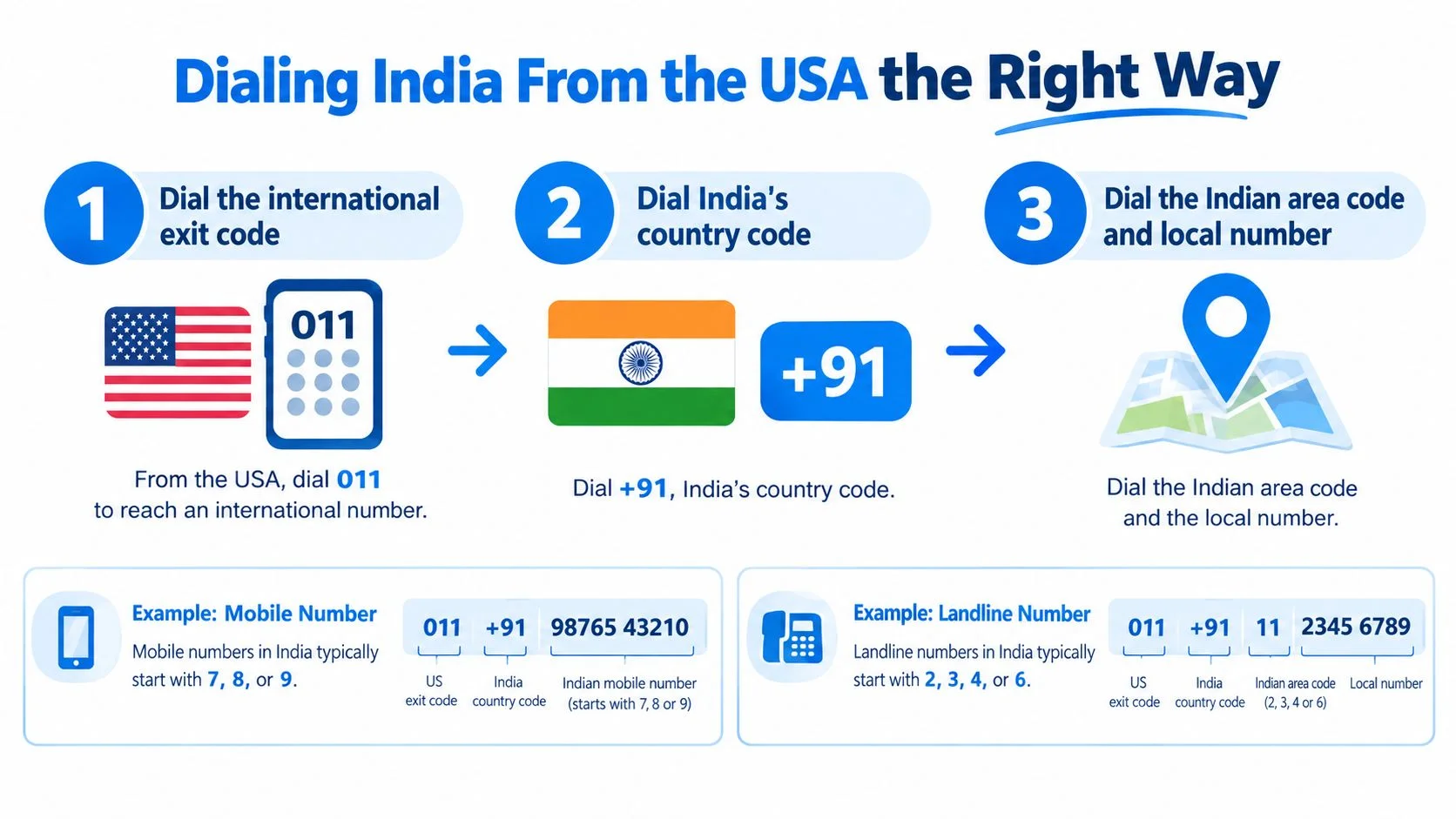
To call India from the USA, use 011 + 91 + the Indian number without its domestic trunk zero, or use +91 directly from a device that accepts plus-format dialing. The recipient's number must remain complete after you remove only the leading domestic zero.

Mobile numbers
India uses a 10-digit subscriber number for both fixed-line and mobile services, excluding the country code, according to TRAI's numbering recommendations. Indian mobile numbers generally begin with 6, 7, 8, or 9. From a US line, the format is:
011 91 XXXXXXXXXX
From a plus-format dialer, use:
+91 XXXXXXXXXX
If the Indian number is written domestically with a leading zero, remove that zero before adding +91. Don't add the US exit code and the plus sign together. Use either 011 or +91, depending on the phone or dialer.
Landlines and area codes
Indian landlines use regional STD codes. Common examples include 011 for Delhi and 022 for Mumbai. When dialing internationally, include the area code but remove the domestic trunk zero if the number is written with one.
India's international numbering plan specifies the country code 91, and the country's international access code is 00, as described in the Department of Telecommunications numbering document. From the United States, however, the outgoing international prefix is 011.
Mistakes that cause failed calls
- Keeping the leading zero: Convert a domestic number into international format before dialing.
- Dropping part of the subscriber number: Indian mobile and fixed-line numbers use the national numbering structure, so check every digit.
- Confusing an STD code with the full number: The regional code is only one part of a landline destination.
- Forgetting 011 on an older phone: Use 011 before 91 when the phone doesn't support plus-format dialing.
- Assuming the first mobile digits identify the current network: Mobile number portability means the prefix may not identify the current operator.
Before launching a call, read the formatted number back against the recipient's saved contact. If you're comparing connectivity while traveling in India, you can also browse India eSIM options. For a concise dialing reference, see how to call India.
Calling Cards vs App Calls vs Browser Calling
For short, recurring calls to Indian mobiles and landlines, browser calling is usually the most practical middle ground. Calling cards work without recipient setup but add PINs, access numbers, and fee complexity, while app-to-app calls are easy only when both people use the same app and have suitable internet access.
The trade-offs in plain language
Calling cards remain familiar. A caller can use a landline or mobile, and the recipient doesn't need a device or account. But the process depends on access numbers and PINs, and a connection fee can distort the rate on a short call.
App-to-app calling removes per-minute phone charges when both parties use internet data, but it creates a dependency chain. The recipient must be online, use the same app, keep the app installed, and accept the call through that service. That's a poor fit for an older relative with a basic mobile phone or a family member who doesn't want another account.
Browser calling avoids both extremes. The caller needs a browser and an account with prepaid credit, but the recipient receives an ordinary call on a regular mobile or landline. There's no PIN to enter, no access number to remember, and no recipient installation step.
The browser advantage for ordinary phone numbers
Browser calling is especially useful when the caller needs to reach a landline, a mobile, or a person who won't install anything. The caller can check the live rate before dialing, top up a small balance rather than buying a large block of minutes, and monitor the call timer.
The same browser-first thinking appears in business communications. Teams evaluating voice-based AI for service businesses should separate automated workflows from ordinary human calls, then choose a route that matches the contact's device and consent requirements.
BubblyPhone provides browser-based calls to Indian landlines and mobiles, with per-minute billing rounded up to the whole minute, prepaid credits starting at $5, and credits that never expire. Calling doesn't require a subscription, and the optional dedicated-number plan is the only recurring product. Dedicated numbers can receive calls and receive SMS, but they aren't a general outbound texting feature.
A Pre-Call Checklist for Any Method You Pick
Before adding credit or dialing, check the number, effective per-connected-minute cost, balance rules, connection quality, and backup route. This quick review prevents avoidable charges and failed calls.

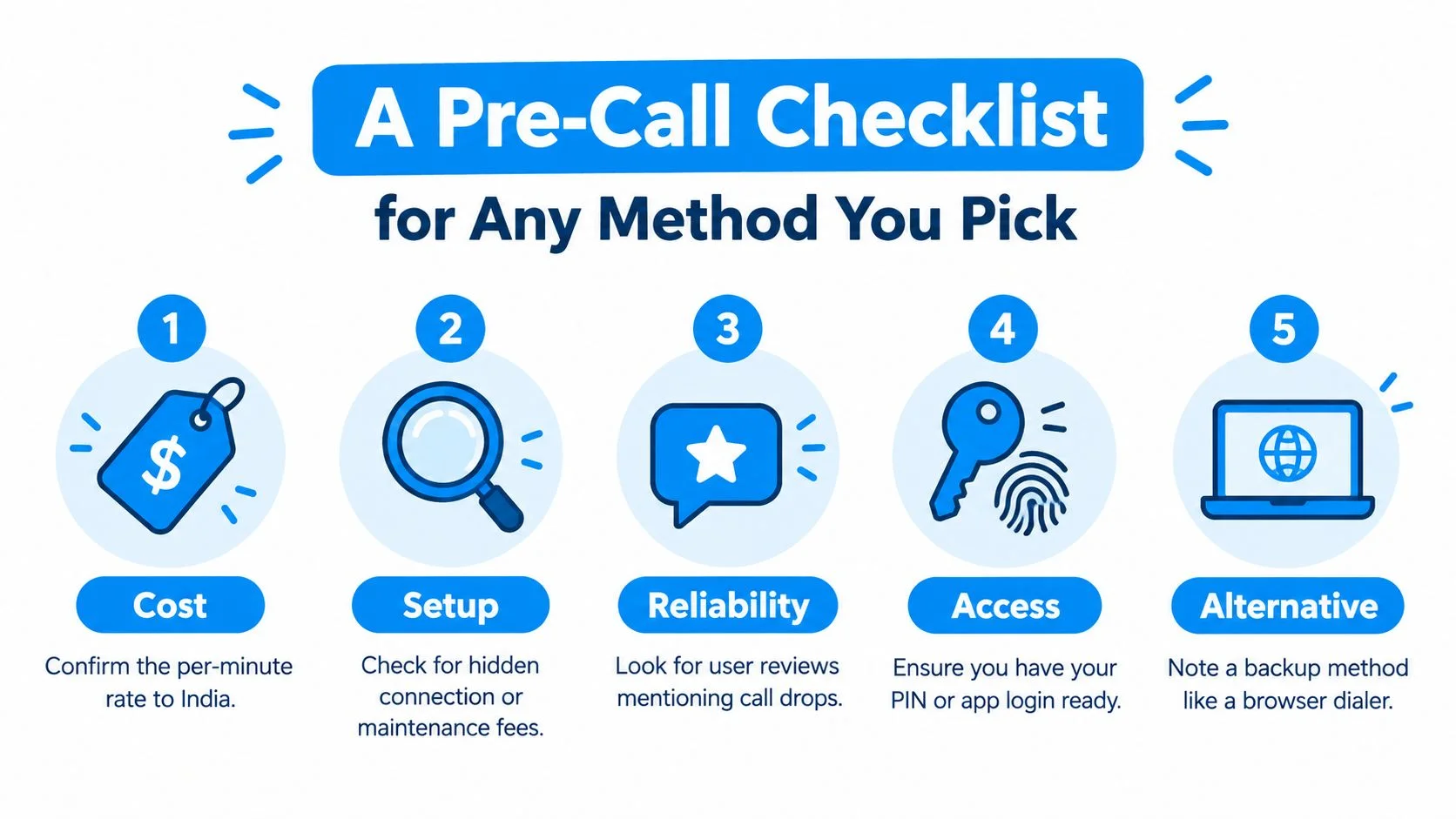
- Format the number: Use 011-91-XXXXXXXXXX or +91-XXXXXXXXXX. Remove the domestic trunk zero, while keeping every valid digit in the Indian subscriber number.
- Check effective cost: Judge the expected connected minutes, not the advertised headline rate. For calling cards, account for connection fees, rounding, maintenance charges, and expiry. For browser calling, check the published rate table immediately before dialing, since live rates can change.
- Inspect the credit: Confirm that a card balance has not expired and that digital credit appears after a top-up. Add only what you expect to use.
- Test the route: Make a short call before a longer family or business conversation. Check for delay, echo, clipping, and one-way audio. A brief test exposes route problems before they consume paid minutes.
- Prepare a backup: Use stable Wi-Fi or a reliable wired connection for browser and app calls. Keep the handset charged for PIN entry, and save another recipient number in case the first route fails.
Choose based on actual calling habits. Short, frequent check-ins need transparent connected-minute billing more than a dramatic card rate. If the recipient uses a basic phone, direct phone termination matters more than app features. Calling cards remain useful for simple access, but browser-based calling fits regular family and business calls when you need flexible credit and a clear cost check.
Making Your First Call to India From a Browser
You can place a first browser call to India after a short setup. Create and verify an account, add prepaid credit, check the current rate, then dial the recipient's Indian number. The person answering needs no app or account.
Start with a small balance and review the published rate immediately before dialing. Credit begins at $5. Calls are billed by the minute and rounded up to a whole minute, with no subscription required. Judge the likely connected-minute cost, not just the displayed rate.
Enter +91 followed by the 10-digit subscriber number. Check every digit before calling. A formatting mistake can block the connection or send it to the wrong destination. After connection, watch the timer so you can see how usage is measured.
Improve the first-call experience
Use a reliable Wi-Fi connection and a good headset. A wired headset can reduce microphone trouble, and muting while silent helps control background noise at home or work.
Choose a time when both people can speak without rushing. Keep a backup number available, then begin with a short test call. Confirm that your family member or business contact hears you clearly before starting a longer conversation. This simple check can expose delay, echo, clipping, or one-way audio early.
Browser calling suits short, frequent family and business check-ins because you set it up once while the recipient answers like a regular phone call. It also makes the effective cost easier to review before each call. Check the live rate, add only the credit you expect to use, and test the route first.
BubblyPhone lets you call Indian landlines and mobiles directly from a browser. The receiving person does not need an app or account. Credits begin at $5 and do not expire, so check the live rate and make your first call with BubblyPhone when you are ready.