Best Time to Call Clients: 7 Windows Across Regions

Table of Contents
You've got a quote ready, a client in another country, and it's 9 a.m. where you sit. The best time to call clients is a time that works in their local business day, not yours. At 9 a.m. your time it could be lunch, the end of a shift, or 9 p.m. where they are, so a good message still lands badly.
Why the Same Call Lands Differently at 9 a.m. and 9 p.m.
A 9 a.m. call reaches a desk with the day's priorities still open. A 9 p.m. call reaches a kitchen table, a train carriage, or a phone left face down. That gap is why outbound teams that build sales development services around the recipient's clock rather than their own get more conversations from the same list.
Each of the seven windows is set by the recipient's local clock and tied to a client type and region, and each carries a trade-off: a window that suits a German supplier won't suit family in Manila or a buyer in Brazil. Two constraints cut across all of them, how far the zones overlap and the local rules on when you may call. Pick the window that matches the person, run it for two weeks, and keep notes by country and role.
1. Early Morning Business Window (8:00–10:00 Recipient Local Time)
Call between 8:00 and 10:00 recipient local time when you need a decision-maker before meetings fill the day. This suits B2B suppliers, distributors, and service providers in Europe, the Middle East, and Africa, where the first desk hours are often the clearest.
Say a Dubai-based importer calls German suppliers at 8:30 local time to confirm container dates before production shifts start. A London procurement team does the same with Singapore vendors at 8:00 Singapore time, using the morning overlap before both sides get pulled into internal meetings. You're catching people at their desks, but you're also competing with overnight email and urgent operational work, so keep it short.
Seniority changes the math here. The CallingAgency analysis by industry notes finance and insurance contacts tend to be more reachable around 8:30–10:00 a.m. and senior executives may answer early, around 7:30–9:00 a.m. That doesn't make early morning right for everyone. Mid-level staff who start with team stand-ups often won't talk properly until later.
How to Use This Window Without Wasting It
- Convert first: Check the recipient's zone before you dial, and use the free Best Time to Call tool to confirm a suitable window by country.
- Keep it under five minutes: Confirm one decision, then book a fuller follow-up for mid-morning.
- Staff it properly: If volume is growing, hire cold callers who can work to the recipient's hours instead of forcing one shift to cover every market.
The trade-off is simple. You get access, but not always attention, so don't try to run a full negotiation in this slot.


2. Mid-Morning Decision Window (10:00–11:30 Recipient Local Time)
A renewal clause that needs a considered answer rarely gets one at 8:45. By 10:00 recipient local time, mid-level managers and office-based clients have cleared the stand-up and the overnight inbox, and the desk is theirs until lunch starts pressing on the calendar.
That makes this the most reliable default window for negotiations, account reviews, and any question where you need a considered answer rather than a reflex. It is also the window where people will open the contract on screen while you are still talking.
Evidence supports the slot. A 2026 review citing Gong's analysis of roughly 100,000 connected business-to-business calls, published in the CallingAgency cold calling statistics review, found 10:00–11:00 a.m. in the prospect's local time outperformed other periods repeatedly. Urgent morning work is handled by then; lunch and afternoon meetings have not taken over.
Cross-border teams pay for this window in their own hours. A customer success team in Toronto calls UK clients at 10:30 UK time to review renewal terms with contracts open on both sides, which is 5:30 a.m. in Toronto. An export manager in Shanghai calling Brazilian buyers at 10:00 Brazil time is working at 21:00 Shanghai. Someone on your side usually has to flex.
Practical rule: If you can only test one business window first, test this one, and measure answer rate separately from meeting rate. A high answer rate with no booked follow-up means you are reaching people who cannot decide.
Send a short calendar invite the day before so the client expects the call. Have invoices, contracts, or product specs open before you dial, because this is the window where people work through detail line by line.
Confirm the working day as well as the hour. Friday and Saturday form the weekend in Saudi Arabia, the UAE, Kuwait, Qatar, Bahrain, Oman, Egypt, Jordan and Israel, and Bangladesh and parts of Malaysia and Indonesia follow the same pattern. A Tuesday for you can be an ordinary working day for them; a Friday call cannot.


3. Post-Lunch Callback Window (13:30–15:00 Recipient Local Time)
A Mexico City logistics desk calls US freight clients at 14:00 Eastern to confirm delivery windows. The clients have just returned from lunch, their inbox is still quiet, and the call has one clear purpose. That is the post-lunch callback window in practice: 13:30 to 15:00 on the recipient's clock, used for return calls and short check-ins rather than fresh pitches.
Use it when the client is in Southern Europe or Latin America, where lunch breaks often run long and a noon call goes nowhere. Don't force the lunch hour. The Gangly sales call statistics synthesis advises suppressing calls during 12:00 to 14:00 local time for international outreach. A separate large dataset summarized in the Allo cold calling statistics review found 11:00 a.m. to 4:00 p.m. produced consistent 27% to 28% hourly connection rates. Early afternoon is steady, not peak. That is enough for a callback, not for a negotiation.
A Spanish hotel group calls UK travel agents at 13:45 UK time to confirm group bookings, timing it for when agents are back at their desks. Both callers name the voicemail, order number, or booking in the first sentence. The client should not have to reconstruct context.
Keep Post-Lunch Calls Tight
- Skip 12:00 to 13:00: Avoid this hour in Spain and parts of Latin America, and push later if lunch runs longer locally.
- Lead with the reference: Name the voicemail, order number, or booking you sent that morning.
- Ask one or two questions: Save detailed reviews for mid-morning, when energy and time are better.
You will reach people in this window, but you will not close a decision that needs contracts open and three people in the room. Book the callback, confirm the next step, and move the detailed review to a morning slot.
4. Late Afternoon Close Window (15:30–17:00 Recipient Local Time)
A Canadian software vendor calls Indian clients at 16:00 IST to confirm contract signatures before the weekend. A German machinery exporter calls Turkish buyers at 16:30 local time to finalize shipment paperwork while finance staff are still in. Both send a written summary right after hanging up, so the agreement doesn't drift overnight.
The 15:30–17:00 recipient local time slot exists for exactly that work: closes, same-day approvals, and paperwork that cannot wait until tomorrow. Final orders, signatures, dispatch confirmations. People still at their desk at this hour have usually cleared the day's queue, so they pick up ready to decide rather than ready to defer.
Where the peak falls inside the window moves by market. A SalesHandy best time to cold call analysis of 7,699 sales calls identified 4:00–5:00 p.m. as the strongest hourly window in the prospect's local time, with its 4:00–6:00 p.m. Eastern block reaching connection rates of 50.7% and 53.7% in the two highest-performing hours. Treat that as directional for your list, not a guarantee.
Don't schedule an important close after 17:00 local time unless the client confirmed they're available. An answered call from someone rushing out rarely closes anything.
The trade-off here is thin margins. If your contact needs a signature from someone who left at 16:30, or wants a colleague to read the clause first, you have no daylight left to recover. Put the call at 15:30 when the decision needs one hop through another desk, and at 16:30 only when the approver is the person who answers.
Watch Friday carefully in this slot. Shortened Friday schedules, leave, and local holidays can empty an office by mid-afternoon. Check the calendar for that country before you attach a deadline to a Friday close. If the Friday window collapses, Monday morning in their time zone is the safer shoulder.


5. Evening Family Window (18:00–20:30 Recipient Local Time)
A family in Toronto calls parents in Manila every Sunday at 19:00 Manila time. That is 07:00 Sunday in Toronto, and the caller sets an alarm for it. The slot survives because both households plan around it: the Manila side knows the call lands after church and before lunch, the Toronto side knows Sunday morning belongs to it.
That is the mechanism behind 18:00 to 20:30 recipient local time. People are home from work, dinner is underway or finished, and no one is squeezing you between meetings. A diaspora community organizer in London schedules monthly family calls to Lagos at 19:30 local time for the same reason. The fixed time matters more than the exact minute, because relatives can plan around school runs, prayer, and household routines.
Business benchmarks don't map neatly onto home life. Office data on connect rates assumes a workday, a desk, and a professional reason to answer. At home, permission and habit do the work instead. Agree the slot in advance, test early evening against a weekend morning, and adjust for the household rather than copying a sales window. The guide to the best way to call family abroad covers the practical setup for these regular calls.
Make the Evening Slot Reliable
- Fix a weekly time: Relatives answer more often when the call is expected, and a standing slot takes the negotiation out of every week.
- Recheck daylight saving: A one-hour clock change at your end moves the call. The Toronto caller who misses the November shift rings Manila at 20:00 instead of 19:00, which is late enough to collide with a weekday-style bedtime.
- Use live AI translation if needed: It helps when a family member is more comfortable in another language.
Evening is relaxed time and private time, and the second half is what callers forget. A call that opens at 18:45 and drifts to 21:10 has already left the window. Children are in bed, the person you reached is watching the clock, and the conversation you wanted becomes a promise to talk next week.
6. Weekend Morning Personal Window (Saturday 10:00–12:00 Recipient Local Time)
A remote worker in Berlin dials a sister in Sydney at 10:00 Saturday Berlin time. It is Saturday evening in Sydney. Both sides know that before dialing, and the call works because it is a planned family catch-up, not a business call squeezed into a weekday. Apply the weekend morning window to the recipient's clock, not yours. Saturday 10:00 to 12:00 recipient local time is for unhurried calls with friends and extended family, plus pre-agreed urgent matters for travelers and remote workers whose contacts are unreachable during weekday office hours.
Day of week still matters when a call has any business purpose. The Lemlist best time to cold call analysis of roughly 1.9 million calls reported connect rates of 15.2% on Wednesday against 12.1% on Monday, with Tuesday and Thursday in between. That pattern comes from working days and desks. A Saturday morning call reaches someone in a different mode, so use the window for personal calls or agreed urgent items, not cold outreach.
A freelancer in Paris calls a client in a country where Saturday is a working day, but only for urgent, agreed items. Consent changes how the call is received. The same rule applies to family: a short message asking whether Saturday morning still works costs nothing and prevents an awkward wake-up or interruption.
Check the local weekend first: Friday and Saturday form the weekend in Saudi Arabia, Egypt and Israel, while Sunday is the main family day in much of Europe and the Americas.
Keep a shared calendar for contacts in different countries. Note weekend days, holidays and family routines next to each name, and confirm before you call if you haven't spoken in a while.
7. Time-Zone Overlap and Compliance-Aware Calling Window
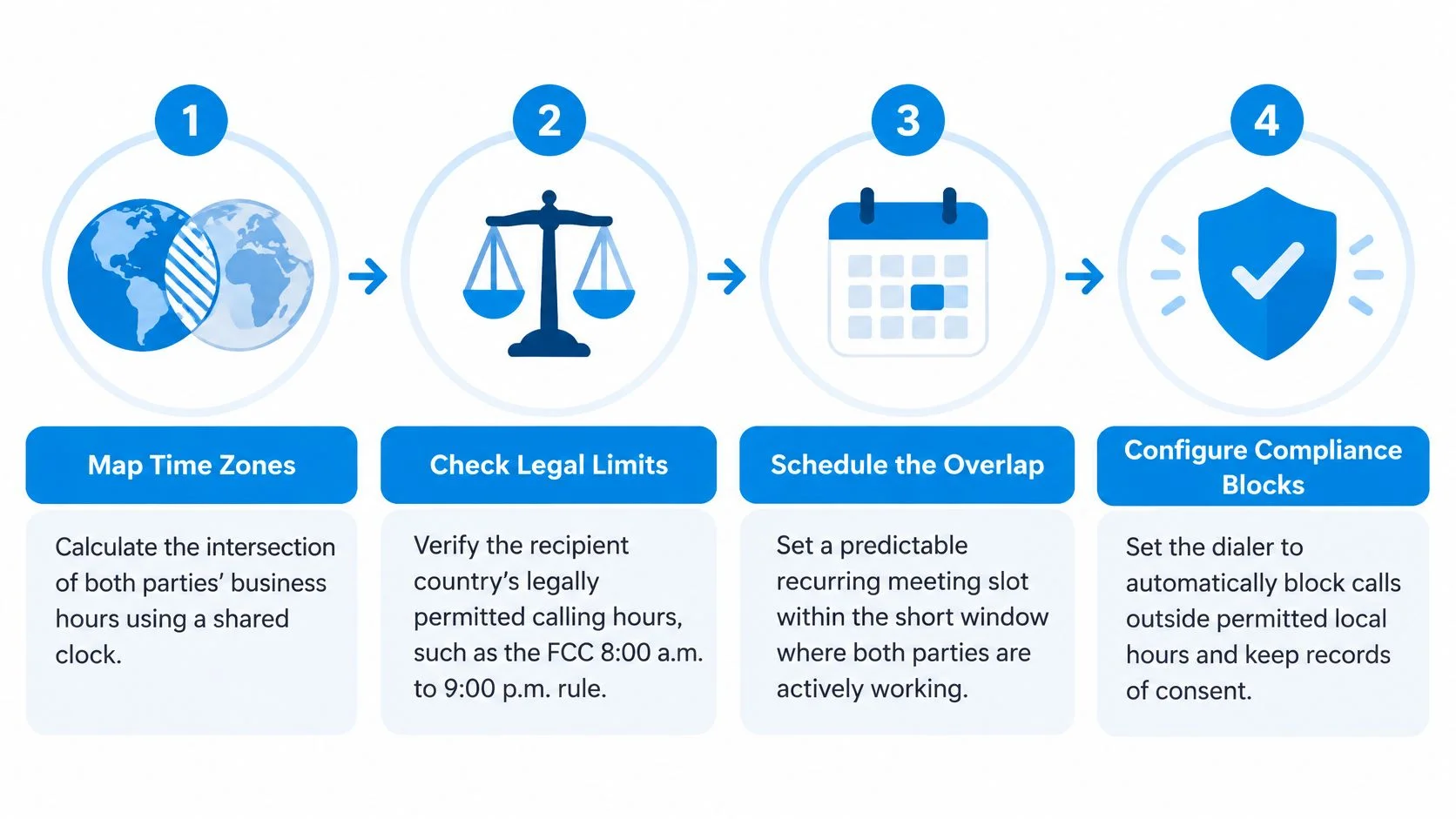
A New York sales team and a Manila supplier protect 20:00 to 21:00 Eastern Time for live calls. That is 08:00 to 09:00 the next morning in Manila, inside business hours for both sides. A Sydney firm and a London client do the reverse, using 07:00 to 08:00 Sydney time to reach London in the afternoon.
Neither pair gets a perfect hour. They get a workable one. Notes and documents move asynchronously before and after, and the live slot handles decisions only.
Compliance Comes Before Convenience
Check permitted calling hours in the recipient's country before you dial, and confirm telemarketing limits with the official regulator for that jurisdiction. An insurance agency in this setup schedules outbound sales calls only between 9:00 and 18:00 in each client's local time, well inside the outer limit, because the safe window is narrower than the legal one.
Apply stricter local limits where they exist. A European subscription company sets earlier evening cutoffs for consumer calls in several member states, because rules vary by jurisdiction, sector, and call type.
Block bad hours in your system. Set your dialer to stop calls outside permitted hours, and keep records of consent and call times.
Map both zones on a shared clock with a BubblyPhone time zone converter for international calls before you set recurring calls. Recheck the overlap every March and October, when many regions change clocks, and treat urgent support as a separate case with its own consent.

How the seven calling windows compare
Missed connections usually come from the wrong window, not the wrong message. Use the recipient's local time to pick one row, run its check, then keep or move the slot.
Pick One Window, Test It for Two Weeks, Then Adjust
Pick the window that matches your client's local day, log results for two weeks, and move the slot if it underperforms. No single best time to call clients exists, and acting as if one does wastes credits and goodwill.
Published averages disagree, which is why your own answer rates should decide. The HubSpot State of Cold Calling survey of more than 350 sales professionals found late morning, 10:00–12:00, was the most commonly preferred window among frequent cold callers, selected by 38%. In HubSpot's separate 2025 survey, the HubSpot best time to make a sales call report found 39% of regular cold callers and 30% of daily cold callers identified Tuesday as the best day. Start with Tuesday to Thursday, then let your own answer rates by country, industry, and role decide.
Speed overrides the calendar when someone asked you to call. The EnzoDialer cold calling benchmarks summary of the 2007 InsideSales and MIT research reported contact rates dropped more than tenfold after the first hour, so respond immediately to inbound requests and save scheduled windows for planned follow-ups. Planning SDR follow-ups with H2 keeps the sequence on schedule, because a good window on the wrong day of a sequence still underperforms.
Track four outcomes separately for each segment. Log answer rate, qualified conversations, booked meetings, and opt-outs by weekday and local-hour bucket, then compare against a control schedule. Watch the edges too. The Cognism Cold Calling Report 2026, based on more than 200,000 calls, found calls before 9:00 a.m., after 4:00 p.m., and during the 12:00–1:00 p.m. lunch period performed worse in its dataset. The Leads at Scale analysis of 40,000 outbound calls reported peak connection rates of up to 21.4% compared with 6.1% for calls made after 5 p.m.
When you're ready to dial, check the live BubblyPhone rates before you call so the cost is clear first. Calls bill per minute, rounded up to the whole minute, with no subscription required for calling and credits delivered immediately on payment. You can call from a browser, iPhone, Android, tablet, or desktop, and your call history shows each call, its length, and what it cost.
You've picked the window and converted it to your client's local time, so make the call while that slot is open with BubblyPhone, which works in any browser and needs no app or account for the person you're calling on any landline or mobile. Credits start at $5 and never expire, you see the rate before you dial, and there is no subscription to start calling.