How to Dial India from the US: A Practical 2026 Guide

Table of Contents
- Start with the US exit code
- Add India's country code
- Identify the destination
- Remove the domestic leading zero
- Choose a time that works for both sides
- The wrong international prefix
- A stray zero after the country code
- An incomplete or mistyped mobile number
- A toll-free line that doesn't accept international calls
- Audio connects, then drops
You're standing by your phone, ready to call family or a business in India, and the last thing you want is to waste the call on one missing digit. To dial India from the US, enter 011 + 91 + the Indian area code or mobile number + the local subscriber number, or use +91 followed by the complete Indian number on a modern smartphone.
Dialing India From the US in the Next Five Minutes
Dial 011, then 91, then the Indian city or mobile prefix, and finally the local number. For a landline, the pattern is 011 91 [area code] [local number]. For a mobile, use 011 91 [ten-digit mobile number].
On a traditional US handset, open the keypad and enter 011. This tells the phone service that you're placing an international call. Pause briefly if the handset gives you an international dial tone, then enter 91, India's country code. Finish by entering the Indian destination number. Press the call button only after checking the full sequence.
On a modern smartphone, you can usually avoid the exit code by entering +91 followed by the Indian number. To type the plus sign, press and hold the 0 key on most phone dialers. The phone converts the plus notation into the appropriate international access sequence for your location.
Practical rule: Use either 011 91 or +91, never both together. +011 91 is an invalid combination.
For a first call, copy the number into a notes app and compare each group before dialing:
- 011, the US international exit code
- 91, India's country code
- The Indian landline area code or mobile number
- The remaining subscriber digits
The number may look unfamiliar because Indian contacts are often saved for domestic use. A local number can include a leading 0, but that trunk prefix normally needs to be removed for an international call. If your contact is saved as 09876543210, for example, check whether the intended international form is +91 9876543210.
The structure is easier to remember once you know what each group does. The next section breaks down the exit code, country code, area code, and subscriber number using one landline example.
The Building Blocks of an International Call to India
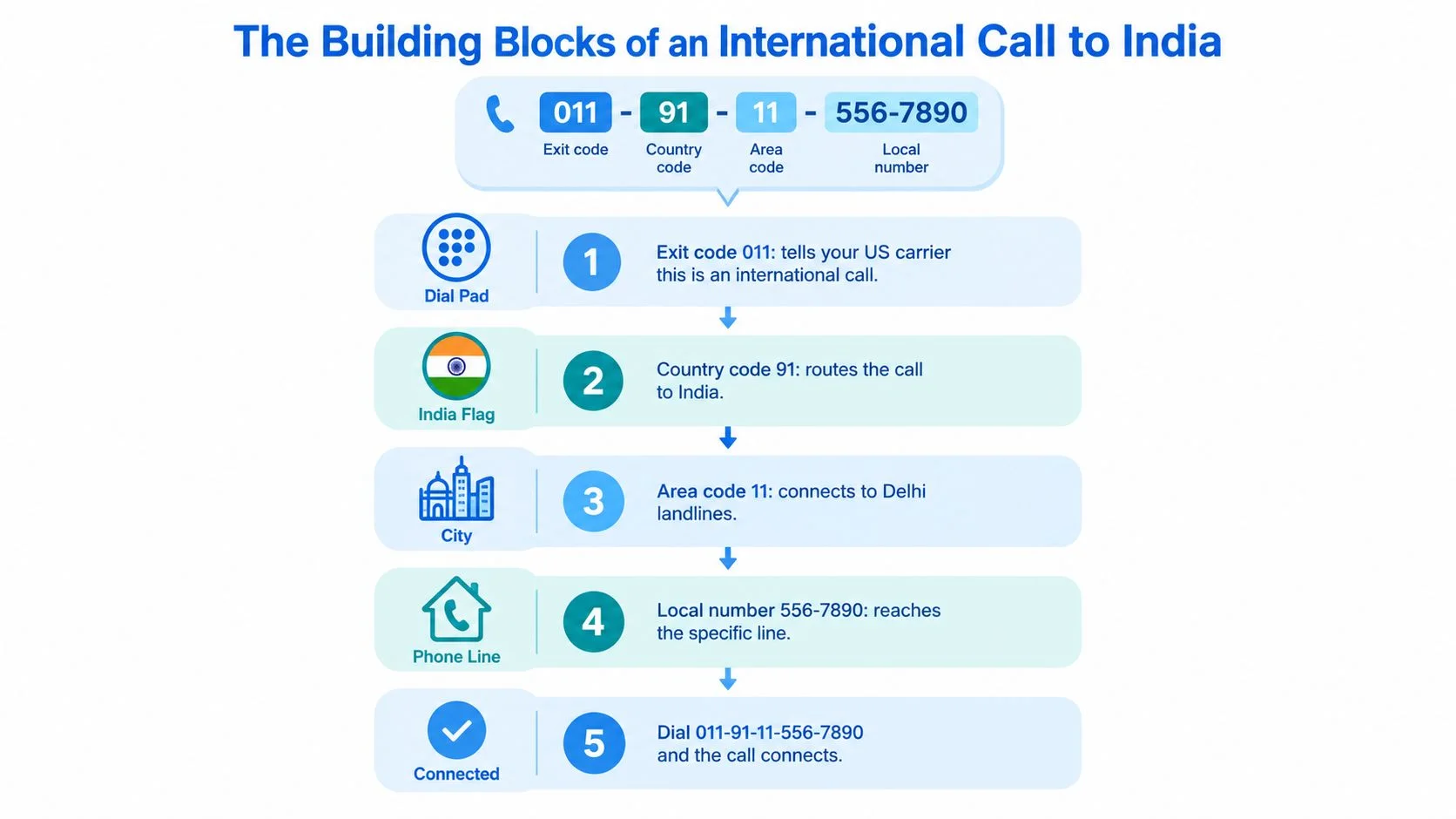
A call to a Delhi landline can be written as 011-91-11-556-7890. Each group has a separate job, so you can diagnose a failed call by checking the groups one at a time.

Start with the US exit code
011 tells the US phone network that the digits following it belong to an international destination. If you're using a smartphone with plus notation, type + instead. The phone handles the international access prefix automatically, so the same example becomes +91 11 556 7890.
Add India's country code
91 routes the call to India. It doesn't change based on the US state you're calling from or the Indian city you're trying to reach. India's numbering plan uses national numbers under country code +91, and official telecom material describes fixed-line numbering through the country code, destination code, and subscriber number in its numbering guidance.
Identify the destination
The Delhi landline area code in this example is 11. Landline area codes in India are commonly two to four digits, depending on the destination. After the area code, enter the local subscriber number, here shown as 556-7890.
For a clearer explanation of the country-code portion, use this guide to India's country code. It helps separate 91, which identifies India, from the area code, which identifies a landline destination within India.
Put everything together as 011-91-11-556-7890. If you use the plus format, enter +91-11-556-7890 instead. Don't add an extra plus sign, and don't insert a domestic trunk prefix after 91.
Mobile and Landline Numbers in India
Indian mobile numbers use a complete ten-digit number after +91, while landlines need an area code before the local number. That distinction tells you whether the destination requires a city prefix.
A mobile number normally appears as one uninterrupted ten-digit sequence after the country code. You don't add a city area code to it. The practical format is 011 91 [ten-digit mobile number] or +91 [ten-digit mobile number].
A landline combines a short city or regional code with the local subscriber number. In the example above, 11 identifies the Delhi destination and 5567890 identifies the particular line. India's numbering structure uses ten national digits excluding the country code for both fixed and cellular services, although those digits are grouped differently for dialing purposes.
Remove the domestic leading zero
The most common contact-list problem is a number saved with a leading 0, such as 09876543210 or 011-5567890. That zero is used in domestic Indian dialing as a national trunk prefix. When calling from the US, remove it before adding 91.
So, a mobile saved as 09876543210 becomes +91 9876543210. A Delhi landline saved domestically with its trunk prefix should be checked carefully, because the local format and area code may be combined in the contact entry.
The plus sign replaces 011, but it doesn't change the Indian digits that follow it. Whether you're calling a Mumbai mobile or a Bengaluru landline, use one international access method, remove the domestic trunk zero, and preserve the actual destination digits.
Toll-Free Indian Numbers and What They Actually Cost From the US
An Indian number beginning with 1800, 1860, or a 1300-prefix range isn't automatically free for someone calling from the United States. Toll-free treatment generally applies within the domestic numbering arrangement, while an international route may charge the US caller for connecting to that destination.
India's numbering framework covers special services, including toll-free and Intelligent Network services, alongside ordinary telephone services, as described in official telecom recommendations. The important practical point is that a domestic toll-free label doesn't guarantee free international access.
The dialing sequence still begins with the US exit code and India's country code. If the destination is represented as an Indian number, enter 011 91 followed by the service number, unless the organization gives separate international instructions.
Don't assume an advertised “free” line will connect without charge. Before calling, check the destination's international calling information or enter the full number into BubblyPhone's free-call-to-India guide and verify how the number is treated from abroad.
Some businesses publish a toll-free number for callers inside India but don't accept international traffic on it. Others redirect calls to a chargeable service or a premium-rate route. If the company offers a standard international number, that may be the more predictable option.
Checking Rates and Picking the Best Time to Call India
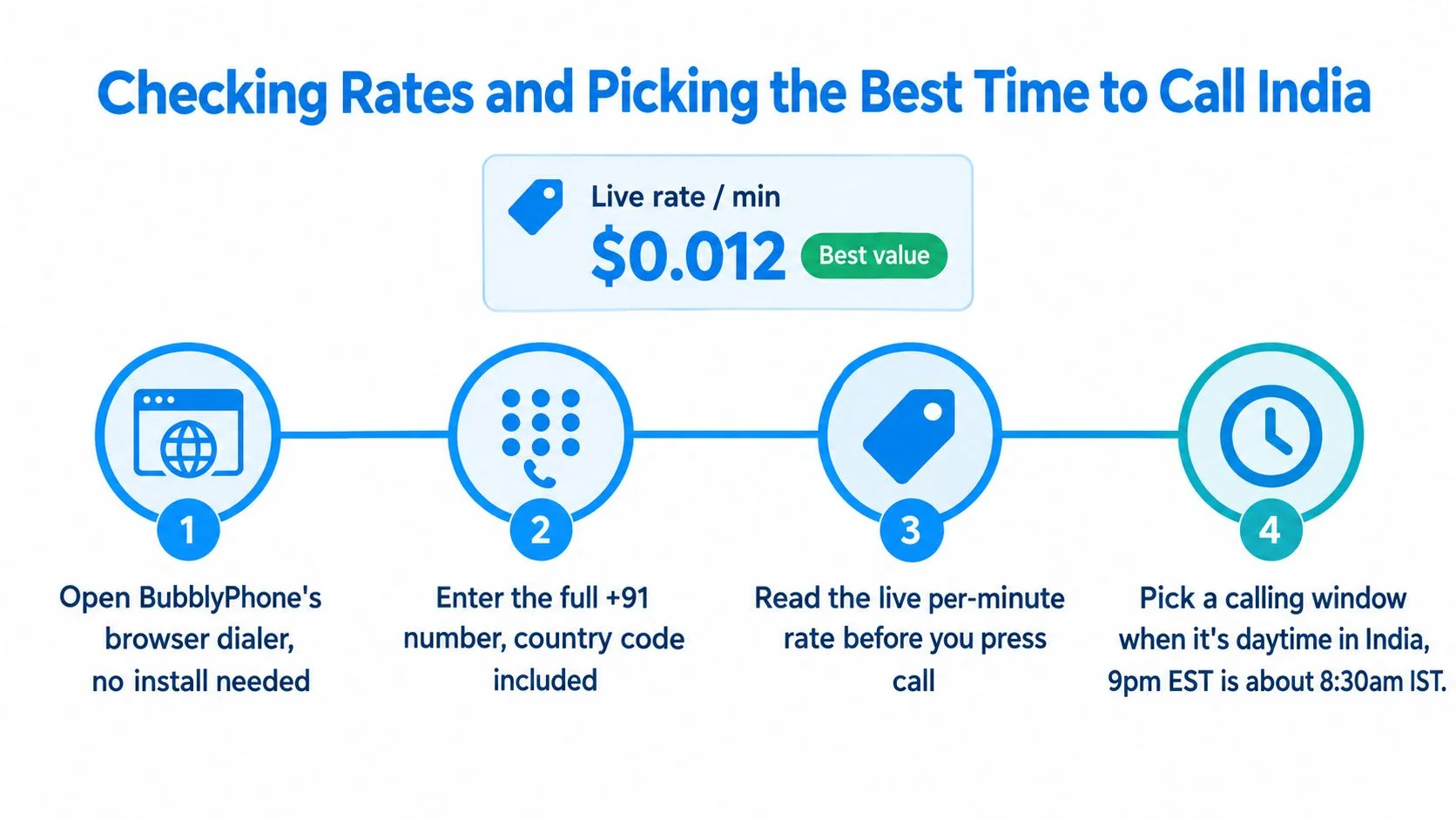
Check the cost and the time zone before pressing call. Open BubblyPhone's browser dialer, enter the complete +91 number, and read the live per-minute rate shown before connecting.
The displayed rate is the useful number to trust at that moment because international pricing can vary by destination type and network route. Calls are billed by the minute and rounded up to the whole minute, so a short call can still occupy a full billing minute. Credits start at $5 and never expire, and calling doesn't require a subscription.
Use the call cost calculator when you want to check a destination before opening the dialer. Enter the number exactly as it should be dialed, including +91, and confirm whether it is a mobile, landline, or special-service destination.
Choose a time that works for both sides
India is 9 hours and 30 minutes ahead of Eastern Time. That means 7:00 AM in New York is 4:30 PM in Mumbai. A US morning call may reach India during the afternoon, while a US evening call can arrive during India's late night or early morning.
For many families and teams, 8:00 PM to 11:30 PM India time is a comfortable overlap because it falls during a more usable part of the day for the Indian recipient and may align with morning or daytime hours in the US. Always check the recipient's city and local schedule rather than relying only on the clock.
Weekends and Indian holidays, including Diwali and Republic Day, can change availability and demand. If a call connects poorly during a busy period, try another time instead of assuming the number is wrong.

Troubleshooting Calls That Will Not Connect
Most failed US-to-India calls come from formatting errors, an unsupported service number, or an unstable route. Check the number from left to right before changing phones or repeatedly redialing.
The wrong international prefix
If your smartphone already expects a plus-formatted number, adding 011 manually can create a double exit sequence. Use 011 91 on a conventional international dialing screen, or use +91 on a smartphone. Never combine them.
A stray zero after the country code
A contact saved for domestic Indian dialing may include a leading 0. Strip that zero before adding 91, then compare the result with the original contact so you don't remove a genuine subscriber digit.
An incomplete or mistyped mobile number
Indian mobile numbers should contain ten digits after the country code. If the entry is shorter, longer, or split strangely, don't guess the missing digit. Ask the recipient to resend the number in international format, or use a number lookup before spending credits on a test call.
A toll-free line that doesn't accept international calls
An 1800 or 1860 prefix may be free only for domestic callers. Check whether the organization publishes an international alternative and confirm the applicable rate before dialing.
Audio connects, then drops
A call can connect but lose audio when the route is congested or lacks enough capacity at that hour. First check your Wi-Fi or mobile signal, then try again at a different time or choose a higher-priority route inside the calling service if that option is available.
Before redialing: Confirm the number format, verify the destination type, and check the live rate. Repeating the same malformed number won't improve the result.
Your Pre-Call Checklist and the Simplest Way to Call
Use one short routine every time: confirm the number, remove the domestic zero, identify the destination type, check the rate, check India's local time, and then dial. This prevents a misdial from becoming a paid call.
- Confirm the full number. Build it as 011 + 91 + area code + local number for a landline, or 011 + 91 + ten-digit mobile number for a mobile. On a smartphone, use the equivalent +91 format.
- Strip a stray leading zero. Remove the national trunk prefix from a domestically stored Indian contact before adding the country code.
- Identify the line. A fixed line needs its area code and local subscriber number. A mobile uses the full ten-digit mobile number after +91.
- Check special-service status. If the number begins with 1800, 1860, or a 1300 range, verify that it accepts international calls and that the expected charges are clear.
- Check the clock and connection. Call during a reasonable local hour in India, then use stable Wi-Fi or a strong mobile signal.

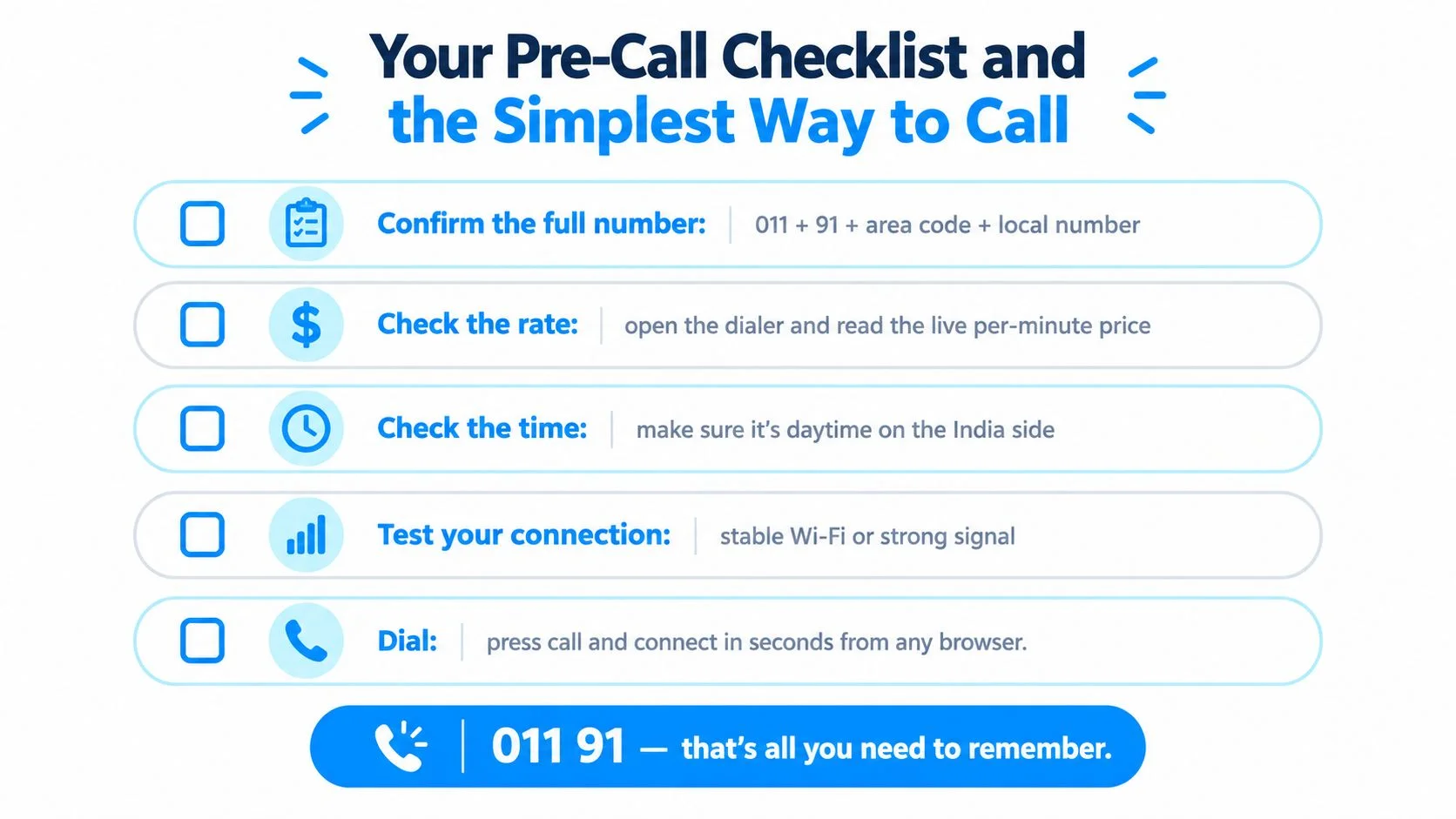
BubblyPhone lets you apply the routine from a browser by entering the number with +91, viewing the live per-minute rate, and placing the call without retyping the full 011-91 sequence. The recipient doesn't need an app or account, and the service can call regular Indian landlines and mobile phones.
There's no subscription for ordinary calling. Prepaid credits are billed per minute and rounded up to the whole minute, while the optional dedicated-number plan is a separate recurring product for receiving calls and SMS.
Make your next India call with BubblyPhone from any browser, whether the recipient uses a landline or mobile. You don't need to install an app, and the person you're calling needs no app or account, while credits start at $5 and never expire.