That is the advice you get from basically everyone when you mention calling family abroad. And look, it is good advice — sometimes. WhatsApp works great when both people have smartphones, decent internet, and the app installed.
But what about grandma's landline in the village? What about your uncle who still uses a flip phone? What about when the internet connection on the other end is so bad that WhatsApp sounds like you are talking through a tin can underwater?
Those are the situations nobody talks about. And they are exactly when you need a real solution for calling abroad.
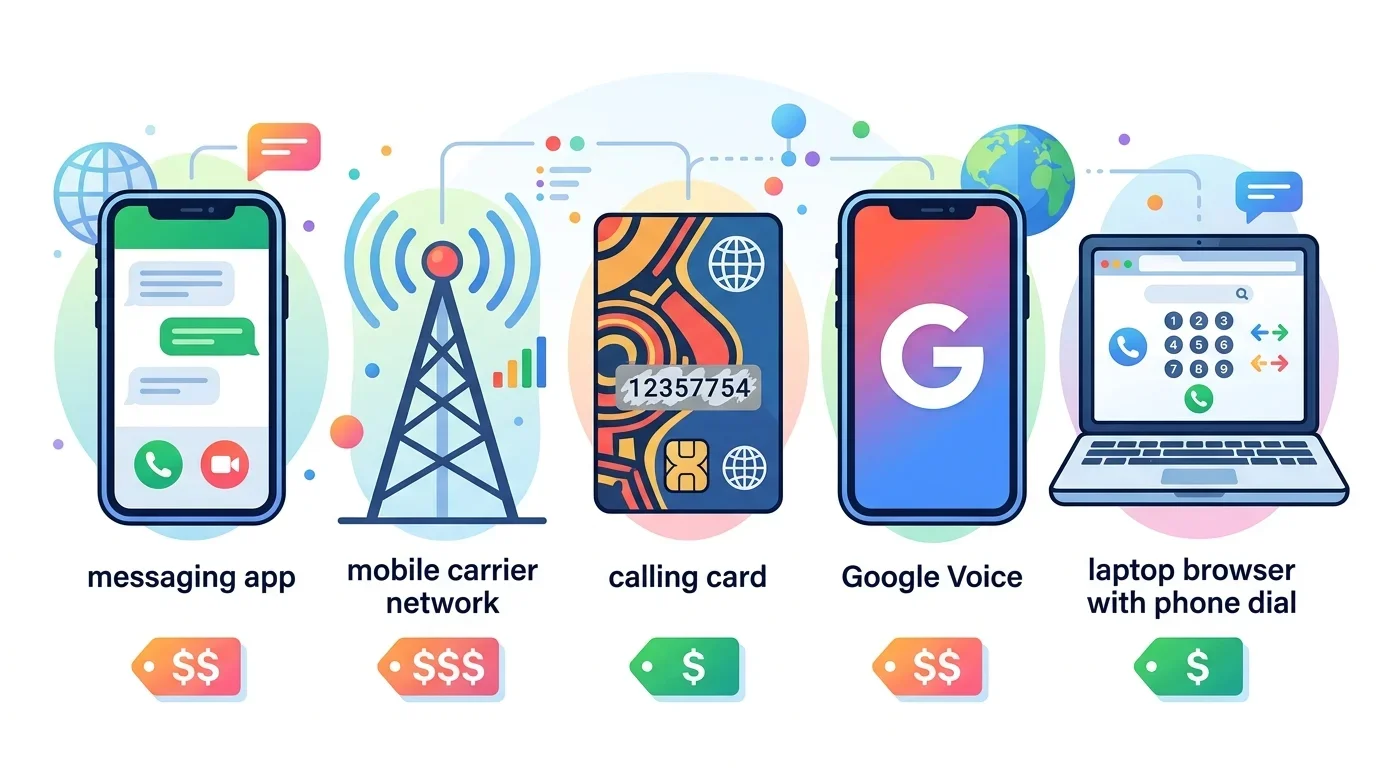
I have tested every major option for international calling in 2026. Here are the five that actually matter, with real costs and honest opinions on each.
Option 1: WhatsApp, FaceTime, and Free Messaging Apps
Cost: Free
Requirements: Both sides need a smartphone, internet, and the same app
Let me start with the obvious. If both you and the person you are calling have smartphones with decent internet, just use WhatsApp, FaceTime, Telegram, or whatever free app you both prefer. It costs nothing. The quality is usually excellent. Video calling is included.
This is genuinely the best option when it works. I am not going to pretend otherwise.
But here is when it does not work:
The person you are calling has a landline (no app installation possible)
They have a basic phone or flip phone (no WhatsApp)
Their internet is unreliable (common in rural areas of many countries)
They are not tech-savvy enough to use the app
You need to call a business or government office abroad
For any of these situations, you need something that calls actual phone numbers. Keep reading.
Option 2: Your Carrier's International Calling Plan
Cost: Expensive ($1-5/min depending on carrier and destination)
Requirements: A phone plan with an international add-on
Your cell phone carrier will happily let you make international calls. AT&T, Verizon, T-Mobile — they all offer it. The problem? It is absurdly expensive.
AT&T charges $3-5 per minute for most international destinations without a plan. Even with their international calling add-on ($15/month), you still pay per-minute rates that are way above what VoIP services charge.
T-Mobile is a bit better — some plans include international calling to certain countries. But it is often at reduced quality (2G speeds for data, non-HD voice). And it is not available in all plans.
Verizon? Do not even bother looking at their international rates unless you enjoy feeling angry.
The math is simple. A 30-minute call to India on AT&T without a plan could cost you $90-150. That same call through a VoIP service costs $0.60-3.00. That is not a typo.
Verdict: Unless your carrier includes it free in your plan, avoid this option. It is a terrible deal.
Option 3: International Calling Cards
Cost: Varies wildly ($0.01-0.10/min advertised, but hidden fees everywhere)
Requirements: A phone and the card's access number
Remember calling cards? Those prepaid cards you used to buy at gas stations and corner stores? They still exist, but honestly, they are a relic of a different era.
The advertised rates look amazing. "Call India for just 1 cent per minute!" But the reality is different. Connection fees. Maintenance fees. Rounding up to the nearest 3-minute increment. Expiration dates. The actual cost per minute ends up being much higher than advertised.
Plus, the experience is terrible. You dial a long access number, then enter a PIN, then dial the country code and number. It is clunky and annoying.
Verdict: Skip these. The industry is dying for good reason. There are better options in every way.
Option 4: Google Voice
Cost: $0.01-0.25/min depending on destination
Requirements: Google account + US phone number (US residents only)
Google Voice is solid. You get a free US phone number, free calls to the US and Canada, and international calls at competitive rates. India runs about $0.02/min. The UK is around $0.02/min. Mexico is about $0.03/min.
The catch — and it is a big one — is that Google Voice is only available if you have a US phone number. If you are outside the US, this is not an option for you. And even if you are in the US, you need a Google account and a US number to verify with.
For US-based callers, Google Voice is one of the best deals around. The rates are low, the quality is good (it is Google), and the domestic calling is free. But for the rest of the world? Look elsewhere.
Verdict: Great if you are in the US. Useless if you are not.
Option 5: Browser-Based VoIP (Like BubblyPhone)
Cost: $0.01-0.22/min depending on destination
Requirements: Any browser + internet connection
This is the option most people do not know about, and it is arguably the most flexible. Services like BubblyPhone let you make calls to real phone numbers directly from your web browser. No app to download. No country restrictions. No subscriptions.
You go to the website, sign up, add credit, and start dialing. The call goes from your browser over the internet to the other person's actual phone — landline or mobile. They do not need any special app or internet connection on their end.
Here are BubblyPhone's rates for popular destinations:
India (mobile): $0.10/min
Mexico: $0.01/min
United Kingdom: $0.01/min
Philippines: $0.22/min
Pakistan: $0.06/min
Brazil: $0.01/min
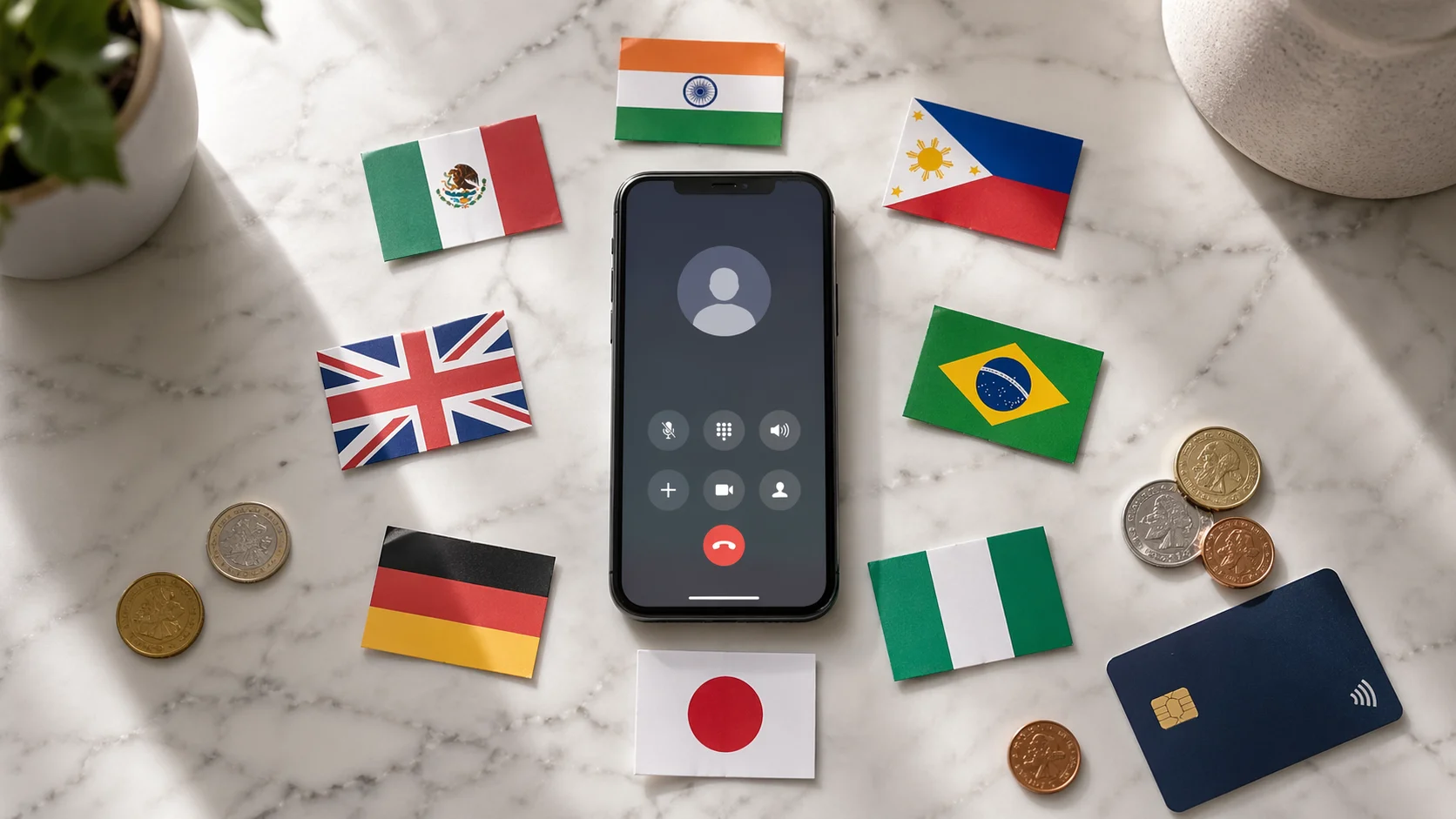
The big advantage here is accessibility. You could be sitting in a cafe in Bangkok, open your laptop, and call your grandmother's landline in rural Mexico for a penny a minute. No restrictions on where you are calling from.
Verdict: The best option for anyone outside the US, or anyone who needs to call landlines and basic phones abroad.
The Comparison Table
Here is how all five options stack up:
WhatsApp/FaceTime: Free | Requires smartphone + internet on both ends | Global
Carrier international plan: $1-5/min | Requires phone plan add-on | Depends on carrier
Calling cards: $0.01-0.10/min (plus hidden fees) | Requires card + access number | Global but clunky
Google Voice: $0.01-0.25/min | US residents only | US only
Browser VoIP (BubblyPhone): $0.01-0.22/min | Browser + internet | Global
The Real Talk: Why This Still Matters in 2026
People assume that calling abroad is a solved problem. "Everyone has WhatsApp now." That is true in certain demographics and certain countries. But globally? Not even close.
Billions of people still use landlines. Hundreds of millions use basic phones. Rural internet is still unreliable in large parts of Asia, Africa, and Latin America. Your elderly relatives may not be able to navigate smartphone apps.
When you need to reach those people, you need something that dials an actual phone number. That is not WhatsApp. That is not FaceTime. That is VoIP.
Tips for Keeping Your International Calling Costs Down
No matter which option you choose, here are some practical tips:
Use free apps when possible. If both sides have smartphones and decent internet, WhatsApp or FaceTime is still the cheapest option (free). Save VoIP for when free apps are not an option.
Check rates before you call. Different VoIP services have wildly different rates for different countries. A service that is cheap for India might be expensive for the Philippines, and vice versa.
Call on Wi-Fi. VoIP calls use data. On Wi-Fi, that is free. On cellular, it eats into your data plan. A typical VoIP call uses about 0.5-1 MB per minute.
Know the difference between landline and mobile rates. In many countries, calling a mobile number costs more than calling a landline. India is a classic example — mobile rates are higher.
Avoid your carrier's international rates like the plague. This cannot be overstated. Carrier rates are almost always 10-100x more expensive than VoIP alternatives.
Schedule your calls. If you regularly talk to family, set a weekly call schedule. This way you can plan to be on a good Wi-Fi connection, which improves call quality.
So What Should You Actually Use?
Here is my honest recommendation based on the most common scenarios:
Both sides have smartphones and internet? Use WhatsApp or FaceTime. It is free and works great. Do not overcomplicate it.
You are in the US calling a landline or basic phone abroad? Google Voice is your best bet for most countries. Cheap rates, backed by Google, works well.
You are outside the US, or calling Mexico/Brazil/UK? BubblyPhone. Open a browser, add credit, and call. Rates are excellent for these destinations and you are not restricted by geography.
You make 400+ minutes of international calls per month? Consider Skype's World plan at $13.99/month. It is the cheapest option for very heavy users.
The key takeaway is this: there is no single best option. The right choice depends on where you are, where you are calling, what kind of phone the other person has, and how often you call. But one thing is clear — you should never be paying your carrier $3-5 per minute for international calls. That is just throwing money away.
Whatever you do, check the rates, pick the cheapest option for your specific situation, and stop overpaying. Your family abroad wants to hear from you more often — and now you know how to make that happen without breaking the bank.
5 ways to call abroad: from free (with limitations) to cheap (with flexibility)