That's the default advice whenever someone mentions calling abroad. And honestly? It's not bad advice. WhatsApp is free, it's everywhere, and it works. Most of the time.
But here's what nobody mentions: WhatsApp has real limitations that show up at the worst possible moments. Like when you're trying to reach your grandmother's landline in rural India. Or when you need to call a hospital in Mexico City. Or when your cousin's internet in Manila cuts out mid-conversation for the third time.
VoIP services like BubblyPhone solve a different problem. They cost money — pennies per minute, not dollars — but they reach any phone number on earth. Landlines, mobiles, business lines, the works.
So which should you use? Both. But let me explain when each one makes sense.
WhatsApp's Dirty Secret: It Doesn't Reach Everyone
WhatsApp calls have one massive requirement that people forget about: both sides need a smartphone with internet access and the WhatsApp app installed.
That sounds obvious, right? But think about who you're actually trying to call internationally:
Your elderly parents or grandparents who still use a basic phone (or a landline — yes, billions of landlines still exist)
Businesses, doctor's offices, government agencies, banks — none of these have WhatsApp numbers
People in rural areas with spotty or no internet connections
Anyone who just... doesn't use WhatsApp (yes, they exist)
And here's the other thing people gloss over: WhatsApp call quality is only as good as the worst internet connection in the call. You can have gigabit fiber at home, but if the person you're calling is on a shaky 3G connection in a small town, your call quality is going to be terrible. Choppy audio. Dropped words. Random disconnects.
I've personally had WhatsApp calls drop four times in a 10-minute conversation because of WiFi issues on the other end. That's not a phone call — that's a frustration exercise.
When WhatsApp Is the Right Call (Pun Intended)
Let's be fair. WhatsApp is genuinely great in the right circumstances:
Both people have smartphones with WhatsApp installed
Both have decent internet (WiFi or strong 4G/5G)
You're calling friends or family who are already in your WhatsApp contacts
You don't mind the occasional quality dip
If all of that checks out, WhatsApp is hard to beat. It's free. The audio quality on a good connection is solid. Video calls work well too. And with 2+ billion users worldwide, there's a good chance the person you're calling already has it.
For casual calls with tech-savvy friends and family? WhatsApp all day.
When WhatsApp Falls Apart
Here's where things get real. These are the situations where WhatsApp simply can't help you:
Calling a landline number. Your mom's house phone, the one she's had for 30 years? WhatsApp can't dial it. Period. There's no workaround. Landlines don't have apps.
Calling someone without a smartphone. In many developing countries, feature phones are still common. Your relative in a rural village might have a Nokia that makes calls and sends texts — and nothing else. WhatsApp isn't an option.
Calling businesses or offices. Need to call a hospital in London? A bank in Mumbai? An immigration office in Toronto? Good luck finding their WhatsApp number — they don't have one. These places have phone numbers. Regular, old-fashioned phone numbers.
Bad internet on the other end. This is the sneaky one. You can't control the other person's internet quality. If they're in an area with unreliable connectivity — and let's be honest, that describes a lot of the world — your WhatsApp calls will suffer. Constant buffering, robotic voice, drops.
The VoIP Advantage: Reach Any Phone Number on Earth
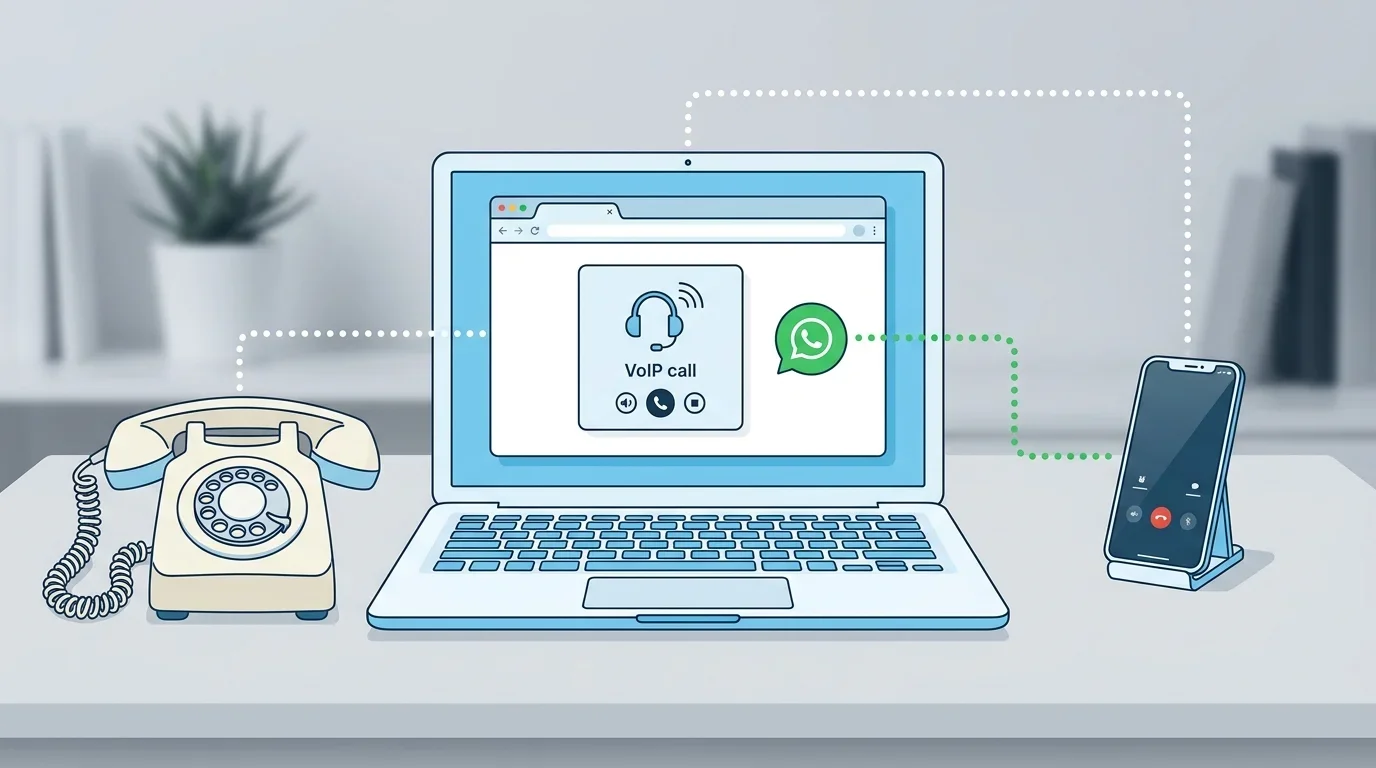
This is where VoIP (Voice over Internet Protocol) services come in. VoIP is a broad category — it includes everything from Skype to Google Voice to BubblyPhone. The key difference from WhatsApp is simple:
VoIP calls reach real phone numbers.
Landlines, mobiles, business lines — any number you can dial, VoIP can connect to. The call goes through the actual telephone network on the receiving end. The person you're calling doesn't need a smartphone, an app, or even internet access. Their phone just rings.
You, on your end, just need internet access. With BubblyPhone specifically, you don't even need an app — you open your browser, type in a number, and call. That's it.
The tradeoff? VoIP costs money. Not much money — we're talking cents per minute, not dollars — but it's not free like WhatsApp.
The Real Cost Breakdown
Let's put actual numbers on this, because vague comparisons are useless.
WhatsApp calls:
Free (but uses data — roughly 0.5-1 MB per minute for voice)
On WiFi, that data cost is zero
On mobile data, a 30-minute call uses maybe 15-30 MB — negligible on most plans
BubblyPhone VoIP calls (examples):
India mobile: $0.10/min — a 30-minute call costs $3.00
UK landline: $0.01/min — a 30-minute call costs $0.30
Philippines mobile: $0.22/min — a 30-minute call costs $6.60
Mexico: $0.01/min — a 30-minute call costs $0.30
So yeah, WhatsApp is free and VoIP costs money. But the question isn't really about cost — it's about whether you can actually reach the person you need to reach.
A free call that doesn't connect is worth exactly nothing.
Call Quality: It's Not Even Close (Sometimes)
When both sides have great internet, WhatsApp call quality is actually very good. I'd say it's comparable to VoIP quality in ideal conditions.
But ideal conditions aren't the norm for international calls. Here's why:
With WhatsApp, the audio has to travel over the internet on BOTH ends. If either person has bad internet, the call suffers.
With VoIP-to-phone calls, the audio only travels over the internet on YOUR end. The other person's phone is connected to the regular telephone network, which is rock-solid reliable. So as long as you have decent internet, the call quality is consistent.
This is a huge deal when you're calling countries where internet infrastructure isn't great. Your grandma's landline connection in a small town is way more reliable than her neighbor's shared WiFi.
The Smart Approach: Use Both
Here's what I actually recommend, and this isn't a sales pitch — it's just common sense:
Use WhatsApp for:
Friends and family who have smartphones and good internet
Video calls (VoIP is voice-only for most services)
Quick check-ins where call quality dips are tolerable
Group calls (WhatsApp handles this well)
Use VoIP (like BubblyPhone) for:
Calling landlines (no other option)
Calling businesses, hospitals, government offices, banks
Reaching people who don't have smartphones
When you need reliable call quality and can't depend on the other person's internet
Important calls where dropping isn't an option
What About Other Apps? Viber, Telegram, FaceTime?
Quick rundown:
Viber has a "Viber Out" feature that actually works like VoIP — you can call real phone numbers for a fee. Rates are competitive. Worth considering if you already use Viber.
Telegram has voice calls but they're app-to-app only, same as WhatsApp. Can't reach phone numbers.
FaceTime is Apple-only. Great if everyone has an iPhone or Mac. Useless otherwise.
Skype used to be the king of this space. It can still call phone numbers (Skype Credit), but Microsoft has been slowly letting it die for years. I wouldn't bet on it for the long term.
The Bottom Line
This isn't a VoIP vs. WhatsApp debate. They solve different problems.
WhatsApp is for free calls between two smartphones with good internet. VoIP is for reaching any phone number, anywhere, reliably.
If everyone you call internationally has a smartphone with WhatsApp and solid internet, you might never need VoIP. But the moment you need to reach a landline, a business, or someone without a smartphone — and that moment will come — you'll want a VoIP option ready to go.
BubblyPhone works right in your browser. No download, no account required to browse rates. When you need to call a real phone number abroad, it's there. And at $0.01/min for some countries, it's barely more expensive than free.
Smart callers don't pick one tool. They use the right tool for the job.
VoIP reaches any phone number — landlines and mobiles alike