Quo (Formerly OpenPhone) vs Google Voice 2026
OpenPhone rebranded to Quo on 23 September 2025 alongside $105M growth financing. Most comparison pages still quote pre-rebrand prices. Verified 2026 pricing: Quo Starter $15/$19 vs Google Voice Workspace Starter $10 + Workspace base.
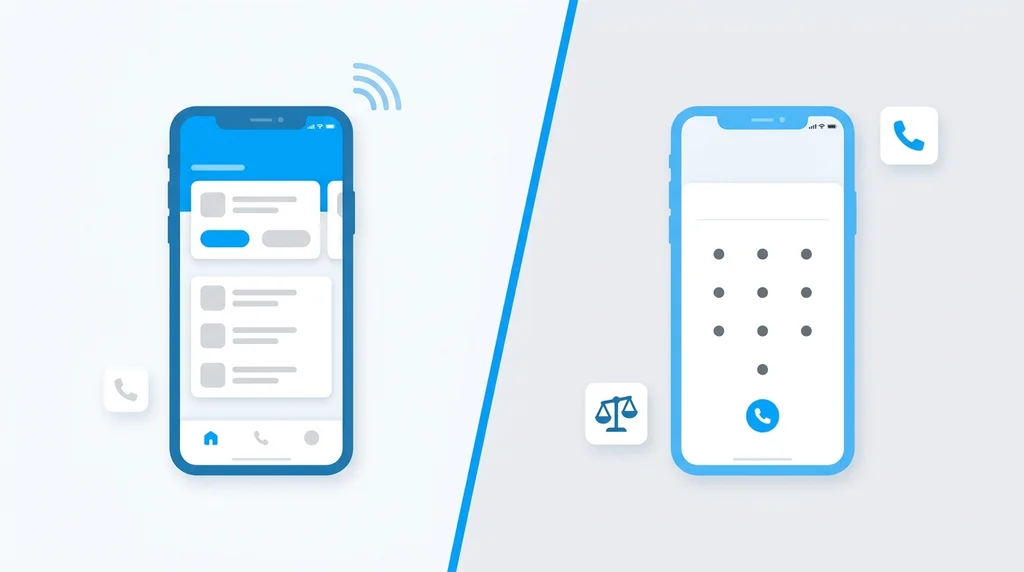
TL;DR — Quo (formerly OpenPhone) vs Google Voice (2026)
- OpenPhone rebranded to Quo on 23 September 2025 alongside $105M growth financing (Y Combinator S18, founders Mahyar Raissi and Daryna Kulya). Many comparison pages still call it OpenPhone — or quote pre-rebrand prices.
- Pick Quo if: you need an inbound US/Canada business number with full SMS / MMS / AI call summaries / 50+ native integrations / shared inbox for sales teams.
- Pick Google Voice if: you're a solo user in the US who just needs a cheap second number ($10/mo Voice Starter Personal, launched 2025), or your team already runs on Workspace and wants a tightly-integrated Voice add-on.
- Pick neither (use BubblyPhone) if: you only need outbound calling, no inbound number, no SMS — e.g. expats, occasional callers, Skype-Out refugees, or anyone calling countries Quo doesn't route to (China, Cuba, Nigeria, Estonia, several others).
- Verified 2026 pricing: Quo Starter $15/$19 annual/monthly, Business $23/$33, Scale $35/$47 per user/month. Google Voice Workspace Starter $10, Standard $20, Premier $30 per user/month (+ Workspace base ~$7/user/mo).
The single biggest fact every “OpenPhone vs Google Voice” comparison article misses: OpenPhone became Quo on 23 September 2025. The rebrand came with a $105M growth-financing round and a new product strategy. Most SERP pages still call it OpenPhone, quote the pre-rebrand $10 Starter / $20 Standard prices, and don't reflect Google's own 2025 launch of a $10/month personal Voice Starter plan that meaningfully changed the solo-user calculus. This guide is the verified 2026 comparison: real pricing from quo.com and workspace.google.com, the integrations and AI features each one actually offers, and an honest assessment of when neither product is right for you.
The OpenPhone → Quo rebrand: what changed in September 2025
OpenPhone — the Canadian-founded SaaS phone company that came out of Y Combinator's S18 batch — rebranded to Quo on 23 September 2025. The announcement coincided with a $105M growth-financing round: $96M from General Catalyst's Customer Value Fund plus $9M in follow-on equity (not a traditional Series C, despite some press characterising it that way). At rebrand, Quo had approximately 90,000 customers and had launched its Sona AI assistant five months earlier in April 2025.
Co-founders Mahyar Raissi (CEO) and Daryna Kulya (COO) remain in place. The company is headquartered in San Francisco but the founders are Canadian-based. The product's capabilities, integrations, and value proposition are the same as late-stage OpenPhone — just under a new name with new pricing. If you used OpenPhone in 2024, you're using Quo now; your URL changed, your account didn't. The key practical implication for this comparison: most third-party reviews of “OpenPhone vs Google Voice” published before late September 2025 are working from outdated pricing.
Side-by-side pricing (verified May 2026)
| Tier | Quo (per user/mo) | Google Voice (per user/mo, USD) |
|---|---|---|
| Cheapest paid tier (annual) | Starter $15 | Starter $10 + Workspace ~$7 = ~$17 |
| Cheapest paid tier (monthly) | Starter $19 | Starter $10 + Workspace ~$7 = ~$17 |
| Mid tier (annual) | Business $23 | Standard $20 + Workspace ~$7 = ~$27 |
| Top tier (annual) | Scale $35 | Premier $30 + Workspace ~$7 = ~$37 |
| Solo / personal option | Not offered — 7-day free trial only | $10/mo Voice Starter Personal (US-only, no Workspace required, launched 2025) |
| Free tier | No | Free personal Google Voice (US-only) |
The honest read: Quo Starter is roughly $2/month cheaper than the smallest Workspace + Voice bundle for businesses, before considering that Workspace gives you Gmail, Drive, Docs and Meet which Quo doesn't replicate. For a solo US user who only needs a cheap second phone number, Google's new $10/mo Voice Starter Personal is dramatically cheaper than Quo's $15 entry point — this is a real shift that most SERP comparisons miss.
Feature-by-feature comparison
| Feature | Quo | Google Voice (Workspace) |
|---|---|---|
| Inbound numbers issued in | US + Canada only | 14 first-party countries (US, UK, CA, FR, DE, IT, ES, NL, IE, BE, PT, SE, CH, DK) + 20+ SIP Link |
| SMS / MMS (inbound and outbound) | Full support, A2P 10DLC, group messaging, MMS | US/Canada numbers only, no MMS to non-US, no A2P registration |
| AI features | Sona AI assistant, call summaries, action items, sentiment | Voicemail transcription; basic call recording on Standard+; less full-fat AI |
| Native integrations | 50+ including HubSpot, Salesforce, Slack, Gong, Pipedrive, Zapier | Workspace-native (Gmail, Calendar, Meet); limited 3rd-party |
| Shared inbox / team features | Built-in shared inbox, contact intelligence, snippets | Ring groups, auto-attendant; less sales-team-oriented |
| International outbound rates | $0.02–0.09/min by country; cannot call China, Cuba, Estonia, Latvia, Lithuania, Nigeria, Guinea, Gambia, Maldives, Somalia, Tunisia, Zimbabwe | Varies by destination; works for nearly all countries with internet |
| Number porting | US + Canada numbers | US + Canada only (no EU mobile/VoIP/nomadic, no APAC SIP Link porting) |
| Toll-free numbers | Yes (US 800/833/844/855/866/877/888 + Canadian toll-free) | US toll-free only on Workspace tiers; not in CA / EU / APAC |
| Free trial | 7 days | 14-day Workspace trial; Voice Starter Personal has no free tier |
| Support | 24/7 chat + email; phone on Scale tier | Workspace support tiers (varies by plan) |
Sources: quo.com/pricing, workspace.google.com/products/voice/, Voice Starter Personal (US-only), Quo rebrand announcement (23 Sep 2025). Last verified May 2026.
Where Quo clearly wins
- Inbound SMS / MMS on US and Canada numbers. Quo does proper SMS with A2P 10DLC carrier registration, MMS attachments, and group messaging. Google Voice does SMS only on US-linked accounts and never does MMS to non-US. For sales teams, customer support, or anyone who needs two-way SMS with customers, Quo is the right tool.
- Sales-team workflows. Shared inbox, contact intelligence, conversation snippets, message templates, and 50+ CRM integrations (HubSpot, Salesforce, Pipedrive, Gong) are first-class Quo features. Google Voice is more like a managed business phone line than a sales-tool layer.
- AI — Sona AI assistant. Launched April 2025 (still under the OpenPhone name at that point). Handles call summaries, action items, sentiment analysis, and a free monthly allowance even on Starter. Google Voice's AI is more limited (voicemail transcription, basic recording).
- Modern UX. Quo's web and mobile apps feel like a 2024-2026 SaaS product. Google Voice's UI is functional but feels like a Workspace add-on (because it is).
Where Google Voice clearly wins
- Geographic coverage. Google Voice issues first-party numbers in 14 countries (UK, Canada, Germany, France, Italy, Spain, Netherlands, Ireland, Belgium, Portugal, Sweden, Switzerland, Denmark, US) plus SIP Link in 20+ more (Australia, Mexico, Philippines, Brazil, Hong Kong, Vietnam, etc.). Quo issues numbers only in US + Canada. If you need a non-North-American business number, Google Voice is the only one of the two that can provide it.
- Solo US user pricing. Google's 2025 Voice Starter Personal at $10/mo (US users only, no Workspace required) is dramatically cheaper than Quo's $15 minimum. For an individual freelancer or solo professional in the US, this is a real win.
- Already-paying-for-Workspace users. If your team already uses Google Workspace for Gmail, Calendar, Meet and Drive, adding Voice as another line item is operationally simpler than introducing a separate Quo subscription with separate billing, SSO config, and identity provisioning.
- International outbound reach. Quo cannot call China, Cuba, Estonia, Latvia, Lithuania, Nigeria, Guinea, Gambia, Maldives, Somalia, Tunisia, or Zimbabwe. Google Voice routes to all of these (at standard international rates). For diaspora calling or NGO / international business contexts, this matters.
Where both lose — and BubblyPhone fits
Both Quo and Google Voice are subscription-based products that issue inbound numbers. They're built for businesses that need a permanent phone-number identity. Neither is the right tool when:
- You don't want a phone number, you just want to make outbound calls.
- You make a few hundred minutes a month, not a few thousand, and don't want a $15–30/user/month commitment.
- You're part of a diaspora corridor calling family back home (Filipino OFWs, Vietnamese Việt kiều, Brazilian-Americans, Mexican-Americans, BNO HKers, Italian-Americans — we cover these in our country guides).
- You're a Skype Out refugee — Microsoft retired consumer Skype on 5 May 2025 and there's no pay-as-you-go to PSTN consumer alternative inside the Quo / Google Voice category.
- You need to call a country Quo doesn't route to (China, Cuba, several others).
For those cases, BubblyPhone is the third option. We don't compete head-to-head with Quo or Google Voice: we don't issue inbound numbers, don't do SMS, and don't run a Workspace integration. What we do is pay-as-you-go outbound calling from any browser at roughly $0.03/min to US, Canada, UK and competitive rates everywhere else. No subscription, no contract, no app for your contacts to install. For the audiences above, this is the right shape of tool.
Decision tree: which one is right for you?
Pick Quo if:
- You run a US or Canadian sales / support team that lives on SMS, MMS and CRM integrations.
- You want a polished, modern SaaS phone UX with AI call summaries baked in.
- You don't need numbers outside North America.
- You're willing to commit $15–35/user/month for the team-oriented features.
Pick Google Voice if:
- You're a US-resident solo user who wants a $10/mo second number (Voice Starter Personal).
- Your team already runs on Google Workspace and you want voice tightly integrated.
- You need a non-North-American business number (one of the 14 first-party countries or via SIP Link).
- You don't need rich SMS / MMS / CRM functionality (Workspace Voice is functional but minimal here).
Pick neither (use BubblyPhone) if:
- You only need outbound calling, not inbound numbers or SMS.
- You make occasional calls and don't want a subscription.
- You're a diaspora user calling family back home in PH, VN, BR, MX, IT, IE, HK, or anywhere else.
- You're a Skype Out refugee after the May 2025 shutdown.
- You need to call a country Quo doesn't support.
2026 freshness anchors — what changed since most articles were written
- 23 September 2025: OpenPhone rebrands to Quo; $96M from General Catalyst CVF + $9M follow-on equity (Y Combinator S18, founded by Mahyar Raissi and Daryna Kulya).
- April 2025: Sona AI assistant launched (still under the OpenPhone name at the time).
- 5 May 2025: Microsoft retires consumer Skype globally — the pay-as-you-go to PSTN consumer category needed a new champion. Neither Quo nor Google Voice fully fills that gap; BubblyPhone does.
- 2025 (mid-year): Google launches Voice Starter Personal at $10/mo for US-resident Gmail users — the first time personal Voice has had a paid tier. Still US-only.
- 27 February 2025: Google Voice SIP Link expansion adds 15 countries including Australia, Hong Kong, Philippines, Vietnam, Indonesia, Malaysia, NZ, Taiwan, Thailand, Finland, Israel, Norway, Romania, South Africa, Peru. Quo does not match this.
Need outbound calling, not a phone number?
BubblyPhone is the third option for callers who don't fit the Quo or Google Voice model. Pay-as-you-go from $5, no subscription, calls to any country including ones Quo can't route to.
Start Calling →Frequently Asked Questions
Is Quo the same as OpenPhone?
Is Quo cheaper than Google Voice?
Does Quo work outside the US and Canada?
Which has better SMS for sales teams?
Does Quo have an AI feature like Google Voice doesn't?
Can I port my number from Google Voice to Quo (or vice versa)?
When does it make more sense to use neither and just use BubblyPhone?
What integrations does Quo support?
Is Quo HIPAA / SOC 2 / GDPR compliant?
How does Quo compare to Google Voice for international teams?
Related Resources
Google Voice Worldwide Hub
Full country list and per-market guides
Google Voice in the UK
First-party Workspace + alternatives
Google Voice in Canada
May 2020 launch + Quebec Law 25 + Quo / Fongo
Skype Shutdown Alternatives
May 2025 retirement — migration paths
STIR/SHAKEN Explained
Why your call gets “Spam Likely”
BubblyPhone Rates
Per-country pay-as-you-go pricing