Live Phone Call Translation: How It Works and Its Limits
Table of Contents
- The relay explained without jargon
- Where the relay came from
- What to settle before you dial
- Language detection is a stage, not a setting
- The two directions rarely run at the same speed
- Echo would restart the relay if it weren't handled
- What you can check mid-call
- The table measures a segment, not your call
- What listeners prefer
- Quality also depends on the language pair
- Habits that make a translated call work
- The failure lands hardest on names and numbers
- Checks you can run during the call
- Encryption protects the audio in transit; storage is a separate decision
- The legal layer isn't one law
- A consent and retention checklist
Live phone call translation listens to one speaker, turns that speech into text, translates the text, and delivers the result to the other person as spoken audio or on-screen captions while the call keeps running. Neither person leaves the call, switches apps, or installs anything.
Say your cousin in Manila calls about a hospital invoice, or a supplier in Guangzhou quotes a price per carton. You speak English, they answer in Filipino or Mandarin, and a relay sits between you, handing words back and forth slightly behind the conversation. It's good enough to settle a delivery date and not good enough to trust with a bank transfer you haven't confirmed. Both of those things are true for the same reason.
What Live Phone Call Translation Does on a Call
Live phone call translation converts one caller's speech into the other caller's language while the call continues, and it can deliver that language two ways. Spoken audio arrives in the listener's ear, or bilingual captions appear on the screen of whoever has the dialer open.

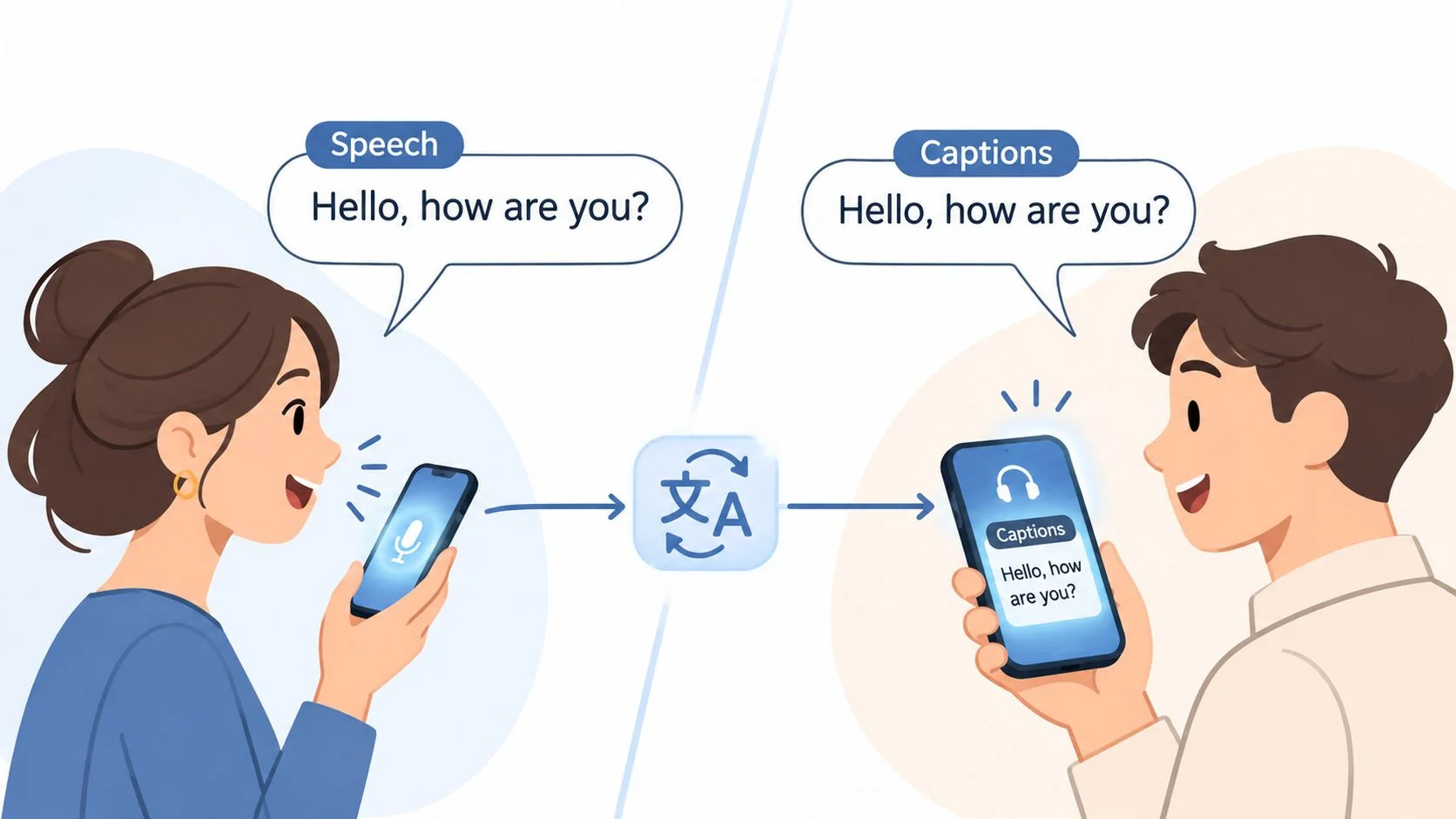
Some calls need both at once. In the picture above, one person talks into a phone while the other reads the translation as it lands, which is what a relay looks like when the listening side can't hold a handset to an ear.
The relay explained without jargon
Think of a runner standing at the midpoint of a track with a baton. The first caller speaks a sentence and puts the baton in the runner's hand, the runner carries it across, and a moment later the second caller has it. The runner doesn't summarize, doesn't decide which sentences matter, and doesn't stop the race.
That single image explains the usefulness and the limits together. The baton arrives slightly late, and whatever the runner misheard travels with it.
The two handoffs feel different in practice.
- Translated voice: the right choice for a hands-free call in a car, for a grandparent holding a landline, or for anyone who can't read a screen mid-sentence.
- Bilingual captions: better when details matter, because you can read a surname, a street address or an account number instead of guessing at a pronunciation.
Where the relay came from
Live phone call translation grew out of decades of speech research rather than one product launch. Bell Labs demonstrated the Audrey speech-recognition system in 1952, and Carnegie Mellon's Harpy system reached approximately 1,011 recognized words in 1976 under a five-year DARPA speech-understanding program. DARPA later ran spoken-language and machine-translation programs, including Babylon and CAST in 2001 and TRANSTAC beginning in 2005-2006, which built the recognize, translate, speak pipeline that services still use, as a published history of spoken-language translation from AAAI sets out. The step that made phone calls workable was incremental speech-to-speech translation over SIP-based systems, where translating from partial recognition guesses produced high-quality output at roughly half the latency of waiting for a finished sentence.
What to settle before you dial
Two decisions, made in advance. Choose your output, meaning spoken translation, captions only, or both, then check whether the person you're calling is on a mobile phone or a landline. On a landline they'll hear voice and nothing else, so anything you need them to read should be spelled out aloud instead.
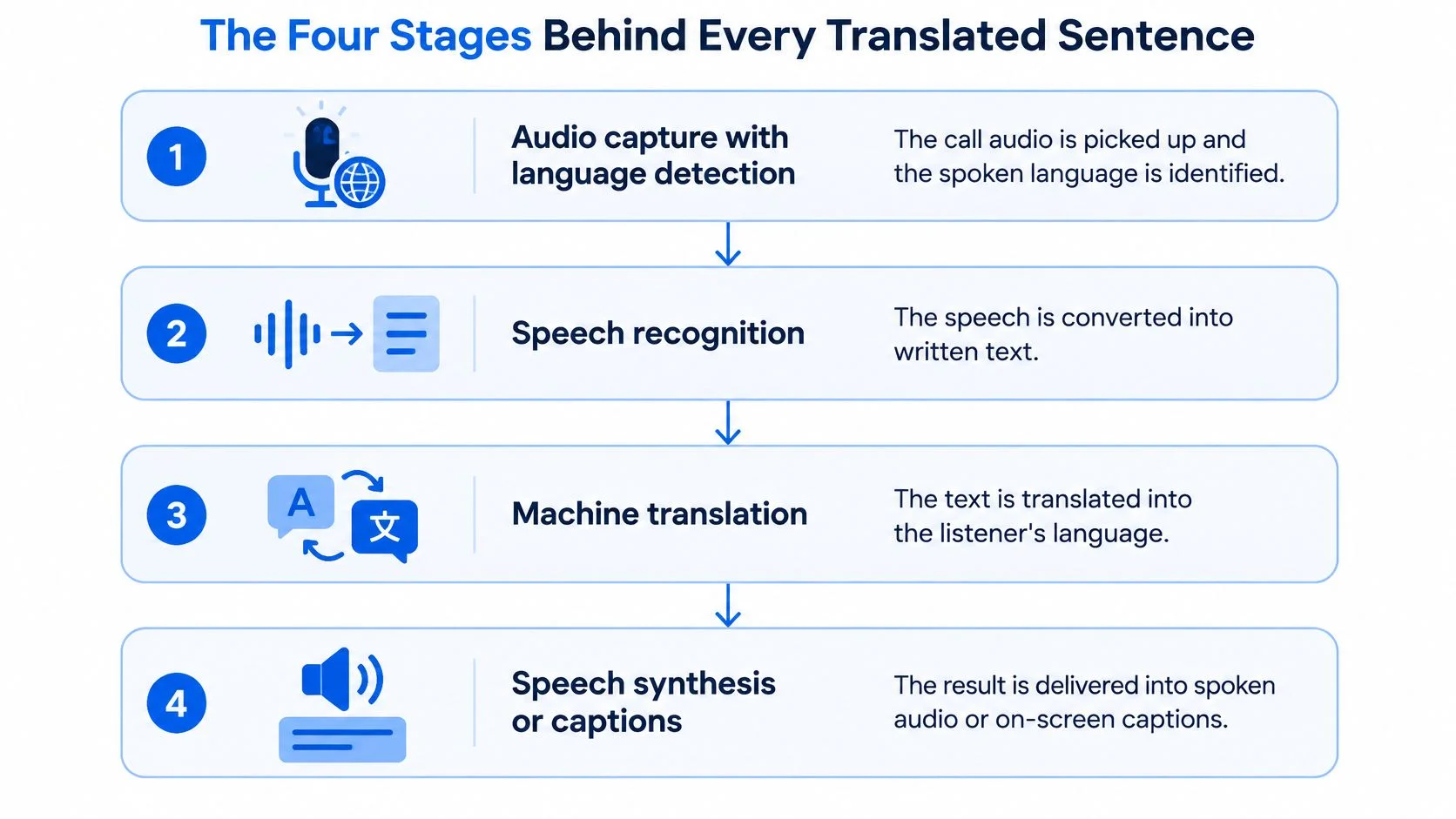
The Four Stages Behind Every Translated Sentence
Every translated sentence on a call passes through four stages in order, and each stage fails in its own way. Knowing the order turns a vague complaint such as "translation was bad" into a more useful question: did the system hear the wrong audio, recognize the wrong words, translate them poorly, or deliver the result too late? The relay works like a chain of classroom messengers. If the first child mishears the sentence, every later messenger has to work with that mistake.
| Stage | What it does | Where it fails |
|---|---|---|
| Audio capture and language detection | Receives phone audio and identifies the spoken language | Wrong language guess when callers switch languages mid-call |
| Speech recognition | Converts speech into text | Misheard names, numbers and accents, especially on noisy lines |
| Machine translation | Translates the recognized text | Recognition errors carry forward; idioms and code-switching are often lost |
| Speech synthesis or captions | Speaks the translation or shows it as text | Added delay, or captions that keep changing as the system revises them |

Language detection is a stage, not a setting
When you don't pick a language before speaking, the system guesses it from the opening seconds of audio. Treat the detected language as a hypothesis until the first few sentences confirm it. Callers who mix two languages in one sentence, or who open with a name that sounds foreign to the model, can push the whole relay toward the wrong model and keep it there until the system gets stronger evidence.
Identifying a language correctly also doesn't mean the words inside it get recognized correctly. Accents, background noise and borrowed vocabulary defeat recognition even after the language is right, which is why the two stages deserve separate skepticism. A short pause before answering can help here, because it gives the system more speech to work with before it commits to text.
The two directions rarely run at the same speed
A 2026 research prototype tested voice-to-voice translation on 155 Korean-English calls over the public switched telephone network, with 148 calls instrumented and 147 completed. It reported a median caller-to-callee latency of 555 milliseconds, against 2,684 milliseconds in the reverse direction, according to the ACL demo paper on translating legacy telephone calls. Same call, same participants, and one side hears the translation roughly five times sooner than the other.
That asymmetry explains a specific confusion. One person says "the translation is instant," and the other says "it lags badly," and both are describing the same conversation accurately. The delay belongs to a direction of the relay, so a complaint from only one side points to that side's path, not to the whole language pair.
Echo would restart the relay if it weren't handled
Translating a caller's voice and playing it back into the same line creates an obvious hazard, because the system can pick up its own output and treat it as fresh speech. The ACL demo paper on translating legacy telephone calls reported zero echo-induced translation loops, which sounds like a small detail until you imagine a sentence that translates itself back and forth while two people wait. Echo control acts like a closed door between the loudspeaker and the microphone, so the relay listens to the people on the call rather than to its own voice.
What you can check mid-call
Two questions settle most doubts. Do captions appear for both speakers, or only for the one who started the call? And does the delay sit on one side, or on both? If only one direction is slow, the fix is usually in that direction's synthesis or echo control, not in the language pair. If the captions keep changing, the recognizer may still be revising words before translation. If a name or number sounds wrong, slow down and spell it out, because recognition errors can travel through the remaining stages.
Latency Bands and Why a Short Pause Helps
A delay of about one second feels close to live, and spoken translation usually gets more faithful at three to four seconds. Both statements are accurate, and the gap between them explains most of the frustration people feel on a translated call.
| Latency band | Delay per segment | Effect on a phone conversation |
|---|---|---|
| Low | 1,000 ms or less | Feels close to live; suits interactive captions |
| Medium | 1,001 to 2,000 ms | Usable, but turn-taking becomes awkward |
| High | 2,001 to 4,000 ms | Interruptions and talking over each other become likely |
Those bands come from the way the IWSLT simultaneous-translation workshop classifies Average Lagging. They're measured per segment, and that's the first place readers get confused.
The table measures a segment, not your call
The pause a caller hears is end to end, and it stacks up from every part of the path: audio capture, packet transport, jitter buffering, the recognizer's endpointing decision, translation decoding, caption rendering, and any text-to-speech. A system that leads a latency benchmark can still hand you a noticeable pause once the rest of the path is counted in, because the model was never the slow part.
The endpointing step deserves a closer look, because it explains why waiting helps. The system has to decide where one sentence ends and the next begins, and a longer window gives it more of your sentence to work with. A clause like "we can't ship on Friday" translated after one second may only contain "we can't ship." Give the system three or four seconds and the Friday arrives too. Speed is bought with context, and context is what makes translation faithful.
Practical rule: judge the delay with a stopwatch on a real call, not from a specification sheet.
What listeners prefer
A 2025 study of translated speech found that a delay of roughly one second frequently produced incorrectly translated half-sentences, and two seconds still produced word-level errors. Most participants preferred a three to four second delay, because the translation quality improved enough to be worth the wait, according to the ACM study of latency preferences in translated speech. Fast and wrong loses to slower and right.
Quality also depends on the language pair
Simultaneous-translation research consistently shows that accuracy diverges sharply by language pair, even when systems run at similar latencies. Closely related pairs with plenty of training data tend to score well; distant or lower-resource pairs lose far more quality when forced to answer quickly. If your two languages sit on opposite sides of that spread, a delay that feels tolerable in one direction can feel unusable in the other, and the slower side benefits most from longer clauses.
Habits that make a translated call work
- Pause at clause boundaries: finish a thought before starting the next one, so the system translates a whole clause instead of half of one.
- Don't talk over the translation: overlapping speech gives the recognizer two voices and no way to choose.
- Read names and numbers back: "Smith, S-M-I-T-H, the fifteenth" costs four seconds and prevents a wrong delivery.
- Treat the transcript as part of the call: the same patience that improves accuracy also produces a cleaner written record, so speak as if every sentence will be read later, because it may be.
Reconciling the two findings is simpler than it looks. One second is the target for interactive captions, where reading speed covers the gaps, and three to four seconds is where spoken output usually earns its delay.
Why Ordinary Phone Audio Lowers Translation Accuracy
A clear speaking voice doesn't guarantee a correct translation, because the recognizer is working with telephone audio rather than studio audio. Conventional narrowband calls are commonly sampled at 8 kHz, which leaves less acoustic detail for any model to decode.
| Audio condition | Word error rate | Final-result latency |
|---|---|---|
| Clean 8 kHz μ-law audio | 6.2% | about 1.96 seconds |
| Clean audio plus 5.2% packet loss | 6.8% | about 1.98 seconds |
| Pink noise at 10 dB signal-to-noise ratio | 10.1% | Not reported for this condition |
Those figures come from a reproducible streaming telephony benchmark of speech recognition quality, which ran the same recognizer across three conditions. Notice what changed and what didn't: the model stayed identical, and noise alone pushed the word error rate from 6.2% to 10.1%.
The failure lands hardest on names and numbers
A misheard word becomes a mistranslated word, and translation errors compound recognition errors rather than cancelling them out. The categories most exposed are exactly the ones people put in a call on purpose: names, addresses, prices, dates and account numbers, plus any sentence where a speaker switches languages mid-thought.
The NIST OpenASR20 challenge makes the scale of that problem concrete. Run in 2020 in cooperation with IARPA, it evaluated recognition of conversational telephone speech in ten low-resource languages: Amharic, Cantonese, Guarani, Javanese, Kurmanji Kurdish, Mongolian, Pashto, Somali, Tamil and Vietnamese. A system built on clean recordings doesn't transfer to a phone line just because the language is supported.
Media handling deserves as much attention as the language model. Jitter buffers, packet-loss concealment, echo cancellation, voice-activity detection and audio normalization all sit upstream of translation and decide how much clean signal reaches it. For a longer look at where recognition ends and translation begins, there's a solid walkthrough of how accurate AI call translation really is.
Checks you can run during the call
- Spell the name: letter by letter, then ask the other person to read it back.
- Repeat numbers and dates: twice, in two formats, such as "the fifteenth of March, 15/3."
- Confirm amounts aloud: ask a direct yes-or-no question instead of assuming the number landed.
- Keep the transcript: it's the only record of what was said if a detail turns out wrong.
Privacy, Consent and What Happens to Your Transcript
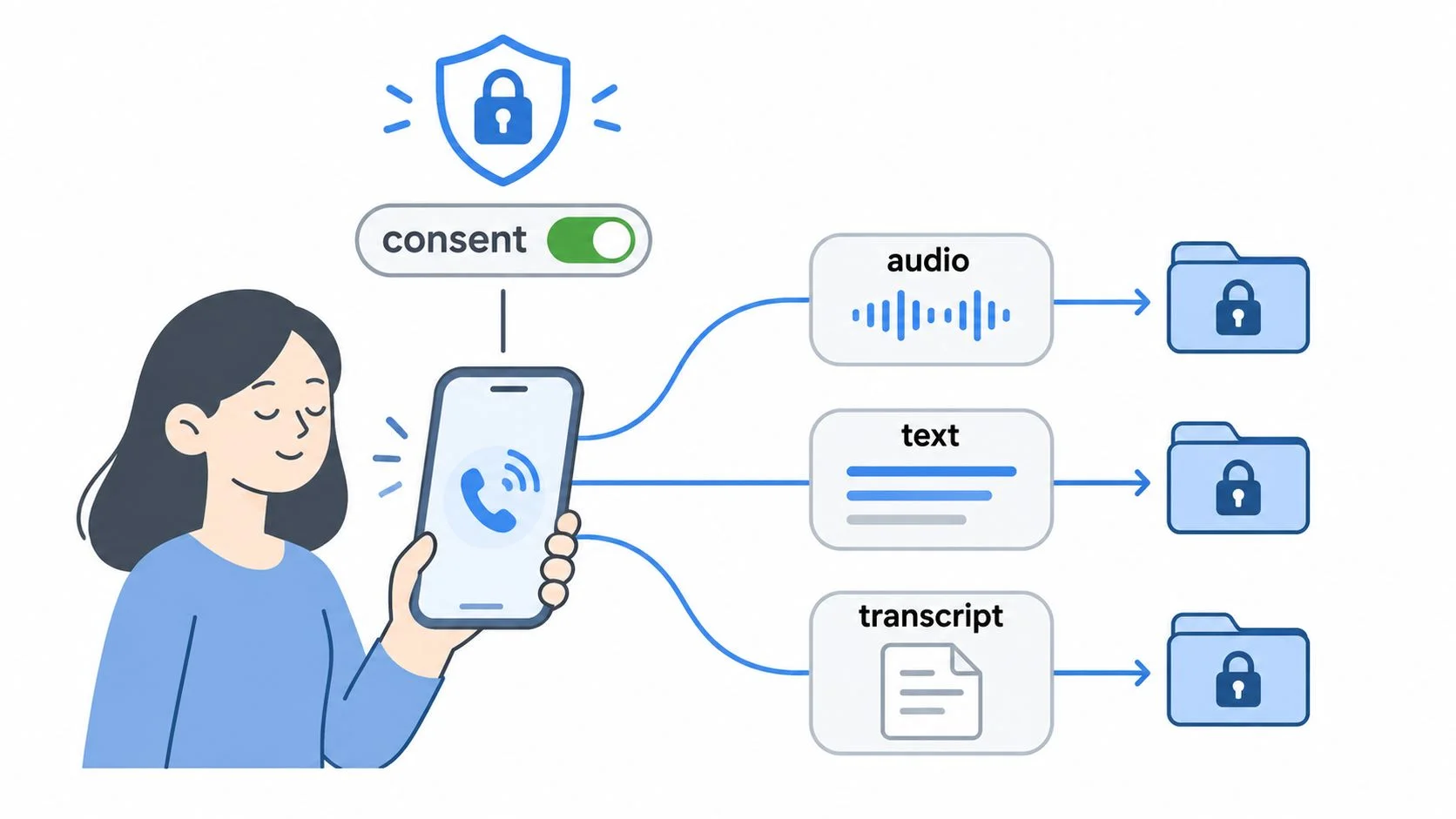
A short pause can improve fidelity, but it also gives the call a shape that lasts beyond the audio. Voice, translated captions and the written transcript can become records. Treat those records as part of the call, with their own rules for permission, access and deletion.

Encryption protects the audio in transit; storage is a separate decision
Transport encryption protects the audio while it crosses the network. Recording and retention are chosen at the application layer, so a call can be encrypted in transit and still create a stored transcript. That distinction matters when you ask a provider what is kept.
A practical question is simple: what exists after the call ends? For live translation, the answer may include the original speech, translated text and a transcript saved to call history. With transcription turned on before a call, BubblyPhone shows the transcript and a short AI summary in the call history. That written record is useful when names, dates or commitments need checking, and it also deserves limits.
The legal layer isn't one law
Privacy rules such as GDPR and Korea's PIPA can apply to voice and transcripts, and telecom recording laws differ by country. A 2026 ACL demo paper on bidirectional translation over legacy phone lines points out that legal expectations can differ across the people on one call. You and the person you are calling may be under different rules at the same moment.
A common consent mistake is assuming that understanding the language is the same as agreeing to translation and transcription. Someone may be happy to continue the call but may not know that text is being produced. Say the important part before the conversation starts.
Say it in one sentence at the top: "I'm using a translator on this call, and it writes down what we say. Is that all right?"
Recording law varies enough that a short check is worthwhile before a sensitive call. Use call recording laws by country as a starting point for the jurisdiction you are in, and see Attorney Assistant on recording consent for plain-language context on monitoring and notification.
The opening sentence does more work than any feature setting. It gives the other person a chance to object, ask what is saved, or suggest a safer way to handle a detail. If the call involves medical, legal, financial or family-confidential information, that pause should happen before anything sensitive is said.
A consent and retention checklist
- Announce translation and transcription at the start, in the language the other person speaks.
- Switch transcription off for medical, legal, financial or family-confidential conversations unless everyone has agreed.
- Ask how long transcripts are kept and how to delete one, before you need to.
- Verify commitments independently: names, dates, account numbers and promises get confirmed by message, not by memory.
- Watch the screen: captions expose sensitive content to anyone standing behind you.
Direction matters too. The 2026 ACL demo paper on bidirectional translation over legacy phone lines measured semantic adequacy at 0.71 in one direction and 0.62 in the other, so quality and privacy risk can differ across the same conversation. The weaker direction may carry more uncertainty, even while both people hear a fluent sentence. That is why the transcript belongs in the workflow: it gives you a record to inspect when a detail sounds right but needs confirmation.
Where Live Translation Helps and When to Call a Human
Live translation fits everyday calls where both people want to be understood and can absorb a short delay. A professional interpreter is the right call whenever a wrong word would cost money, health or legal standing.
| Call type | Live translation fit | Book a professional interpreter when |
|---|---|---|
| Family call across two languages | Good fit for everyday talk | A decision depends on exact wording |
| Supplier quote or shipment confirmation | Good fit if names, quantities and dates are repeated back | Contract terms or disputed payments are involved |
| Customer support call | Good fit when agent and customer can follow each other | Account security or refunds need a written record |
| Travel call to a hotel or airline | Good fit for bookings and questions | Changes to paid bookings where an error costs money |
| Medical consent or diagnosis | Not a fit | Always |
| Legal statements or signed agreements | Not a fit | Always |
| Emergency situations | Not a fit | Always, or use the emergency service's own interpreter line |
| Money disputes | Not a fit | Always |
The ten-second rule: if a wrong word would cost money, health or legal standing, verify it independently or book a human. Everything else can survive the relay.
Telephone-based language support is already an established channel, which is why machine translation has real ground to cover. In British Columbia, a province-wide telephone interpretation service recorded 23,484 interpreted calls between November 2017 and December 2020, and a 2023 New York State report found telephonic interpreters handled 81% of encounters involving limited-English-proficient individuals at the surveyed agencies, according to the British Columbia Medical Journal analysis of telephone interpretation uptake. Interpretation by phone isn't a niche service for travelers; it's infrastructure.
Medical calls are exactly where a human should take over, and MedicalVirtual assistants support practices that need trained staff handling those conversations. If your next call is to a clinic rather than a cousin, start with this guide to calling a doctor abroad when you don't share a language.
Set Up Your First Translated Call
A first translated call is easiest when you treat the setup like a relay: confirm the route, choose what you want to hear and see, then test the pause before relying on it. BubblyPhone runs live translation on ordinary calls from a browser, so the person you call answers a landline or mobile with nothing to install and no account to create.
- Check the rate before you dial. Enter the number and read the rate shown in the dialer. Live call translation costs $0.20 per minute on top of the call rate when used on the web, so check the combined cost before you begin. BubblyPhone displays call rates before each call, and your call history shows each call, how long it lasted and what it cost.
- Confirm both languages. Set the language you speak and the language the other person speaks. Live AI translation works on ordinary phone calls in 62 languages and is in beta, so check the pair before the call rather than sorting it out mid-sentence.
- Choose your output. Captions give you a read-only record you can check names against. Spoken translation keeps the call hands-free. For a call that matters, using both gives you a way to listen and a way to recheck what was said.
- Place a two-minute test call. Use a real phone number, not a recording. Listen for which direction lags, and check whether captions appear for both speakers. That short pause is part of the relay: a moment of waiting can produce a more faithful sentence than a rushed handoff.
- Decide about transcription before sensitive calls. Keep transcription off until the other person agrees to it. When transcription is turned on before a call, the transcript and a short AI summary appear in the call history, so the call creates a record that needs to be governed.
The person you call needs no app, no account and no smartphone. A landline works, which matters when the person you are calling has never installed anything for a call like this. On the web, live call translation requires nothing to be installed by the other person.
For the wider telecom layer that supports translated calling, OSS/EMS modernization for telecom operators covers routing, billing and quality monitoring systems. That machinery is easy to ignore until a call fails to connect.
Make your first translated call with BubblyPhone. Start at BubblyPhone, where credits begin at 5 and never expire. Calls to any phone start from 0.02 per minute, and the rate is shown before dialling.