What Is AI Translation? How Real-Time Calling Works
Table of Contents
- From spoken words to translated conversation
- Why live calls differ from typed translation
- Stage one reads the sound
- Stage two interprets the words
- Stage three creates the voice
- What creates the pause
- How callers adapt
- Family and personal calls
- Suppliers, clients, and support teams
- Travel and remote work
- Follow the data path
- Fluent output can still be wrong
- Language availability isn't equal quality
- Use a simple verification routine
AI translation uses machine-learning models to convert spoken language into another language in real time, and for live calls it chains speech recognition, translation, and synthesized audio or captions together. The field traces back to Warren Weaver's 1949 proposal and the Georgetown–IBM public demonstration on January 7, 1954.
You may be calling a relative abroad, speaking with a supplier, or trying to solve a customer issue in a language you only partly understand. The person on the other end hears a pause, then a translated voice or sees captions that carry your words into another language. It feels like one action, but several systems are working together behind the scenes.
That distinction matters. A translation tool that handles typed text has time to process a complete sentence. A live call must listen while people speak, decide when an utterance ends, interpret context, and respond quickly enough for the conversation to continue. A fluent result can still contain a wrong name, number, date, or meaning.
What Is AI Translation and How It Works During Live Calls
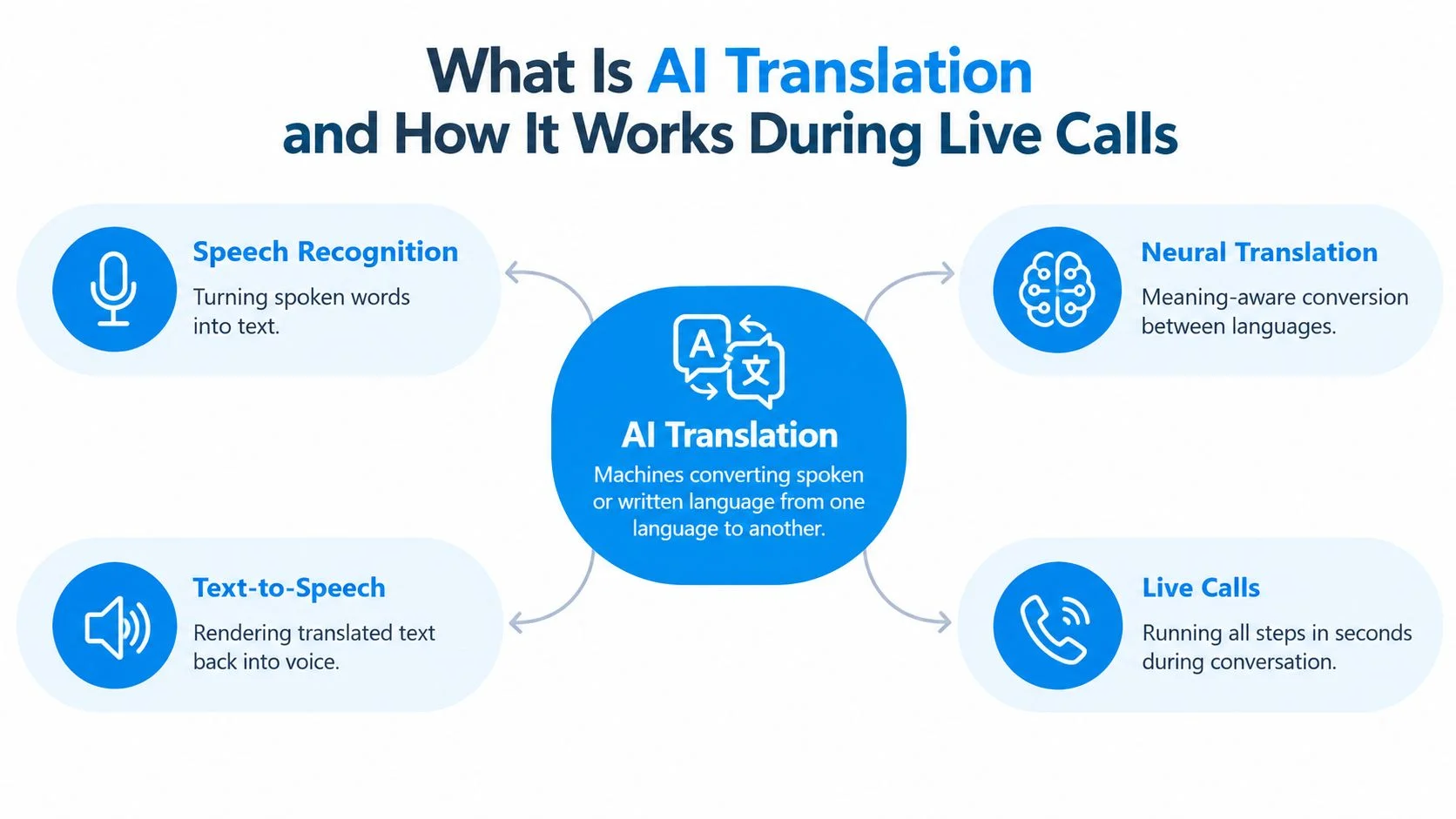
AI translation is the use of computational models to convert text or speech from one natural language into another. During a live call, it works as a connected process that captures speech, turns it into words, translates those words, and returns the result as audio or captions.
From spoken words to translated conversation
Suppose you speak in English to someone who speaks another language. The system usually performs these steps:
- Speech capture: A microphone records your voice and separates speech from silence or background sound.
- Speech recognition: Automatic speech recognition, or ASR, converts the audio into text.
- Neural translation: A machine-learning model converts the source-language text into the target language by using patterns and context from multilingual examples.
- Delivery: The translated text appears as bilingual captions or passes to text-to-speech software, which generates spoken audio for the other person.
The listener's reply travels through the same process in reverse. That means live translation isn't one magic language engine. It's a chain, and each link can affect the final result.

Why live calls differ from typed translation
Typed translation starts with visible text. Live calling starts with sound, which may include accents, hesitation, overlapping speech, poor audio, and background noise. The system must first determine what was said before it can determine what it means.
Modern translation is also fundamentally data-driven. Rule-based systems once depended on manually encoded vocabulary and grammar. Statistical machine translation became prominent during the late 1980s and 1990s because systems could estimate likely translations from parallel texts, or documents available in two languages. The academic history of machine translation explains how that shift led toward the machine-learning methods used today.
If you want a broader introduction to using AI for language learning, the Gaeilgeoir AI guide for beginners offers useful context. For live calling, the practical details are covered in this guide to live call translation, including how captions and translated speech fit into a conversation.
How Speech Recognition, Translation, and Synthesis Chain Together
Live AI translation depends on three main stages, automatic speech recognition, neural machine translation, and text-to-speech synthesis. Each stage can introduce a different kind of mistake, so a fluent translated sentence doesn't prove that the original meaning was preserved.
Stage one reads the sound
ASR listens to the caller and produces a transcript. It may mistake a person's name, a street address, a technical term, or a short word such as “not.” If the transcript says the wrong thing, the translation stage receives incorrect input and may produce a polished version of that error.
That's why call testing should examine more than whether the output sounds natural. Quality assurance should check names, numbers, dates, negation, account identifiers, and domain-specific vocabulary.
Stage two interprets the words
Neural machine translation uses learned relationships between languages rather than looking up every word in isolation. It can use surrounding words to select a likely meaning, but ambiguity remains difficult. Idioms, cultural references, code-switching, and specialized language can lead to a translation that sounds reasonable while changing the speaker's intent.
Researchers commonly use word error rate, or WER, to evaluate speech recognition and measures such as BLEU, TER, and METEOR to evaluate translation. National Institute of Standards and Technology evaluation work on spoken translation shows why live systems need separate recognition and translation checks.
BLEU compares a machine output with one or more reference translations by measuring overlapping word sequences. It produces a score from 0 to 1, and a higher score generally indicates more overlap, but it can undervalue a valid paraphrase or fail to capture meaning in a specific conversation. The original BLEU paper describes why the metric was created as a fast, language-independent way to compare systems.
Practical rule: Treat automated scores as testing instruments, not as proof that a call translation is safe.
Stage three creates the voice
Text-to-speech turns the translated text into audio. This stage can affect pronunciation, names, rhythm, and the timing of turn-taking. A synthetic voice may sound confident even when the earlier transcript or translation was wrong.
Human review remains important because people can judge whether the output preserves meaning, tone, and intent. The OECD discussion of human assessment for language technologies describes blind testing and direct quality ratings as practical ways to compare translations. In a high-stakes call, showing bilingual captions gives participants another way to notice and correct a suspicious result.
Real-Time Translation Latency and Call Experience
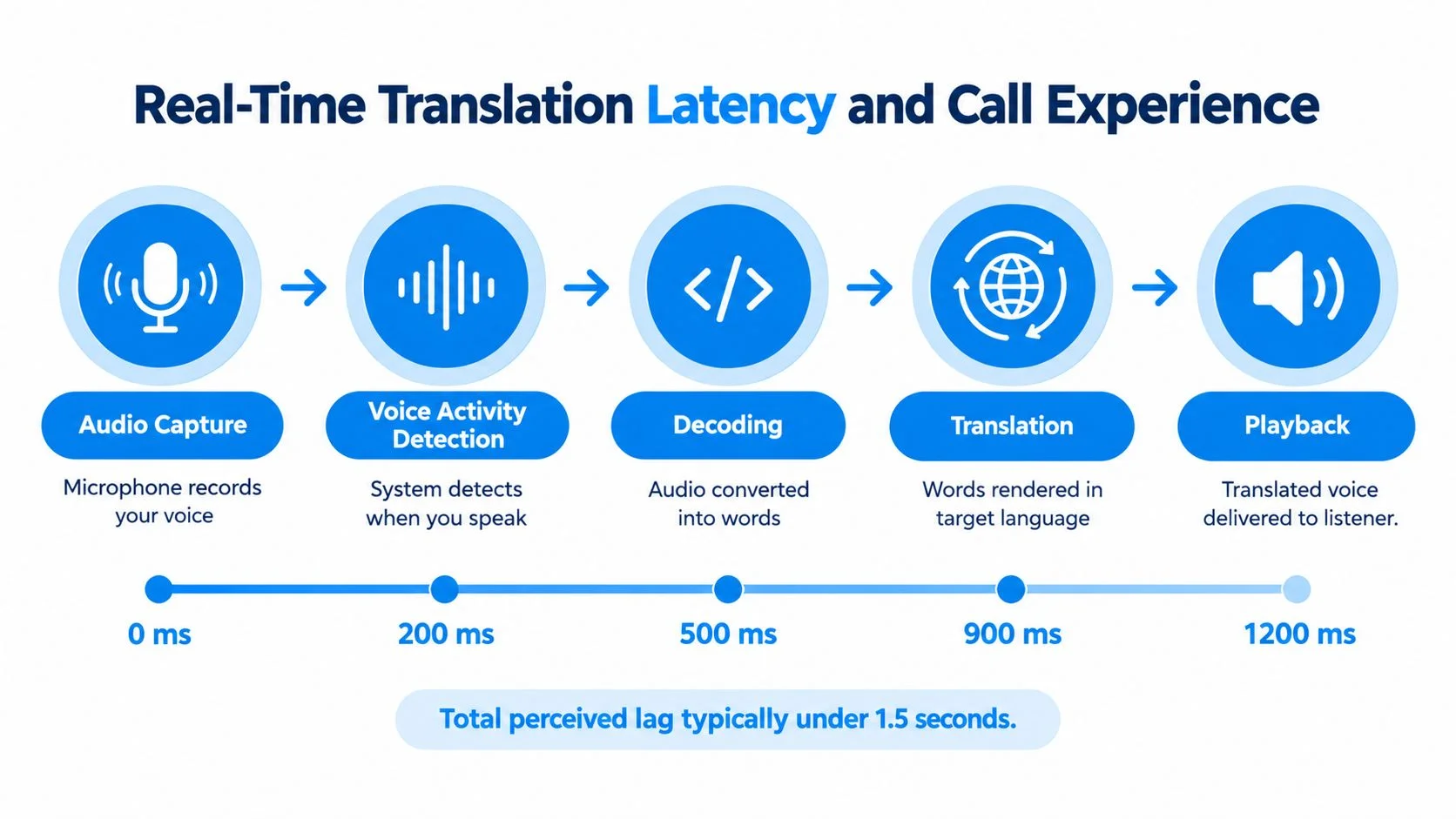
During an international call, one speaker finishes a sentence, then waits for the translated voice to respond. That pause comes from a hidden speech-to-speech pipeline. The system captures audio, detects speech, turns sound into text, translates the text, sends the result across the network, and plays a new voice. One research system reported average end-to-end latency below three seconds. Another measured 2.05 ± 0.31 seconds from speech to translated speech. (Research on latency and quality in speech translation)
What creates the pause
Translation is only one part of the wait. Each stage adds a small handoff, much like a relay race where every runner must finish before the next can start:
- Audio capture collects the speaker's words through the microphone.
- Voice-activity detection identifies speech and pauses.
- ASR decoding changes sound into text.
- Translation inference changes the source text into the target language.
- Speech synthesis turns translated text into audio.
- Network transfer and buffering moves information between services and prepares it for playback.
In the measured pipeline, ASR contributed 1.18 ± 0.21 seconds, translation contributed 0.60 ± 0.09 seconds, and speech synthesis contributed 0.25 ± 0.06 seconds. These measurements explain why a short pause can be normal even when the system is operating correctly.

How callers adapt
A family conversation may accommodate a pause more easily than a supplier confirming an address. Callers often use shorter speech segments, wait for the translated response, and avoid interrupting while the system processes audio. Streaming partial results can make waiting feel shorter, while captions let the listener read before spoken output finishes.
The same evaluation reported WER of 8.28% for non-urgent audio and 10.30% for urgent audio, with BLEU scores of 0.40 and 0.33, respectively. The comparison shows that urgency and speaking conditions can affect both recognition and translation quality.
For payment details, account identifiers, addresses, and other sensitive information, ask the speaker to repeat the detail or confirm it in writing. A fast response with a wrong detail can cause more trouble than a brief delay.
Live AI Translation Use Cases That Fit International Calling
Live AI translation is most useful when it helps people complete an ordinary conversation without requiring both sides to learn the same language or install the same software. It works best as decision support, with human confirmation for details that carry financial, legal, medical, or emotional consequences.
Family and personal calls
A relative may speak a regional dialect, switch between languages, or use expressions that don't translate directly. Captions can help family members catch names and places, while translated audio keeps the exchange conversational.
The technology can also reduce friction for diaspora families. One person can speak naturally, the other can respond in their preferred language, and both can pause when a phrase sounds unclear. Humor, affection, and culturally specific expressions still need patience because a literal translation may miss the intended feeling.
Suppliers, clients, and support teams
A small business may use live translation for an initial supplier conversation, a delivery update, or a routine customer-support request. The system can help participants identify the subject of the call and agree on next steps, but written confirmation should follow any important commitment.
Teams researching cross-border hiring or regional operations may also benefit from practical resources such as this guide to hiring developers in Latin America. The same principle applies to calls with overseas contractors: translation can open the conversation, while people should verify responsibilities, dates, and technical requirements directly.
Travel and remote work
A traveler can use translated calling to contact accommodation providers, local services, or a workplace. A remote worker may need to reach a client or family member from a browser rather than asking everyone to adopt a shared calling application.
Calling costs should remain easy to understand when translation is optional. A service may charge the phone call by the minute and add translation as a separate per-minute feature, with billing rounded up to the whole minute. Before dialing, check the live phone call translator comparison guide and the applicable rate information rather than assuming translation is included.
Use live translation to establish shared understanding. Use a human check to finalize important facts.
Privacy, Trust, and Accountability in Live Call Translation
AI translation isn't only an accuracy question. It also raises questions about where voice data goes, whether a transcript is created, how long information remains available, and who must act if a mistranslation causes harm.
Follow the data path
A live speech system may transmit audio to cloud infrastructure, convert it into text, translate that text, and then synthesize or display the result. Each step can introduce a different privacy or security consideration. A caller may think they're having a temporary conversation while the system creates captions or a transcript that persists in call history.
Before using translation, look for clear answers to these questions:
- Recording: Is the audio recorded, or does the system process it without retaining the recording?
- Transcription: Is a transcript created, and can participants access or delete it?
- Storage: How long do audio, captions, and translated text remain available?
- Access: Which people, services, or administrators can view the call content?
- Control: Can users disable storage or transcription when the conversation is sensitive?
These questions matter during a family call, but they become more serious when people discuss medical information, legal terms, financial details, supplier negotiations, or customer records. Users should avoid sharing unnecessary sensitive information and should understand whether captions or transcripts persist after the conversation.
Fluent output can still be wrong
A polished voice encourages trust. That creates a risk because listeners may accept a confident sentence without checking the source meaning. Privacy research on real-time speech systems identifies a trade-off among response speed, accuracy, accents, noise, connectivity, and the handling of voice data. (Research on privacy and responsibility in AI translation)
Accountability should therefore be explicit. If a translated instruction could affect money, health, legal rights, identity, or safety, participants should repeat the key fact, spell names aloud, or confirm the result in writing. A human interpreter should handle conversations where a mistake would carry serious consequences.
Trust should come from visible controls and deliberate confirmation, not from a natural-sounding synthetic voice.
Language Coverage, Accuracy Limits, and When to Verify Details
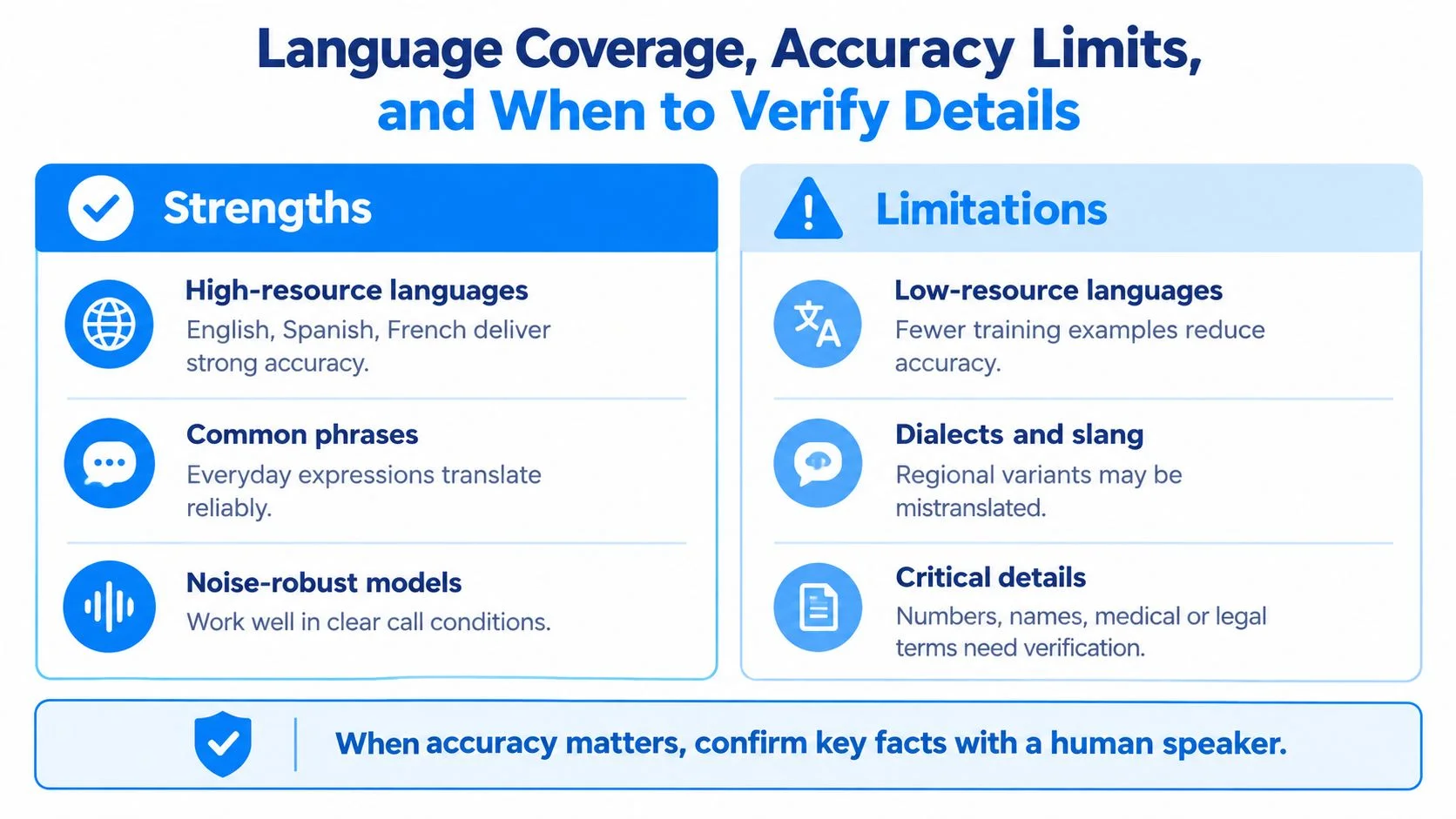
A live call can sound natural while the meaning is still wrong. AI translation quality depends on the language pair, dialect, speech conditions, and every stage of the speech-to-speech pipeline. High-resource languages usually have more digital training material. Low-resource languages, regional varieties, idioms, and code-switching can produce less reliable results.
Language availability isn't equal quality
A language in a product menu does not guarantee faithful conversation. Researchers working on four African low-resource languages reported improvements of up to 9.8% in BLEU and 4.3% in METEOR over earlier baselines, while still describing major accuracy gaps for languages such as Igbo and Nigerian Pidgin. (Research from the Low-Resource Southeast Asian and African Machine Translation workshop)
A separate 2025 study reported generative zero-shot BLEU scores of roughly 20 to 25 for English to Swahili, English to Bengali, and Spanish to Nepali. Results varied by language pair, so a successful test for one route does not establish equal performance for every route. (Research on generative zero-shot translation)
Live speech adds another layer of uncertainty. Accents, background noise, interruptions, unusual names, and unstable connectivity can affect speech recognition before translation starts. The system may handle a clear, familiar phrase well, then misread a fast idiom spoken in a regional dialect. A recognition error can pass into translation and then appear as a confident synthetic sentence.

Use a simple verification routine
Before calling, identify the language variety and the terms most likely to affect the discussion. During the call, use captions when available and slow down for names, addresses, numbers, and specialized vocabulary.
Verify these details directly:
- Names and identifiers: Ask the speaker to spell names, company names, reference numbers, and email addresses.
- Dates and times: Repeat them in a shared format and state the time zone.
- Addresses and payment details: Confirm each part separately.
- Medical and legal language: Use a qualified human interpreter when an error could affect treatment, consent, rights, or obligations.
- Idioms and cultural expressions: Ask what the speaker means when a phrase sounds unusually literal, harsh, or confusing.
Bilingual captions and transcripts make review easier, but they do not replace someone who understands the source language and context. The guide to AI call-translation accuracy provides practical questions to consider before relying on translated speech.
AI translation can keep an international call moving when language would otherwise stop it. Treat it as an assistant, not an unquestionable authority.
Trust should come from visible controls and deliberate confirmation, not from a natural-sounding synthetic voice.
Make an international call with BubblyPhone from any browser, with optional live AI translation. The person you call needs no app or account, credits start at $5 and never expire, and current calling rates are available before you dial.