International Calls Prepaid: How Credit Becomes Minutes
Table of Contents
- Billed minutes for common call lengths
- Why brief calls can cost more
- Controls that prevent avoidable spending
- Recognize the expiry model
- Prepaid credit vs monthly subscription
- Calculate the break-even point
- Run a pre-purchase checklist
- Test conversation quality, not just connection
- Prepare credit and the destination
- Connect and manage the call
- Separate known contacts from unsolicited calls
You need to call family abroad or reach an overseas office, but you don't know how much credit to buy. Prepaid international calls let you pay in advance and spend that balance as you call, but the minutes you're billed for can exceed the time you spend talking.
Before topping up, check the destination's live rate, the number type, and the billing increment. Those checks matter more than the headline top-up amount, especially when you're making short calls or waiting on automated menus.
How Prepaid Credit Turns Into Billed Minutes
A prepaid international call draws credit from your balance according to its billed duration. Our calls are charged when they end, per minute, rounded up to the next whole minute.
Think of the balance as a fuel gauge, except every started minute burns a full unit. A call that runs just one second past a minute uses two billed minutes, even though you barely entered the second one.
Billed minutes for common call lengths
The following calculations apply whole-minute rounding. A “unit” means one minute at the applicable destination rate, not a fixed currency amount.
Balance used = billed minutes × the applicable per-minute rate. That rate is determined by the destination and number type, so a landline and mobile in the same country needn't cost the same.
The distinction between actual minutes and billed minutes isn't just accounting terminology. The ITU's proposed roaming indicators track them separately, a useful model for checking whether a balance deduction matches the billing rule.
Why brief calls can cost more
Say you make ten check-in calls lasting 30 seconds each. You've spoken for five minutes, but whole-minute rounding produces ten billed minutes; one uninterrupted five-minute call produces five.
That doesn't mean you should keep a finished call open. It means repeated short calls carry more rounding overhead than a single conversation with the same total speaking time.
Practical rule: Estimate rounded minutes before dialing, then compare the balance deduction with that estimate afterward.
Save the call duration, destination number, and displayed rate when checking a charge. If the deduction looks wrong, those details help distinguish a rounding effect from an unexpected number classification or rate.
For frequent calls, pay particular attention to how many conversations end shortly after a minute boundary. You don't need to rush a conversation, but you should know what each started minute costs.
Costs That Drain a Prepaid Balance Faster Than Expected
A call to a bank can start costing money before you reach an adviser. Recorded menus and queue time count as connected time, so a five-minute hold uses five billed minutes. Have account details ready, know which menu options you need, and check opening hours before calling.
Premium-rate destinations can cost far more than ordinary landlines or mobiles. Ofcom's guidance on scam calls and messages flags UK high-cost and premium-service ranges including 070, 076, 084, 087, 090, 091, and 118. Treat these as UK-specific warning signs. Other countries use different numbering arrangements, so check the exact prefix and destination against the live rate table before adding credit.
Whole-minute rounding can also affect the balance, as explained in the previous section. For this section, the key extra cost is time spent connected without speaking.
Controls that prevent avoidable spending
- Check the number type: Confirm the destination classification and rate before calling. If the number is premium, unfamiliar, or absent from the rate table, verify it before connecting.
- Prepare for menus and queues: Gather the details you need and decide which questions to ask. This can reduce time spent listening to recorded options or waiting on hold.
- Combine routine questions: Ask related questions in one conversation to avoid spending additional connected time on separate calls.
- Set a spending ceiling: Decide how much credit you're willing to use, then end the call if it reaches that limit.
Prepaid credit caps the available balance, not the cost of a particular destination. Check the live rate table before topping up, then watch how long the call remains connected.
Expiry Rules and What Happens to Unused Credit
A balance left after a call may still have a clock attached to it. Prepaid describes how you pay; the validity period is a separate term you must check. Before buying, find out whether unused credit expires and what event, if any, starts or resets the expiry period.
The FCC's guide to prepaid phone cards advises checking whether advertised minutes apply across multiple calls or only one. It also explains that international prices can vary by destination and by how the call is placed.
Recognize the expiry model
Expiry rules vary by provider. Check the written terms for the expiry date or inactivity period, what action preserves the balance, and whether paid and promotional credit follow different rules.
Single-call products need particular care. If an offer provides minutes for one call only, ending the call early may forfeit the unused time instead of leaving it available for another call.
A balance displayed in an account isn't enough. Confirm that it remains spendable and whether it can be used across multiple calls.
Before paying, check the expiry terms, unused-balance refunds, bonus-credit conditions, and whether the product supports multiple calls. Keep the terms with your receipt. If the credit has an end date, record it. If inactivity triggers expiry, note the qualifying activity rather than assuming that signing in will preserve the balance.
Prepaid vs Monthly Subscription for International Calls
Prepaid usually suits occasional or irregular international calls, while a subscription can suit steady, high-volume calling to the same destinations. The deciding figure is your monthly billed usage, not how often you intend to call.
With prepaid, you buy credit and consume it through calls. With a subscription, you pay a recurring fee even during quiet months, and the plan may still charge separately for excluded destinations or usage.
Prepaid credit vs monthly subscription
Consider a hypothetical family that calls a parent abroad for about 20 minutes twice a month. If both calls end at those durations, that's 40 billed minutes, with no reason to pay for a larger allowance unless the subscription's total cost justifies it.
A business calling the same overseas supplier every working day has a different calculation. A suitable plan might reduce spending, but a finite allowance can also run out, leaving additional calls chargeable.
Calculate the break-even point
For a simple subscription covering your destination without extra usage charges:
Break-even minutes = monthly subscription fee ÷ prepaid per-minute rate.
Compare that result with your actual rounded minutes. If the plan has an allowance, setup charges, or excluded number types, include those before deciding.
A traveler making a few calls per trip generally benefits from flexibility. A business with predictable calling may prefer a recurring plan, provided the destinations and number types match its contacts.
Our prepaid versus postpaid guide explains the broader payment-model distinction. For the purchase decision, log two months of real call durations and destinations rather than estimating from memory.
Don't subscribe because you expect to become a frequent caller. Subscribe only when your recorded usage supports the commitment.
How to Compare Providers Using Their Rate Tables
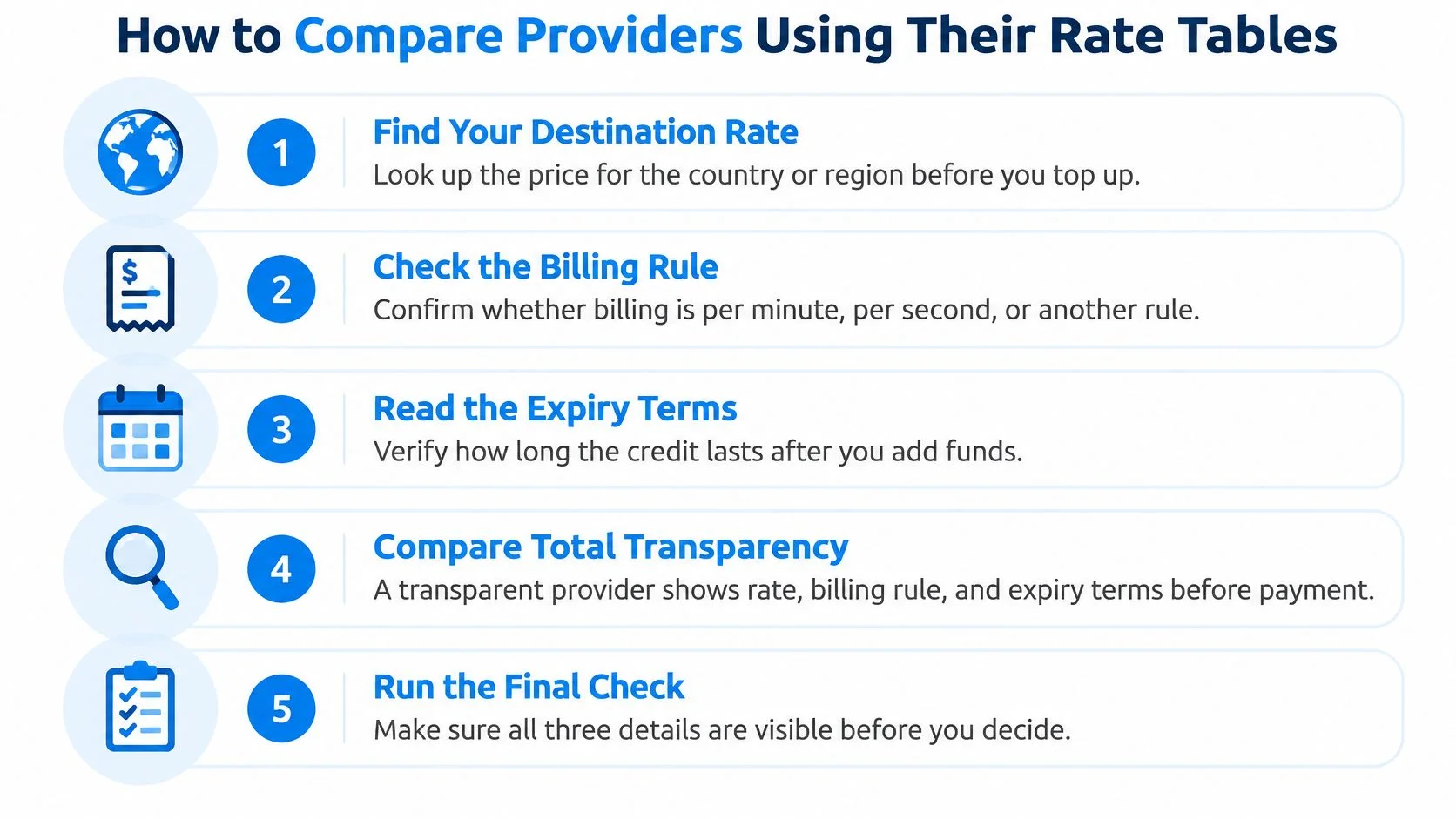
A transparent provider lets you establish the destination rate, billing rule, and expiry terms before you top up. If you can't predict how a call will consume credit, a low advertised price isn't enough.
Use the live international rate table to identify the exact country and number category you need. Don't compare a landline listing with another service's mobile listing and assume they describe the same call.

Run a pre-purchase checklist
- Exact destination rate: Find the price for the full number's category, not just the country headline. Check whether special prefixes receive separate treatment.
- Billing increment: Establish whether calls use whole-minute rounding, per-second charging, or another increment.
- Additional fees: Look for connection or setup charges and any stated treatment of failed calls.
- Top-up mechanics: Confirm the minimum purchase, accepted payment methods, and when successful payment becomes usable credit.
- Credit conditions: Read expiry, inactivity, and refund terms together. Promotional credit may have separate restrictions.
- Recipient requirements: Establish whether the other person needs an app, account, or particular device.
- Coverage: Confirm support for the destination and for the specific mobile or landline number.
- Audio quality: Test a known contact before committing to a long conversation. Listen for delay, echo, missing syllables, and dropouts.
A provider that answers every item clearly is easier to budget for than one that hides a key condition until checkout. Our guide to transparent calling prices explains why visible rates need equally visible billing terms.
Test conversation quality, not just connection
A call can connect successfully yet remain difficult to use. Repeatedly talking over each other is a warning sign of delay, even when the voice sounds clear.
An ETSI-hosted evaluation citing ITU-T G.114 describes one-way mouth-to-ear delay below 150 ms as acceptable, 150–400 ms as increasingly impairing, and above 400 ms as generally unacceptable.
You don't need laboratory measurements to notice a difficult conversation. If gaps or echo appear, try a different network or audio device before a long call.
Save the rate entries for your main destinations. Compare how many rounded minutes a top-up buys, not just how much credit the checkout displays.
How to Top Up and Place Your First Call
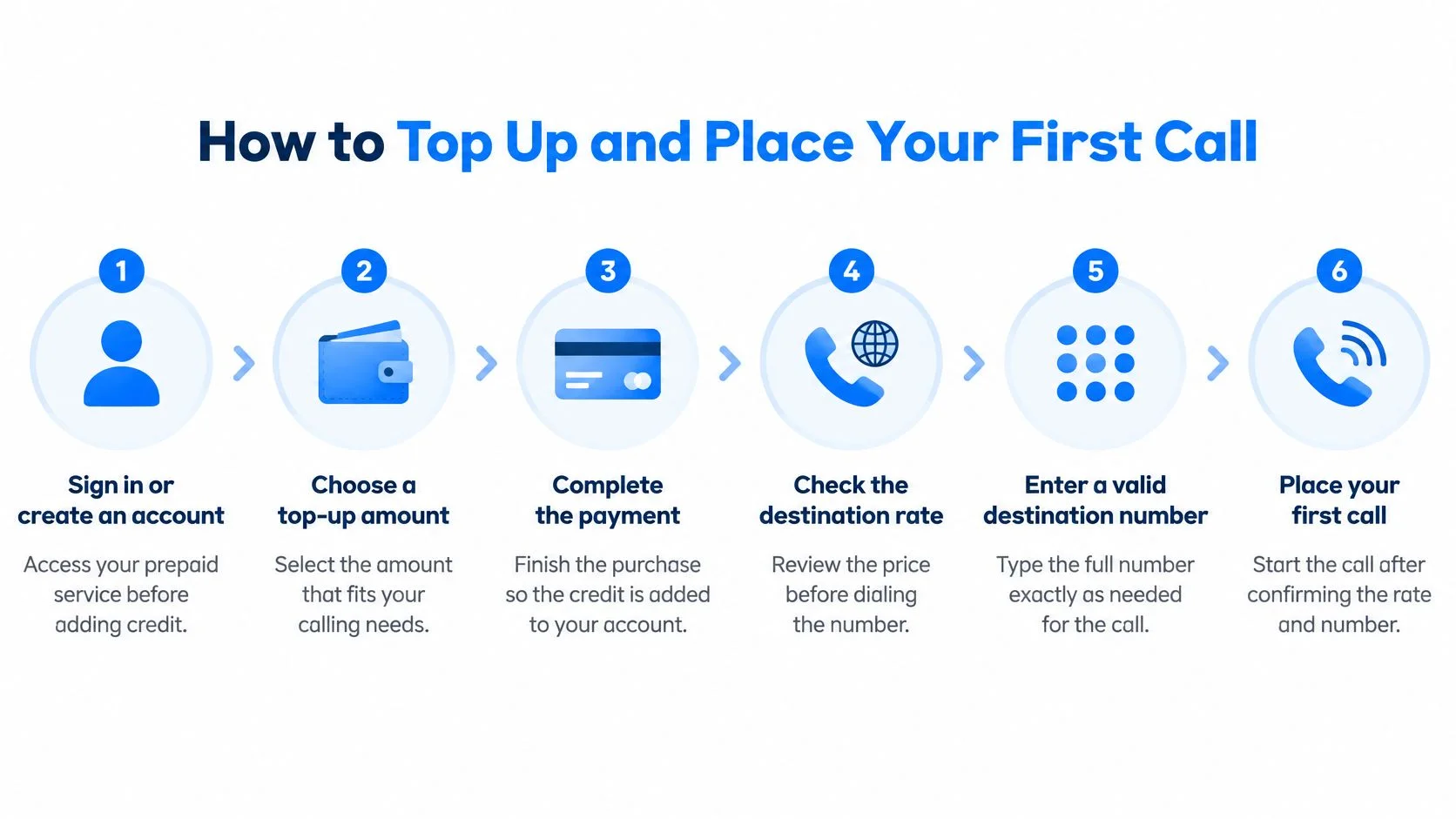
A first call is easiest to manage when the rate, number format, and microphone are ready before you spend credit. BubblyPhone's browser dialer makes outbound calls over Wi-Fi or mobile data, so the recipient needs only a regular phone number.

Prepare credit and the destination
- Create or access your BubblyPhone account. Register or sign in at bubblyphone.com to use the browser dialer.
- Top up your balance. Add at least $5 using an available payment method. Credit is delivered immediately after successful payment, and calling has no subscription.
- Check the rate before dialing. Select the destination and number type in the live rate table. Rates can differ by country and prefix, so confirm the specific entry before choosing a top-up.
- Enter the full international number. Use the plus sign, country code, and complete national number. Remove a domestic trunk prefix where required. For example, a UK mobile written with an initial
07becomes+44 7followed by the remaining digits.
The ITU's E.157 recommendation describes the structure of international calling-party numbers: country code, national destination code, and subscriber number. Use the destination's complete international format so the number routes correctly.
Connect and manage the call
- Test with a known contact. Allow microphone access when prompted, then confirm both people can hear clearly. If there's silence, check the selected microphone and speaker before redialing.
- Keep connected time in mind. Automated menus use credit too. Have documents ready before calling a bank or public office, and avoid staying on a menu longer than necessary.
BubblyPhone bills calls by the minute, rounded up to the next whole minute, with no connection fee. See the earlier billing explanation for how that rounding affects a call's cost. For the payment steps, follow this guide to topping up BubblyPhone credit.
Callback Scams and Spoofed Caller IDs
A missed call from an unfamiliar international number can be a callback trap. The ITU's telecommunications fraud guidance describes Wangiri fraud, where brief calls are intended to prompt recipients to call back, potentially at a high rate. Caller ID alone does not establish who called.

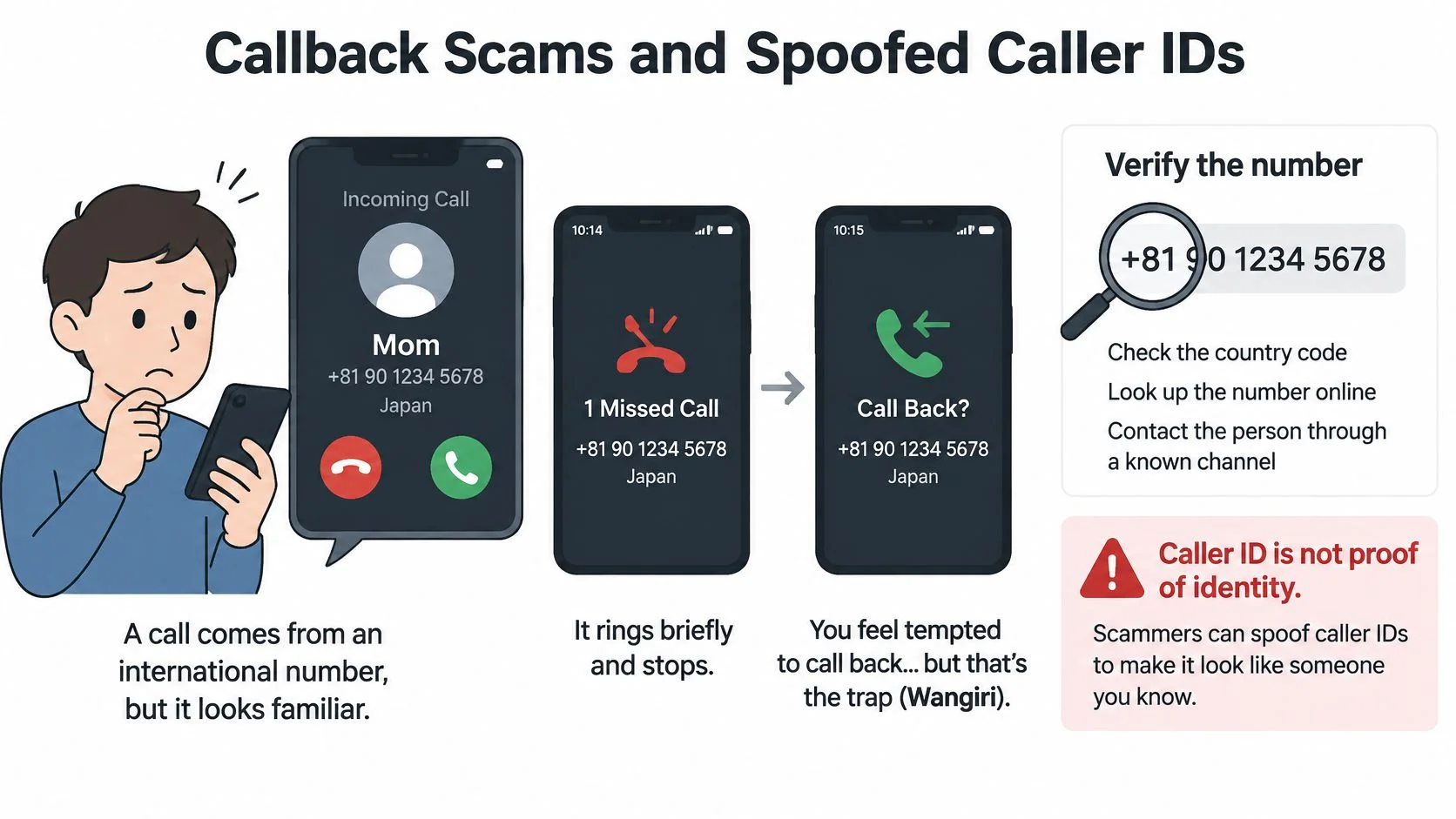
Separate known contacts from unsolicited calls
A familiar country code, local-looking number, or urgent voicemail can be spoofed. Before returning an unexpected international missed call, confirm the attempt through a channel you already trust.
For a call claiming to come from a bank, supplier, or public office, compare the number with the organization's published contact details. Use that independently obtained number to check requests for payment, credentials, or changes to bank details.
- Look up the number carefully: Online warnings can be useful, but no complaints do not prove a number is legitimate.
- Verify payment requests independently: Contact the organization using its published number before sharing information or approving a transfer.
- Report suspicious calls: Give your calling provider and local regulator the displayed number, approximate call time, and a description of what happened.
Tell family or business contacts when to expect your call, using a channel they already trust. That gives them a way to check an unexpected call without relying on caller ID.
Confirm the Rate, Then Make Your First Call
A long automated menu can use more prepaid credit than expected: calls are billed in whole minutes, so any part of a minute is charged as a full minute. Check the live rate for the exact destination and number type before topping up. Prefixes can change the price, too.
For a first call, choose a number you can reach without a long wait. A brief test can reveal whether the audio works well on your connection before you rely on it for a time-sensitive call.
BubblyPhone lets you call landlines and mobiles in 200+ countries through a browser, using Wi-Fi or mobile data rather than your carrier's international rates. The recipient does not need an app or an account.
A larger top-up may include bonus credit, but a bonus is useful only if you expect to use the balance. Match the amount you add to the destinations and call lengths you need.
Check the rate, add credit from $5, and make your next international call with BubblyPhone. Credits do not expire, and there is no monthly calling subscription.