How Much Do International Calls Cost in 2026
Table of Contents
International calls in 2026 typically cost anywhere from a few cents to several dollars per minute, depending on the destination, number type, and provider. Recent rate indexes put median prices at 0.47 per minute for landlines** and **0.56 for mobiles, but the only reliable way to price a specific call is to check a live rate table before dialing.
That wide range explains why one person can make an overseas call for a modest amount while another receives a surprisingly large bill for a short conversation. The destination country, mobile or landline termination, connection fees, and rounding rules all affect the final charge. A headline “per-minute rate” is only the starting point.
The Short Answer on International Call Costs in 2026
You dial a number abroad expecting a short, inexpensive conversation, then find that the bill reflects far more than the minutes spoken. International calls can cost a few cents per minute on some routes, while calls to expensive mobile, premium, remote, or satellite destinations can reach several dollars per minute. The number on the rate card is only one part of the calculation.
A 2026 rate index reports median destination costs of 0.47 per minute for landlines** and **0.56 for mobiles. Its regional figures also show how strongly location changes the result, with Europe at a median of 0.085** and Oceania and the Pacific at **0.94 per minute. These are market snapshots, not a fixed global tariff.
The same index found that mobile termination costs more than landline termination in 124 of 219 destinations. A separate 2026 index reports a median country price of 0.70 per minute**, with **21% of countries at 0.10 or less. Together, those figures show why the country alone cannot predict your final charge.

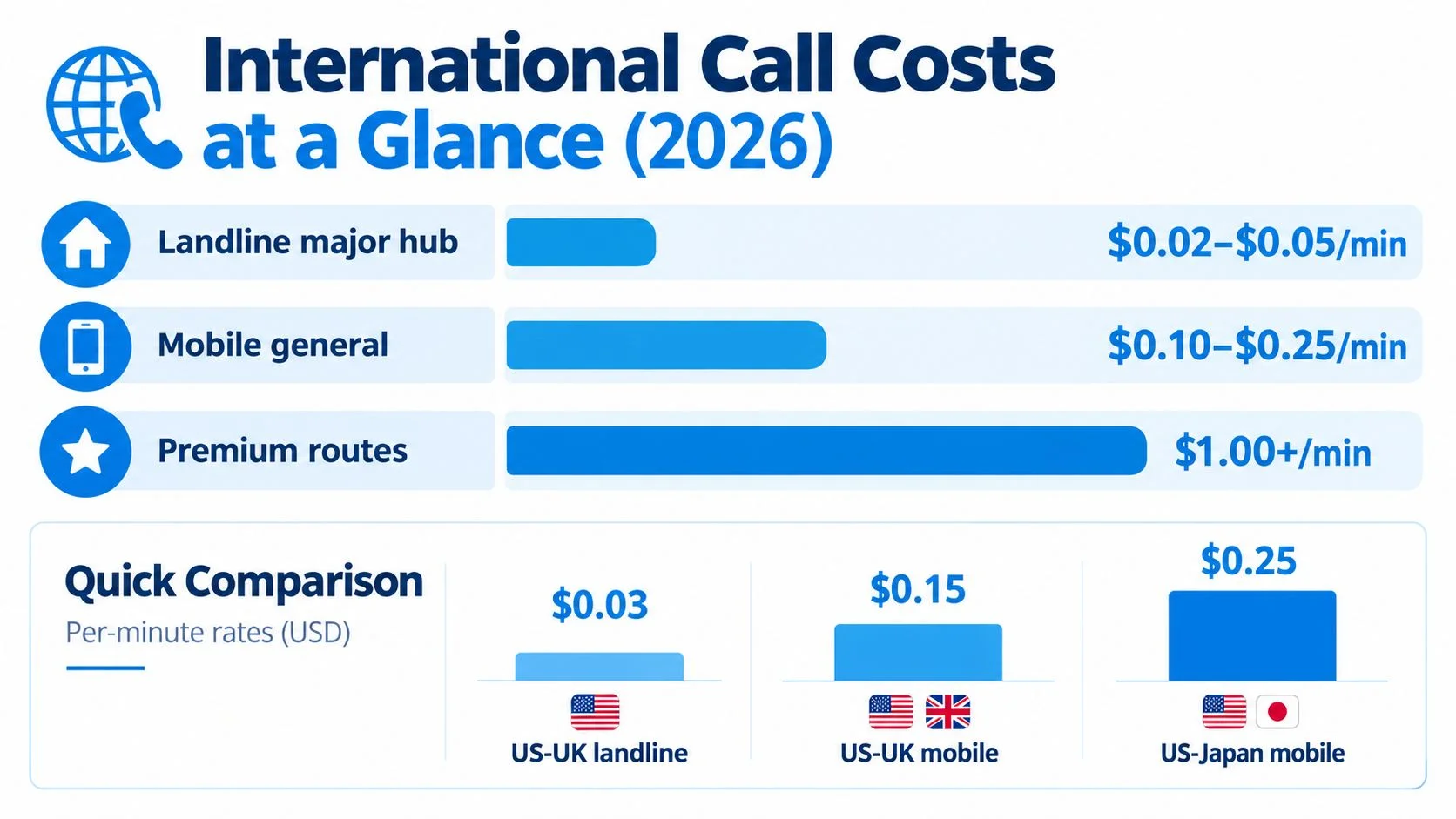
The practical answer is to check the current rate for the exact country and number type before you call. A mobile and a landline in the same country may use different pricing tiers. Premium and special-service numbers can cost more than ordinary fixed lines. Connection fees and whole-minute billing can also raise the charge for a short call, even when the advertised per-minute rate looks low.
Practical rule: Treat “international calls cost X per minute” as incomplete. Check the destination, number type, billing increment, and any connection fee.
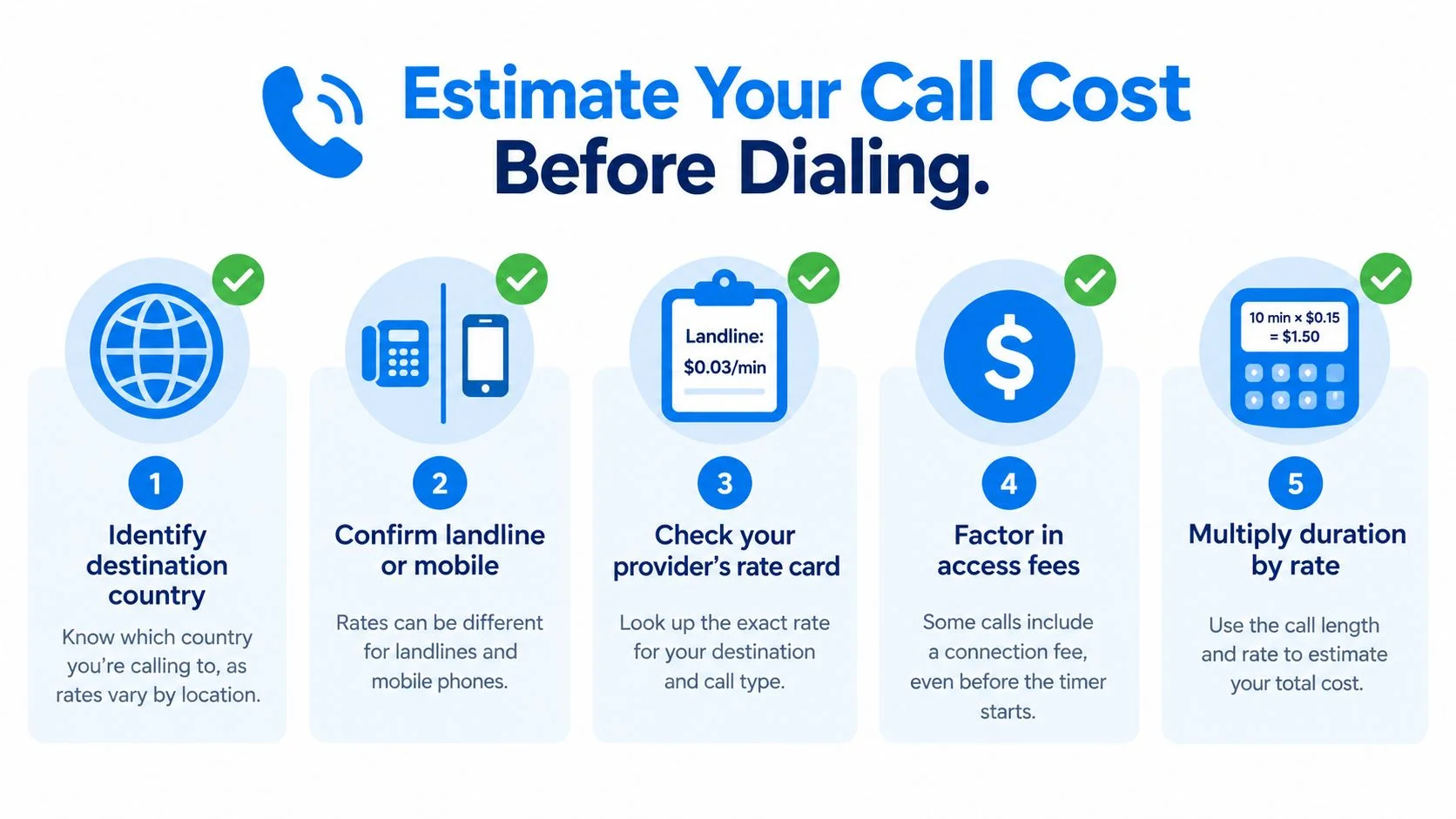
Before dialing, identify the country, confirm whether the number is fixed or mobile, find the live rate, review the billing policy, and estimate the call length. That approach gives a more realistic bill estimate than a broad average.
Why International Calls Cost What They Cost
A call from New York to Berlin can follow a path much like an envelope crossing a border. One network carries it toward Germany, then a local network delivers it to the recipient. The first part may travel over the internet, but the final handoff still depends on the destination's telephone infrastructure.
An international call usually has two broad legs:
- The originating and transport leg, which carries the call from the caller through internet or carrier infrastructure.
- The termination leg, where a local phone network delivers the call to the recipient's landline or mobile.
The transport portion is often relatively inexpensive. Much of the underlying cost appears at the far end, because the provider must pay an operator that can reach the specific destination number. The ITU benchmarking guide identifies destination-side termination fees as a major part of international calling prices. The provider then adds its own margin and may apply separate billing rules.


A provider may not connect directly to every network in every country. It may use another operator to complete the final handoff. Each routing arrangement can influence the retail price, particularly in markets with limited connectivity, remote geography, or specialised number ranges.
Why remote routes and mobiles cost more
A call to a major urban fixed network may have several available routes. A call to a remote territory or restricted network may have fewer, which can increase the termination cost and the rate shown to customers.
Mobile calls can also cost more because the receiving network terminates them through wireless infrastructure rather than a fixed line. As noted earlier, mobile termination costs more than landline termination in 124 of 219 destinations. The country name alone therefore cannot reveal the final price.
The bill reflects several layers at once: the destination network, the number type, the route used for completion, and the provider's pricing model. Connection fees and billing increments can raise the effective cost of a short call even when the advertised minute rate appears low.
For a plain-language explanation of the mechanics, read how international calling rates are calculated.
The Main Factors That Change Your Per-Minute Rate
You check a country rate, make a short call, and still see a higher charge than expected. The difference usually comes from the call's destination details and billing rules, not from distance alone. Destination, number type, fees, and billing increments all influence the number on your bill.
Destination country
The country establishes the starting price tier because each destination has its own networks, regulations, routing options, and termination costs. Prices can also change as more carriers gain access to a route. Historical data shows how sharply international calling prices have moved: a World Bank paper citing TeleGeography data reports that the average retail price fell from 1.57 per minute in 1983** to **0.42 in 2001. On competitive routes, New York to London fell from 0.30 in 1997** to **0.04 in 2003, while Santiago to Miami declined from about 1.60** to roughly **0.15 per minute over the same broad period.
Those drops followed greater competition on routes after markets were liberalized, along with expanded network access. That history does not mean every route is inexpensive today. Current rate indexes still show wide differences between destinations, so the country name gives you a starting point, not a complete quote.
Landline versus mobile
The number type can change the price even when the country remains the same. Mobile termination often costs more than fixed-line termination because the receiving carrier completes the call through wireless infrastructure. One carrier pricing document notes that calls ending on international mobile or wireless devices may carry an additional per-minute charge (international mobile termination documentation).
Check the number itself before dialing. A mobile number may be identified by its prefix, while a household or business number may belong to a fixed-line range. If the prefix is unclear, ask the recipient which type of number they use. A country can therefore have several rates for what appears to be the same destination.
Special number ranges
Ordinary landlines and mobiles are only part of the picture. Toll-free, premium-rate, satellite, and special-service ranges may each have separate pricing. A premium route may cost a dollar or more per minute, and some satellite destinations can reach several dollars per minute. Use the live rate table for the exact number range. An ordinary country rate is not a reliable estimate for a special number.
The FCC's basic-rate guide shows how widely standard rates can vary. One carrier comparison includes 1.55 per minute to Canada** and **5.00 per minute to China (FCC guidance on international basic rates). These figures are examples from that comparison, not universal current prices.
Connection fees
A provider may charge a flat fee when the call connects. Because the fee applies once per call, it has the greatest effect on short conversations. A low advertised minute rate can produce a high effective cost when a setup charge is added.
The ITU guide identifies connection fees and rounding as factors that can raise the effective per-minute price. Search the rate terms for setup fee, connection fee, access fee, or minimum charge. Also check when billing begins, since some services start counting when voicemail answers or the network reports a connection.
Rounding
Per-minute pricing does not always mean that every second is measured precisely. Some services apply a one-minute minimum, then round additional time upward in whole-minute blocks or other intervals. One international long-distance rate sheet states that a call lasting 1 minute and 12 seconds is billed as 2 minutes.
That rule can make a brief check-in cost more than its speaking time suggests. It matters for voicemail calls, quick confirmations, and calls that disconnect shortly after connection. Before dialing, find the billing increment and minimum duration, then estimate the charge using the provider's actual policy.
How Pay-As-You-Go Billing Works
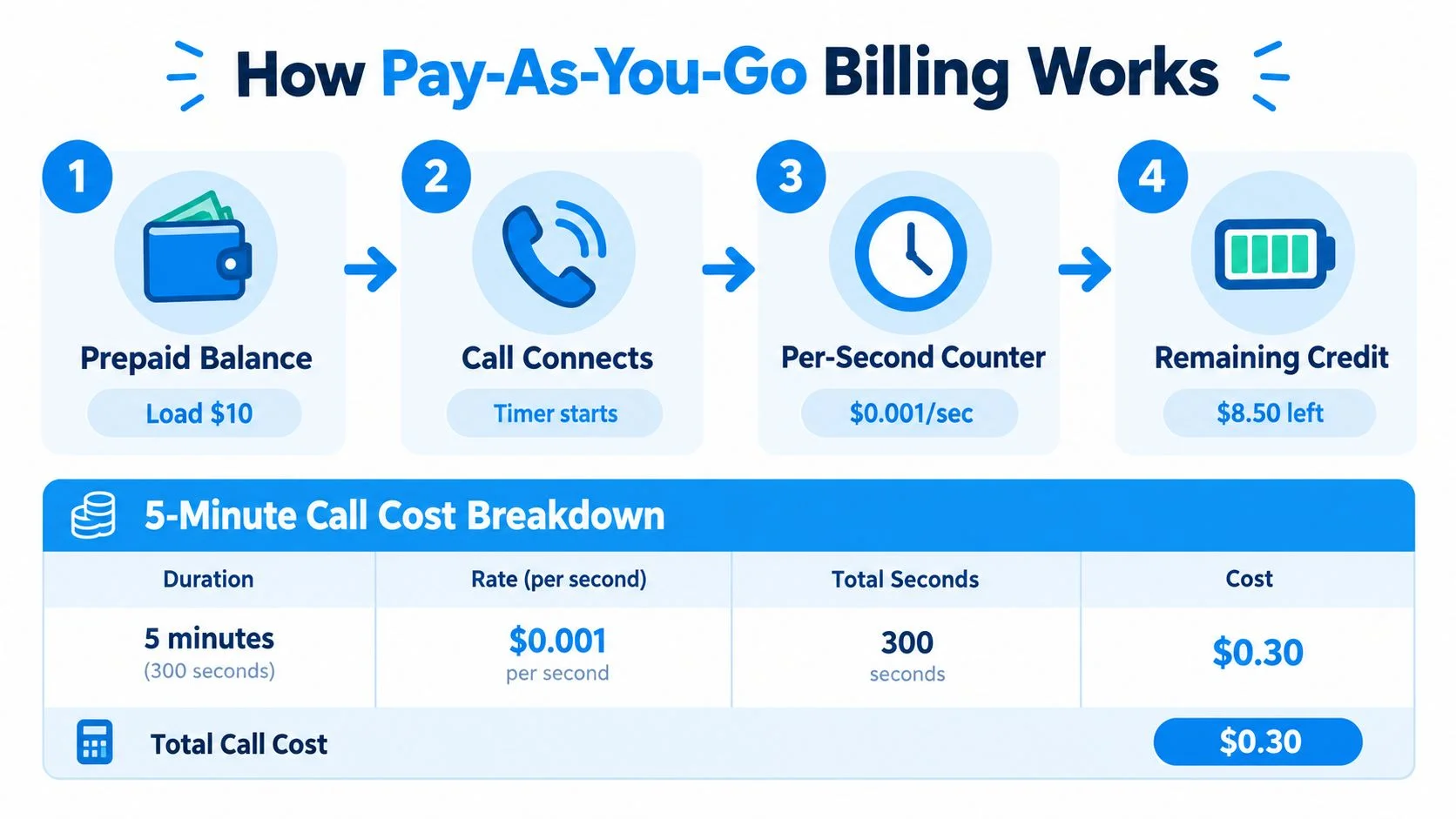
A pay-as-you-go call works like a taxi meter with a starting charge. Your prepaid balance covers the destination rate as the call runs, plus any connection fee. The amount on the bill depends on three moving parts: the number reached, the time the provider counts, and the way it rounds that time.
Suppose a provider quotes 0.04 per minute to the UK**, adds a **0.15 connection fee, and bills a 4-minute 12-second call under a 30/6-second rule. The first four minutes cost 0.16**. The remaining 12 seconds fill two six-second blocks, adding **0.004. Add the connection fee, and the total is $0.314.
This example explains the arithmetic, not a current destination quote. Providers set their own rates, minimum durations, rounding blocks, and connection fees. Check the live rate card and terms before estimating a real call.

The basic calculation
Use this formula:
Billable call cost = billable duration × destination rate + connection fee
The meter may start when the recipient answers, voicemail picks up, or the network reports a connection. An automated system can therefore create a charge before a person speaks.
Pay-as-you-go credits suit occasional callers because they pay for use without a recurring allowance. Monthly plans trade a fixed fee for a set group of destinations or minutes. That arrangement can suit someone calling the same region regularly, although unused minutes can reduce its value.
Roaming tariffs belong to a different billing context from prepaid calling credit. A roaming benchmark should not replace the provider's own pay-as-you-go rate card. For context, BEREC reports average outgoing international roaming voice tariffs of approximately 26.69 euro cents per minute in Q3 2025 (BEREC roaming benchmark report%2028_32nd%20BEREC%20Report%20on%20IR%20BMK%20Data%20and%20TACR_.pdf)). The practical figure for your call still comes from the service's destination, number type, billing rule, and fees.
What International Calls Cost in Real Situations
A weekly family call, a short business conversation, and a traveller calling home can all produce different bills, even when they last the same five minutes. The number receiving the call and the route carrying it matter as much as the country code.
A diaspora caller reaching a relative's mobile may pay a higher termination rate than when the same call reaches a landline. Suppose the mobile rate is an illustrative 0.20 per minute with a 0.10 connection fee. A five-minute call would cost $1.10 before any other charge. If the provider rounds a four-minute-ten-second call to five minutes, the same arithmetic applies. The estimate must use the exact mobile number type, not a single country-wide rate.
A freelance designer calling a client's office faces a different route. A fixed business line may use a landline tier, so the mobile premium may not apply. At an illustrative fixed-line rate of 0.08 per minute, five billed minutes would cost 0.40. A provider that rounds to whole minutes could bill six minutes for a five-minute-and-one-second conversation, raising the call to $0.48. The rounding rule can matter more than a small difference in the advertised rate.
A traveller calling home has two moving parts. The caller's physical location may trigger roaming or access charges, while the destination number may still be a mobile. For example, a 0.15 destination rate for five minutes equals 0.75. Add an illustrative 0.50 access charge, and the total becomes 1.25. Check both the service used to place the call and the number type receiving it.
These figures are teaching examples, not quoted prices. A five-minute international call has no single global cost. One rate index found that the twelve most expensive destinations in its dataset were islands or remote territories, showing how distance, route availability, and termination conditions create many pricing tiers.
Before dialing, check the live international calling rates, then confirm the destination country, mobile or landline status, rounding rule, and any connection or access fee.
How to Estimate the Cost Before You Dial
You are about to call a relative abroad for five minutes. The advertised rate looks simple, but the final charge depends on the route, number type, billing block, and fees attached to the call. Treat the estimate like a taxi fare: the per-minute rate is only one part of the meter.
Start with these checks:
- Confirm the destination. Use the country code and identify the destination network. Your own location does not determine the international rate by itself.
- Check the number type. A landline, mobile, premium number, toll-free number, or special-service line may each have a different charge.
- Read the live rate table. Note the per-minute rate, connection or setup fee, access charge, and any minimum charge.
- Set the expected duration. Record minutes and seconds, then identify the provider's billing block. A service may bill by the minute, by another interval, or by a partial block.
- Apply the billing rule. Round the call up to the next billable block before adding fixed fees.
Use this formula when the provider bills in blocks:
Estimated total = ceil(duration ÷ billing block) × live rate + connection fee
For example, a call lasting just over one billing block is charged as two blocks, even if only a few seconds spill into the next one. That rounding step can change the result more than a small difference in the advertised rate. As noted earlier, benchmark data shows that at least one major US carrier applies international mobile termination charges in one-minute increments.

Check whether peak and off-peak pricing applies, then compare mobile and landline entries for the destination. Enter those details into the international call cost calculator before dialing, and compare the result with the provider's live rate table.
Common Misconceptions About International Calling Rates
A caller can see a tiny rate for one destination and a double-digit rate for another. One index reaches 10.80 per minute**, while another lists a highest destination price of **6.87 (Quikring's 2026 calling cost index, BoraPhone's international rate index). The useful question is not “What do international calls cost?” but “Which details produced this bill?”
Myth one, all international rates are similar
International calling prices spread widely because routes, networks, and number types differ. A competitive destination may cost only a few cents per minute, while a remote or premium route costs much more. These high figures do not describe every call. They show why a country-specific rate table matters more than a single global average.
Connection fees can widen the gap further. Two calls with the same destination and duration may produce different totals if one provider adds a setup charge or marks up access to the route. The displayed per-minute figure is one ingredient, not the whole bill.
Myth two, landlines are always cheaper
Landlines often have lower rates than mobiles, but the pattern changes by destination and number range. A mobile network may be the main way to reach people in a country, while a particular fixed network can carry its own higher termination charge. Compare the actual mobile and landline entries instead of assuming one category always wins.
Myth three, every service bills by the second
Billing rules vary. Some providers charge in whole-minute increments or apply a one-minute minimum, so a brief 30-second voicemail call may appear as a full minute on the bill. Other services use shorter blocks. A published rate sheet illustrates how these rounding rules can change the charged duration.
A Wi-Fi connection also does not make every international call free. It can reduce the cost of carrying the call over the internet, but reaching a regular landline or mobile still involves paid termination. The destination number, routing method, rounding rule, and connection fee determine the final amount.ефон
Practical Ways to Lower Your International Calling Bill
A lower bill begins before you dial. Choose a calling service with a clear destination rate table, use reliable Wi-Fi instead of hotel systems or roaming where possible, and check whether the recipient's number is mobile or landline. The route may reduce access charges, but it does not remove the cost of reaching the destination network.
Use this checklist:
- Compare number types: Read the separate mobile and landline rates. The cheaper option depends on the destination.
- Check fees: Look for connection charges, minimum charges, and access surcharges.
- Review rounding: Match the billing increment to your calling pattern, especially for brief calls.
- Match the plan to usage: A recurring plan can fit frequent calls to one region. Pay-as-you-go avoids paying for unused allowances.
- Watch the access route: Wi-Fi may avoid roaming or hotel-room charges, while destination termination still applies.
BubblyPhone provides browser-based calls to regular landlines and mobiles, so recipients need no app or account. Calls use prepaid credits, bill by the minute, and round up to a whole minute. Credits start at $5 and never expire. The optional dedicated-number plan is its only recurring product.
Make your next international call from any browser with BubblyPhone. Check the live destination rate first, then call without requiring an app or account.