How Call China

Table of Contents
You're probably staring at a Chinese number copied from a contact, wondering whether the leading zero belongs in the call. To call China from abroad, dial your country's international exit prefix, then +86, then the Chinese destination number, with one key distinction: drop the domestic trunk zero for landlines, but keep all 11 digits for mobiles.
The Correct Way to Dial China From Abroad
The complete sequence is international exit prefix + 86 + Chinese destination number. From the United States, that normally means 011 + 86; from countries that use 00, it means 00 + 86. You can also enter the number with the plus sign as +86, allowing your phone or calling service to apply the appropriate international access method.

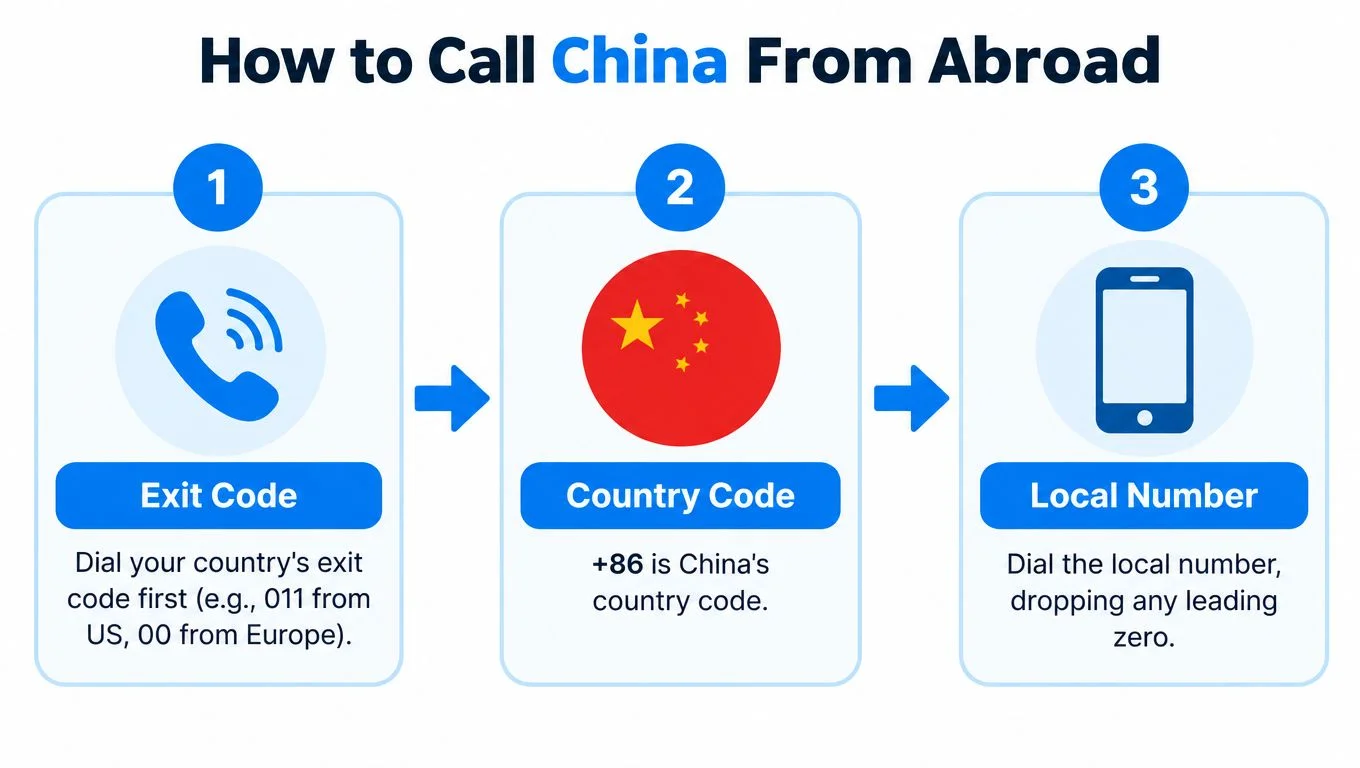
The part that causes most failed calls is the number after +86. Chinese landlines use a domestic area code that begins with 0 inside China. That zero is a domestic trunk prefix, so you remove it when dialing internationally. A Beijing number written domestically as 010 followed by its local number becomes +86 10 followed by the local number. Keeping 010 after +86 adds an unwanted digit and can produce an invalid destination.
Mobile numbers work differently. A Chinese mobile number is dialed in full as 11 digits after +86, and you don't remove its opening 1. If a mobile number is written domestically as 1XX XXXX XXXX, the international form is +86 1XX XXXX XXXX.
Use the destination type as your check
Before dialing, identify whether your contact gave you a fixed-line or mobile number.
- Start with the exit code. Use your country's international dialing prefix, or enter
+when your device supports it. - Add China's country code. China's international code is +86, assigned within the international numbering system and still used for mainland China calls today. China's country-code guidance provides the same core format.
- Format the local number correctly. Remove the leading domestic
0from a landline area code. Keep every digit of a Chinese mobile number. - Check the final string before calling. Look for a repeated
0, a missing1, or an area code copied from a domestic format.
The international dialing guide can help you check the sequence before you spend call credit. It's especially useful when a contact sends a number with spaces, brackets, or a domestic prefix.
Practical rule: If the number starts with a Chinese mobile pattern beginning with 1, preserve the full mobile number. If it includes a city area code beginning with 0, remove only that domestic zero.
Call timing matters after the digits are correct. China uses one national time zone, so check the recipient's local working hours rather than calling whenever it's convenient for you. For business, schedule the call during the recipient's daytime and confirm the appointment in writing if the conversation affects a shipment, payment, or deadline.
Understanding China's Numbering System
China's numbering structure separates landlines by geographic area and mobiles by an 11-digit national format. That difference determines whether you remove a zero or preserve the entire number after +86.
A fixed-line number normally contains a city area code and a local subscriber number. Area codes vary by location, and the domestic form includes a leading 0. When you call from abroad, that 0 identifies domestic trunk access, not part of the international destination number. A Beijing landline therefore uses +86 10 followed by the local number, while a Shanghai landline uses +86 21 followed by its local number.
Chinese mobile numbers don't use a city area code in the same way. They follow an 11-digit structure beginning with 1, so the international form keeps those digits after the country code. Treating a mobile number like a landline can remove a digit the network needs, while treating a landline like a mobile can leave an extra domestic prefix in place.
Why the distinction matters technically
The ITU-T E.164 recommendation defines an international geographic number through a country code and a national significant number. Country codes can contain one, two, or three digits, which is why the country code and the destination number must be handled as separate fields.
International numbering also has a maximum length of 15 digits for the complete number, as described in the E.164 numbering overview. China's +86 format fits within that structure, but a duplicated trunk prefix can still make the number invalid or route it incorrectly.
Save contacts in international format whenever possible. That avoids having to remember whether a number was originally copied from a Chinese address book, a business card, or a local directory. For more background on the identifier itself, use this China country-code reference.
Cultural Etiquette and Best Times to Call
A successful call to China starts with choosing a reasonable local time and opening with a clear introduction. Business contacts usually appreciate a short confirmation before an unexpected call, while family members may prefer a more relaxed conversation once you've established that the connection is working.
China uses a single national time zone, so callers abroad need to convert their own working hours carefully. A convenient morning in Europe may reach China during the afternoon, while an evening call from North America can arrive during the recipient's following morning or late night. Use the best time to call tool before scheduling a business conversation, especially when several people are joining from different locations.
A practical business opening
Suppose you're calling a supplier about a delayed order. Don't begin with a long explanation while the other person is still trying to identify you. Start with your name, organization, and reason for calling:
“Hello, this is [name] from [company]. Is now a convenient time to discuss the shipment?”
If the contact agrees, state the immediate purpose in one sentence. Then ask focused questions and pause long enough for the other person to respond. Short, orderly exchanges are easier to follow when accents, background noise, or translation needs affect the conversation.
For a personal call, the opening can be warmer but should still confirm that you reached the right person. A simple greeting, your name, and a question about whether they can talk is enough. If the recipient sounds busy, offer to call later rather than forcing the conversation.
Keep the conversation easy to follow
Avoid slang, rapid speech, and jokes that depend on cultural context. Say dates, times, quantities, and addresses slowly, then repeat the critical details back to the other person. For a supplier call, summarize the agreed action before hanging up and send a written confirmation afterward.
Respect local breaks, meal periods, and public holidays when planning repeated calls. A missed call doesn't necessarily mean disinterest. The recipient may be working, commuting, handling a customer, or avoiding an international call at an inconvenient hour.
If the conversation involves recording, transcription, or translation, tell everyone before enabling the feature. Consent expectations can vary by location and relationship, so transparency protects both sides and keeps the call focused.
Troubleshooting Common VoIP Call Issues
Correct formatting won't fix a poor network path, microphone conflict, or one-way audio. Diagnose VoIP problems in a fixed order, starting with your device and connection before assuming the Chinese number is wrong.
Start with a controlled test
Make a short test call before an important supplier or family conversation. Use a wired headset or a reliable headset connection, close bandwidth-heavy browser tabs, and check that the browser has permission to use your microphone.
If you hear the other person but they can't hear you, inspect microphone permissions and the selected input device first. If neither side hears audio, check whether the call connected without media and whether your network blocks real-time voice traffic. Switching from crowded public Wi-Fi to a stable private connection often gives you a clearer diagnostic result.
Audio rule: One-way audio usually points to a microphone permission, device selection, or media-path issue. Don't keep redialing the same number until you check those basics.
Dropped calls and sudden latency need a different response. Note whether the failure occurs immediately, after a similar amount of time, or only when you move between networks. An immediate failure can indicate formatting or routing trouble. A call that starts clearly and then breaks up may reflect unstable connectivity, congestion, or a browser resource problem.
Separate number errors from routing issues
Run these checks in order:
- Confirm the destination type: Recheck whether you removed a landline's domestic
0or accidentally removed the first digit of a mobile number. - Test another connection: Try a dependable home or office network instead of crowded public Wi-Fi.
- Reduce local load: Pause large uploads, video meetings, and unnecessary browser activity.
- Check the headset: Select the correct microphone and speaker, then test both before dialing again.
- Compare call behavior: If other international destinations work but one Chinese number fails, recheck the number and route. If several destinations fail, investigate your connection or calling service.
- Record the symptoms: Note echo, silence, delay, distortion, and the point at which the call dropped. Support teams can act faster with those details.
Background noise can make a good route sound unusable. Move away from fans and open windows, use a headset with microphone isolation, and avoid speakerphone in reflective rooms. Latency requires patience too. Ask one question at a time, pause after speaking, and don't interrupt just because the reply hasn't arrived.
Teams evaluating broader calling workflows may find this overview of VoIP for small businesses useful for thinking through device, workflow, and support requirements. For a critical call, keep the corrected number in a written message and agree on a fallback channel before the meeting begins.
Making Your First Call With BubblyPhone
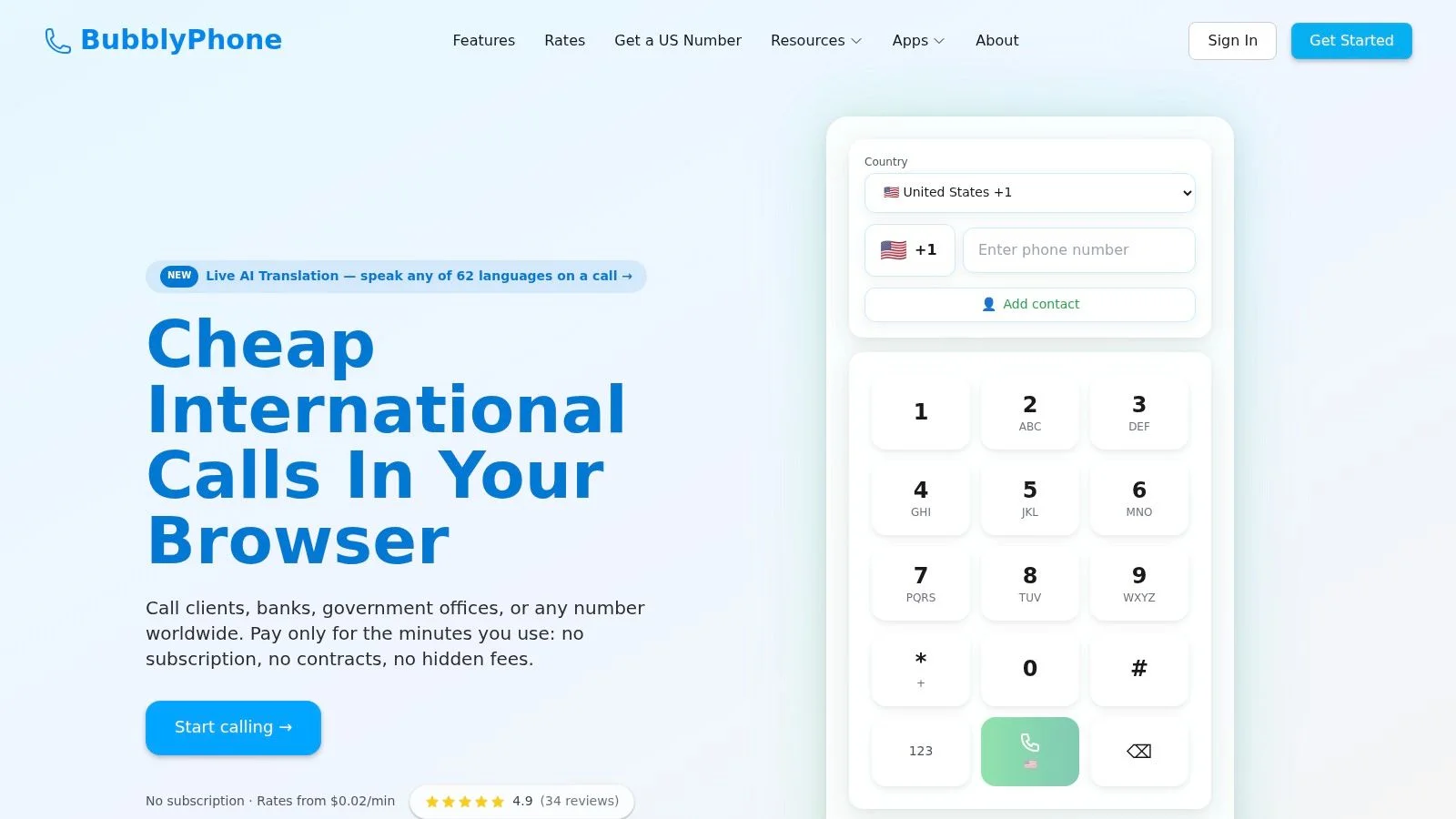
BubblyPhone lets you call a Chinese landline or mobile from a browser by entering the number in international format, using +86, and starting the call. The recipient doesn't need an app or account, so the setup stays on the caller's side.
Open the service in a modern browser, create your account, and enter the destination with the country code. Check the live China rate table before dialing, because rates can change and landline and mobile destinations may be listed separately. Calls use prepaid credits and are billed per minute, rounded up to the whole minute.

Keep the first call simple
Start with a small top-up rather than committing to a subscription. Credits start at $5, never expire, and can be used for calls to regular landlines and mobiles. No subscription is needed for ordinary calling. The only recurring product is the optional dedicated-number plan, which is separate from pay-as-you-go outbound calls.
Before clicking call, check three details:
- Number format: Use
+86, remove the domestic0from a Chinese landline area code, and preserve all 11 digits of a Chinese mobile number. - Displayed rate: Review the current rate for the destination type at BubblyPhone's rates page.
- Audio setup: Confirm your browser microphone permission and headset before starting a time-sensitive conversation.
The browser dialer is useful when you're traveling, working from a shared computer, or calling family without wanting the recipient to install anything. BubblyPhone also supports mobile dialers, but the browser option keeps the process direct. Optional live AI translation can add captions and a transcript when language support is needed, subject to its separate per-minute charge.
Watch the short walkthrough before your first call if you want to see the browser flow in context.
For repeat callers, save the destination in full international format and label it as either a landline or mobile. That small habit prevents the most common formatting error, especially when a contact sends a number without explaining whether it's domestic or international.
Make your China call from any modern browser with BubblyPhone, whether the destination is a regular landline or mobile. The recipient needs no app or account, credits start at $5 and never expire, so check the current rate and call with BubblyPhone today.