Dialing France from Us
Table of Contents
If you're trying to call France from the US right now, use 011 + 33 + the French number without its leading 0 from a US landline, or +33 + the French number without its leading 0 from a US mobile. That's the clean answer, and it saves you from the two classic mistakes, dialing both exit formats at once or keeping France's domestic 0 in the number.
The Exact Dial String From a US Phone
From a US landline, dial 011 + 33 + the French number without its leading 0. From a US mobile, dial +33 + the French number without its leading 0. That's the whole game, and if you use the wrong exit method, the call can fail before it even leaves your phone.

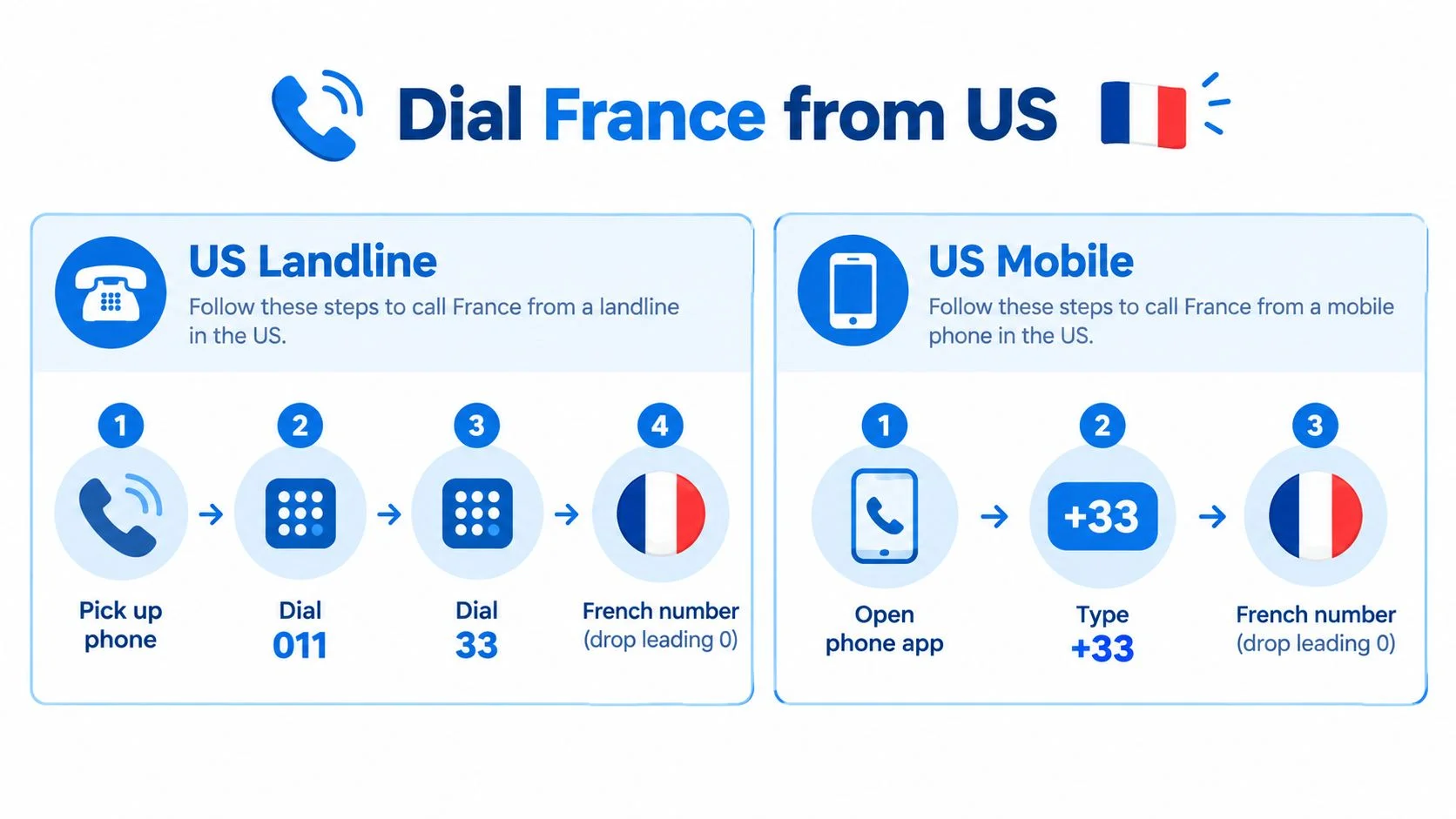
Take a Paris landline like 01 42 68 53 00. From the US landline, you dial 011 33 1 42 68 53 00, because 011 tells the phone to leave the US network, 33 identifies France, and 1 is the Paris area code once the domestic trunk 0 is removed. The same logic applies to a mobile such as 06 12 34 56 78, which becomes +33 6 12 34 56 78 on a mobile phone that accepts the plus sign as the international access symbol.
Practical rule: never dial 011 and + together, and never keep the French leading 0 once you're dialing internationally.
If you're using a dual-SIM phone or roaming, the plus sign still does the job as the international prefix on the device. Extensions are a separate issue, so don't just tack them onto the main number and hope for the best, use a pause or the service-specific sequence the contact gives you. If you want a quick reference for the country code itself, keep the France country code guide handy.
Reading a French Number Before You Call
Before you type anything, figure out what kind of French number you've got. Landlines usually begin with 01 to 05, and mobiles usually begin with 06 or 07, so the first two digits tell you how to strip the number down for international dialing.

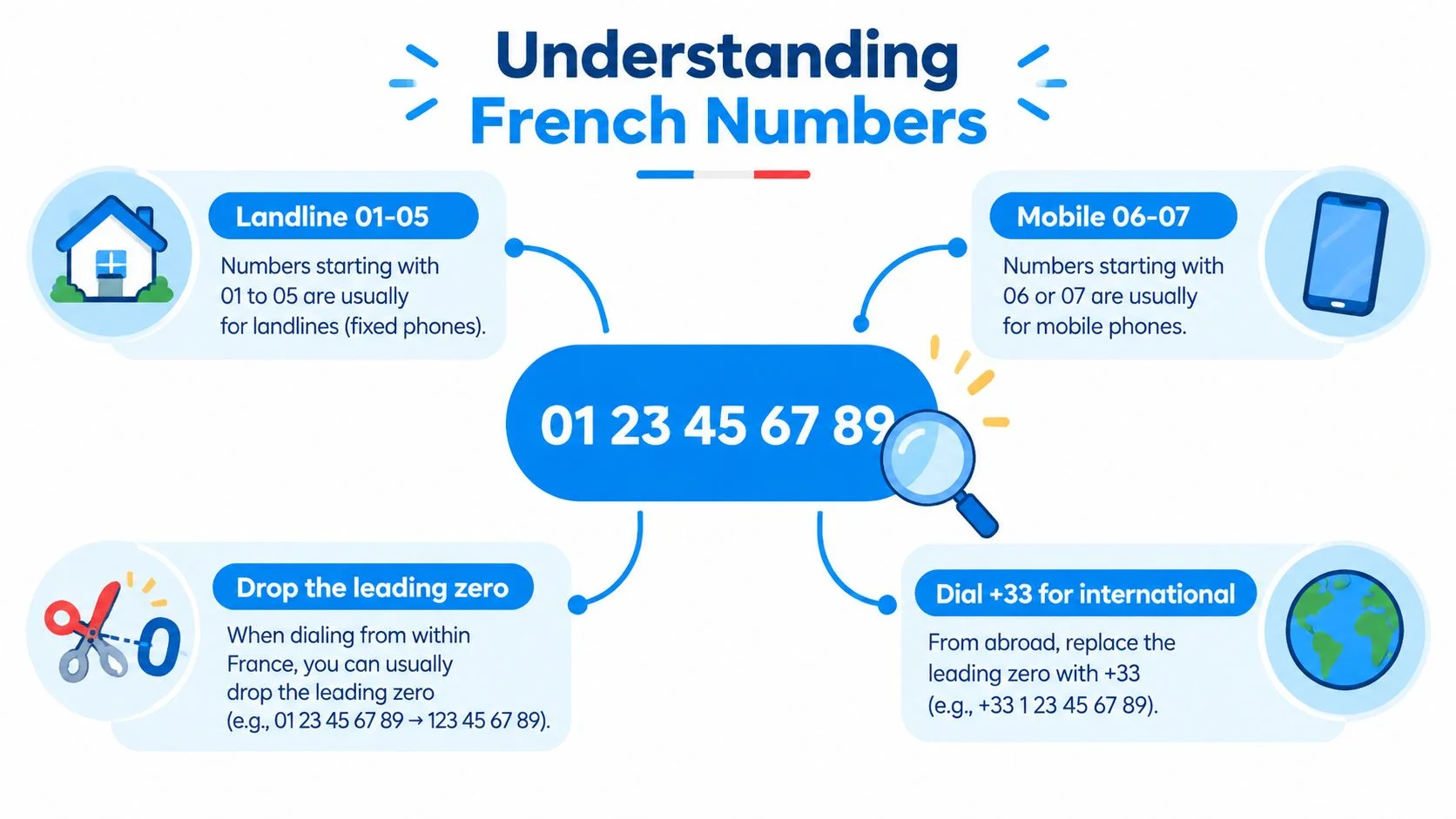
A number like 04 91 57 12 34 is a southeastern France landline, so from the US landline it becomes 011 33 4 91 57 12 34. A mobile like 07 65 43 21 98 becomes 011 33 7 65 43 21 98. The point is simple, once you know the prefix, the rest of the digits stay exactly as they are.
Don't assume every French number follows the same pattern
France also uses 08 and 09 numbers for specialized services, so don't force every contact into the landline-versus-mobile box. Some numbers are tied to non-geographic or service use, which means your usual habits can mislead you if you glance too fast. If the number already shows a +33, use it as displayed and don't add another international prefix on top.
Keep the digits, lose the domestic zero, and stop there.
Also, French numbers are often written in pairs, so you'll see spaced formats that are easy to read but easy to mis-enter if you rush. Check the original card, message, or directory entry, then preserve the digits exactly and only remove the trunk 0 when you switch to international format. For an overview of how the numbering plan is structured, the French regulator's numbering note is the most useful neutral reference, especially on the 01 to 05 geographic split and the 06/07 mobile split. ARCEP's numbering plan note
How to Place the Call From a Browser


A browser dialer is the cleanest option when you do not want to think about 011 or + at all. Open the calling page, let it handle the exit method, and enter the French number in international format, such as +33 1 42 68 53 00 for Paris or +33 6 12 34 56 78 for a mobile.
Check the France rate page before you connect. Match the destination row to the exact number type, because a French landline and a French mobile can sit on different cost lines. Then confirm the billing increment and any connection terms before you add credit. People skip that step and then act surprised by the bill.
Grant microphone access, plug in headphones if you want cleaner audio, and place the call. A good browser dialer handles the exit step behind the scenes, so you do not need to remember whether the call is leaving from a US landline or a US mobile. If the microphone fails, check browser permissions first, then the operating system privacy settings, then your headset controls.
Keep the call log open after the call ends and review the actual duration. That is the fastest way to confirm that the number format, destination, and charge matched what you expected. If you want a browser-based option that shows country-specific pricing before you connect, BubblyPhone does that.
Once the number is entered, the browser should handle the formatting work for you.
Choosing Your Exit From the United States
Use 011 from a US landline if that's what you've got in front of you, use + from a US mobile if your phone supports it cleanly, and use a browser dialer if you want the call screen to handle the exit logic for you. Those are the three real paths, and the right one depends on the device in your hand, not on some abstract “best practice.”
The landline route works, but it's the blunt instrument. The mobile route is simpler when your device accepts + directly, but it still depends on the rules of your plan and any travel settings you've already enabled. The browser route removes the memory test, which is why I prefer it when I'm calling from a laptop or when I'm not sure which network setting I'm on.
If the rate isn't visible before you connect, you're guessing, and guessing is how small calls turn into annoying bills.
For people comparing call methods across borders and payment habits, a broader France crypto card comparison can be useful context if you're also thinking about how you fund international services. It won't dial France for you, but it does help frame how different cross-border payment setups behave when you're already handling multiple countries.
Timing the Call Across Time Zones
France is usually 6 hours ahead of Eastern Time and 9 hours ahead of Pacific Time, so your call window changes fast depending on where you're calling from. If it's 8 AM in New York, it's 2 PM in Paris. If it's 10 AM in Los Angeles, it's 7 PM in Paris.

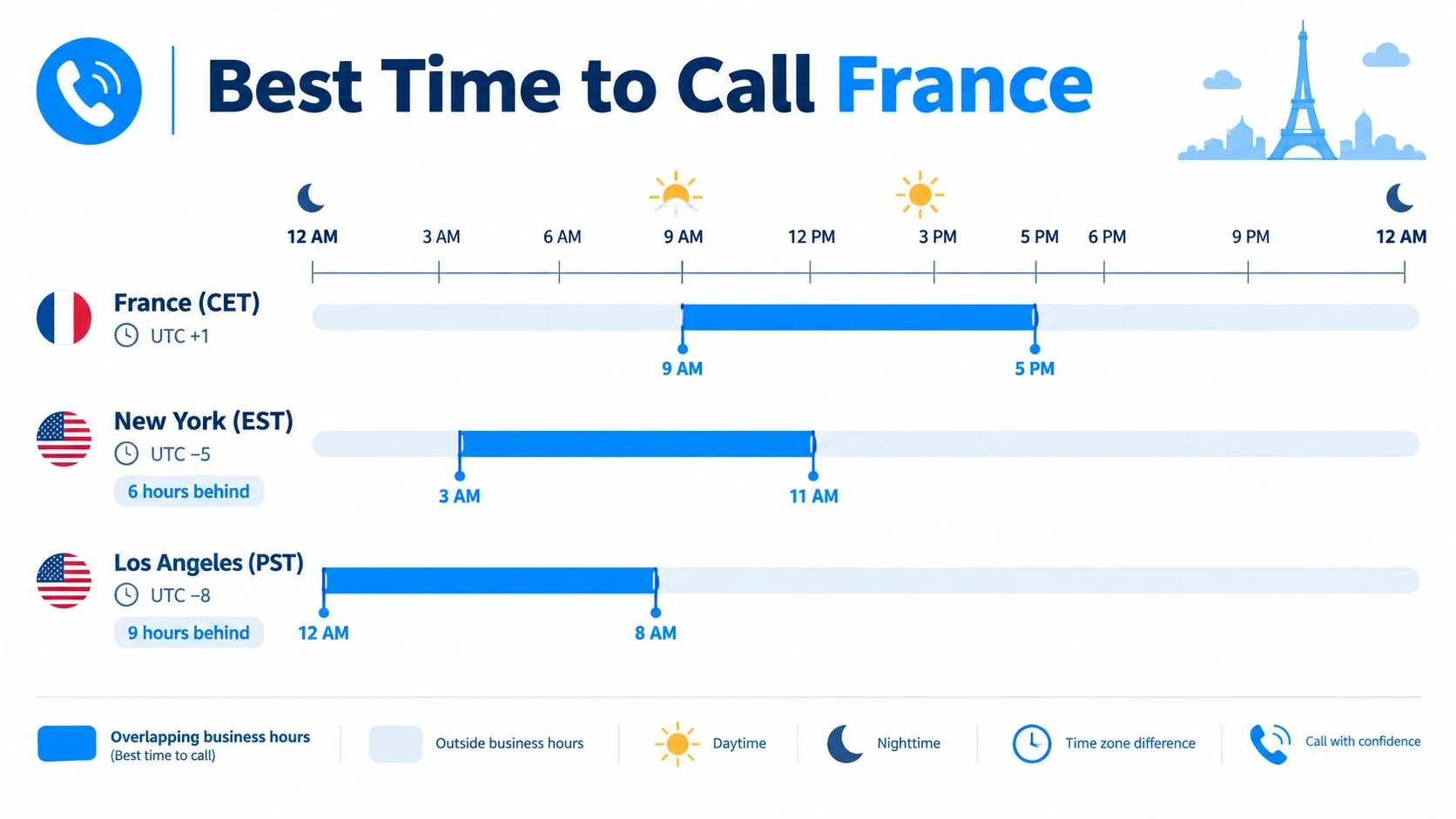
That offset is why the East Coast has the best practical overlap for business. If you call between 9 AM and 11 AM Eastern, you land in France between 3 PM and 5 PM, which is a sensible work window that avoids the worst of lunch and dinner. West Coast callers need to be more deliberate, because a morning in California often lands squarely in the middle of the French evening.
For family calls, the sweet spot shifts later. 6 PM in Paris is noon Eastern, which works well for a weekend catch-up without waking anyone up or dragging someone into a dinner table interruption. If you're unsure, use a time-zone converter before you hit dial and stop pretending the gap is intuitive. The time zone converter is the fastest way to check it without mental gymnastics.
What the Call Will Cost and How to Check
A five-minute call, a thirty-minute client call, and a weekly family check-in all behave differently once billing starts. The first one is a quick sanity check, the second one is where sloppy rate checks become expensive, and the third one is the kind of routine call that adds up if you never look at the rate page.
Before you place the call, read the destination row that matches the exact French number type. French mobiles under 06 and 07 usually sit in a different cost bucket than 01 to 05 landlines, so don't assume they're interchangeable just because both are French numbers. Also check whether the page shows a connection fee and what billing increment applies, because per-minute and rounded billing can change the total faster than people expect. For a live estimate, use the call cost calculator before you connect.
Sanity-check the bill before you trust the number
If a short call feels harmless, it usually is. If a longer conversation starts turning into a standing weekly habit, the math matters more, and that's when you want the rate row in front of you, not after the bill shows up.
The number you dial and the rate row you choose should match exactly. If they don't, you're looking at the wrong price.
A Pre-Call Checklist Before You Hit Dial
Ask yourself four questions before every call. What type of French number is this, landline 01 to 05 or mobile 06 or 07? Which exit method am I using, 011 from a US landline, + from a US mobile, or a browser dialer? What time is it in France right now? Is the rate visible before I connect?
- Confirm the number type. If it starts with 01 to 05, treat it as a landline. If it starts with 06 or 07, treat it as a mobile.
- Pick the right exit. Use 011 on a US landline, +33 on a mobile, or let a browser dialer absorb both pieces.
- Check France time. If you're on the East Coast, the overlap is usually manageable. If you're on the West Coast, verify the hour before you call.
- Verify the rate. Don't connect until you can see the destination row and billing terms on the screen.
If any answer is not sure, switch to the browser dialer and let it format the number, show the destination time, and surface the per-minute rate before the call connects. That's the safe move, and it's usually the faster one too.
If you want the least annoying way to call France, use BubblyPhone. It works in any browser, the person you call doesn't need an app or account, and you can start with credits from $5 that never expire.