Calling from Italy to USA: Dial Codes and Fixes

Table of Contents
To call a US number from Italy, dial 00 or +, then 1, then the 10-digit US number made of a three-digit area code and seven local digits. Leave out +39 and do not add an extra 0 before the area code.
You're sitting in a Florence hotel room or standing outside a Milan train station, trying to reach a US bank, an airline desk, or a family member back home. You punch in the digits, hit call, and hear an abrupt error tone instead of a ring. That happens constantly because calling from Italy to the USA involves more than memorizing a country code.
In the second quarter of 2024 alone, the National Travel and Tourism Office at the U.S. Department of Commerce counted 1.4 million U.S. resident international air departures heading to Italy. Add expats, remote workers, and Italian exporters to that stream of travelers, and thousands of people face the same two snags every week. The exact same phone number can fail on a hotel landline while connecting cleanly on a mobile phone, and the hour gap between Italy and the United States shifts twice a year during spring and autumn clock changes. Getting your call through takes the right button presses, a quick diagnostic habit when a line refuses to connect, and an accurate read of the recipient's local clock.
Dialing a US Number From Italy Step by Step
Dial 00 (or + on a mobile keypad), followed by 1, followed by the 10-digit US number consisting of a three-digit area code and seven subscriber digits. Never insert +39 or place an extra 0 in front of the area code.
The reason you dial 1 instead of 39 comes down to call direction. Country code +39 routes calls into Italy, so adding it when dialing outward sends your call into the wrong network or triggers an instant rejection. According to the North American Numbering Plan Administrator, a standard US telephone number always contains 10 digits after country code 1 (a three-digit area code plus a seven-digit local number), written internationally as +1 followed by those 10 digits without spaces or punctuation.
That +1 prefix doesn't identify a single state or city on its own. As the International Telecommunication Union operational bulletin details, country code 1 is shared across the United States, Canada, Bermuda, and Caribbean nations and territories, so the three-digit area code immediately following 1 determines the exact numbering area you reach. Count the digits after the plus sign and you'll always land on 11 digits in total. If you're unsure which regional prefix belongs to a city, you can check a complete US country code and area code guide before placing the call.
Exact Keys to Press by Starting Phone
Different Italian phones handle the exit code differently. The ITU E.164 international dialing standard lists Italy's international access prefix as 00, the United States country code as 1, and the US national significant number as 10 digits. On mobile phones and browser dialers, the + symbol replaces 00 automatically, while fixed Italian lines still expect the physical 00 prefix.
| Calling from | What to press | Note |
|---|---|---|
| Italian mobile phone | + then 1, area code, number | Press and hold 0 until + appears |
| Italian landline | 00, then 1, area code, number | 00 is Italy's international access code |
| Hotel room phone | Outside-line digit, then 00 1, area code, number | Outside-line digit is usually 0 or 9; ask the front desk |
| Browser dialer on a phone or laptop | +1, area code, number | No Italian prefix after +1 |
Keep one Italian quirk in mind when moving from local calls to US calls. Inside Italy, landline numbers start with a leading 0 that stays in place even when dialed from abroad, which tempts callers to sneak a 0 in front of US area codes. North American numbers never take a trunk 0 after country code 1.
Seven Steps to Format and Place the Call
Follow these button presses in order so your handset doesn't misread the string:
- Copy the US number and strip out formatting. Delete spaces, hyphens, periods, and parentheses so you're looking at plain digits.
- Count to confirm exactly 10 digits. Verify you have a three-digit area code plus a seven-digit local number before touching the keypad.
- Enter the international exit code for your device. On an Italian mobile phone, press and hold the
0key for a second until+appears; on a standard Italian landline, dial00. - Type 1 right after the exit code. Don't leave a leftover Italian access prefix or
39sitting between the plus sign and the1. - Key in the area code and seven-digit subscriber number. Keep the sequence clean with no extra
0inserted ahead of the area code. - Check the normalized E.164 string. On a browser-based dialer or saved mobile contact,
+12025550123is the safest format because it avoids device-specific rules for handling00. - Press call and wait a few seconds for ringing. If the line cuts off immediately or rings into dead silence, stop redialing right away and run a quick route check instead of burning attempts on the same blocked format.
Fixing a Call That Will Not Connect
A US number that rings on your Italian mobile can fail on the hotel handset, even when the digits on both screens match. Hotel lines and mobiles do not share one path out of Italy, so the failure is often the route, not the number you typed.
Recount first. Confirm a three-digit area code and a seven-digit local number before you swap phones or call the carrier. If those ten digits match what the person or business gave you, change one thing at a time: the handset, then the network.
Hotel switchboards work like a front desk that has to open the outside line before your call can leave the building. Many room phones need that outside-line digit, and some desks block calls that leave Italy. Press the outside digit, wait for the new tone, then dial. If the handset still refuses, ask reception whether outbound international calls are allowed. The same saved contact can succeed on an Italian SIM, fail on that room phone, stumble on Wi-Fi calling, and go through on a browser dialer over hotel Wi-Fi or mobile data. If it fails from the SIM or the room phone and rings through a browser dialer on another internet connection, the US number is valid and your local route is the problem.
Then check the type of US number. Geographic landlines and ordinary mobiles usually pass international gateways. Toll-free prefixes, short codes, and some automated business switchboards do not. When a toll-free customer-service line will not connect from Italy, use the geographic or international number on the back of the card or on the company's contact page. One ring and a drop, or a message that the number is unassigned, means confirm the digits with the person or business, then try a second US geographic number you already know works.
Symptoms, Causes, and Fixes
Match what you hear to one row, and fix that row before you redial the same way.
| Symptom | Likely cause | Fix |
|---|---|---|
| Italian recorded message, no US ringback | The call never left Italy; international access is barred on this line | Place the same number over mobile data or a browser dialer; ask the hotel to allow outbound international |
| Error or number not recognized | Area code or number has too few or too many digits | Recount: 3-digit area code, 7-digit number |
| Fails only from a hotel phone | Outside-line digit missing or international dialing blocked | Add the outside-line digit or ask reception; test on mobile data |
| Works on Italian SIM, fails over Wi-Fi calling | Wi-Fi calling is sending the call on a route that drops US numbers | Turn Wi-Fi calling off and retry over cellular or a browser dialer |
| Toll-free or short-code number fails | Special number types are restricted on some international routes | Confirm the number type; use a geographic number where available |
| Rings then drops | Number no longer assigned or blocked | Verify the number with the business; test a known geographic number |
Testing Signal and Route Limits
Thick stone in older apartments and boutique hotels can look like a bad number. Indoor bars fall just enough that call setup dies before the first ring. Step near a window, or use these practical reception tips from Simply Tech Today to rule out a dead zone before you blame the digits.
You know the fix worked when a normal US ringback starts within a few seconds and the voice matches the person or office you expected. If carrier blocks, silence, or dropped routing remain after these checks, use this guide to why international calls fail to separate a bad number from a blocked route.
Other Routes When Your Phone Cannot Dial the US
When an Italian SIM plan, hotel room phone, or Wi-Fi calling toggle blocks international calls, a browser dialer gives you a reliable second route over Wi-Fi or mobile data, and the person you call in the United States needs no app or account.
Before jumping between SIM cards or paying front-desk surcharges, look at how a blocked route typically plays out when you're trying to reach someone across the Atlantic.

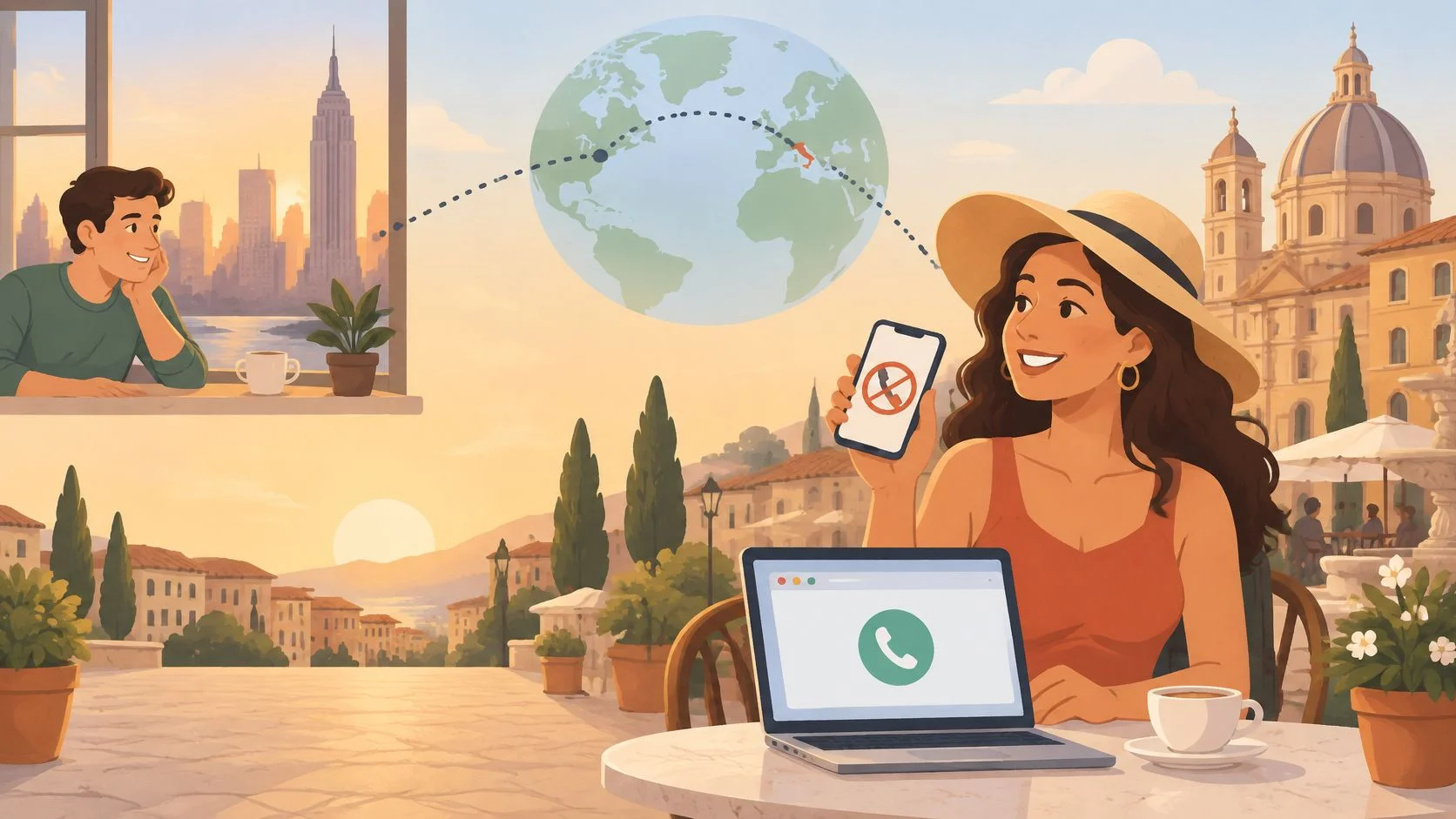
Three everyday situations show where switching away from a traditional Italian voice line saves hours of frustration:
- Travelers without a working local SIM: Say your flight out of Venice gets delayed and you're using a data-only eSIM or hotel Wi-Fi. Because your phone has no voice minutes, opening a browser dialer lets you reach your US airline, hotel, or relatives directly on their standard phone numbers.
- Expats living in Italy with restricted local plans: Many budget Italian mobile plans include domestic minutes but refuse outbound calls outside Europe. People living abroad who need to call US or UK banks, tax offices, pension services, and embassies can place those calls from a laptop or phone browser instead of renegotiating an Italian telecom contract.
- Small businesses coordinating with US partners: According to ISTAT figures cited in the U.S. Department of Commerce Italy market overview, Italy had 4.9 million small and medium-sized enterprises in 2024, accounting for 76% of employment and one-third of GDP. An Italian supplier or agency calling US buyers can store every client number in normalized
+1format in a browser dialer and check the recipient's local time zone before calling, keeping international voice lines separate from personal mobile plans.
Receiving Calls Back With a Dedicated US Number
Outbound calling solves half the challenge, yet banks, clients, and family members in the United States often need a familiar US number they can dial back without paying international charges themselves. A dedicated US phone number can be issued to someone living outside the United States, so you don't need a US residency address or a physical American SIM card to hold one.
Once active, that US number receives inbound calls wherever you live in Italy. Incoming calls can ring straight in your browser or mobile app, forward to your Italian mobile, or drop cleanly to voicemail when you're asleep. Dedicated US numbers also receive SMS for incoming verification codes and notifications, though text capability on these numbers is receive-only.
If you'd like to see how browser-based calling connects directly to regular landlines and mobile phones without requiring setup on the other end, watch this short walkthrough.
Use your Italian phone for routine outbound calls, switch to a browser dialer whenever a hotel landline or carrier blocks international dialing, and add a dedicated US number when American contacts need to reach you directly.
Time Differences and the Best Hours to Call
Eastern Time in the United States runs 6 hours behind Rome for most of the year, but that gap narrows to 5 hours during two daylight-saving windows: March 8 to March 29 and October 25 to November 1, 2026.
To find the local clock for the person you're calling, subtract the zone's hour gap from Rome time. For most of the year, placing a call between 17:00 and 20:00 in Rome lands between 11:00 and 14:00 Eastern (New York) and 08:00 and 11:00 Pacific (Los Angeles), catching both coasts during working hours without intruding on dinner. By contrast, dialing early in your Italian workday at 09:00 Rome time rings someone's phone at 3:00 a.m. in New York and midnight in Los Angeles, which explains why a quick clock check prevents awkward voicemails.
The reason one fixed rule fails every spring and autumn comes down to geography and differing clock schedules. Italy observes a single national time zone from Milan to Sicily, while the United States spans six main time zones. As Time and Date's Rome time zone data shows, most US locations shift clocks on March 8 and November 1 in 2026, whereas Italy moves its clocks on March 29 and October 25. During the three weeks in March and one week in late October between those dates, every US zone that observes daylight-saving time sits one hour closer to Italy than usual.
Hours Behind Rome Across US Time Zones
Check the recipient's city or time zone below before dialing, paying special attention during the spring and autumn transition weeks.
| US time zone | Example city | Most of the year | Mar 8 to 29 and Oct 25 to Nov 1, 2026 |
|---|---|---|---|
| Eastern | New York | 6 hours | 5 hours |
| Central | Chicago | 7 hours | 6 hours |
| Mountain | Denver | 8 hours | 7 hours |
| Pacific | Los Angeles | 9 hours | 8 hours |
| Alaska | Anchorage | 10 hours | 9 hours |
| Hawaii | Honolulu | 11 hours | 11 hours |
Hawaii doesn't observe daylight-saving time, so Honolulu doesn't jump ahead with the US mainland in March or fall back in November. During both 2026 transition windows, Rome is on standard winter time (UTC+1), keeping Honolulu steadily 11 hours behind Rome.
Avoiding Scheduling Mistakes Around Clock Changes
Relying on a memorized "always call at 4:00 p.m. Italian time" habit works smoothly for ten months and then trips you up in March and October. A 15:00 Rome call to Chicago hits 8:00 a.m. Central most of the year, then suddenly lands at 9:00 a.m. Central during the transition weeks, causing missed meetings if someone calculated the offset by hand.
When scheduling recurring client check-ins or family catch-ups, set calendar invitations using named time zones such as Europe/Rome paired with the recipient's exact US zone instead of manually calculating hours. Before placing an unscheduled one-off call, verify the exact overlap in our live best-time-to-call tool so you know whether the office on the other end is open.
Scheduling habit: Book recurring transatlantic calls with named zones like Europe/Rome rather than a fixed hour offset, so your calendar adjusts automatically across March and October clock shifts.
Confirm the Number and Place Your Call Today
A dial string that works perfectly on your mobile can still fail on a hotel switchboard, so place a brief test call to a US number you control, such as a relative's cell phone or a colleague's voicemail, before the important conversation. Use the same device and the same line you plan to call from, because that is the only combination your test proves. If the test reaches a live voice or voicemail with clean audio, your formatting and routing are sound.
Before you press call for the conversation, run through three quick checks:
- Confirm the area code matches the right city: country code
1spans multiple countries and all fifty states, so verifying the three-digit area code is what protects you from dialing a mistyped region. - Check the recipient's local clock: if your call falls in a March or October transition week, confirm the current gap using the time-difference guidance above before dialing.
- Make sure your balance covers the conversation: a hold queue with a US bank or tax office can run long, so top up before dialing rather than mid-call. Prepaid credits start at $5 and never expire, so whatever you do not use stays available for the next call.
Per-minute pricing for US landlines and mobiles is published in the BubblyPhone international calling rates, so you can see the exact cost of the destination before you dial.
Ready to reach a US landline or mobile from Italy without fighting hotel switchboards or restricted SIM plans? Open any modern browser on your phone or computer and place the call through BubblyPhone. The person you are calling answers on their ordinary phone, with no app or account needed on their end.