How to Call from Ireland to Any Country
Table of Contents
You're on a Dublin sofa with your phone in hand, trying to reach family overseas, and the number looks simple until you wonder whether the first zero stays in. To call from Ireland, dial 00, the destination country code, then the local number in international format. To call the Republic of Ireland from abroad, use your country's exit code, 353, and remove the Irish number's leading domestic zero.
Dialing Out From Ireland Starts With 00
If you're calling family in Mumbai on a Sunday afternoon, start with 00. That's Ireland's international exit code, so the basic sequence from an Irish landline or mobile is 00 + destination country code + local number. On a smartphone, holding the + key produces the same international shortcut, so +91 and 00 91 serve the same purpose when calling India.

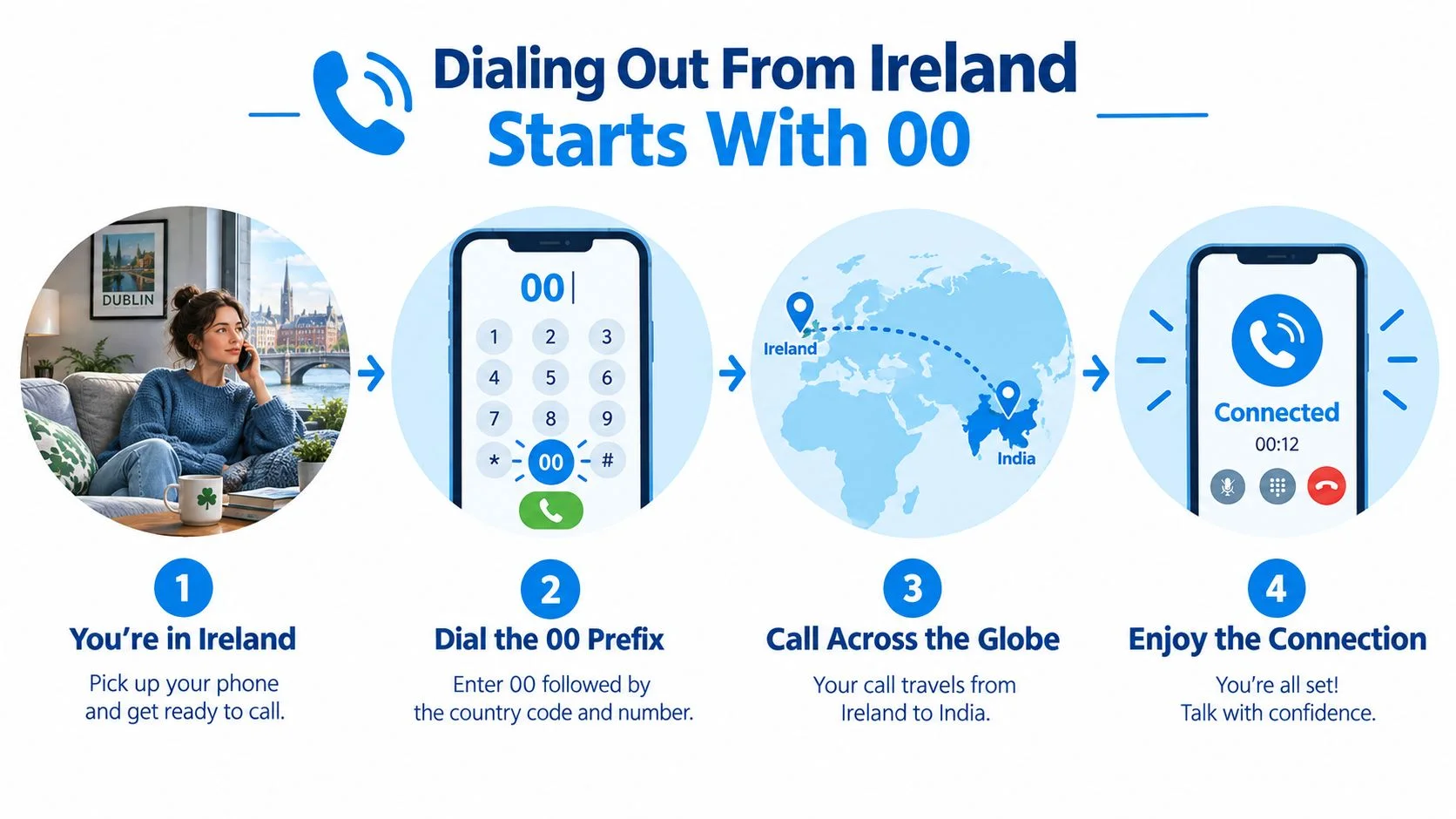
The first part tells the Irish network that the call is leaving the country. The second part identifies the destination, and the remaining digits identify the person, business, landline, or mobile you're trying to reach. For a call to an overseas number, don't copy the domestic version blindly. Check whether its local format includes a trunk zero that must be removed internationally.
Irish networks generally charge international calls by time connected, so check the applicable rate before you press call. For browser calling, you can use the international dialing guide to confirm the destination format before entering the digits.
The country-code framework sits within the international numbering system described by the ITU E.164 recommendation. In practical terms, the order stays stable:
- Exit code: 00, or + on a mobile.
- Destination code: The code for the country you're calling.
- Subscriber number: The international version of the local number.
Once those three pieces are separated, the dial pad stops feeling like a puzzle. Every digit has a job.
The Three Parts of Every Irish International Call
Every international call placed in Ireland has the same three-part structure: 00, the destination country code, and the correctly formatted local number. The middle digits change by destination, but the order never does.
Start with the exit code
Press 00 when dialing from Ireland. If you're using a mobile, storing the contact with + is usually more convenient, because the phone can apply the correct international access convention as you travel.
Add the destination code
Common examples include:
- 91 for India
- 44 for the United Kingdom
- 1 for the United States and Canada
- 34 for Spain
The next step is where many calls fail. Remove the destination number's domestic trunk zero when the international format requires it. Irish callers should verify the number rather than assume that a zero shown in a local listing belongs in the overseas dial string.
Here are practical examples using the requested city and subscriber formatting:
The plus-sign versions are +91 22 1234 5678, +44 20 7946 0958, and +1 212 555 0199. Use the country code lookup tool when you're unsure which code belongs before entering the number.
The reliable habit is to split the number into blocks first, then reassemble it. Don't add extra zeros to make the sequence look familiar.
Calling Ireland From Common Origin Countries
A caller in New York, London, Sydney, Toronto, or Madrid will use a different exit code, but the Irish number follows the same international structure. To reach the Republic of Ireland, enter your country's exit code, 353, then the Irish number with its leading domestic 0 removed. The Irish mobile number 087 555 0123 becomes +353 87 555 0123 from the United States and 00 353 87 555 0123 from Spain.
The exit code changes by origin country. The Irish country code remains 353.
From a mobile, the plus-sign format is usually easier: +353 87 555 0123. From a landline in a country using 00, dial 00 353 87 555 0123. A browser dialer accepts the same international format, although its keypad and billing method differ.
The domestic number begins with 08. After 353, use 87 instead. Irish landlines follow the same zero-removal rule. A Dublin number written domestically as 01 344 1111 becomes 00 353 1 344 1111 from a country using 00 as its exit code, as described in official guidance on making calls in Ireland.
Northern Ireland uses the United Kingdom code. From abroad, dial 00 44 followed by the number's international format. From the Republic of Ireland, call Northern Ireland with 048, not 353. This distinction matters when calling family, suppliers, or offices near the border.
Write the number in blocks before pressing call. That simple check catches an incorrect exit code, a duplicated zero, or a missing Irish country code.
Why Browser-Based Calling Beats Mobile Carrier Rates
Browser calling changes the route, not the number. To reach Madrid, you still enter +34 612 345 678, but a browser dialer sends the call over your internet connection instead of placing it directly through your mobile voice service.
A mobile call can be perfectly convenient when your plan includes the destination. The problem appears when international billing is unclear, the call is rounded in a way you didn't expect, or you're roaming and trying to understand which side of the connection is being charged. Browser calling makes the spending decision more deliberate because you can check the destination rate before dialing.
It also helps when mobile reception is poor but fixed broadband is stable. A rainy evening with weak signal can make an ordinary mobile conversation frustrating, while a laptop connected to reliable Wi-Fi may provide the steadier route. Browser calling still depends on your internet connection, so overloaded hotel Wi-Fi or unstable broadband can introduce delay and audio interruptions.
Practical rule: Treat the dial string and the delivery route as separate decisions. First format the number correctly. Then choose the connection that gives you the clearest cost and network conditions.
For phone users who want to keep calls on a handset over Wi-Fi, this guide to iPhone Wi-Fi calling in rural areas offers useful background on the connectivity side. For international voice billing and route choices, see this international calling rates guide.
Your First Browser Call in Under Five Minutes
You can place a first browser call in a few straightforward steps, provided you've formatted the number before opening the dial pad. A recipient doesn't need an app or an account, because the call reaches their ordinary mobile or landline.
Use the browser dialer
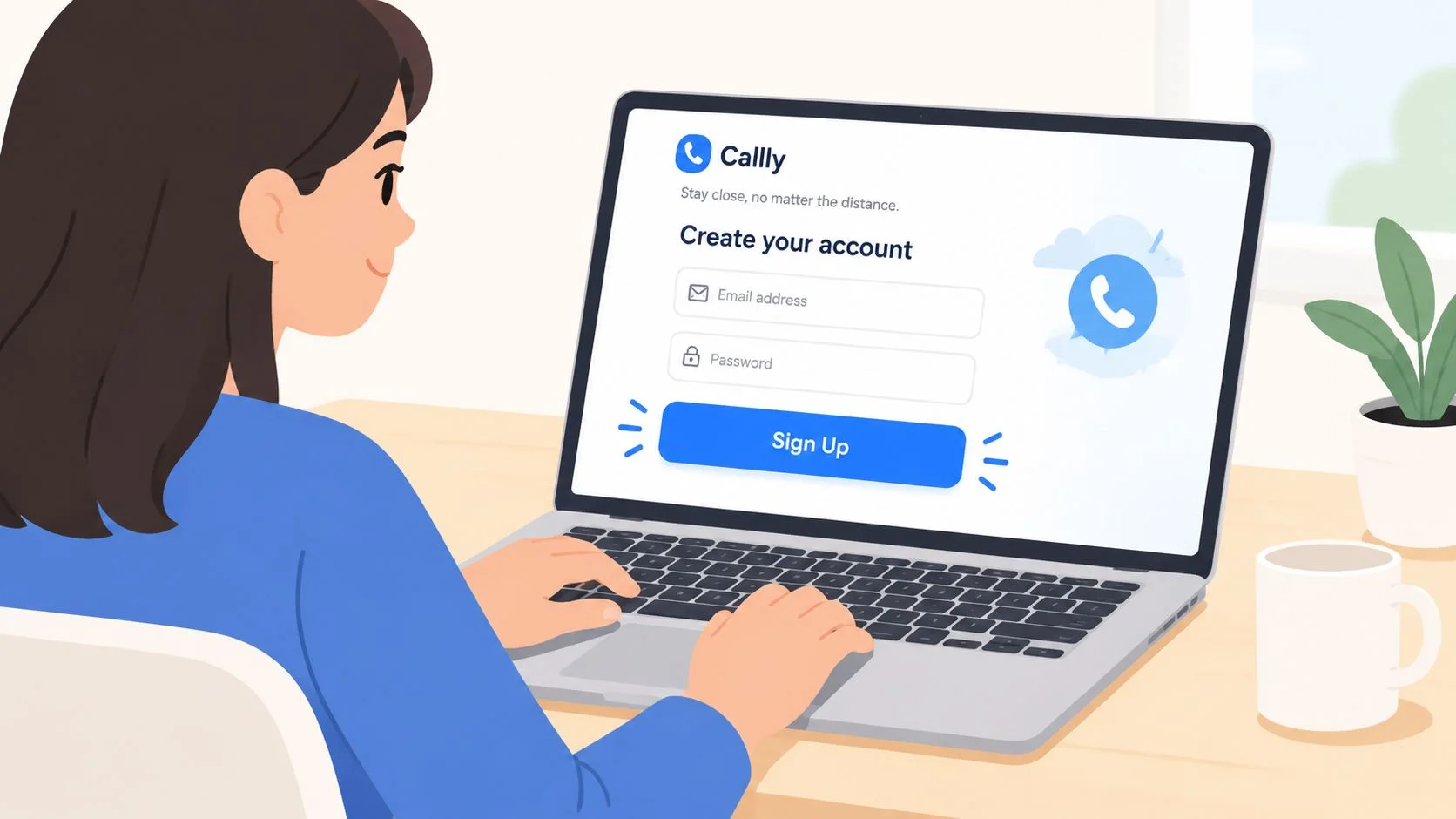
Open BubblyPhone in a modern browser and create an account with an email address and password. No app download is required for the browser route. Once you're in, check the displayed destination rate before committing credits.

Enter the full international string into the keypad. For London, that means 00 44 20 7946 0958, or the equivalent plus-sign format. Don't enter the domestic leading zero if the number is written with one. Press the call button only after the country, area, and subscriber sections look right.
BubblyPhone uses prepaid credits, bills calls per minute rounded up to the whole minute, and doesn't require a calling subscription. Credits start at $5 and never expire. The recipient needs no special setup, and the service can call regular landlines and mobiles.
Keep the cost visible
The balance display gives you a running indication of usage, while the rate lookup lets you check the destination before dialing. That's more useful than guessing from a general international plan, especially when you're calling a number type with different pricing from the same country.
You can top up when the balance is low and save frequently used contacts for easier redialing. For an occasional family call, the pay-as-you-go model avoids adding a recurring calling plan. The optional recurring product is a dedicated-number plan, not a requirement for outbound calls.
Spotting Spoofed Numbers and Wangiri Scams
An incoming +353 number isn't proof that the caller is physically in Ireland. Spoofed caller ID can make an overseas call appear Irish, while a Wangiri scam uses a brief missed call to tempt you into calling back.
Irish regulators warn that scam activity includes spoofed international numbers and Wangiri-style missed-call traps. Their advice is direct: don't call back unfamiliar numbers, and a voice-firewall defense against spoofed international numbers was slated for deployment in the first half of 2026, as reported in this Irish regulator and scam-call coverage.

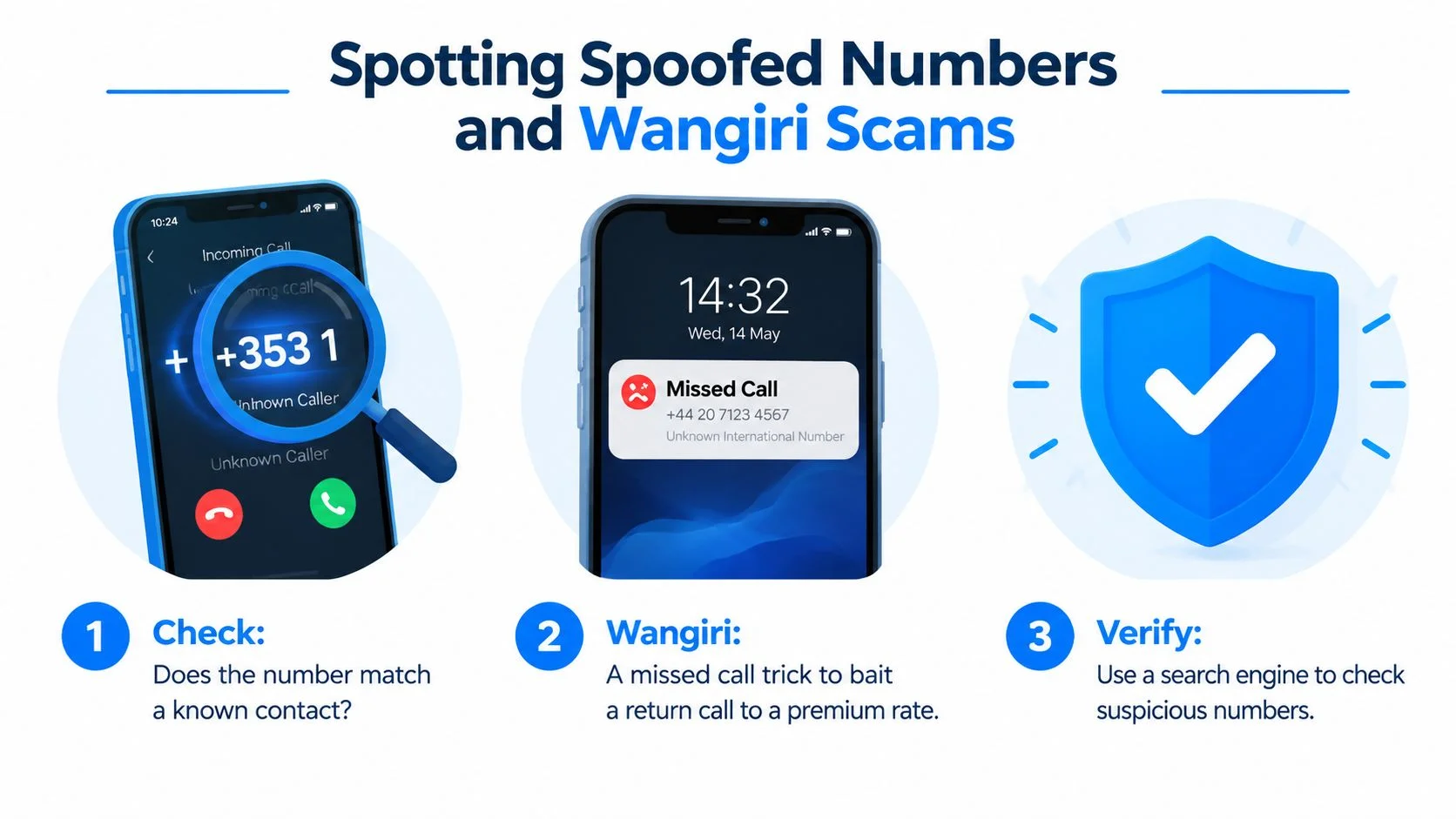
Use a simple screening process:
- Check the context: If the number isn't saved and leaves no voicemail, treat the missed call cautiously.
- Wait for verification: A genuine caller can usually identify themselves by voicemail, message, or a follow-up call.
- Search before returning: Look up an unfamiliar number through a reputable search service or your phone provider's safety guidance.
- Protect payment details: Don't provide card information during an unexpected call claiming to involve an urgent account problem.
- Block repeated attempts: Blocking and reporting persistent suspicious calls prevents the same number from becoming a recurring nuisance.
A real contact may call from a different number while roaming or using a business phone system, so caller ID alone can't authenticate identity. If the call matters, verify it through a known contact method rather than trusting the displayed Irish code.
Putting It All Together on Your Next Call
To call a parent in Madrid from Dublin, enter 00 34 612 345 678 on an Irish landline or mobile. If you've stored the contact internationally on a mobile, use +34 612 345 678 instead. The destination code is 34, the mobile number is written in international form, and there's no Irish domestic prefix to remove from this example.
A browser dialer follows the same number logic. You enter the international string, review the displayed destination rate, and place the call over your broadband or Wi-Fi connection. Billing is handled through prepaid credits, with calls rounded up to the whole minute, so check the live rate rather than relying on an old estimate.
The practical routine is short:
- Identify the direction: Are you calling out from Ireland, or calling into the Republic of Ireland?
- Format the number: Use 00 or + when leaving Ireland. Use the origin country's exit code plus 353 when calling Ireland.
- Remove the domestic zero: Apply the international format before dialing into Ireland or another country that uses a local trunk prefix.
- Choose the route: Use mobile voice service, a landline, or browser calling based on connection quality and billing clarity.
- Screen unexpected calls: Don't return unfamiliar Irish missed calls until you've verified the caller.
Ireland's international dialing system was modernized in 1992, when the Republic adopted 00 as its European international access code, replacing the older 16 prefix and legacy arrangements for calling Britain. Earlier infrastructure had already expanded substantially. An archival report on Dublin's international telephone exchange in 1974 described around 200 international circuits and capacity for around 8,000 calls an hour, recorded in the historical material on subscriber trunk dialling.
Modern calling increasingly uses internet-based infrastructure. A 2026 industry summary estimates that over 40% of voice calls worldwide now run on VoIP networks and places the global VoIP market at $195.39 billion in 2026, while another voice-traffic summary reports 1.2 trillion minutes of global international voice traffic in 2023, up from 1.1 trillion in 2022. Those figures come from the VoIP statistics summary, and they underline why browser calling is now a practical option rather than a specialist workaround.
Use BubblyPhone to call Irish or overseas landlines and mobiles from any browser, with no app or account required for the person you're calling. Credits start at $5 and never expire, so check the live rate, enter the international number, and make your next call without adding a subscription.