What Is HD Voice Calling and How It Works

Table of Contents
- More speech detail, not music quality
- Why intelligibility matters in ordinary conversations
- Sampling and compression do different jobs
- Why a codec has operating modes
- Speech codecs behind HD and ordinary calls
- How to read a codec specification
- Follow the conversation through the network
- What common destinations mean for quality
- A listening benefit that reached ordinary phones
- Clear audio helps people and automated systems
- Why working at home doesn't prove roaming compatibility
- Match the phone to the destination
- Check the destination before dialing
- Keep the audio and account choices separate
HD voice calling sends about 50–7,000 Hz of speech at a 16 kHz sample rate, versus roughly 300–3,400 Hz on a traditional telephone call. Yet an HD-capable phone can still deliver an ordinary narrowband call, particularly when you're calling another country.
The surprising part is that clearer audio isn't something your phone can provide on its own. The devices and networks carrying the conversation have to preserve that extra speech detail all the way to the listener.
What HD Voice Calling Actually Sends
HD voice calling carries a wider slice of your voice than a traditional telephone call. The wideband speech glossary describes approximately 50–7,000 Hz for wideband speech, compared with about 300–3,400 Hz for conventional narrowband telephony.
Those ranges describe audio frequencies, not internet speed. Lower frequencies contribute weight and warmth to a voice. Higher frequencies contain details that help you distinguish similar speech sounds.
Think about someone spelling a surname over the phone. The distinction between an “s” and an “f” can become harder to hear when the connection removes higher-frequency information. Turning up the volume makes the remaining sound louder, but it doesn't restore what the call discarded.
More speech detail, not music quality
Wideband audio helps preserve consonants and makes familiar voices sound more natural. It doesn't turn a phone call into a studio recording, and it isn't the same as CD-quality audio.
The comparison below separates ordinary telephone speech, wideband speech, and the broader audio range associated with music.
Narrowband, HD voice, and full-band audio
These telephone ranges and sampling distinctions reflect the ITU's wideband voice presentation, which also traces G.722 standardization to 1987 and AMR-WB, also standardized as ITU-T G.722.2, to work around 2001–2003.
That history matters because HD voice isn't a recent name for a better microphone. Engineers developed standards so different pieces of telephone equipment could exchange a richer speech signal.
Why intelligibility matters in ordinary conversations
Say you're booking a cleaning appointment and giving a street name that sounds similar to another nearby road. Better consonant detail can help the person answering distinguish the address before confirming the booking.
The same concern applies when software answers the call. Estimatty's guide to AI voice agents for cleaners offers useful context for businesses considering automated appointment conversations. Audio transport and speech recognition are separate issues, but both matter when the caller provides names, addresses, and service details.
Wideband capture is only the beginning. If any segment of the connection supports narrowband audio only, the extra detail won't reach the other person, even if both handsets have capable microphones.
How a Wideband Codec Packs the Voice
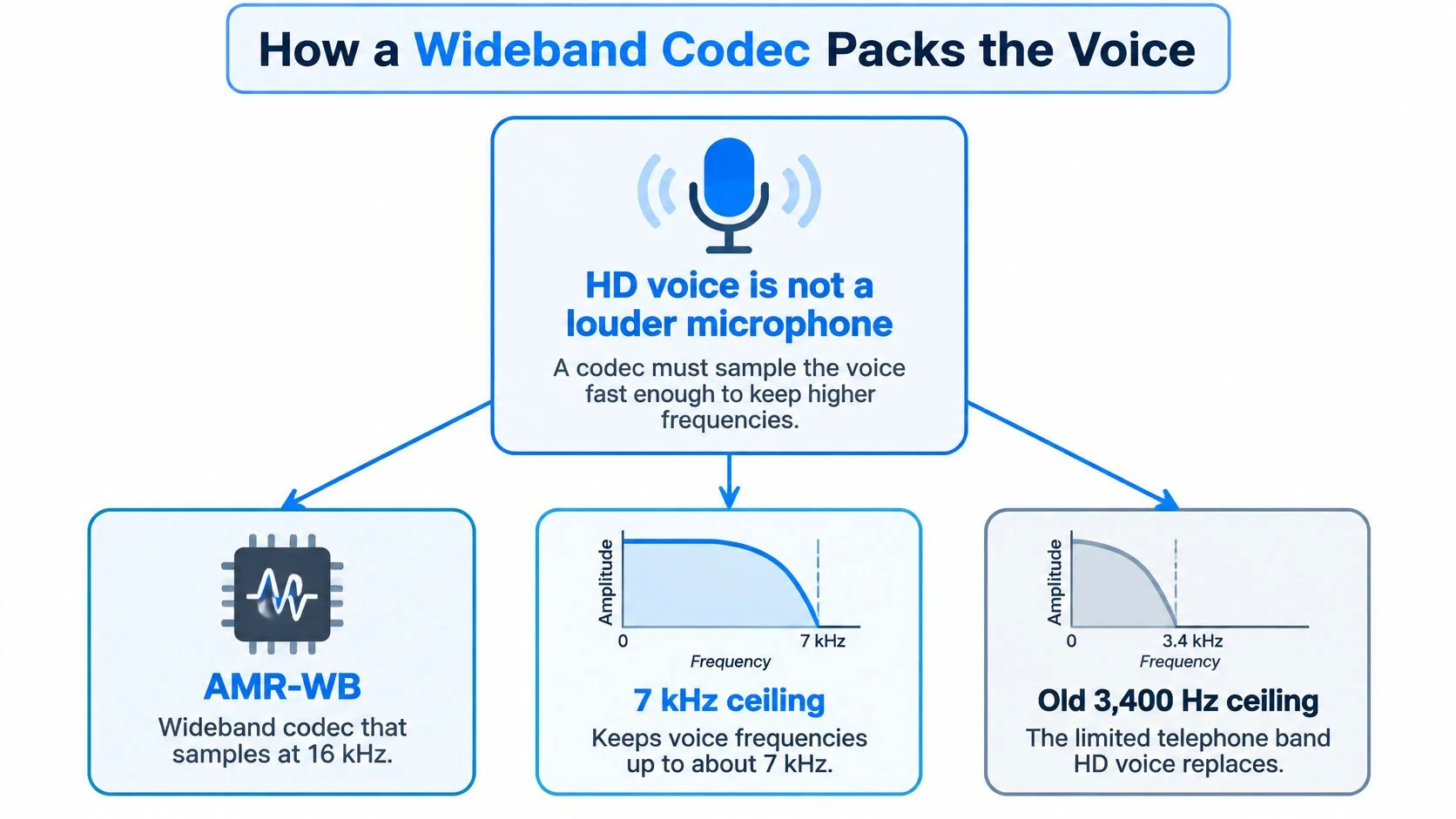
HD voice isn't a louder microphone. A codec converts captured speech into digital information and reconstructs it at the receiving end, and it must preserve the higher frequencies that make wideband speech useful.
Consider a parent calling a relative abroad. As the parent speaks, the device captures changing air pressure as an electrical signal. The codec represents that signal digitally so the network can carry it.
A helpful analogy is a handwritten letter. Narrowband audio is like receiving the letter with the tops of some letters cut off: you can often infer the words, but similar shapes become harder to distinguish. Wideband keeps more of those distinguishing marks without trying to send a photograph of every detail.
Sampling and compression do different jobs
Sampling rate describes how frequently the sound is measured. Bit rate describes how much encoded information the codec produces over time. They're related design choices, but they aren't interchangeable.
The AMR-WB codec specification overview gives a 16 kHz sampling rate, an input speech band of 50 Hz to 7 kHz, operating modes from 6.60 to 23.85 kbit/s, and 20-millisecond speech frames.
To represent a frequency faithfully, sampling must occur more than twice as fast as that frequency. That's why ordinary narrowband sampling can't be reused to preserve the wider speech band.
The diagram shows the relationship between the microphone, the codec, and the extra speech detail.

Why a codec has operating modes
A mobile network doesn't always have the same radio conditions or available capacity. AMR-WB's operating modes let it balance encoded speech quality against those conditions instead of requiring a single fixed data rate.
The codec processes speech in short frames. The network transports the encoded speech, and the receiver decodes it for playback. This happens continuously while you speak, rather than waiting for a complete sentence.
Practical rule: A microphone can capture excellent sound, but the call still needs an agreed wideband codec to carry that detail.
When checking a device's calling specifications, look for wideband codec support, not just claims about microphone quality or speaker loudness. A handset marketed as HD-capable tells you what it can do under suitable conditions, not what every connection will use.
Codecs That Count as HD and Those That Do Not
Two codecs can occupy the same-sized channel and still sound different. HD depends on the speech bandwidth and sampling design, not on how many bits the call carries.
The G.722 technical reference describes wideband speech sampled at 16 kHz, carrying roughly 50 Hz–7 kHz, with selectable rates of 48, 56, or 64 kbit/s; traditional G.711 uses 8 kHz sampling and can also occupy a 64 kbit/s channel without preserving the same speech detail.
G.722 divides the signal into sub-bands so it can encode higher-frequency speech information rather than discarding it. G.711 represents the traditional telephone speech range, so a larger-looking bit rate doesn't make it wideband.
Speech codecs behind HD and ordinary calls
The important distinction is between preserving more speech frequencies and using more transmission capacity. A wideband codec at a modest bit rate can retain useful consonant detail that a higher-bit-rate narrowband codec never captures.
These codecs are optimized for speech communication. Their job isn't to reproduce every element of a musical performance.
How to read a codec specification
If you're evaluating a business phone system or debugging a calling integration, read the codec name alongside the audio bandwidth. Don't treat the highest bit-rate option as the automatic winner.
Useful questions include:
- What was negotiated? An advertised codec list describes available options, not necessarily the codec selected for a particular call.
- Was the audio converted? A network boundary may require transcoding, which can remove wideband detail.
- What reaches the receiver? A capable sending device can't make a narrowband destination reproduce missing frequencies.
The distinction between internet transport and traditional telephone service also matters. Our VoIP versus landline explanation helps separate how a call travels from how much speech detail it preserves.
Codec support is evidence of capability, not proof of an end-to-end result. For that, you need to consider the actual route.
When a Call to Another Country Stays HD
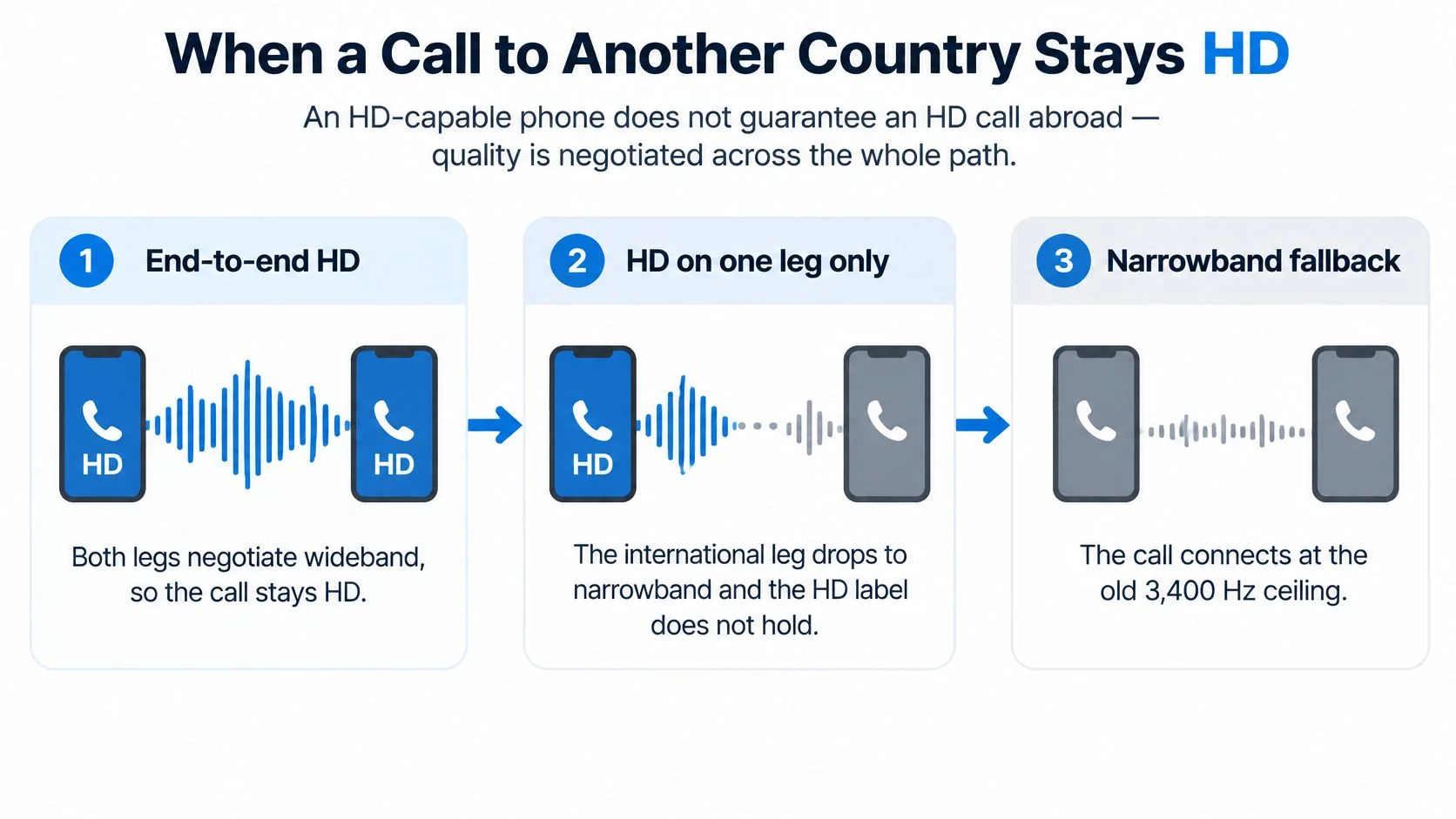
An international call stays HD only when the complete connection preserves wideband speech. An HD-capable handset doesn't guarantee that the destination network, interconnection, or receiving phone will support the same audio.
It helps to separate the label into distinct states:
HD-capable means the device and calling software can use a wideband codec. HD-negotiated means the endpoints and connecting networks actually agree on a compatible wideband path. HD-perceived means the listener still hears the extra detail after the connection, packet delivery, and playback equipment have done their work.
Those states answer different questions. Your phone's specifications establish capability; call diagnostics may reveal negotiation; your listening experience reflects the final result.
The diagram illustrates where an international connection can lose its wideband characteristics.

Follow the conversation through the network
First, the microphone and sending device capture speech. A codec encodes it, and the access network transports the resulting digital audio.
Next comes any interconnection between networks. This is a critical boundary: the operators must preserve a compatible wideband representation rather than convert the speech to narrowband.
Finally, the receiving device decodes and plays the signal. A conventional telephone connection can become the limiting segment even when the caller starts with excellent internet audio.
The VoLTE technical overview explains that AMR-WB is the recommended wideband codec, while AMR-NB compatibility allows calls to continue when a wideband connection isn't available. That fallback prioritizes completing the conversation over preserving the wider speech band.
What common destinations mean for quality
A radio-network indicator tells you how the device connects to the mobile network. It doesn't identify the codec negotiated across the entire international call.
Consider these destination cases:
- Compatible mobile networks: Calls between HD-capable mobiles can remain wideband when the operators support the necessary interconnection.
- Conventional landlines or legacy networks: The call may connect successfully but lose wideband detail at the telephone-network boundary.
- Browser-to-mobile calls: The internet portion can support high-quality audio, but the mobile-network leg must also preserve wideband for the entire conversation to qualify.
Internet calling uses Wi-Fi or mobile data to carry packetized voice. When you dial an ordinary telephone number, that internet connection still has to meet the public phone network.
A provider may therefore support HD audio without being able to promise that every international destination reproduces it. Destination compatibility and the live route matter more than the logo on the sending phone.
What Callers Gain from HD Voice
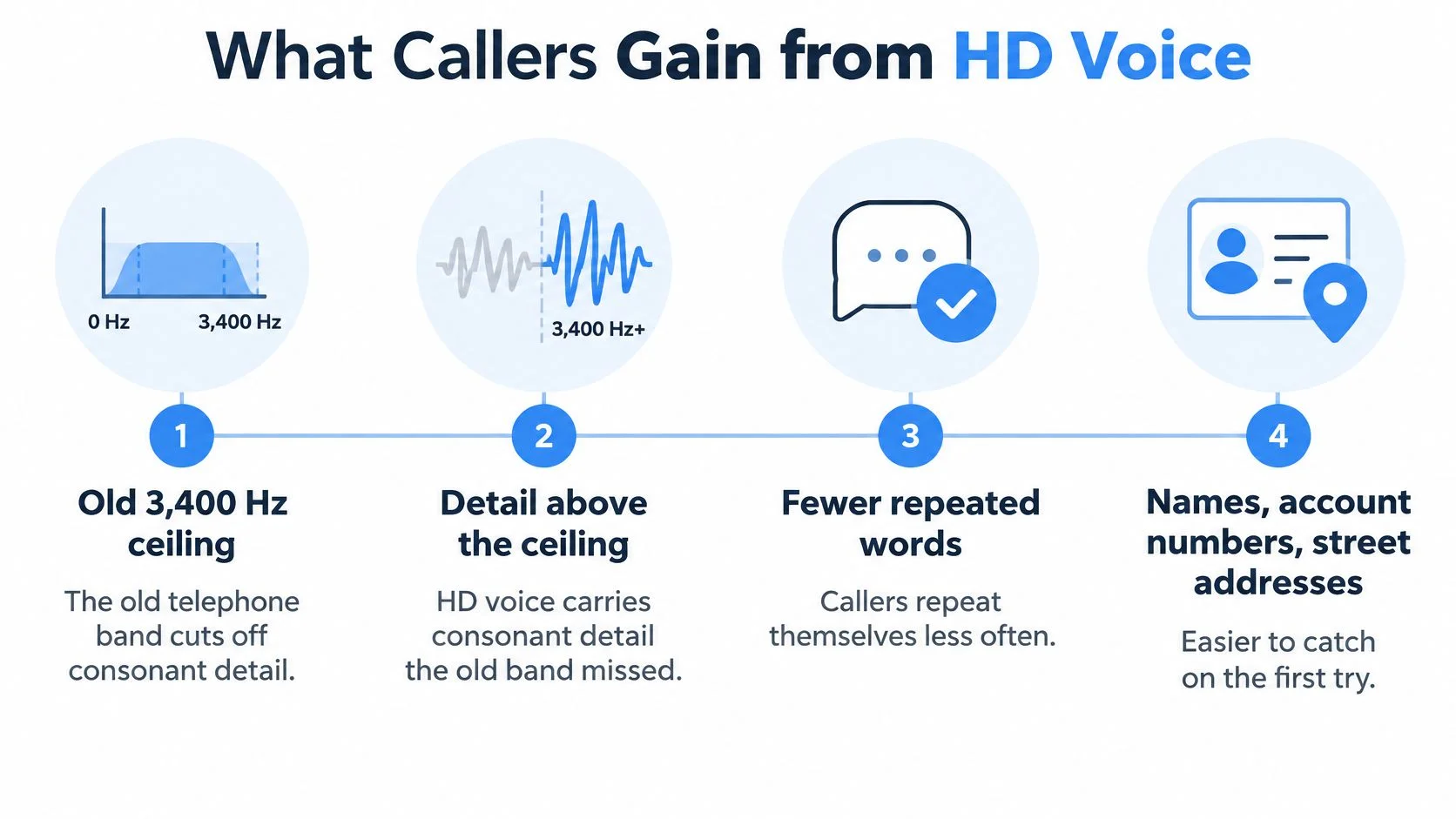
Callers gain more intelligible speech and a more natural voice, not just a louder line. The practical benefit is less effort distinguishing names, spoken numbers, and unfamiliar addresses when the connection preserves useful detail.
Say a parent calls family overseas and hears a grandchild's name for the first time. A clear distinction between similar consonants can make the name easier to catch without asking someone to spell it.
Now consider a supplier calling from a laptop. The caller's headset may capture detailed audio, but a narrowband telephone segment can still make the supplier's name harder to recognize.
A listening benefit that reached ordinary phones
The GSA industry account published by 3GPP reports 61 mobile networks in 45 countries by January 2013, followed by an estimate of more than 300 million mobile HD Voice users and 150 commercially launched operators in 87 countries by the first quarter of 2015.
That later account included 128 operators on 3G/HSPA, 17 on 2G/GSM, and 40 using LTE-based VoLTE, and some operators reported initiated HD Voice calls at up to 10 times the level a year earlier. Those deployment categories shouldn't be added together as separate operators, because an operator could support more than one network technology.
The listening improvements are easiest to understand through everyday information exchange.

Clear audio helps people and automated systems
For customer support teams, catching an account identifier correctly can prevent an unnecessary clarification loop. For families, recognizable voices can make an overseas conversation feel less strained.
The same practical concern applies to automated intake. Lighthouse Legal's guide to AI voice agents for injury firms provides context for handling spoken inquiries, where names and incident details need careful confirmation regardless of audio quality.
Clearer speech can make a conversation easier. It doesn't remove the need to confirm important details.
A published voice-subscription outlook projected 6.3 billion global VoLTE subscriptions by the end of 2024. That was a projection about subscriptions, not a measurement of how many calls remained wideband.
If speech cuts out rather than merely sounding muffled, investigate connection stability as well as bandwidth. Our guide to improving VoIP call quality covers practical troubleshooting for that different problem.
When a Network Shutdown Breaks the Call
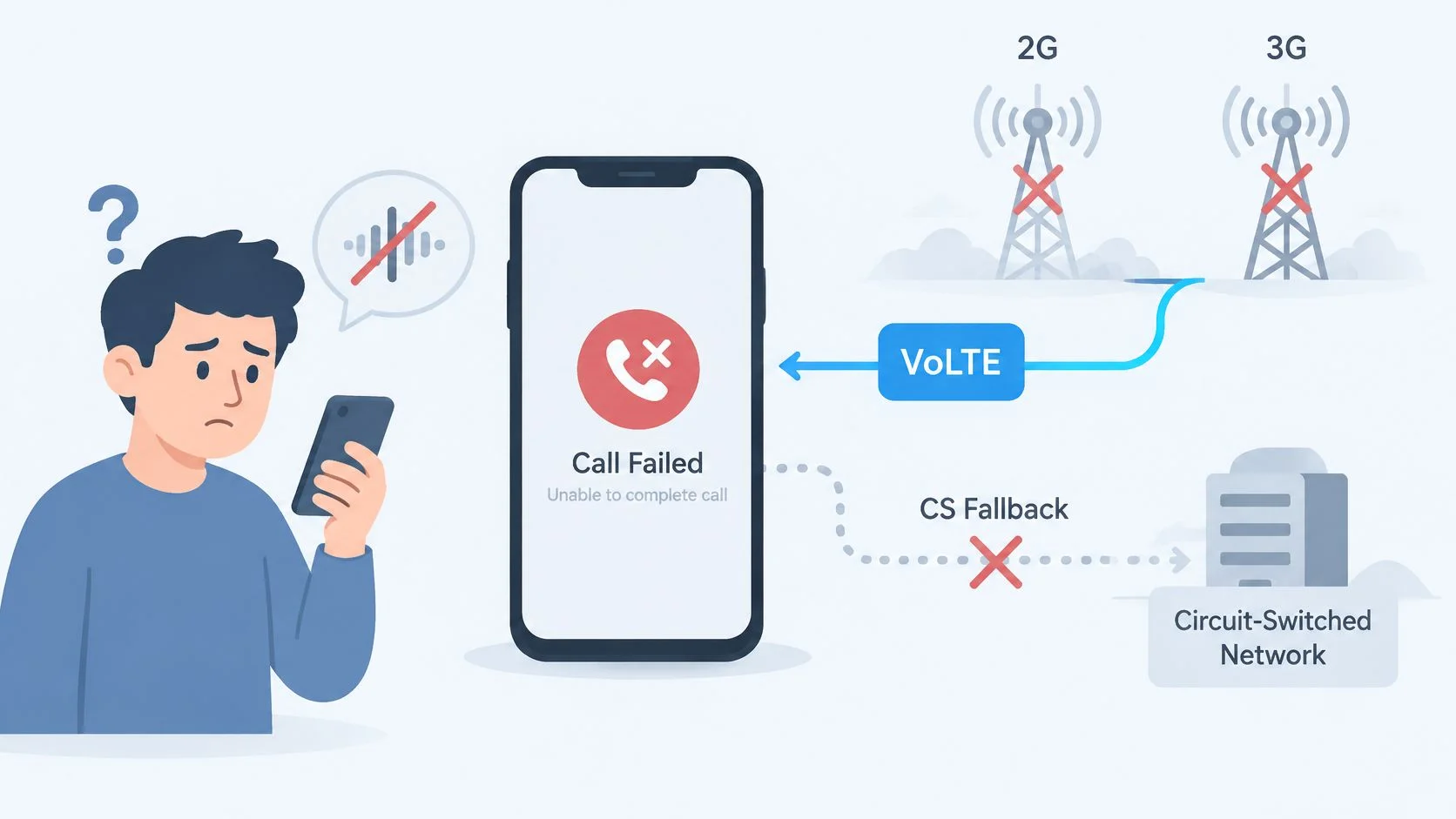
Retiring older mobile networks can turn voice calling into a compatibility problem, not just an audio-quality choice. A phone may need supported packet-based voice settings to keep making calls after its usual fallback network disappears.
The high-definition voice industry analysis identifies network retirements, device fragmentation, and roaming limitations as challenges in the move toward VoLTE. A handset can support mobile data yet lack the configuration or approval needed for voice on a particular network.
A failed call can therefore reflect a network mismatch rather than a broken microphone.

Why working at home doesn't prove roaming compatibility
A handset may have the correct VoLTE profile for its home operator but not for a visited network. Unsupported radio bands, older firmware, carrier-certification requirements, and emergency-calling configuration can also affect service.
That matters for travelers, immigrants, and remote workers who keep an older handset or move between markets. The device's model name alone isn't enough to establish compatibility; its regional version and software configuration can matter too.
Before depending on the phone for an urgent conversation, make these checks:
- Confirm the destination's active networks. Check whether the radio technology your handset normally uses is still available there.
- Verify packet-voice support. Confirm that VoLTE or the relevant voice profile is enabled and supported for the handset, SIM, and roaming arrangement.
- Test the destination type. Call the mobile or landline number you'll need, rather than assuming a successful test to another number proves compatibility.
- Investigate muffled speech carefully. Narrowband fallback is one possibility, but also check the headset, microphone, and call configuration before identifying the cause.
Match the phone to the destination
A software update may resolve a configuration problem, but it can't add missing radio hardware or guarantee approval on another network. The useful question is whether that exact handset configuration supports the destination's voice service.
This video provides an additional visual reference for the calling discussion.
Prepare before a trip or a network retirement. Finding out that mobile data works but voice doesn't is particularly inconvenient when you're trying to reach family, a supplier, or a local service under time pressure.
Place a Clearer Call from the Browser
You can place an internet-based call from your browser without asking the recipient to install anything. With BubblyPhone, the other person receives an ordinary call on a landline or mobile and needs no app or account.
Our browser calling uses WebRTC over your Wi-Fi or mobile data connection. We describe our calls as HD voice quality, but we don't guarantee specific quality levels: your internet connection, destination network infrastructure, congestion, and routing affect what you hear.
Check the destination before dialing
Enter the number, check the displayed rate, and press call. For help formatting an overseas number, use our international calling guide.
The live rate table lets you check destination pricing before calling. Call history records each call's duration and cost, so you can review what you used afterward.
Keep the audio and account choices separate
Calling is pay as you go, billed per minute and rounded up to the next whole minute. No calling subscription is required; the only recurring product is an optional dedicated-number plan.
Credits become available immediately after successful payment. Optional live translation is a separate feature, not a substitute for a stable connection or compatible audio route.
For a useful test, choose a quiet place, use a reliable connection, and call the number you plan to use. Listen for intelligible speech and uninterrupted conversation rather than relying only on an HD label.
Make a call with BubblyPhone from any browser to a landline or mobile, with no app or account needed for the recipient. Credits start at $5 and never expire, so you can check the rate and try the international route when you're ready.